


This article was automatically translated from the original Turkish version.
+2 More
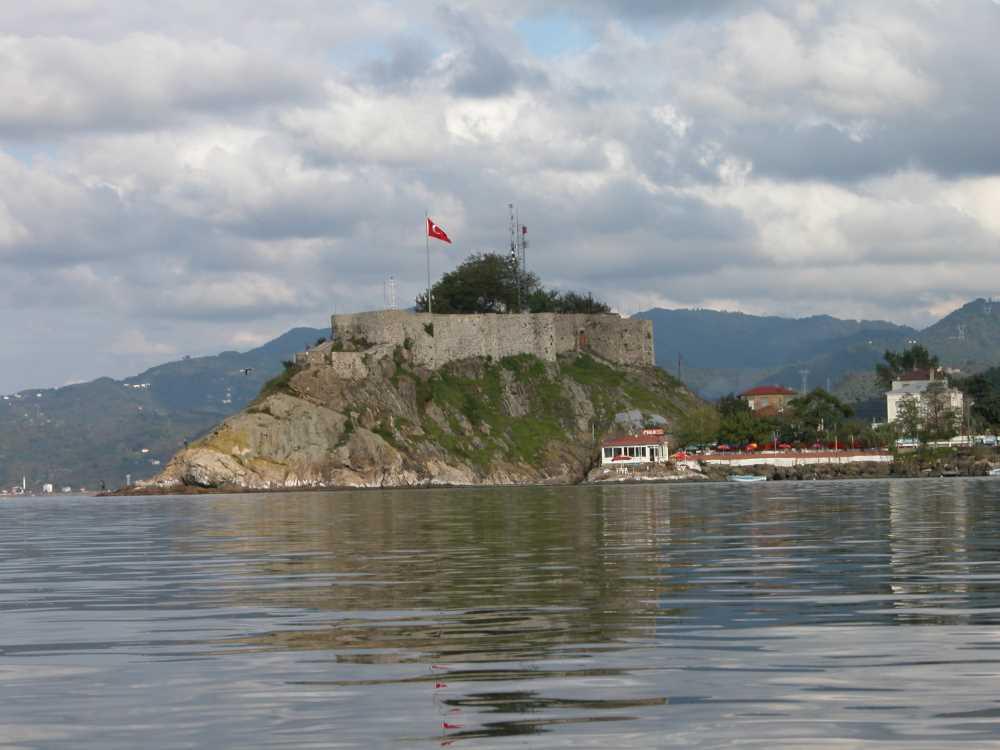
Tirebolu Castle
Location | Tirebolu - Giresun / Türkiye | ||||||||
|---|---|---|---|---|---|---|---|---|---|
Entrance | Accessed through a recessed archway and a vertical staircase. | ||||||||
Building Type | Castle (defensive structure) | ||||||||
Building Material(s) | Ünye limestone Basalt Roughly dressed rubble stone | ||||||||
Cultural Relics | Gravestones from the Ottoman period | ||||||||
Tirebolu Kalesi is a defensive structure located in the center of Tirebolu district, within Giresun province on the eastern Black Sea coast of Türkiye. The castle is built on a natural promontory extending toward the Black Sea, providing a secure position against threats coming from both sea and land.
Originally constructed during the Hellenistic or Roman period, the castle underwent repairs and renovations during the Pontic Kingdom and Trabzon Komnenos periods. During the Ottoman era, it retained its strategic importance, reflecting historical continuity through its thick curtain walls, remnants of a chapel and mosque, water cisterns, and various tombstones. Today it is protected and open to visitors as part of cultural tourism.
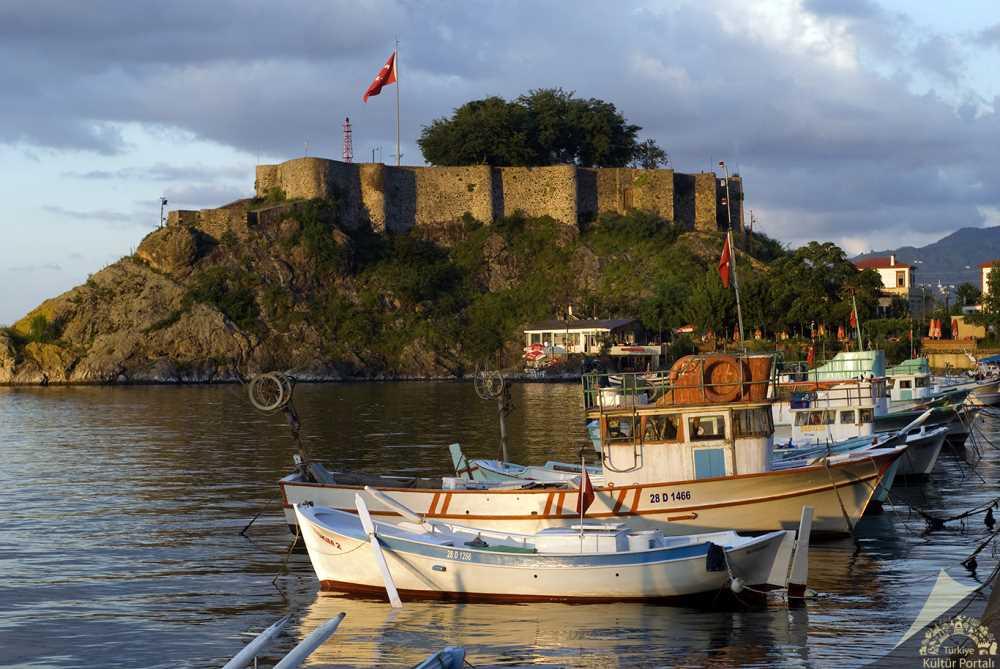
Tirebolu Kalesi (Türkiye Kültür Portalı)
No definitive document exists regarding the construction of Tirebolu Kalesi. However, architectural features and historical sources indicate that the castle was first built during the Hellenistic or Roman period. It is situated on a high promontory between two bays along the Black Sea coast. Its earlier designation as “Saint Jean” in ancient sources suggests that the structure may have served a religious function during the pre-Christian or early Christian era.
It is generally accepted that during the Pontic Kingdom the castle was completely rebuilt and acquired the characteristics of a medieval fortress. Under the Trabzon Komnenos, it was transformed into a more systematic defensive structure and was repaired or reconstructed under Emperor John II Komnenos (1287–1297). Historical records document that during the 1285 attack on Trabzon, John II and Alexios III sought refuge within the castle. This confirms that the fortress served not only as a military outpost but also as a political sanctuary.
During the Ottoman period, the development of Tirebolu as a port town ensured the continued military significance of the castle. After coming under Ottoman administration, the structure was used for centuries for protection and surveillance, with its walls, internal layouts, and fortifications largely preserved during this era.
In the 19th century, various restoration and reinforcement works were carried out, during which additional lower ramparts were constructed on the western end. Towards the end of the same century, under the administration of Kaymakam Eyübzâde İzzet Bey, a 120-step staircase was built to improve access to the castle.
In 1875, the small chapel inside the castle was converted into a mosque by the addition of a mihrab and a minbar. Some sources interpret this transformation as having occurred shortly after the Ottoman conquest. In 1911, an acetylene-powered maritime lighthouse was installed within the castle grounds. Although this structure has not survived to the present day, its existence demonstrates that the castle remained in active use into the early 20th century.
Tirebolu Kalesi is a medieval fortress constructed in a rubble masonry system, adapted to the natural topography of the promontory. The curtain walls, built using roughly dressed rubble stone, are externally reinforced at intervals with buttresses and range in thickness from 1.25 to 1.50 meters. Access to the castle is via a steep staircase from the south, constructed between 1896 and 1904 by Kaymakam Eyübzâde İzzet Bey.
The main entrance is through a low arch opening facing the town. Within the castle grounds, structures include armories, storage rooms for provisions, and water cisterns. On the western end, a later-added outer wall lies at a lower elevation. Within the enclosed inner courtyard, there is a structure that was formerly used as a chapel and was converted into a mosque in 1875 with the addition of a mihrab and minbar.
The construction materials include basalt and water-worn stones brought from the Harşit River, as well as yellow and red limestone blocks from Ünye. This selection of materials enhanced both the durability and architectural aesthetics of the fortress.
Tirebolu Kalesi has served throughout history as a strategic and economic defensive point in the region. During the Trabzon Komnenos period, it functioned as a refuge and military center. Under Ottoman rule, its military function was maintained due to Tirebolu’s status as a port town. Additionally, in the late 19th century, an acetylene-powered maritime lighthouse was added to the structure. Although this feature no longer survives, it illustrates the castle’s integration into the modernization process.
Tirebolu Kalesi (Youtube/Giresun)
Giresun. "Tirebolu Kalesi - Giresun." YouTube. Accessed May 20, 2025.https://www.youtube.com/watch?v=sQsoqyknBII
Güney, Gül. "GİRESUN MÜZESİ VE TİREBOLU KALESİ’NDE BULUNAN MEZAR TAŞLARINDAN ÖRNEKLER." *UNIMUSEUM*. 7, no. 1 (2024): 32–45. Accessed May 20, 2025.https://dergipark.org.tr/en/pub/unimuseum/issue/84997/1491252
T.C. Kültür ve Turizm Bakanlığı. "Tirebolu Kalesi." Giresun İl Kültür ve Turizm Müdürlüğü Resmi Web Sitesi. Accessed May 20, 2025.https://giresun.ktb.gov.tr/TR-211330/tirebolu-kalesi.html.
T.C.Tirebolu Kaymakamlığı Governorship. "Tirebolu Castle." T.C. Tirebolu District Governorship Official Website. Accessed May 20, 2025.http://www.tirebolu.gov.tr/tirebolu-kalesi
Türkiye Kültür Portalı. "Tirebolu Kalesi - Giresun." Türkiye Kültür Portalı Resmi Web Sitesi. Accessed May 20, 2025.https://www.kulturportali.gov.tr/turkiye/giresun/gezilecekyer/tirebolu-kalesi

Tirebolu Castle
Location | Tirebolu - Giresun / Türkiye | ||||||||
|---|---|---|---|---|---|---|---|---|---|
Entrance | Accessed through a recessed archway and a vertical staircase. | ||||||||
Building Type | Castle (defensive structure) | ||||||||
Building Material(s) | Ünye limestone Basalt Roughly dressed rubble stone | ||||||||
Cultural Relics | Gravestones from the Ottoman period | ||||||||
History
Architectural Features
Historical Function and Strategic Importance