This article was automatically translated from the original Turkish version.
+2 More
Construction Date | the second half of the 19th century | ||||||||
|---|---|---|---|---|---|---|---|---|---|
Original Owners | Ali Rıza Efendi and Zübeyde Hanım | ||||||||
Ownership Status | belonging to the Republic of Türkiye | ||||||||
Opening as a Museum | 10 November 1953 | ||||||||
Comprehensive Restorations | 1980–1981 2024–2025 2012–2013 | ||||||||
Ground Floor | Atatürk and the Children's Room | ||||||||
First Floor | Selanik Room Manastır Room | ||||||||
Second Floor | Ankara Room İstanbul Room | ||||||||
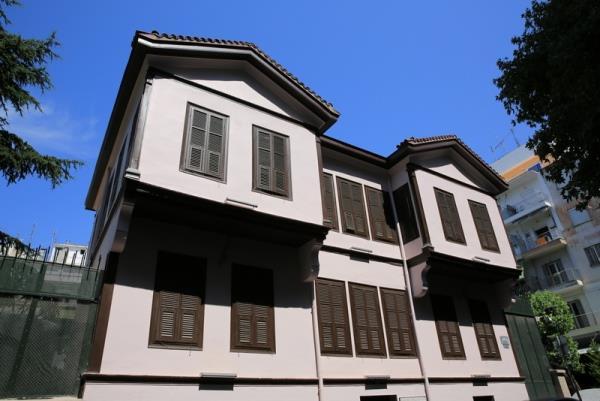
Thessaloniki Atatürk House is the house where Mustafa Kemal Atatürk, the founder of the Republic of Türkiye, was born in 1881 and spent part of his childhood and youth. The building, located today in the city of Thessaloniki in Greece, has been converted into a museum in memory of Atatürk. The property, owned by the Republic of Türkiye, is situated within the grounds of the Thessaloniki Consulate General and represents an original example of Ottoman residential architecture.
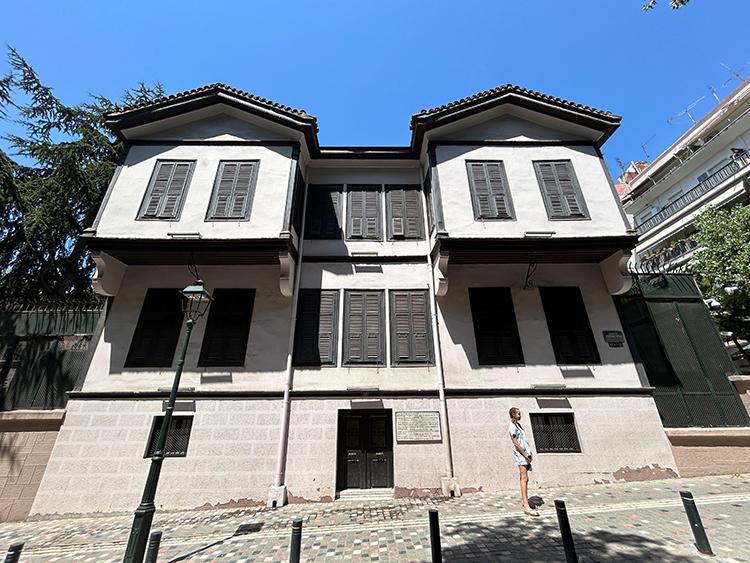
Front Facade of the Thessaloniki Atatürk House (Anadolu Ajansı)
The building housing the house is located in the Koca Kasım Paşa neighborhood of Thessaloniki, on Islahhane Street, and was constructed in the second half of the 19th century. Although the exact construction date of the house is unknown, it is mentioned in neighborhood census records dated 1875. In early 1878, ownership of the house passed to Ali Rıza Efendi, who served as a customs official and waqf clerk in Thessaloniki, and his wife Zübeyde Hanım. Mustafa Kemal Atatürk was born in this house in 1881 and spent his childhood and part of his early youth here.
After Ali Rıza Efendi’s death in 1887, Zübeyde Hanım, due to financial difficulties, rented out the house for a time and then moved with her children to live with her brother Hüseyin Ağa in Langaza. During his studies, whenever Mustafa Kemal returned to Thessaloniki, he again resided in this house with his mother and sister. While serving as a young officer in Thessaloniki in 1907, he also conducted some of his political activities from this house.
Following the capture of Thessaloniki by the Greek army in 1912 after the Balkan Wars, Zübeyde Hanım and her daughter Makbule Hanım, like many Turkish families, left the city and settled in Istanbul. In 1917, the Greek government seized Turkish properties in Thessaloniki, and the house where Atatürk was born came under state ownership. After the Treaty of Lausanne, the building was used for a time by families involved in the population exchange and was sold to private individuals in 1930.
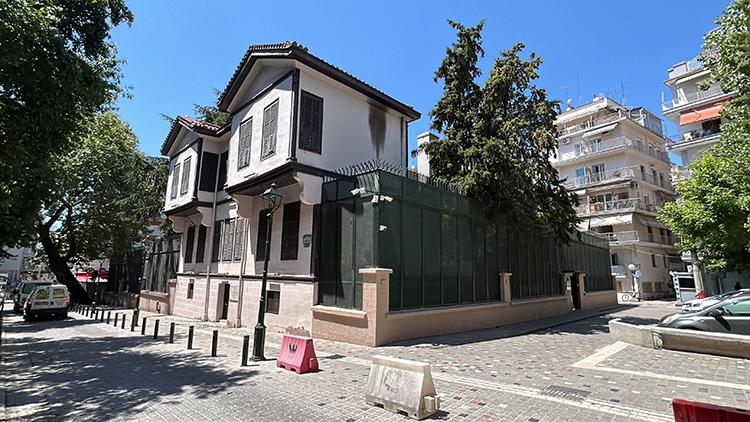
Thessaloniki Atatürk House (Anadolu Ajansı)
On the occasion of the 10th anniversary celebrations of the Republic, on 29 October 1933, the Thessaloniki Municipal Council decided to install a commemorative plaque on the house where Atatürk was born, as a symbol of Turkish-Greek friendship. The marble plaque, prepared in Turkish, Greek, and French, bears the inscription: “The great reformer of the Turkish nation and advocate of Balkan unity GAZİ MUSTAFA KEMAL was born here. This plaque was placed on the occasion of the 10th anniversary of the Republic of Türkiye. Thessaloniki, 29 October 1933.”【1】 This decision became a symbol of the rapprochement between the two countries, and the plaque was officially affixed to the house’s wall on 4 November 1933 during a ceremony.
In 1936, the Thessaloniki Municipality purchased the building from its current owners for 650,000 drachmas and formally gifted it to the Republic of Türkiye on 19 February 1937. The keys were handed over to the Thessaloniki Consulate General, thereby granting the building diplomatic status. During the same period, preparations began under Atatürk’s instructions to convert the house into a museum. However, restoration work was halted due to the outbreak of the Second World War and was only completed in 1950.
On 10 November 1953, on the 15th anniversary of Atatürk’s death, the restoration of the house was completed and it was opened to the public as the “Thessaloniki Atatürk House Museum.” The museum’s curation during this period was carried out under the chairmanship of Professor Dr. Enver Ziya Karal, President of the Ankara University Institute of Turkish Revolution History, in coordination with the Ministries of Foreign Affairs and National Education.
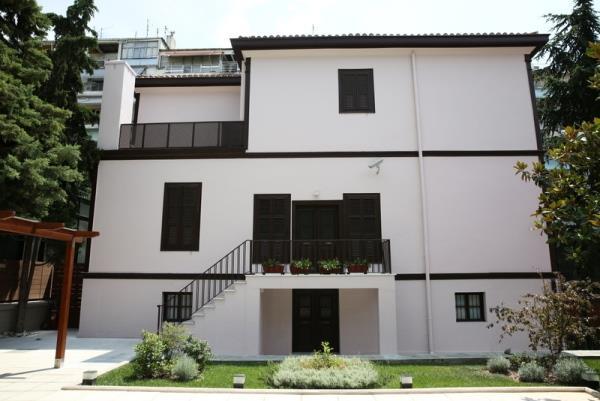
Rear Facade and Garden of the Thessaloniki Atatürk House (Ministry of Culture and Tourism)
The Thessaloniki Atatürk House was constructed in the last quarter of the 19th century as one of the urban examples of Ottoman residential architecture. The building reflects a three-story residential typology: a stone and lime mortar ground floor rising above a basement, with two upper wooden floors. The house occupies a rectangular footprint of approximately 7 by 13.5 meters and is situated within the narrow street fabric typical of the period, with its long facade facing the street.
The construction materials consist of stone and lime mortar walls on the ground floor and timber frame structures filled with wattle and daub on the upper floors. The exterior facades are painted pink over plaster, a feature that led to the house being known over time as the “pink house.” The lower-floor windows feature iron grilles, while the upper floors have wooden lattice screens (muşabak), characteristic of Ottoman residential tradition. The roof is covered with traditional clay tiles and designed with a sloped profile to suit Thessaloniki’s climatic conditions.
The house’s floor plan is organized around a functional interior layout. The basement served as a storage area, housing pantries and service rooms. The ground floor contains the stone room and auxiliary spaces; the first floor includes the kitchen, sofa room, Zübeyde Hanım’s sitting room, and guest rooms. The second floor completes the layout with a bathroom (gusülhane), a sofa room, and the room with the hearth where Mustafa Kemal was born. The wooden staircase connecting these spaces forms the center of the house’s internal circulation. The sofa rooms served both as connectors between floors and as shared living areas within family life.
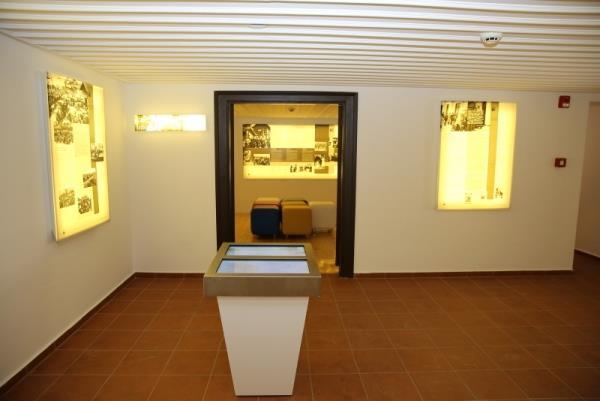
Ground Floor, Atatürk and Children’s Room (Ministry of Culture and Tourism)
The garden, measuring approximately 7 by 6 meters, is enclosed by high walls that ensure privacy. The mulberry tree planted by Ali Rıza Efendi and the stone-paved courtyard are elements that contribute to the building’s integration with its natural surroundings. Access to both the basement and the first floor is provided from the garden.
The materials and fittings used in the interior spaces also reflect traces of 19th-century Ottoman domestic tradition. Floors are covered with wooden planking, and ceilings feature plaster moldings. Hearth niches were provided for heating, and inward-opening wooden shutters were used for windows. Although the overall character of the building is simple, it possesses a balanced aesthetic in terms of window proportions and facade symmetry.
When converted into a museum in 1953, the restoration process remained faithful to the house’s original architectural fabric: facade colors, window proportions, interior layout, and wooden joinery were renewed in accordance with the original design. Subsequent repairs—in particular during the restorations of 1978, 2012, and 2024—have preserved the building’s structural integrity while integrating modern museum requirements without compromising its historical form.
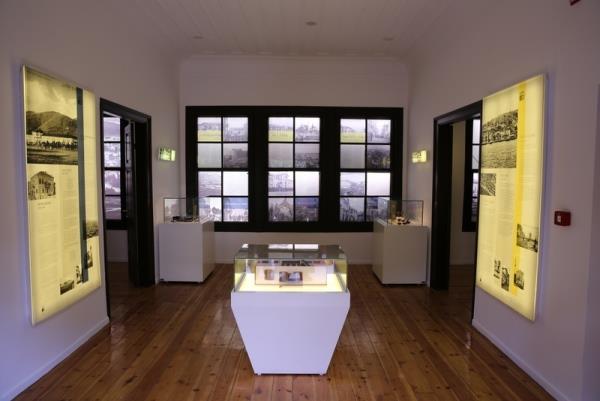
First Floor of the Thessaloniki Atatürk House (Ministry of Culture and Tourism)
Since its conversion into a museum in 1953, the Thessaloniki Atatürk House has undergone numerous repairs, restorations, and exhibition updates. These interventions aimed to preserve the building’s physical integrity while establishing an exhibition layout consistent with contemporary museum practices.
The first comprehensive restoration works began in 1940 to prepare the building for museum use after the Second World War, but were not completed until 1950 due to wartime conditions. When the building opened to the public as a museum on 10 November 1953, its initial exhibition was arranged to reflect domestic life of the period.
The earthquake that struck Thessaloniki in 1978 caused serious damage to the building, resulting in cracks in its walls. In response, the Ministry of Culture launched a restoration project in 1980 under the supervision of Turkish architects Köksal Anadol and Esin Arıoğlu. The work was carried out faithfully to the building’s original form, and the house reopened to the public in 1981 as part of the centenary celebrations of Atatürk’s birth. Repairs during the 1980s and 1990s primarily focused on exterior facade improvements and maintenance.
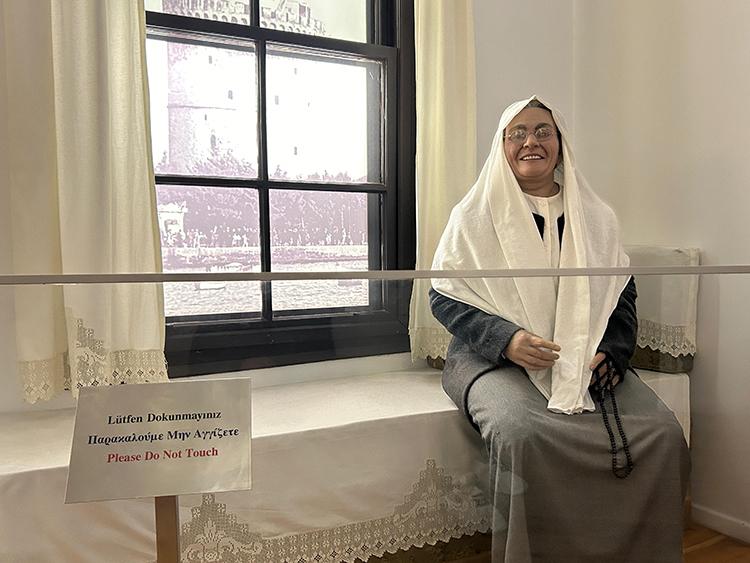
First Floor, Thessaloniki Room with Statue of Zübeyde Hanım (Anadolu Ajansı)
In the early 2000s, the need to renew the museum in accordance with contemporary museum principles became a priority. A 2007 report prepared by the Ministry of Foreign Affairs proposed both structural and exhibition upgrades. Under the coordination of the Ministry of Culture and Tourism, restoration work began in 2012 and was completed by mid-2013. During this period, non-authentic additions made in later years were removed, and the interior spaces were reorganized based on archival documents.
The most recent comprehensive restoration was carried out between 2024 and 2025. As part of a project implemented in cooperation between the Ministry of Culture and Tourism and the Turkish Cooperation and Coordination Agency (TİKA), wooden joinery, the roof, and garden walls were renewed; the storage room and bathhouse were restored to their original state. Additionally, the electrical infrastructure was upgraded to meet modern standards.
Along with the 2013 restoration, the exhibition system was renewed and the building was divided into five thematic sections: “Atatürk and the Children’s Room,” “Thessaloniki Room,” “Manastır Room,” “Istanbul Room,” and “Ankara Room.” These rooms display informational panels, replicas of personal belongings, and period photographs illustrating different phases of Atatürk’s life. A multilingual audio guide in Turkish, Greek, and English was also introduced. The wax statue of Atatürk placed in the “Ankara Room” became one of the museum’s most striking features.
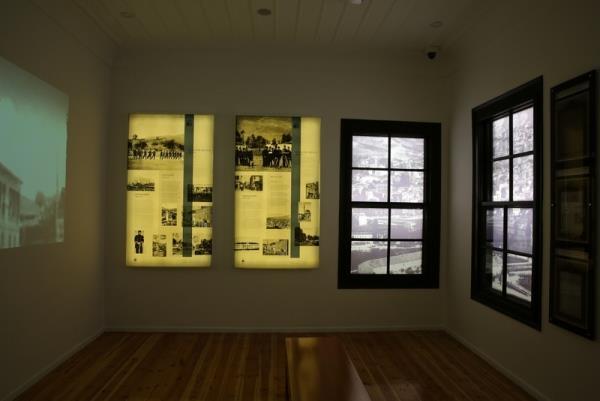
First Floor, Manastır Room (Ministry of Culture and Tourism)
In 2022, the Ministry of Culture and Tourism initiated a new restoration project to develop a broader exhibition plan while preserving the house’s historical fabric. After obtaining the necessary permits, implementation began in December 2024 and was completed during the autumn of 2025. The Turkish Cooperation and Coordination Agency (TİKA) participated as a project partner. During the restoration, wooden joinery was restored to its original form; the roof, garden walls, and stone paving were refurbished. The electrical and security infrastructure was upgraded to meet current standards, and the storage room and bathhouse were returned to their original condition.
As part of this final renovation, the museum’s collection was enriched. Personal items belonging to Zübeyde Hanım, Ali Rıza Efendi’s prayer beads, objects from Atatürk’s infancy, and 19th-century Ottoman documents were reintroduced into the exhibition. Additionally, the painting of the Atatürk House by Rahmi Pehlivanlı, the 1925 Greek property deed, and photographs taken during the visit of the third President of Türkiye, Celal Bayar, were added to the museum’s inventory.
Following the completion of the restoration on 9 November 2025, the museum was reopened with the participation of Minister of Culture and Tourism Mehmet Nuri Ersoy and TİKA President Abdullah Eren. The renovation project not only strengthened the structure but also expanded the museum’s exhibition. As a result, the Thessaloniki Atatürk House has preserved its original architecture while meeting contemporary museum standards and continues to serve as one of Türkiye’s most important cultural heritage sites abroad.
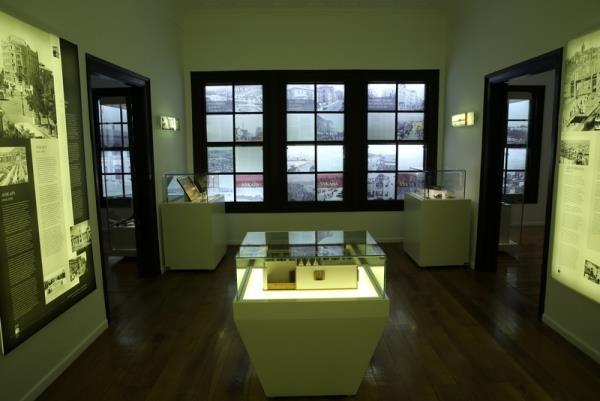
Second Floor of the Thessaloniki Atatürk House (Ministry of Culture and Tourism)
The collection and exhibition layout of the Thessaloniki Atatürk House are thematically structured to chronologically present the life of Mustafa Kemal Atatürk, his family, his education and military years, and the path leading to the founding of the Republic. When the museum first opened in 1953, it was furnished with original artifacts reflecting Turkish domestic life of the period and has since been enriched both physically and thematically through successive restorations. The current exhibition layout was established following comprehensive renewal projects in 2013 and 2025.
The museum consists of three floors and a basement. The ground floor houses the entrance hall and the “Atatürk and the Children’s Room.” This section features informational panels highlighting Atatürk’s emphasis on children, short films depicting his childhood, and a wax figure of Atatürk as a child. Documents, architectural plans, and photographs detailing the house’s history and restoration processes are also displayed on this floor.
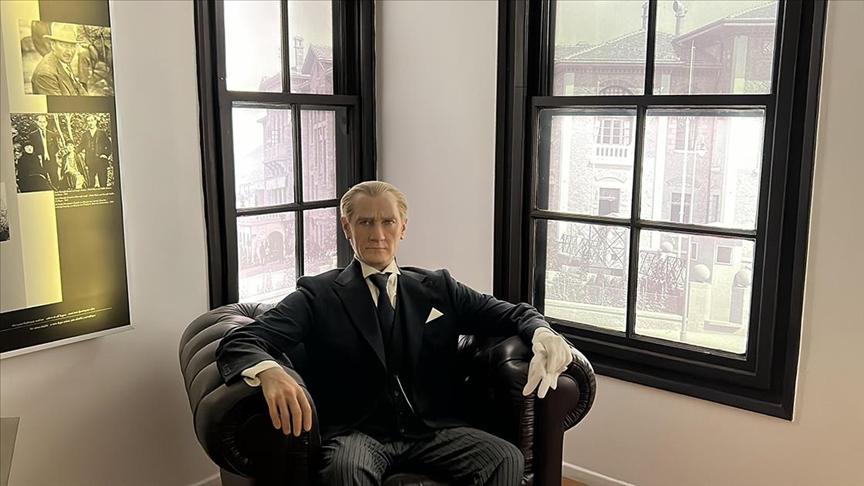
Second Floor, Ankara Room with Atatürk Statue (Anadolu Ajansı)
The first floor contains two main exhibition areas: the “Thessaloniki Room” and the “Manastır Room.” The “Thessaloniki Room” displays photographs of the city where Atatürk was born, maps illustrating the urban fabric of the period, and copies of his school records from Thessaloniki. The “Manastır Room” reflects Atatürk’s years at the Manastır Military High School, featuring transcriptions of his grades, examples of textbooks, and visual materials depicting student life in Manastır.
The second floor is dedicated to the “Istanbul Room” and the “Ankara Room,” representing Atatürk’s military career and public service years. The “Istanbul Room” displays copies of documents from the War School, Atatürk’s enrollment record from the Kara Harp Okulu, and uniform replicas. The “Ankara Room” focuses on the Republican period and features a desk and chair from his presidency, along with a wax statue depicting Atatürk seated in his chair. A gold replica of the Presidential Seal, housed in the Ankara Republic Museum, is also exhibited in a special case in this section.
Personal belongings of Atatürk hold a significant place in the museum’s collection. These include a frock coat, hat, tie, cane, shoes, mouthpiece, plate, matchbox, and scarf. Dining sets, spoons and forks, cigarette holders, and everyday objects also reflect Atatürk’s simple lifestyle. A substantial portion of these items was selected from museums in Kocaeli and Uşak in Türkiye and brought to Thessaloniki. All artifacts are displayed in specially controlled vitrines with regulated humidity and temperature.
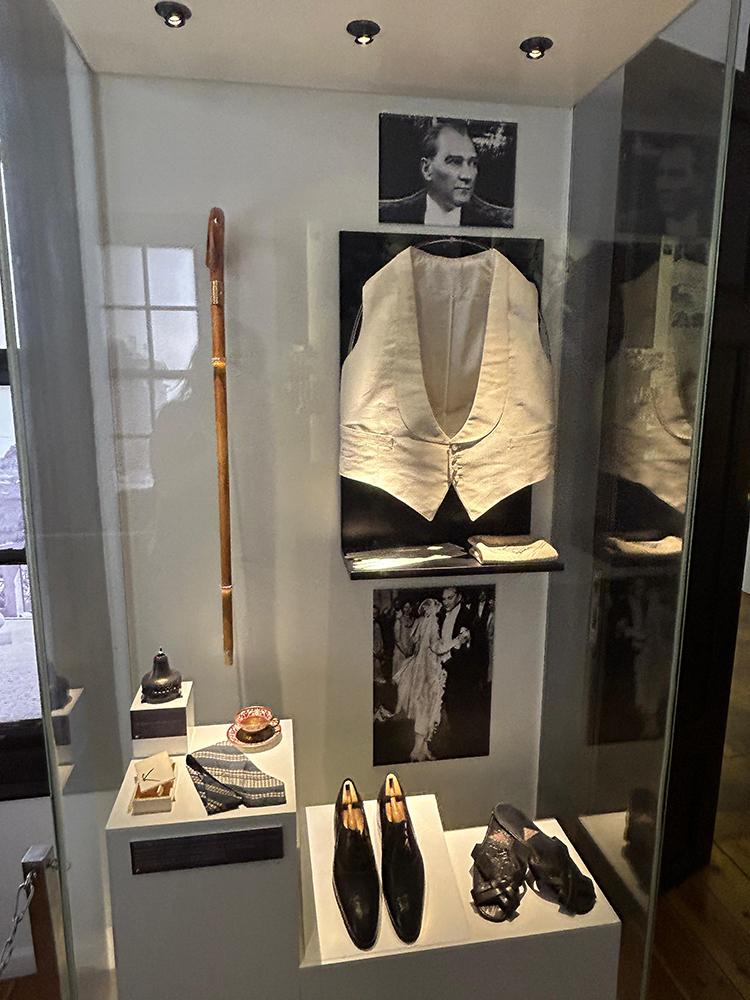
Personal Belongings of Atatürk (Anadolu Ajansı)
Some personal items belonging to Zübeyde Hanım and Ali Rıza Efendi are also part of the collection. Zübeyde Hanım’s prayer beads, headscarf, and hand mirror; Ali Rıza Efendi’s prayer book and wooden cane are among the notable objects in this section. Additionally, a silicone statue depicting Zübeyde Hanım holding prayer beads while seated on a wooden bench is displayed in the “Thessaloniki Room.”
Documents constitute a significant portion of the museum’s collection. These include Ottoman land registry records dated 1878, the 1925 Greek property deed, the 1925 population exchange record, a signed photograph sent by Atatürk to his sister Makbule Hanım in 1921, Rahmi Pehlivanlı’s painting of the Atatürk House, photographs of President Celal Bayar’s 1952 visit, and a replica of the Presidential Seal. Visitors are provided with audio guides in Turkish, English, and Greek, and short documentary films summarizing Atatürk’s life are screened within the museum. Additionally, the library in the basement contains approximately 1,200 books.
Thessaloniki Atatürk House (TRT Avaz)
The Thessaloniki Atatürk House is not merely an architectural structure but also a symbol of cultural interaction between Türkiye and Greece. The 1933 decision by the Thessaloniki Municipality marked a period of growing Turkish-Greek friendship, and the building is regarded as a spatial manifestation of Atatürk’s philosophy of “Peace at Home, Peace in the World.”
Today, the museum attracts significant attention from visitors both from Türkiye and abroad. In 2023, approximately 285,000 people visited the house; before the restoration process began in early 2024, this number reached 490,000.
As a preserved example of 19th-century Ottoman residential architecture, the Thessaloniki Atatürk House holds great historical, architectural, and cultural importance. The house where Atatürk was born acquired the status of an international cultural heritage through its museum conversion process, which began in 1933. Through successive restorations, it has preserved its original identity and endures to the present day. The museum continues to serve as a memory space testifying to both the founder of the Republic of Türkiye and the history of Turkish-Greek cultural relations.
Akın, Veysi. “Atatürk’ün Selanik’teki Evi” *Atatürk Ansiklopedisi*. Accessed November 10, 2025.https://ataturkansiklopedisi.gov.tr/detay/882/Atat%C3%BCrk%E2%80%99%C3%BCn-Selanik%E2%80%99teki-Evi
Akın, Veysi. “Selanik Atatürk Evi ve Müze Haline Getirilmesi.” Atatürk Araştırma Merkezi Dergisi 16, no. 48 (November 2000): 711–52. Accessed November 10, 2025.https://dergipark.org.tr/tr/pub/aamd/issue/55025/755292#article_cite
Anadolu Ajansı. "Atatürk'ün Selanik'te Doğduğu Eve Ziyaretçi Yoğunluğu." Accessed November 10, 2025.https://www.aa.com.tr/tr/kultur/ataturkun-selanikte-dogdugu-eve-ziyaretci-yogunlugu/3297395
Anadolu Ajansı. “Kültür ve Turizm Bakanı Ersoy, Selanik'te Atatürk Evi'nin Açılışını Yaptı.” Anadolu Ajansı. Accessed November 10, 2025.https://www.aa.com.tr/tr/kultur/kultur-ve-turizm-bakani-ersoy-selanikte-ataturk-evinin-acilisini-yapti/3739286
CNN TÜRK. “Selanik'ten Canlı Görüntüler: Atatürk Evi Yeniden Açıldı!” YouTube. Accessed November 10, 2025.https://www.youtube.com/watch?v=cy9caqx7214
T.C. Ministry of Culture and Tourism. Press and Public Relations Advisorship. “Atatürk’s Heritage Reborn in Thessaloniki Opens Its Doors.” Accessed November 10, 2025.https://basin.ktb.gov.tr/TR-409317/ataturkun-selanikte-yeniden-hayat-bulan-mirasi-kapilarini-aciyor.html
TRT Avaz. “Atatürk'ün Selanik'teki Evini Ziyaret Ettik - Dünyadaki Türkiye - TRT Avaz.” YouTube. Accessed November 10, 2025.https://www.youtube.com/watch?v=k_dqPF-6dgE
TRT Haber. "Selanik'teki Atatürk Evi Restorasyonun Ardından Bugün Kapılarını Açıyor." Accessed November 10, 2025.https://www.trthaber.com/haber/gundem/selanikteki-ataturk-evi-restorasyonun-ardindan-bugun-kapilarini-aciyor-925302.html
Türkiye Cumhuriyeti Kültür ve Turizm Bakanlığı. "Selanik Atatürk Evi." Accessed November 10, 2025.https://www.ktb.gov.tr/TR-96346/selanik-ataturk-evi.html
Türkiye Cumhuriyeti Kültür ve Turizm Bakanlığı. “Selanik Atatürk'ün Evinden Görüntüler.” Accessed November 10, 2025.https://www.ktb.gov.tr/TR-96347/selanik-ataturk39un-evinden-goruntuler.html
Türkiye Cumhuriyeti Ministry of Foreign Affairs Thessaloniki Consulate General. "Atatürk Evi’nin Öyküsü." Accessed November 10, 2025.https://selanik-bk.mfa.gov.tr/Mission/ShowInfoNote/413604
[1]
Türkiye Cumhuriyeti Kültür ve Turizm Bakanlığı. “Selanik Atatürk Evi.” Erişim 10 Kasım 2025. https://www.ktb.gov.tr/TR-96346/selanik-ataturk-evi.html

Construction Date | the second half of the 19th century | ||||||||
|---|---|---|---|---|---|---|---|---|---|
Original Owners | Ali Rıza Efendi and Zübeyde Hanım | ||||||||
Ownership Status | belonging to the Republic of Türkiye | ||||||||
Opening as a Museum | 10 November 1953 | ||||||||
Comprehensive Restorations | 1980–1981 2024–2025 2012–2013 | ||||||||
Ground Floor | Atatürk and the Children's Room | ||||||||
First Floor | Selanik Room Manastır Room | ||||||||
Second Floor | Ankara Room İstanbul Room | ||||||||
No Discussion Added Yet
Start discussion for "Thessaloniki Atatürk House" article
History
Conversion into a Museum
Architectural Features
Restoration and Curation Processes
Collection and Exhibition Areas
Cultural Significance