


This article was automatically translated from the original Turkish version.
+1 More
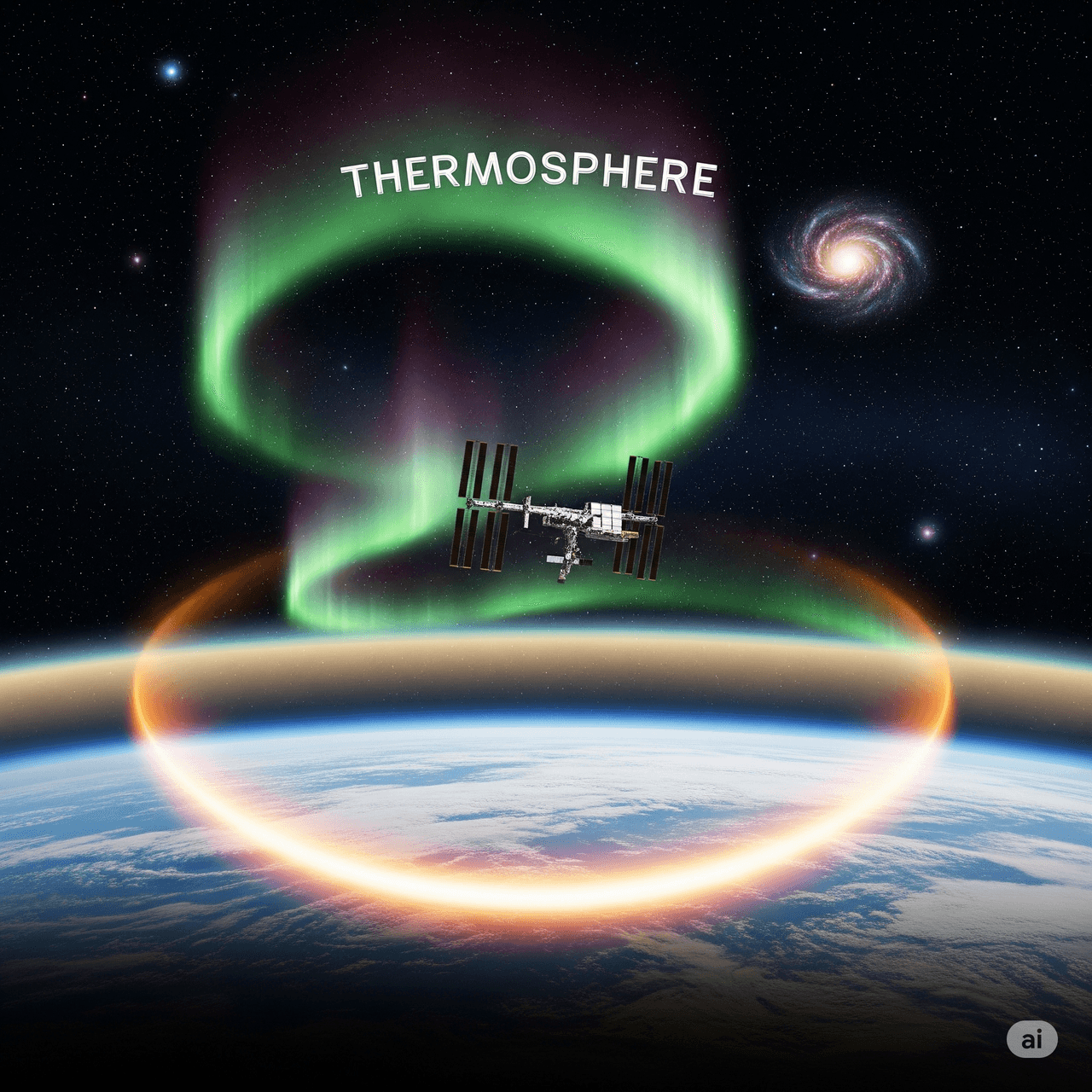
Thermosphere
Altitude Range | Approximately 80 km - 500/1000 km | ||||||||
|---|---|---|---|---|---|---|---|---|---|
Temperature Range | 500°C - 1500°C depending on solar activity | ||||||||
Main Component | Atomic oxygen (O) Atomic nitrogen (N) Helium (He) | ||||||||
Features | Low gas density Ionization processes High temperature | ||||||||
Related Layers | Above the exosphere Within the ionosphere Below the mesosphere | ||||||||
Important Event | Aurora formation Effects on communication systems Effects of space weather | ||||||||
Thermosphere is the layer of the Earth's atmosphere that begins at approximately 80 kilometres above the surface and extends up to a height of 300 to 600 kilometres. This layer reaches very high temperatures due to the absorption of ultraviolet (UV) and X-ray radiation from the Sun; these temperatures can vary between 500 °C and 2000 °C depending on solar activity. However, the temperature measured here is not the same as the sensation of heat in the classical sense, because gas density is extremely low and molecular collisions occur very rarely.
The thermosphere also encompasses a significant portion of the ionosphere. In this region, ionisation of gas molecules leads to the emergence of electromagnetic properties that affect radio wave propagation. Atmospheric emissions such as the auroras also occur in this layer. Moreover, the thermosphere is of critical importance for space research and communication technologies because it is the region where space weather effects are observed and satellite orbits are regulated.
The thermosphere begins immediately above the mesopause at approximately 80 kilometres and can extend up to 600 kilometres. Temperature in this layer increases rapidly due to the absorption of ultraviolet and X-ray radiation from the Sun. Temperatures can vary between 500 °C and 2000 °C depending on solar activity. The primary cause of this temperature rise is the absorption of high-energy photons by gas molecules in the low-density environment, which increases their kinetic energy. However, these temperature values do not represent perceptible heat in the classical sense because molecular collisions are extremely infrequent. In addition, the propagation of atmospheric gravity waves in the upper atmospheric layers can cause fluctuations in the local temperature and density distribution of the thermosphere. These waves have the potential to induce disturbances in the ionospheric structure.
The gas composition of the thermosphere consists largely of nitrogen (N₂) and oxygen (O₂) molecules. However, these molecules become ionised under the influence of photons, forming the ionosphere. Density decreases exponentially with altitude. The gas density in the thermosphere is millions of times lower than in the troposphere. Therefore, in the thermosphere, the individual motion of particles is more significant than the concept of "air" as a continuous medium. Additionally, aerosols detected in the upper thermosphere can influence the region's energy balance through the absorption and scattering of solar radiation, creating indirect effects on atmospheric chemistry and thermal structure.
The lower boundary of the thermosphere is the mesopause, and its upper boundary is the exosphere. The exosphere is the region where molecules can escape Earth's gravity and enter space. While some studies suggest that the thermosphere may be subdivided into internal layers, this division is not definitive. However, it overlaps with the ionospheric regions known as the D, E and F layers based on ion density. The F layer, particularly located between 200 and 400 kilometres, plays a key role in reflecting radio waves.
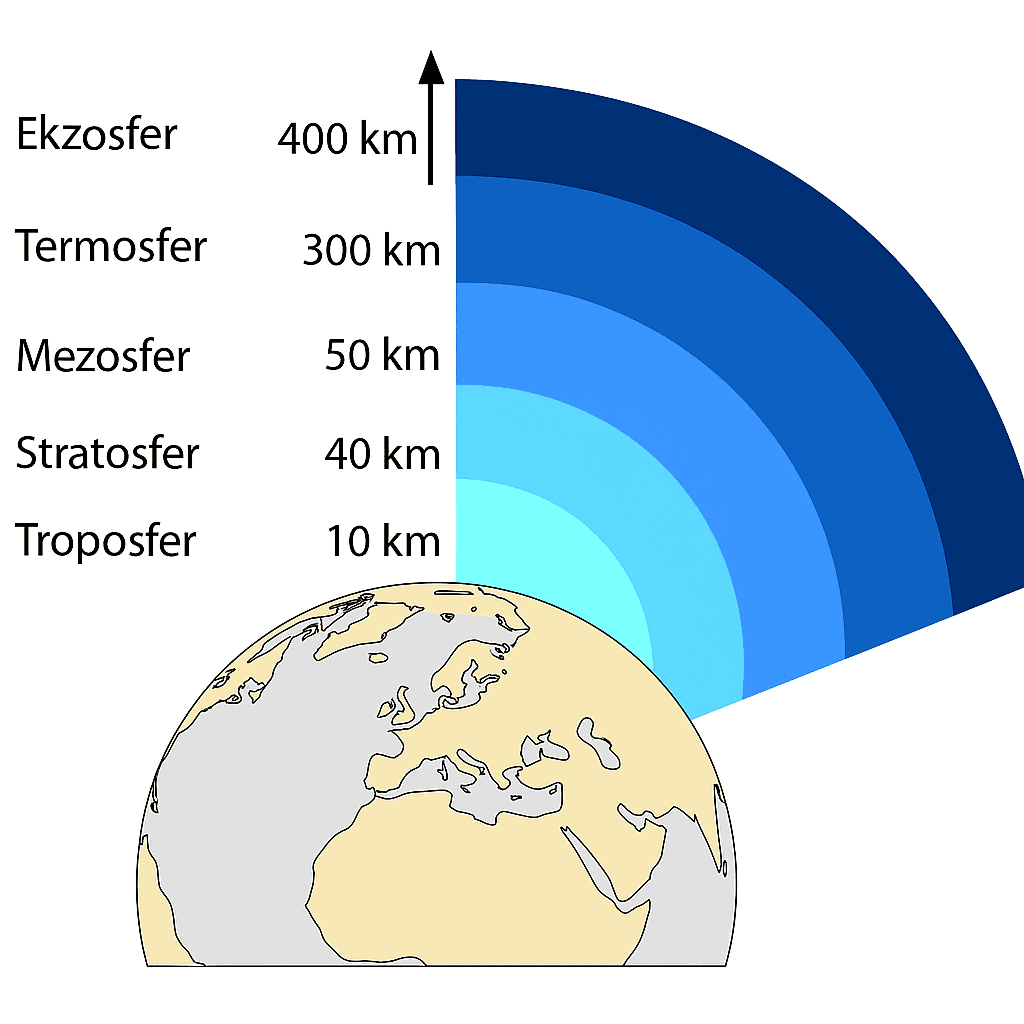
Atmosferi Oluşturan Katmanlar ve Sıcaklıkları (Yapay Zeka İle Üretilmiştir.)
The thermosphere contains a major portion of the ionosphere. The ionosphere is a region formed by the ionisation of gases due to high-energy radiation from the Sun, consisting of electrically charged particles. This region is significant for the propagation, reflection and refraction of electromagnetic waves. In particular, the F2 layer is used for high-frequency (HF) radio communication. The degree of ionisation in the ionosphere is directly related to solar radiation and the day-night cycle.
The thermosphere is the layer where visual natural phenomena such as aurora borealis (northern lights) and aurora australis (southern lights) occur. These phenomena result from charged particles from the Sun moving along the Earth's magnetic field lines and colliding with atmospheric molecules near the polar regions. These collisions produce the emission of high-energy photons, which are observed as visible light displays.
The thermosphere is the atmospheric layer where space weather processes are most distinctly felt. Events such as solar flares and coronal mass ejections directly affect particle density and temperature in the thermosphere. Such events can cause deviations in satellite orbits, disruptions in communication systems and errors in global navigation systems.
The thermosphere is the layer where artificial satellites are placed in orbit and where structures such as the International Space Station (ISS) operate. Therefore, frictional forces in this layer are important for orbital calculations. Although gas density in the thermosphere is low, even this minimal density has a measurable effect over long-term orbital predictions and can cause satellites to gradually lose altitude.
The thermosphere cannot be observed directly from the Earth's surface. It is studied using instruments such as lidar systems, satellite-based spectrometers, ionospheric sounders and rockets. NASA's TIMED (Thermosphere Ionosphere Mesosphere Energetics and Dynamics) satellite and ESA's Swarm satellites provide critical data for understanding the dynamic structure of the thermosphere. Furthermore, inter-hemispheric dynamic coupling processes occurring between the thermosphere and the mesosphere are important for energy and mass transfer. These interactions contribute to a better understanding of global circulation and climate models at upper atmospheric levels.
Current research has demonstrated that the thermosphere is affected by climate change. Increasing carbon dioxide levels enhance radiative cooling in the thermosphere, leading to its overall contraction and cooling. This condition can directly affect the longevity of satellite orbits and their interactions with the atmosphere.
Cervera, M. A., and T. J. Harris. “Modeling Ionospheric Disturbance Features in Quasi‐Vertically Incident Ionograms Using 3‐D Magnetoionic Ray Tracing and Atmospheric Gravity Waves.” *Journal of Geophysical Research: Space Physics* 119, no. 1 (2013): 431–440. Accessed May 27, 2025.https://doi.org/10.1002/2013ja019247
Ganguly, D., P. Ginoux, V. Ramaswamy, O. Dubovik, J. Welton, E. A. Reid, and B. N. Holben. “Inferring the Composition and Concentration of Aerosols by Combining AERONET and MPLNET Data: Comparison with Other Measurements and Utilization to Evaluate GCM Output.” *Journal of Geophysical Research: Atmospheres* 114, no. D16 (2009). Accessed May 27, 2025.https://doi.org/10.1029/2009jd011895
Karlsson, B., C. McLandress, and T. G. Shepherd. “Inter-Hemispheric Mesospheric Coupling in a Comprehensive Middle Atmosphere Model.” *Journal of Atmospheric and Solar-Terrestrial Physics* 71, no. 3–4 (2008): 518–530. Accessed May 27, 2025.https://doi.org/10.1016/j.jastp.2008.08.006

Thermosphere
Altitude Range | Approximately 80 km - 500/1000 km | ||||||||
|---|---|---|---|---|---|---|---|---|---|
Temperature Range | 500°C - 1500°C depending on solar activity | ||||||||
Main Component | Atomic oxygen (O) Atomic nitrogen (N) Helium (He) | ||||||||
Features | Low gas density Ionization processes High temperature | ||||||||
Related Layers | Above the exosphere Within the ionosphere Below the mesosphere | ||||||||
Important Event | Aurora formation Effects on communication systems Effects of space weather | ||||||||
Physical Characteristics of the Thermosphere
Vertical Temperature Profile and Thermal Structure
Gas Composition and Density Profile
Boundaries and Sub-layers
Ionospheric Interactions and Electromagnetic Phenomena
Structure of the Ionosphere
Auroral Phenomena
Space Weather Interactions
Practical Importance and Observation of the Thermosphere
Satellite and Space Shuttle Operations
Observational Instruments and Measurement Methods
Climate Change and the Thermosphere