


This article was automatically translated from the original Turkish version.
The theory of relativity is one of the most important scientific developments of the 20th century and was developed by Albert Einstein. This theory redefined the concepts of space and time under conditions of high velocities and strong gravitational fields where Newtonian mechanics proved inadequate. Going beyond classical Newtonian physics, this theory provides a deep understanding of the relationships between time, space and gravity, and consists of two main components: special relativity and general relativity.
Special relativity, formulated by Einstein in 1905, describes the behavior of objects moving at speeds close to the speed of light, while general relativity, developed in 1915, explains the effects of gravity on spacetime. In developing the theory of relativity, Einstein abandoned the classical notion of absolute time and space and demonstrated that space and time are dependent on the observer. While special relativity applies only to inertial systems, general relativity extends it to include accelerated motion and gravity. Both theories have been confirmed by extensive experiments and are now among the most robust theories in modern physics.
The theory of special relativity was first presented by Einstein in his 1905 paper titled "On the Electrodynamics of Moving Bodies". This theory rejects the classical Newtonian concepts of absolute time and space and asserts that motion and time are relative to the observer.
Special relativity is based on two fundamental postulates:
These two fundamental principles lead to phenomena such as time dilation, length contraction and the relativity of simultaneity. Lorentz transformations are mathematical equations that describe how time and space change between different observation frames.
One of the most famous outcomes of special relativity is the mass-energy equivalence expressed by Einstein’s equation E=mc². This equation shows that mass is a form of energy and can be converted into energy under appropriate conditions, leading to breakthroughs in fields such as nuclear energy and particle physics.
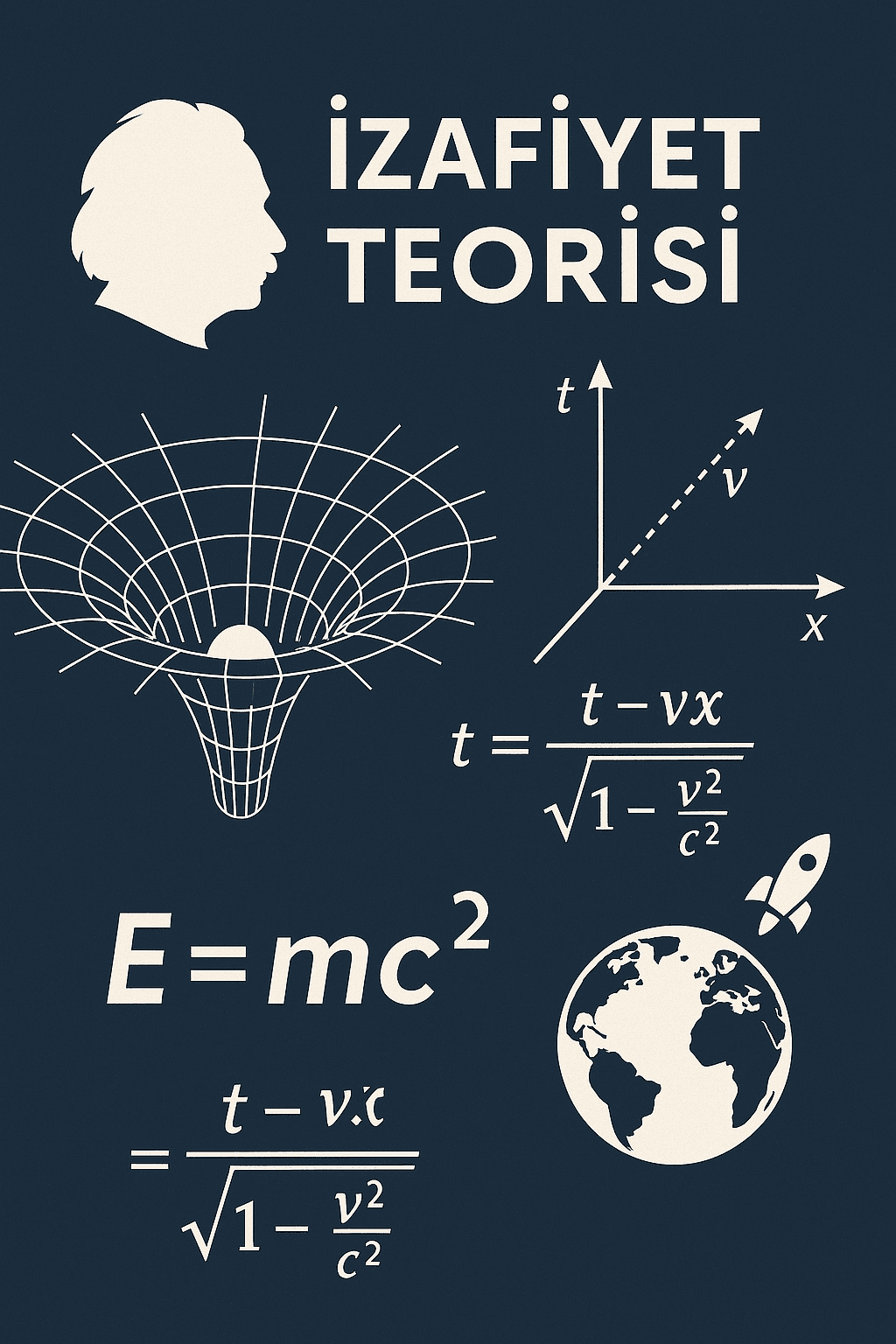
Relativity Theory (This image was generated by artificial intelligence.)
General relativity extends special relativity beyond inertial reference frames to include accelerated motion and gravity. In 1915, Einstein proposed that gravity is not a force as described by Newton, but rather the curvature of spacetime caused by mass and energy.
This theory is based on a fundamental principle known as the equivalence principle, which states that an observer cannot distinguish between the effects of acceleration and those of a gravitational field. Einstein’s Einstein Field Equations are a set of equations that describe how mass and energy curve the fabric of spacetime to produce gravitational fields.
General relativity is used to explain many important physical phenomena, including gravitational lensing of light, gravitational time dilation and black holes.
Since its inception, the theory of relativity has been tested and confirmed through various experiments. These confirmations demonstrate the theory’s remarkable alignment with physical reality and have strengthened the credibility of Einstein’s theories. Experimental verification includes a wide range of observations, experiments and scientific calculations conducted worldwide.
One of the most famous confirmations of relativity theory was made during the solar eclipse observation of 1919. British astronomer Arthur Eddington observed the bending of light rays by the Sun’s gravitational field. Einstein’s general relativity predicted that massive objects would curve the surrounding spacetime, causing light to follow a bent path. This phenomenon implied that light from stars behind the Sun would be deflected as it passed through the Sun’s gravitational field. During the 1919 solar eclipse, Eddington observed that the light from stars behind the Sun was bent exactly as predicted by Einstein’s theory. This observation is widely regarded as the most prominent experimental confirmation of general relativity.
General relativity predicts that time flows at different rates under the influence of gravity. The validity of this phenomenon was tested in the 1971 Hafele-Keating experiment. In this experiment, atomic clocks were flown around the world on airplanes and compared with atomic clocks on the Earth’s surface. The results showed that the clocks in motion ran at a different rate compared to the stationary clocks on Earth. This experiment confirmed the reality of gravitational time dilation—that is, time passes at different rates depending on proximity to a gravitational field. Such experiments have illuminated the practical applications of relativity and reinforced confidence in the theory.
Gravitational Time Dilation Experiment
In 2015, the LIGO (Laser Interferometer Gravitational-Wave Observatory) experiment confirmed the existence of gravitational waves, predicted by Einstein a century earlier. Gravitational waves are ripples in the fabric of spacetime produced by the rapid motion of massive objects. LIGO observed the merger of two black holes, which generated gravitational waves, providing another confirmation of Einstein’s general relativity. This discovery demonstrated that gravity can propagate as waves, as predicted by the theory of relativity.
One of the confirmations of relativity theory comes from observations of rapidly rotating stars. Observations made in the 1980s revealed that the light from these stars was bent in a manner consistent with Einstein’s general relativity, depending on their rotational speed. High-speed rotating stars create distortions that affect the path of light. Such observations align with relativity’s predictions regarding the behavior of light.
Observations of Rapidly Rotating Stars
The cosmic microwave background radiation carries faint traces of light from the early universe and was discovered in 1965 by Arno Penzias and Robert Wilson. The theory of relativity has played a crucial role in explaining the distribution of this radiation. This background radiation has been used to support the Big Bang theory and to describe the expansion of the universe and the evolution of time, in accordance with general relativity.
Cosmic Microwave Background Radiation
In addition to the above, numerous other experimental confirmations exist. Observations in space and ground-based tests have demonstrated the accuracy of relativity theory from multiple perspectives. Advanced GPS system calculations show how general relativity affects everyday life. For GPS systems to function accurately, the effects of relativity must be accounted for. The clocks on satellites in orbit run at different rates compared to those on Earth, continuously testing the validity of relativity theory.
The theory of relativity is one of the most important building blocks of modern physics and continues to form the foundation of many theoretical investigations today. Relativity plays a vital role in fields such as astrophysics, cosmology and particle physics. We will examine in greater depth the place of general and special relativity in modern physics.
Quantum mechanics is a theory that helps us understand phenomena at atomic and subatomic scales. However, quantum mechanics does not account for the gravitational effects described by general relativity. Therefore, various theories have been developed to unify quantum mechanics and general relativity. The leading candidates are string theory and loop quantum gravity.
String theory describes all fundamental particles as tiny vibrating strings. This theory aims to unify general relativity and quantum mechanics. The mathematical structure of string theory plays a crucial role in explaining phenomena predicted by relativity, such as gravitational waves and black holes. String theory also proposes that the fundamental building blocks of the universe are extremely small, vibrating units.
Another important theoretical framework is loop quantum gravity. This theory argues that spacetime can be described using quantum mechanics, contrary to the classical view. Loop quantum gravity is an approach to understanding gravitational interactions at the quantum level and suggests that spacetime is discrete at very small scales.
Black holes are regions of spacetime where gravity is so intense that not even light can escape. They create a gravitational "pull" consistent with relativity’s prediction that mass curves spacetime. Current observations of black holes and their surrounding gravitational waves continue to confirm the accuracy of relativity’s predictions. Black holes are among the most striking predictions of relativity. General relativity mathematically predicted their existence.
Relativity forms the theoretical foundation of cosmology. The Big Bang Theory is a cosmological consequence of relativity and is used to explain the expansion of the universe. General relativity helps us understand how the universe has expanded over time and the effects of this expansion. The expansion of the universe can be explained based on the fundamental principles of relativity and is one of the most important discoveries in cosmology.
Research into the accelerating expansion of the universe and the effects of dark energy helps us understand how relativity shapes the dynamic structure of the universe. Contemporary cosmological observations provide further evidence supporting the validity of relativity.
One of the fundamental predictions of relativity is the curvature of spacetime. This curvature explains many physical phenomena, including planetary motion, the bending of light paths and the propagation of gravitational waves. This curvature is also important in modern technology. For example, the accuracy of GPS systems depends on the correct application of relativity theory. GPS satellites perform position calculations that account for relativistic effects.
The theory of relativity is recognized as one of the foundational pillars of modern physics. Its predictions and effects have been verified in numerous fields, including quantum mechanics and cosmology, solidifying its theoretical basis. Relativity has not only advanced scientific discovery but has also influenced the technologies we use in daily life. Einstein’s theories have provided us with the means to understand the physical universe and have made a revolutionary contribution to humanity.
Einstein, Albert. Relativity: The Special and General Theory. Translated by Robert W. Lawson. New York: Crown Publishers, 1961.
Georgia Tech. (February 11, 2016). *LIGO Gravitational Wave Chirp* [Video]. YouTube. https://www.youtube.com/watch?v=TWqhUANNFXw
Las Cumbres Observatory. (2020, October 19). *Gravitational time dilation* [Video]. YouTube. https://www.youtube.com/watch?v=CbQZ_kDYgbg
Misner, Charles W., Kip S. Thorne, and John Archibald Wheeler. Gravitation. San Francisco: W. H. Freeman, 1973.
PBS Space Time. (2015, March 25). *Cosmic microwave background explained* [Video]. YouTube. https://www.youtube.com/watch?v=3tCMd1ytvWg
Science and more. (September 20, 2017). *Astronomers have observed: a fast-rotating star emitting polarized light in our sky.* [Video]. YouTube. https://www.youtube.com/watch?v=55O7m5Wm9s0
Vox. (2020, June 9). *The eclipse photo that made Einstein famous* [Video]. YouTube. https://www.youtube.com/watch?v=HLxvq_M4218
Wald, Robert M. General Relativity. Chicago: University of Chicago Press, 1984
Weinberg, Steven. Gravitation and Cosmology: Principles and Applications of the General Theory of Relativity. New York: John Wiley & Sons, 1972.
Will, Clifford M. "The Confrontation between General Relativity and Experiment." Living Reviews in Relativity 17, no. 4 (2014): 1-117.

No Discussion Added Yet
Start discussion for "Theory of Relativity" article
Special Relativity Theory
General Relativity Theory
Experimental Confirmations
1919 Solar Eclipse Experiment
Gravitational Time Dilation Experiment
LIGO and the Detection of Gravitational Waves
Observations of Rapidly Rotating Stars
Cosmic Microwave Background Radiation
Other Experimental Confirmations
The Role of Relativity in Modern Physics
Compatibility of Quantum Mechanics and Relativity
Black Holes and Relativity
Cosmology and the Expansion of the Universe
Curvature of Spacetime and Applications