This article was automatically translated from the original Turkish version.
+1 More
Parameters Examined | Expansion Rate, Cosmological Parameters, Galaxy Distributions | ||||||||
|---|---|---|---|---|---|---|---|---|---|
Related Field | Observational Cosmology Astrophysics General Relativity | ||||||||
Field | Cosmology | ||||||||
Subject | The expansion of the large-scale structure of the universe over time | ||||||||
Cosmic expansion is a cosmological phenomenon that describes the increase over time of the average distance between galaxies in the large-scale structure of the universe. This process demonstrates that spacetime has a dynamic structure and is one of the fundamental topics of modern cosmology. Observational data reveal the existence of cosmic expansion through the redshift phenomenon, in which the wavelength of light from distant galaxies is stretched. Today, this phenomenon is studied within the frameworks of observational cosmology, general relativity, and various cosmological models.
The first scientific inferences that the universe is expanding emerged from galaxy observations made in the early 20th century. The redshift observed in the spectra of light from distant galaxies indicates that these galaxies are moving away from the observer. These observations contributed to the development of cosmological interpretations suggesting that galaxies are receding from each other and that the universe is not static.
The concept of cosmic expansion was more precisely articulated with the application of general relativity to cosmology. Mathematical solutions developed within the framework of general relativity demonstrated that the universe could have a structure that changes over time. These studies enabled the modeling of the universe as an expanding system.
The quantitative expression of cosmic expansion is associated with Hubble's law. This law states that the recession velocity of galaxies is proportional to their distance. In other words, more distant galaxies typically recede from the observer at higher velocities.
Hubble's law has been tested using redshift measurements derived from spectral analysis of galaxies and distance measurements. In cosmology, this relationship is expressed by the Hubble constant, which quantifies the rate of cosmic expansion. The Hubble constant is determined through various observational methods.
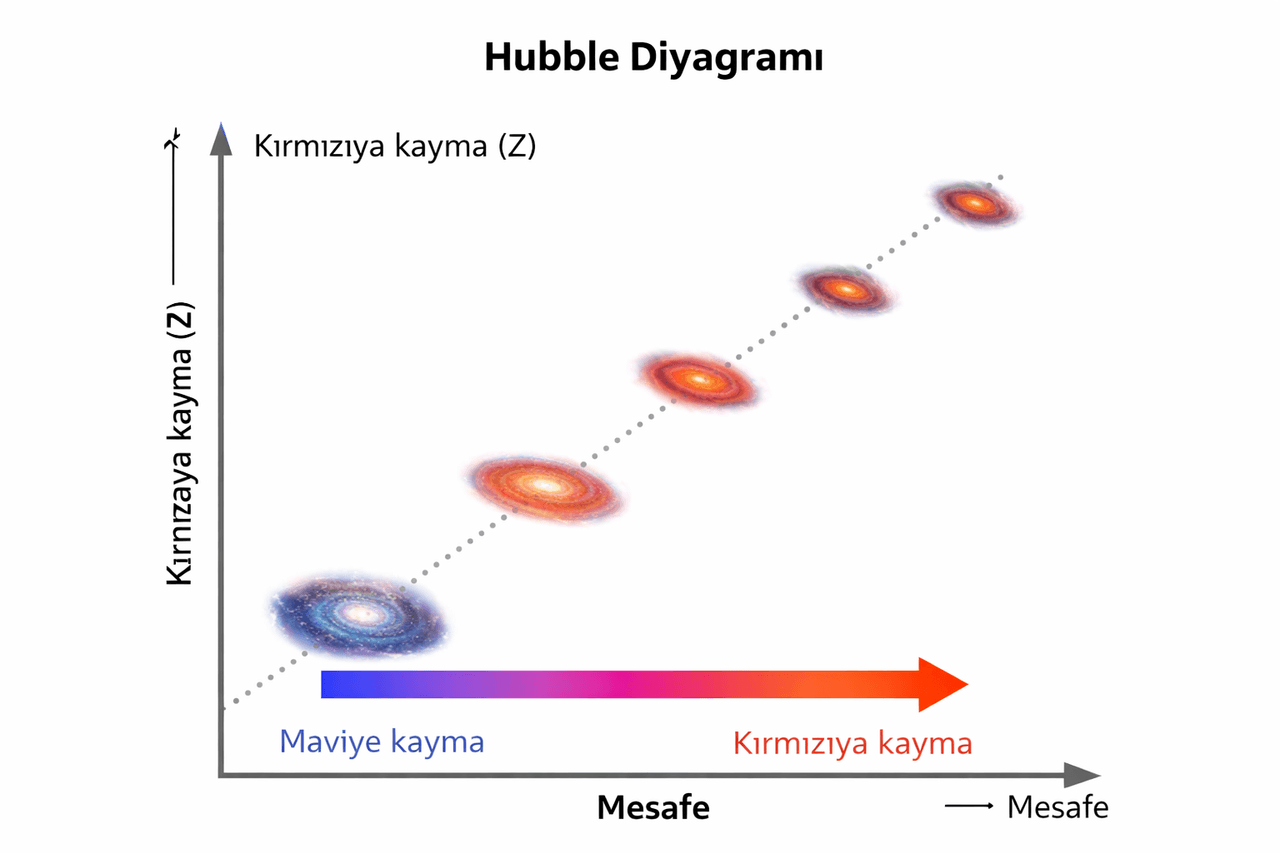
Hubble diagram showing the linear relationship between the recession velocities and distances of galaxies. (Generated by artificial intelligence)
Various observational methods are employed in the study of cosmic expansion. Redshift measurements of galaxies are among the most important observational indicators of cosmic expansion. The change in the wavelength of light from distant galaxies demonstrates that the distances between galaxies have increased over time.
In addition, observations of galaxy clusters, active galaxies, and other astrophysical objects contribute to the determination of expansion parameters. Such observations enable the study of the large-scale structure of the universe and the distribution of galaxies. Research on cosmic expansion aims to determine the expansion rate more accurately by comparing different sets of observational data.
Cosmic expansion is explained by cosmological models developed on the foundation of general relativity. These models assume that the large-scale structure of the universe is homogeneous and isotropic. Solutions derived under these assumptions show that the universe can expand over time or exhibit different dynamic behaviors.
Cosmological models are defined using parameters such as the energy content of the universe, the distribution of matter, and its geometric properties. These parameters are estimated using observational data. Different theoretical approaches are used to explain the expansion history of the universe and to develop models consistent with observational evidence.
Recent studies examine how cosmic expansion can be explained by different physical processes. These include the reevaluation of cosmological parameters, measurements of the expansion rate using different methods, and the development of new theoretical models. Some studies propose alternative theories of gravity or different ways of modeling cosmological parameters to explain the expansion history of the universe. Additionally, the relationship between the cosmic expansion process and conditions in the early universe is being investigated. These studies contribute to a more detailed understanding of the expansion process.
Cosmic expansion is recognized as one of the fundamental concepts of modern cosmology. Many cosmological processes, including the evolution of the universe, the formation of galaxies, and the development of large-scale structures, are closely related to this phenomenon. Studying the expansion process helps determine the age of the universe and the values of cosmological parameters. Therefore, research on cosmic expansion is a significant field of study in both observational cosmology and theoretical astrophysics. Studies employing different observational techniques and theoretical models aim to achieve a better understanding of the dynamic structure of the universe.
Davis, Tamara M. “The expanding Universe.” *Encyclopedia of Astrophysics* 5 (2026): 1-16. Accessed April 20, 2026. https://doi.org/10.1016/B978-0-443-21439-4.00121-8
ESA. “Active galaxies point to new physics of cosmic expansion.” January 28, 2019. Accessed April 20, 2026. https://www.esa.int/Science_Exploration/Space_Science/Active_galaxies_point_to_new_physics_of_cosmic_expansion
Heisenberg, Lavinia et al. “To the Problem of Cosmic Expansion in Massive Gravity.” arXiv:2411.19873 [gr-qc], November 29, 2024. Accessed April 20, 2026. https://doi.org/10.48550/arXiv.2411.19873
Koussour, M. and N. Myrzakulov. “Cosmic expansion history analysis with Hubble parametrization in Qₙ gravity.” International Journal of Geometric Methods in Modern Physics 21, no. 07 (2024): 2450138. Accessed April 20, 2026. https://doi.org/10.1142/S021988782450138X
Lima, P. W. R., and J. A. S. Lima. "Cosmic Expansion Driven by Gravitational Particle Production: Toward a Complete Cosmological Scenario." arXiv:2511.13392 [astro-ph.CO], November 17, 2025. Accessed April 20, 2026. https://doi.org/10.48550/arXiv.2511.13392
Ricciardone, Angelo et al. “Probing Cosmic Expansion and Early Universe with Einstein Telescope.” *arXiv:2601.06017 [astro-ph.CO]*, January 9, 2026. Accessed April 25, 2026. https://arxiv.org/abs/2601.06017
Rodriguez, Brandon. “Exploring the Mystery of Our Expanding Universe.” NASA JPL Education. NASA Jet Propulsion Laboratory, June 17, 2025. Accessed April 25, 2026. https://www.jpl.nasa.gov/edu/resources/teachable-moment/exploring-the-mystery-of-our-expanding-universe/


Parameters Examined | Expansion Rate, Cosmological Parameters, Galaxy Distributions | ||||||||
|---|---|---|---|---|---|---|---|---|---|
Related Field | Observational Cosmology Astrophysics General Relativity | ||||||||
Field | Cosmology | ||||||||
Subject | The expansion of the large-scale structure of the universe over time | ||||||||
No Discussion Added Yet
Start discussion for "Universal Expansion" article
Historical Background
Hubble's Law and the Rate of Expansion
Observational Evidence
Cosmological Models
Current Research
The Importance of Cosmic Expansion in Cosmology