


This article was automatically translated from the original Turkish version.
Among the pantheon of the ancient peoples of Anatolia, the Sun Goddess of Arinna is one of the foremost divine beings in the state religion of the Hittites. She occupies the head of the pantheon alongside her commonly accepted consort, the Storm God. This goddess, who embodies both the sky and the underworld, is regarded as the protector of the monarchy, the provider of justice, and the foundation of the state’s continuity.
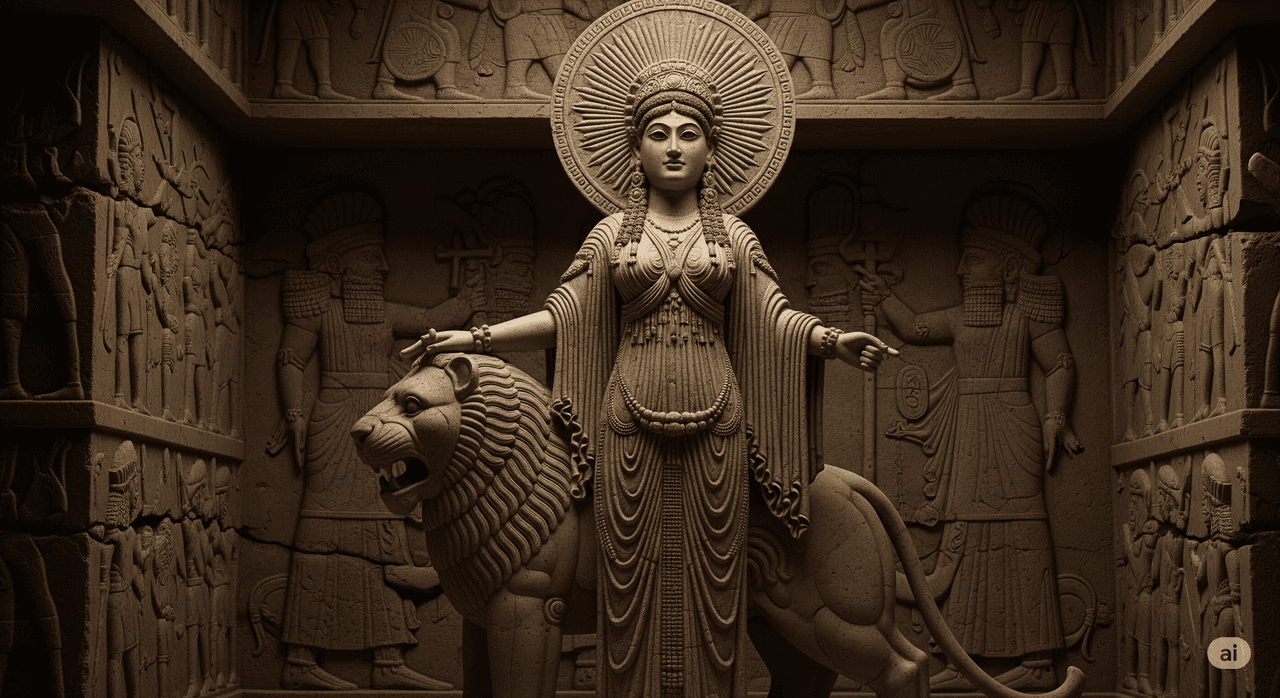
Arinna, Chief Goddess of the Hittite Pantheon, Riding Her Sacred Animal, the Lion (Generated by Artificial Intelligence)
The Sun Goddess of Arinna traces her origins to the indigenous Hattians of Anatolia. Her Hattic name is Wuru(n)šemu. After being adopted by the Hittites, she became associated with the city of Arinna, her cult center. In texts she is described with titles such as “Queen,” “Mother,” “She Who Sheds Light,” “Queen of the Sky,” “Queen of All Lands,” and “Mistress of the Hatti Land.”
The goddess possesses a dual nature. By day she travels across the sky, representing justice and illumination; at sunset she descends into the underworld, where she continues her journey through the night. Consequently, she is also regarded as a “chthonic” or “earth” goddess and is linked to funerary rites. In some texts her name is used interchangeably with that of the Mesopotamian underworld goddess Ereshkigal.
The cult of the Sun Goddess of Arinna extends back to the pre-Hittite Hattian period. She first appears prominently in the annals of Hattusili I (c. 1650–1620 BCE), one of the founders of the Old Hittite Kingdom. In these texts, Hattusili I identifies himself as “beloved by the Sun Goddess of Arinna” and addresses her as “Hâkimem” (GAŠAN-IA). He also records enriching her cult with spoils acquired during his military campaigns.
During the Hittite Imperial Period, the goddess’s position in the state pantheon became even more central. Particularly under King Hattusili III and Queen Puduhepa in the 13th century BCE, a policy of simplification and syncretism—merging deities with similar attributes—was pursued. Within this framework, goddesses from diverse origins but sharing comparable characteristics were assimilated under the identity of the Sun Goddess of Arinna.
The divine figure most closely identified with her during this period was the Hurrian goddess Hepat. Queen Puduhepa, daughter of a priestess from Kizzuwatna (a Hurrian region), sought to elevate Hepat, her people’s chief goddess, to the highest rank in the Hittite state cult. This is reflected in a prayer attributed to Puduhepa:
“Sun Goddess of Arinna, my lady, you are queen of all lands. You have taken for yourself the name Sun Goddess of Arinna in the land of Hatti, and in the land of Sedir you have taken for yourself the name Hepat...”
This identification is also reflected in the reliefs of the open-air sanctuary at Yazılıkaya near Hattusa, where the goddess Hepat is depicted standing atop her sacred animal, the lion. However, some scholars argue that Hepat lacked solar attributes and that this fusion was a politically motivated imposition rather than a natural theological development.
During this period the Sun Goddess of Arinna was also associated with the Mesopotamian goddess of love and war, Ishtar (Hurrian: Šaušga). Common iconographic elements—particularly their shared warrior character and association with the lion—likely formed the basis of this linkage.
After the collapse of the Hittite state, the attributes of the Sun Goddess of Arinna persisted in later Anatolian goddess cults. Kubaba, the local goddess of Kargamish, rose to the status of chief goddess during the Late Hittite city-states period. Her iconography and identity as “Mother Goddess” show strong parallels with Hepat. The cult of Kubaba spread westward and is generally accepted to have transformed into the Phrygian chief goddess Cybele. The cult of Cybele was later adopted by the Lydians, Greeks, and Romans.
The solar cult, like many state religions, tended to be confined to a select minority such as the ruling class rather than the general population. The cult of the Sun Goddess of Arinna is a prime example of this.
The Sun Goddess of Arinna was regarded as the protector and guide of the Hittite royal family. Hittite kings used the title DUTUŠI 【1】 , meaning “My Sun,” indicating a symbolic identification between the king and the sun deity. The king and queen served as the chief priest and chief priestess of the goddess on earth. They were believed to assist the king and his army in battle, and victories were attributed to her favor.
Hittite queens also maintained a special bond with the goddess. Evidence suggests that upon death, queens were identified with her and referred to as the “Sun Goddess of Arinna.” In one text, deceased queens such as Vallani, Nikkalmati, and Ašmunikal are listed alongside the Sun Goddess of Arinna.
Major festivals and ceremonies were held at specific times of the year in honor of the goddess. It was believed that neglecting these rites would bring disaster upon the kingdom. The principal festivals were:
Cengiz, Tülin Bozkurt. “Hitit Krallığında Arinna’nın Güneş Tanrıçası kültü.” *Tarih Araştırmaları Dergisi* 37, no. 64 (October 2018): 125–140. Accessed June 29, 2025.https://doi.org/10.1501/Tarar_0000000696.
Sevinç, Fatma. “Hitit dininde Arinna’nın Güneş Tanrıçası ve onunla özdeş tutulan diğer tanrıçalar.” *Kafkas Üniversitesi Sosyal Bilimler Enstitü Dergisi* 1, no. 1 (March 2008): 175–195. Accessed June 29, 2025.https://dergipark.org.tr/en/pub/sbedergi/issue/11250/134444
Uncu, Ebru. "Mezopotamya, Anadolu ve Mısır medeniyetlerinde güneş kültü." *History Studies* 5, no. 1 (2013): 349–366. Accessed June 29, 2025.https://core.ac.uk/download/pdf/26009504.pdf
Şen, Emre, and Fatma Gürpınar. "Farklı kültürlerde güneş sembolü." *Ulakbilge – Sosyal Bilimler Dergisi* (2019). Accessed June 29, 2025.https://www.ulakbilge.com/makale/pdf/1577953656.pdf
[1]
Tülin Bozkurt Cengiz, “Hitit Krallığında Arinna’nın Güneş Tanrıçası kültü,” Tarih Araştırmaları Dergisi 37, sy. 64 (Ekim 2018): 130, Erişim 28 Haziran 2025, https://dergipark.org.tr/tr/download/article-file/780825#page=6.
[2]
Cengiz, “Hitit Krallığında Arinna’nın Güneş Tanrıçası kültü,” 134, https://dergipark.org.tr/tr/download/article-file/780825#page=10.
[3]
Cengiz, “Hitit Krallığında Arinna’nın Güneş Tanrıçası kültü,” 135, https://dergipark.org.tr/tr/download/article-file/780825#page=11
[4]
Cengiz, “Hitit Krallığında Arinna’nın Güneş Tanrıçası kültü,” 135, .

No Discussion Added Yet
Start discussion for "The Sun Goddess of Arinna" article
Definition and Characteristics
Historical Development
Origins and Early Period
Imperial Period and Syncretism
Post-Hittite Influences
Cult and Worship
Relationship with the Monarchy
Festivals and Rituals
Iconography and Symbols