This article was automatically translated from the original Turkish version.
When a food product is purchased, the packaging displays the production date and the expiration date. The period between these two dates represents the product’s shelf life. Although digital data do not have an expiration date, the cryptographic methods that protect them also have a limited period of resilience against technological advancements. Some encryption methods currently considered secure may not provide the same level of protection against future computing technologies that may emerge.
Today, messages transmitted over the internet, inter-institutional communications, financial transactions, and personal data are protected by strong cryptographic algorithms. Given the processing capacity of current computers, breaking these algorithms in practice appears impossible. However, a significant risk long discussed in the field of cybersecurity is the collection of encrypted data today for decryption in the future. This approach is referred to in the literature as Harvest Now, Decrypt Later (HNDL) or, in its commonly used Turkish equivalent, “Şimdi Topla, Sonra Çöz”.
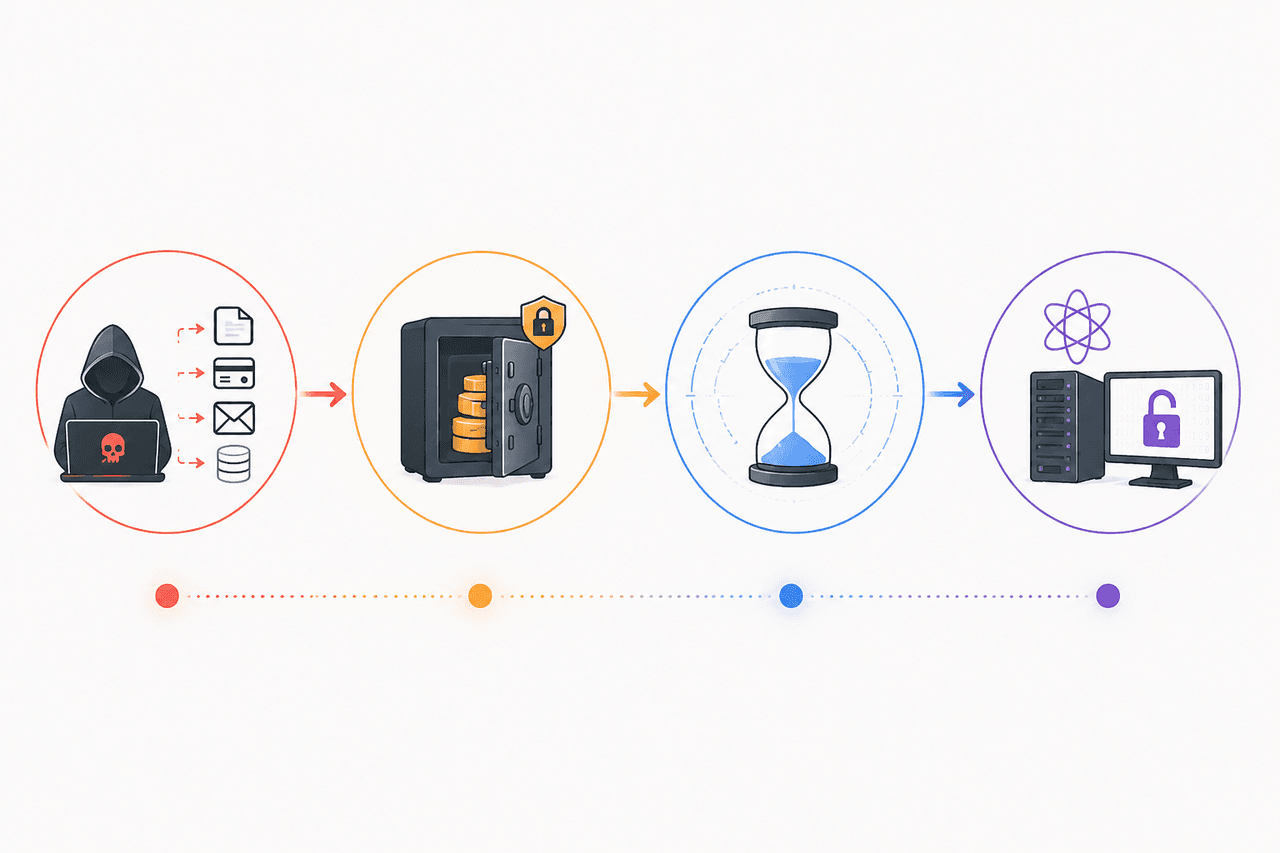
Diagram Illustrating the Harvest Now, Decrypt Later Attack Process (Generated by Artificial Intelligence.)
The Harvest Now, Decrypt Later approach is based on the assumption that attackers store encrypted data they cannot currently decrypt, intending to decode it in the future using more advanced technologies. In this scenario, the attacker’s goal is not to break the current encryption immediately but to preserve the data to exploit future computational capabilities.
This risk is particularly significant for information that must maintain confidentiality for many years. Diplomatic correspondence, military communications, critical infrastructure plans, intellectual property data, and health records often retain their value for decades. Data secured today under current conditions may become targets for reassessment under future technological conditions.【1】
One of the primary reasons the Harvest Now, Decrypt Later approach has gained prominence is advances in quantum computing technology. Quantum computers use different computational principles than classical computers and can theoretically achieve significantly higher processing power for certain problems.
Researchers assess that fault-tolerant quantum computers of sufficient scale could compromise some of today’s widely used public-key cryptographic systems. Consequently, some encryption methods currently deemed secure may not sustain their level of protection against future technological developments.
This approach has long been regarded as a theoretical risk. However, recent research demonstrates that storing large volumes of encrypted network traffic is both technically and economically feasible.
Cover Page of NIST’s FIPS 203 Post-Quantum Cryptography Standard (National Institute of Standards and Technology – NIST)
In a 2026 study by Blanco-Romero and colleagues, the feasibility of Harvest Now, Decrypt Later scenarios in systems using TLS 1.2, TLS 1.3, and QUIC was examined. The study revealed that storing today’s massive volumes of encrypted data is possible, underscoring the importance of risk assessments for data requiring long-term confidentiality.【2】
One of the most important responses to the potential risks posed by quantum computers is post-quantum cryptography. Post-quantum cryptography refers to next-generation cryptographic algorithms designed to be secure against both classical and quantum computers.
One of the most significant developments in this field is the first set of post-quantum cryptographic standards published in 2024 by the U.S. National Institute of Standards and Technology (NIST). These standards provide an international reference framework for new algorithms capable of countering future quantum threats.【3】
The publication of new standards does not imply that existing systems can be rapidly converted. Corporate information systems often consist of hundreds of applications, servers, network devices, and software components. Identifying the cryptographic mechanisms used in these systems, conducting risk analyses, and developing transition plans can take considerable time.
For this reason, many countries and institutions treat the transition to post-quantum cryptography as a long-term process. The United Kingdom’s National Cyber Security Centre (NCSC) proposed a phased transition model for organizations in its 2025 guidance, outlining a roadmap covering the years 2028, 2031, and 2035.【4】
A key concept emerging in this process is cryptographic agility. Cryptographic agility refers to a system’s ability to replace its encryption algorithms with more secure alternatives when needed. This allows security updates to be implemented without requiring complete system redesigns when new technologies or threats emerge. To support this approach, the National Cybersecurity Center of Excellence (NCCoE) within NIST is developing tools and guidance to facilitate organizations’ transition to quantum-resistant algorithms.【5】
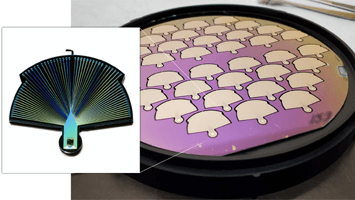
PEACOQ Quantum Photodetector Developed by NASA/JPL-Caltech (NASA Jet Propulsion Laboratory)
The Harvest Now, Decrypt Later approach is viewed as a threat model that considers not today’s but tomorrow’s security risks. Particularly for data requiring long-term confidentiality, it is essential to account not only for current security conditions but also for potential future technological changes.
Therefore, for many institutions, the fundamental question is not merely which algorithms are used, but how long specific data must remain protected. Approaches such as post-quantum cryptography and cryptographic agility are key components of this long-term security planning.
Blanco-Romero, Javier, Florina Almenares Mendoza, Carlos García Rubio, Celeste Campo, and Daniel Díaz Sánchez. "On the Practical Feasibility of Harvest-Now, Decrypt-Later Attacks." *arXiv* 2603.01091. Accessed June 2, 2026. https://arxiv.org/abs/2603.01091
Mascelli, Jillian, and Megan Rodden. "‘Harvest Now Decrypt Later’: Examining Post-Quantum Cryptography and the Data Privacy Risks for Distributed Ledger Networks." *Finance and Economics Discussion Series* 2025-093. Washington, D.C.: Board of Governors of the Federal Reserve System. Accessed June 2, 2026. https://doi.org/10.17016/FEDS.2025.093
National Aeronautics and Space Administration. "NASA’s Quantum Detector Achieves World-Leading Milestone." Jet Propulsion Laboratory. Accessed June 2, 2026. https://www.nasa.gov/centers-and-facilities/jpl/nasas-quantum-detector-achieves-world-leading-milestone/
National Cyber Security Centre. "Timelines for Migration to Post-Quantum Cryptography." ncsc.gov.uk. Accessed June 2, 2026. https://www.ncsc.gov.uk/guidance/pqc-migration-timelines
National Cybersecurity Center of Excellence. "Migration to Post-Quantum Cryptography." National Institute of Standards and Technology. Accessed June 2, 2026. https://www.nccoe.nist.gov/applied-cryptography/migration-to-pqc
National Institute of Standards and Technology. "Post-Quantum Cryptography." Computer Security Resource Center. Accessed June 2, 2026. https://csrc.nist.gov/projects/post-quantum-cryptography
[1]
Jillian Mascelli and Megan Rodden, "‘Harvest Now Decrypt Later’: Examining Post-Quantum Cryptography and the Data Privacy Risks for Distributed Ledger Networks," Finance and Economics Discussion Series 2025-093 (Washington: Board of Governors of the Federal Reserve System, 2025): 1–3, https://doi.org/10.17016/FEDS.2025.093
[2]
Javier Blanco-Romero and others, "On the Practical Feasibility of Harvest-Now, Decrypt-Later Attacks," arXiv 2603.01091 (2026): 1–2, https://arxiv.org/abs/2603.01091
[3]
National Institute of Standards and Technology, "Post-Quantum Cryptography," Computer Security Resource Center, Accessed 2 June 2026, https://csrc.nist.gov/projects/post-quantum-cryptography
[4]
National Cybersecurity Center of Excellence, "Migration to Post-Quantum Cryptography," National Institute of Standards and Technology, Accessed 2 June 2026, https://www.ncsc.gov.uk/guidance/pqc-migration-timelines
[5]
National Cybersecurity Center of Excellence, "Migration to Post-Quantum Cryptography."
What Is Harvest Now, Decrypt Later?
Quantum Computers and Future Risks
Are Harvest Now, Decrypt Later Attacks Realistic?
Post-Quantum Cryptography
Transition Process and Cryptographic Agility
Evaluation