

The rabbit offended the mountain, and the mountain was unaware of it.
This expression is used to describe how a small and insignificant person has become upset with someone much larger and more powerful. However, the larger person is completely unaware of the situation, because the one who is upset holds no importance to them. In other words, someone’s anger or resentment has no effect whatsoever on the other party—just like a tiny rabbit becoming angry at a massive mountain. The mountain does not even know the rabbit is upset.
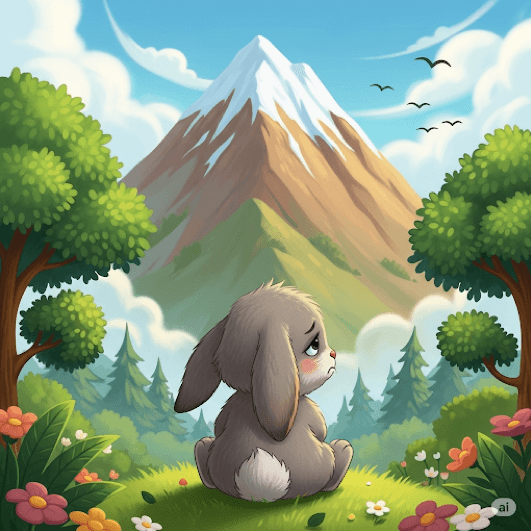
(Generated by artificial intelligence)
⭐Where Does It Come From?
The exact origin of this expression is unknown. However, it is believed to have emerged over time as a way to describe similar situations experienced by people. Events such as one person feeling slighted by another, yet the other person being completely unaffected, gave rise to this idiom. Idioms generally arise from shared experiences and observations within a community. This expression is a beautiful example of how people have used imagery to convey such a situation.
✨Origin and Meaning?
The idiom’s origin lies in the relationship between two opposing natural entities: a tiny rabbit and a colossal mountain. The rabbit represents something fragile, delicate, and easily hurt, while the mountain symbolizes something strong, large, and impervious to influence. Through this contrast, the idiom emphasizes how insignificant a person’s grievance is to the other party. Its meaning can be summarized as: “When someone unimportant becomes upset with someone important, it means nothing to the important person.”

(Generated by artificial intelligence)
✍️How Is It Used in Daily Life?
This expression frequently appears in everyday conversation. For example, when a friend describes being upset with someone in a higher position, another person might respond, “Don’t worry about it, it’s like a rabbit being angry at a mountain—the mountain doesn’t even know.” This phrase is used to convey that the friend’s resentment is pointless and has had no impact on the other person. In short, we use this idiom to indicate that someone is holding onto an unnecessary grievance.