


This article was automatically translated from the original Turkish version.
+2 More
Garip Movement, Orhan Veli Kanık, Oktay Rifat Horozcu and Melih Cevdet Anday, who represented it, is a literary movement that marked a pivotal turning point in 20th-century Turkish poetry and shaped the direction of modern Turkish verse. The movement was formally introduced to the literary world in 1941 with the publication of their joint poetry anthology titled Garip, which gave the movement its name. The Garip Movement ended with Orhan Veli’s death on 14 November 1950 and the closure of the journal Yaprak.
The founders of the movement, Orhan Veli Kanık, Oktay Rifat Horozcu and Melih Cevdet Anday, studied together at Ankara Boys’ High School and developed a close friendship. They published their earliest works between 1930 and 1934 in the school journal Sesimiz. Later, in late 1936 and 1937, their poems appeared in the journal Varlık. These early poems were generally metrical and rhymed, showing influences from “lyric poets” such as Ahmet Hamdi Tanpınar, Necip Fazıl Kısakürek, Ahmet Muhip Dıranas and Ahmet Haşim.
The free-verse poems announcing the Garip Movement were first published in Varlık on 15 September 1937. In 1937, through a questionnaire titled “Is Poetry Dying?” published in the newspaper Ulus, Orhan Veli, Melih Cevdet and Oktay Rifat were introduced as the “three young poets” defending surrealism and declared their shared poetic vision. The 1941 publication of the Garip book presented the literary world with a preface written by Orhan Veli and endorsed by Melih Cevdet and Oktay Rifat, serving as a manifesto.
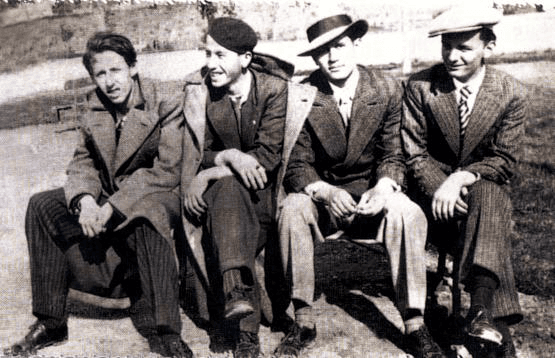
Garip poets (From left: Orhan Veli Kanık, Şinasi Baray, Oktay Rıfat, Melih Cevdet Anday) (AA)
Rejection of Traditional Poetry: The Garip poets sought to liberate poetry from the outdated conventions of traditional verse, regarding meter, rhyme, metaphor, hyperbole and ornamentation as unnecessary. They argued that these elements were mere intellectual games, obstacles to naturalness and distortions of reality. They also tended to abandon the conventional poetic sentence structure.
Naturalness and Simplicity: They asserted that poetry must be naturalized and simplified, opening itself to the unconscious to capture its purity, childlike innocence and naturalness. They emphasized “purity” and “plainness” as defining features of their poetry.
Poetry as Language Art: They maintained that poetry is an art of words and meaning, and therefore must not be mixed with other arts such as painting or music. They insisted that poetry consists entirely of language.
Beauty of the Whole: They believed that the beauty of the entire poem should take precedence over the beauty of individual words or lines.
Shift in Taste and Social Commitment: They emphasized that poetry should reflect the tastes of working people, not those of the religious, feudal or bourgeois classes. They brought poetry out of closed circles into the streets and sought to portray the struggles of the “ordinary person.” According to Orhan Veli, literature would henceforth be the literature of the people who earn their living through labor.
Everyday Language and Simplicity: They introduced the everyday language of the people into poetry and did not shy away from using slang. Their aim was to reach broad audiences through a simple, clear and unadorned language.
Irony and Humor: Their poems occasionally employed irony, wit and humor as products of intellect. These elements can also be interpreted as a stance against the negative aspects of their era and societal clichés.
Childlike Sensibility: They adopted the perspective of a child’s innocence or the simple anxiety of an ordinary person toward the world.
Melih Cevdet Anday (TRT Archive)
Garip’s publication marked the beginning of Orhan Veli, Oktay Rifat and Melih Cevdet developing their own individual poetic styles and publishing their poems independently. The years of the Second World War, along with military service obligations, prevented them from working together and led to a decline in their output.
Orhan Veli Kanık (1914–1950): He continued this poetic style until his death, diversified his themes and occasionally wrote longer poems (Vazgeçemediğim, Destan Gibi, Yenisi, Karşı). In the journal Yaprak (1949–1950), he reunited with his friends in a more socially engaged poetic framework.
Oktay Rifat Horozcu (1914–1988): Later distancing himself from Garip poetry, he briefly joined the Second New movement and wrote satirical and socially committed poems drawing on folk literature and folklore, adhering to socialist and socially engaged artistic principles (Aşağı Yukarı, Karga ile Tilki).
Melih Cevdet Anday (b. 1915): He too moved away from Garip poetry toward a socially and intellectually oriented verse (Telgrafhane, Yan Yana). In a later statement, Melih Cevdet noted that he did not fully agree with some of the ideas expressed in Orhan Veli’s preface to Garip and that these ideas did not fully reflect the poems in the book.
The Garip Movement was one of the most controversial literary phenomena in Turkish poetic history. Criticism began as soon as the poets published their early works in Varlık in 1936 and initially took the form of mockery and dismissal.
Rejection of Traditional Form and Aesthetics: The Garip poets considered meter, rhyme, metaphor, hyperbole and ornamentation unnecessary, arguing that they hindered naturalness. Ahmet Hamdi Tanpınar noted that the movement aimed to free Turkish literature from poetic conventions and undermine the musicality that had long defined Turkish poetry. This provoked strong reactions in their time. Cemal Süreya stated that Orhan Veli did not begin from poetry itself but from “non-poetry,” seeking to destroy the old poetry, discredit it and write its opposite.
Simplicity and Ordinariness: Garip poetry was criticized for being “simple” and “easy” due to its use of plain, accessible language. The ease of this style led to a rapid proliferation of imitations, intensifying criticism. Mehmet Kaplan described the Garip trio’s poems as “the naked exposure of sensations untouched by imagination or thought.”
Meaninglessness and Superficiality: Alongside criticisms that Garip poetry trivialized, reduced to simplicity and alienated itself from society, it was also accused of being “meaningless.” Critics such as Mehmet Çınarlı claimed that the “simplicity and repulsiveness” introduced by Garip generated “boredom and revulsion” in society, pushing subsequent poets toward “abstract” and “meaningless” verse.
Lack of Social Connection: Some critics argued that the Garip poets were disconnected from the people, noting that their poems contained almost no references to history, ideology, social values or belief systems. Asım Bezirci stated that the Garip poets did not love the society they lived in and neither sought nor knew how to change it. In response, Orhan Veli asserted that poetry had no purpose of defending any class’s interests; it merely sought pleasure and sought to dominate art.
The “Kitabe-i Seng-i Mezar” Controversy: Orhan Veli’s poem “Kitabe-i Seng-i Mezar” became one of the most controversial poems of its time, turning into gossip material even in barbershop conversations. It was denounced as “indecent,” and Orhan Veli was labeled the “famous verse poet.” The line “If only I were a fish in a rakı bottle” was frequently compared to Ahmet Haşim’s line “If only I were a reed in these lakes,” sparking debate.
Nurullah Ataç’s Support and Criticism: Nurullah Ataç supported Garip poetry from the outset, even ridiculing its critics with the remark: “Whenever they encounter a novelty they dislike or do not understand, they immediately cry ‘bobsitil’.” However, this support made Ataç himself a target of criticism. Contemporary cartoonists and writers believed that the Garip poets were the official poets of National Chief İsmet İnönü and that Ataç was promoting them by decree.
Reactions from Other Literary Groups: Literary groups that emerged after the Garip Movement, such as the Hisar Group (1950) and the Blue Group (1952), arose in reaction to Garip poetry. The Hisar Group opposed the rejection of tradition and the use of poetry as a political propaganda tool. Ahmet Oktay of the Blue Group described Orhan Veli as an “incomplete pioneer and incomplete poet” and found Garip poetry shallow. Attilâ İlhan also claimed that Garip poetry had corrupted Turkish poetry.
The Garip Movement is regarded as “a significant breakthrough that, though not producing many major works, directed the course of modern Turkish poetry through its influence.” By taking Nâzım Hikmet’s formal innovations further and introducing true “free verse,” the movement attracted even the interest of major poets; both Ahmet Hamdi Tanpınar and Nâzım Hikmet themselves wrote poetry in this style. Although the Second New Movement (1954) emerged as a reaction to Garip poetry, it actually utilized the channel opened by the Garip poets. The emergence of the Second New was driven by the need to restore poetry, which the Garip poets had “trivialized, reduced to simplicity and distanced from society,” to its former esteemed position.
Form and Language Approach: Garip utilized the freedom of spoken language to write poetry about everyday life and ordinary people. The Second New, by contrast, argued that language should move away from everyday speech, deliberately disrupting the balance between word and meaning, and using words outside their conventional applications. Cemal Süreya stated that the Second New “chiseled words,” “half-pulled them from their places” and “slightly diverted them from their meanings,” aiming to create new images and lines.
Meaning and Intended Audience: Garip aimed to appeal to the public, to the taste of the “ordinary person,” and turned poetry into a common subject accessible to all. The Second New, however, wrote “closed poems” in which meaning was hidden through images and associations, requiring active effort from the reader, and addressed an educated, literary audience. It was stated that the true aim of the Second New was not “to write meaningless poetry” but “to transcend the visible and perceptible boundaries of meaning and transport the reader into entirely different worlds.”
Concepts of Tradition and Innovation: Garip rejected everything done in Turkish poetry up to that point, insisting that all things belonging to the past must be destroyed. The Second New also opposed traditional poetry but instead of Garip’s destructive approach, it undertook a different epistemological “repositioning.” The Second New advanced Nâzım Hikmet’s formal innovations.
Irony and Sensibility: Both movements employed irony. Garip addressed the strangeness of the world and the simple anxieties of ordinary people who were fond of comfort, with a childlike innocence or a naive gaze. The Second New embedded the individual’s dilemmas, fears, disappointments and helplessness at the core of poetry. Second New poets occasionally also employed irony, wit and humor as products of intellect.
Philosophical Influences: Garip poetry was heavily influenced by French literature and the movements of Existentialism and Surrealism. In particular, André Gide’s work Les Nourritures terrestres had a strong impact on the young poets of the era. However, Orhan Veli insisted that his poems bore no resemblance to any modern European poets and were instead shaped primarily by his own folk artists. The Second New also drew nourishment from Western movements such as Existentialism, Surrealism, Dadaism and Cubism.
Anadolu Ajansı. "'Garip' akımı şairi: Orhan Veli Kanık." Accessed June 30, 2025.https://www.aa.com.tr/tr/kultur-sanat/garip-akimi-sairi-orhan-veli-kanik/965039
Coşar, Said. “Karikatüristlerin Garip Tepkisi.” Çukurova Üniversitesi Türkoloji Araştırmaları Merkezi Yayınları. Accessed June 29, 2025.https://turkoloji.cu.edu.tr/YENI%20TURK%20EDEBIYATI/said_cosar_karikaturist_garip_tepkisi.pdf.
Doğan, Mehmet Can. “O – Garip Şiiri.” *Türk Dili*, October 2023. Accessed June 29, 2025.https://tdk.gov.tr/wp-content/uploads/2023/10/Mehmet-Can-Dogan-_O_-GARIP-SIIRI_-22-1.pdf
Ministry of Culture and Tourism – e-Book Portal. "Garip Hareketi." Accessed June 29, 2025.https://ekitap.ktb.gov.tr/TR-80328/garip-hareketi.html
Mumcu Ay, Yasemin. “Türk Şiirinde Garip Hareketi.” *Çukurova Üniversitesi Türkoloji Araştırmaları Merkezi Yayınları*, 2009. Accessed June 29, 2025.https://turkoloji.cu.edu.tr/YENI%20TURK%20EDEBIYATI/yasemin_mumcu_ay_turk_siirinde_garip_hareketi.pdf.
Polat, Adem. *İkinci Yeni Şiirinin Felsefî Kaynakları*. PhD thesis,Ardahan Üniversitesi Institute of Social Sciences, Department of Turkish Language and Literature, 2016.https://tez.yok.gov.tr/UlusalTezMerkezi/tezDetay.jsp?id=8vHPN-0A62t3UvJRCwwDwg&no=kq6bnauCOszxryq76sP7IQ
Tütak, Mehmet, and Burcu Tütak. "1908-1960 Yılları Arasında Türk Şiirinde Görülen Yenileşme Hareketleri ve II. Yeni Şiir Hareketinin Konumu." *Akademik İncelemeler Dergisi* 8, no. 2 (2013): 103–119. Accessed June 29, 2025.https://dergipark.org.tr/tr/download/article-file/383335
YouTube. "Cemal Süreya: Garip Akımı ve Etkisi." Cemil Yüksel. Accessed June 30, 2025.https://www.youtube.com/watch?v=-ug8iLOtSS8
YouTube. "Melih Cevdet Anday ve Garip Akımı (1989) | TRT Arşiv." TRT Arşiv. Accessed June 30, 2025.https://www.youtube.com/watch?v=jkjjp_K7zao

No Discussion Added Yet
Start discussion for "The Garip Movement (First New)" article
Emergence and Background
Garip Book and Its Preface (Manifesto)
Core Principles and Characteristics of Garip Poetry
Post-Garip Period and the Evolution of the Poets
Criticism of the Garip Movement
The Garip Movement’s Influence on the Second New