


This article was automatically translated from the original Turkish version.
+2 More
Future of Work Report
Original Name | The Future of Jobs Report 2025 | ||||||||
|---|---|---|---|---|---|---|---|---|---|
Type | Policy document Global analysis report | ||||||||
Prepared by Institution | World Economic Forum | ||||||||
Publication Year | 2025 | ||||||||
Publication Place | Switzerland Cologny/Geneva | ||||||||
Number of Pages | 296 | ||||||||
ISBN | 978-2-940631-90-2 | ||||||||
Language | English | ||||||||
Future of Jobs Report 2025, World Economic Forum published in January 2025, is an analytical study aimed at shedding light on the five-year future of global labor markets. This report constitutes the fifth edition of the Future of Jobs series, published biennially since 2016.
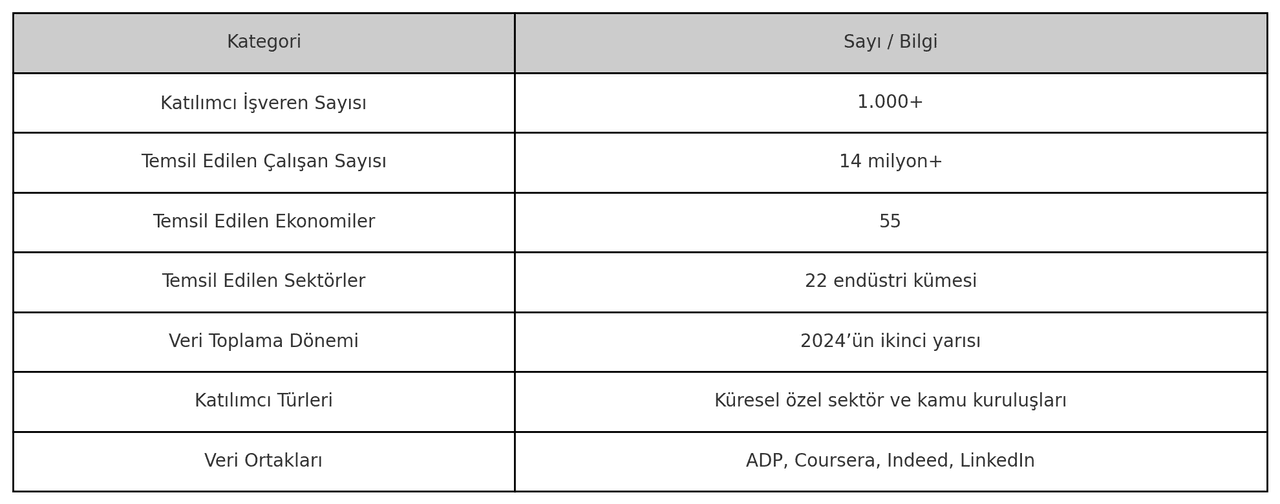
This study is based on projections from over 1,000 employers covering 55 economies and more than 14 million employees across 22 sectoral clusters. The findings are supported by both qualitative and quantitative data and enriched with sectoral insights obtained from data partners such as ADP, Coursera, Indeed, and LinkedIn and others data providers.
The primary objective of the report is to analyze the impact of technological advancements, green transition, demographic shifts, geo-economic fragmentation, and economic uncertainties on the labor market, and to provide forecasts regarding emerging occupations, skill requirements, and employer strategies. It also examines employers’ plans for reskilling and upskilling initiatives and evaluates the impact of skill gaps on the business landscape.
In light of this information, Future of Jobs Report 2025 serves as a multifaceted reference source not only for the business community but also for policymakers, educational institutions, and civil society organizations.
Future of Jobs Report 2025 was prepared by the World Economic Forum to forecast, analyze, and identify the key drivers of transformations expected in the global labor market between 2025 and 2030. The report’s primary goal is to comprehensively assess future occupations, skills, and employer strategies within the framework of five major macro trends affecting the labor force.
The report seeks to answer the following key questions:
To this end, the report generates data at both global and regional levels, offering a strategic perspective on labor transformation through cross-sectoral comparative analyses. The ultimate goal is to provide stakeholders—employers, policymakers, educational institutions, and workers—with an evidence-based framework to navigate the complex transformation process.
The scope of the report is broad both in content and geography. Content-wise, it is structured around five key themes:
Geographically, the report covers 55 countries and 22 industry clusters where these countries’ economic activities take place. Participating firms collectively represent over 14 million employees. In this context, the report takes into account not only global trends but also regional and sector-specific variations.
This report is not merely an attempt to identify current conditions; it is also a call to action offering forward-looking recommendations. It aims to serve as a vital reference for shaping labor policies, restructuring education systems, and achieving inclusive growth objectives. In this regard, the report can be considered a strategic tool not only for the private sector but also for public administration, academia, and civil society.
Future of Jobs Report 2025 was developed using an original research design by the World Economic Forum based on quantitative-analytical methods. The study relies on a comprehensive survey conducted in the second half of 2024. The primary data source is the results of this survey, titled the “Future of Jobs Survey 2024.”
The survey systematically collects employers’ projections on employment growth or decline by occupation, changes in skill requirements, reskilling strategies, hiring approaches, and views on technological transformation. In this way, the study integrates both descriptive and predictive analyses. Furthermore, the findings are interpreted according to internationally recognized methodological criteria.
To enhance the reliability and representativeness of the data, the following criteria were observed:
A total of over 1,000 employers participated in the research, operating across 22 sectoral clusters. When evaluated collectively, these participating organizations represent over 14 million employees. Data were collected from both public and private sector institutions.
Participants cover five continents, 55 countries, and economies at various income levels. The analyses presented in the report are not limited to global averages but also include regional and sectoral subgroups. Below are key statistics of the participant profile presented in table form:
Tabulated with the aid of artificial intelligence.
Survey data were supplemented with large-scale labor market data from global platforms. In this context, training trends from Coursera, employment trends from Indeed and LinkedIn, and wage and labor data from ADP were integrated. These data enhanced the report’s sectoral depth and skill-based analytical capacity.
The scope of the report is limited to sectors and regions meeting statistical thresholds. Consequently, countries or small sectors with low representation were excluded from the general analysis. Additionally, the report considers only formal employment, excluding informal labor markets. This situation has resulted in certain employment structures in developing economies being underrepresented.
As of 2025, global labor markets have entered a phase of restructuring, moving beyond the lingering effects of the pandemic. However, this process is shaped by a complex transformation driven by intertwined technological, demographic, environmental, and geopolitical factors.
Future of Jobs Report 2025 identifies five primary determinants of this restructuring:
Globally, the unemployment rate declined to 4.9% in 2025, the lowest level since 1991. However, this overall improvement is not evenly distributed at regional or societal levels:
Additionally, the proportion of young people neither in employment nor in education or training (NEET) reached 27.6% in low-income countries compared to only 10.1% in high-income countries. These disparities point to serious structural challenges in skill development and transition to productive labor force participation.
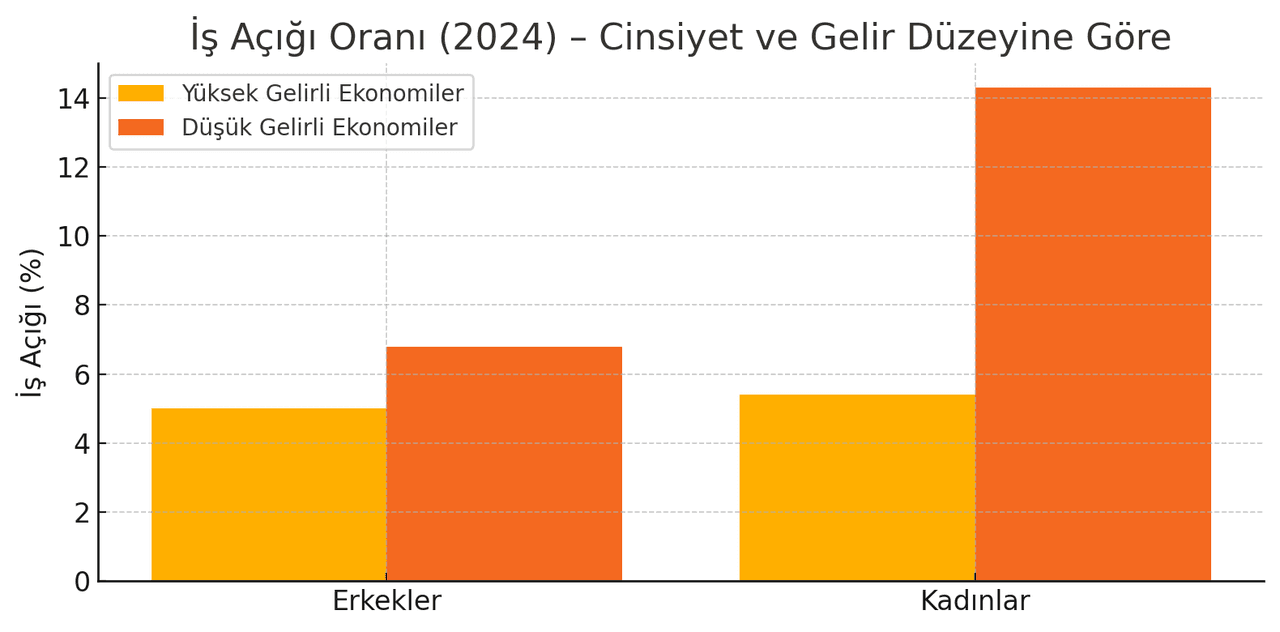
The “labor shortage” indicator developed by the International Labour Organization (ILO) provides a broader measure that includes not only unemployment but also underemployment. As of 2024, a global need for an additional 402 million jobs was identified. Labor shortages have increased in low-income countries compared to pre-pandemic levels. This gap is more pronounced for women:
In low-income economies, the labor shortage for women is 7.5 percentage points higher than for men. Below is a visualization of this situation:
Tabulated with the aid of artificial intelligence.
Future of Jobs Report 2025 identifies five key macro trends that will drive fundamental changes in the labor market between 2025 and 2030. These trends are not independent; rather, they often trigger, overlap, or balance one another. According to employer expectations, the trends are ranked as follows:
One of the report’s most prominent findings is the growing transformative impact of expanded digital access and artificial intelligence—particularly generative AI—on the world of work. Sixty percent of employers indicate that expanded digital access will directly transform their business models. The technological areas with the greatest transformative impact are:
These technologies are both creating new jobs and transforming or eliminating existing ones.
Fifty percent of employers anticipate that rising living costs will transform their businesses by 2030. This trend affects not only consumer behavior but also labor planning, wage policies, and employee motivation. Despite declining inflation, suppressed real incomes are driving businesses to adopt new strategies.
Climate change mitigation (emissions reduction) and climate adaptation processes are viewed by employers as transformative, with respective impacts of 47% and 41%. Key emerging occupations in this context include:
This trend affects not only occupations but also skill sets, accelerating the importance of previously less common competencies such as environmental responsibility.
Two opposing demographic trends are affecting the labor force differently:
Forty percent of employers believe aging and declining labor forces will transform business models, while 25% believe growing youth labor pools will do so.
Disruptions in global supply chains, trade restrictions, and rising protectionist tendencies are prompting firms to reassess their operational areas. Among participating firms:
as decisive factors in transforming their business models. These trends are increasing demand for labor in areas such as security, cybersecurity, supply chain management, and strategic risk management.
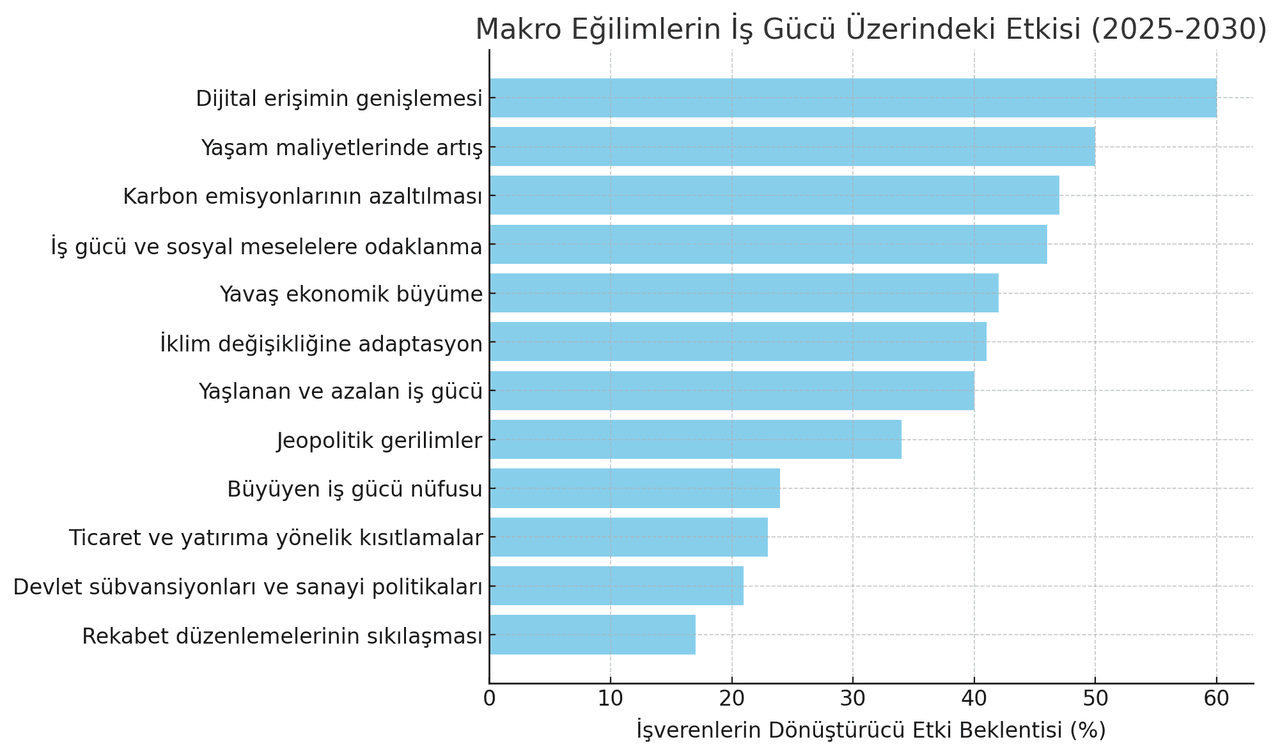
The following graph shows which macro trends employers believe will most significantly impact labor transformation:
Tabulated with the aid of artificial intelligence.
According to the Future of Jobs Report 2025 data, this graph ranks the macro trends employers believe will most influence labor transformation between 2025 and 2030. As shown, digitalization (60%) and rising living costs (50%) rank first and second, followed by green transition-related trends and geopolitical factors.
Future of Jobs Report 2025 forecasts that over the next five years (2025–2030), global labor markets will experience simultaneous dynamics of growth and contraction. According to the report, approximately 23% of the 673 occupations analyzed will decline, while 69% will remain stable or grow. This translates to a net employment increase of 2.3%.
This projected increase corresponds to the creation of approximately 69 million new jobs, offset by the elimination of 83 million jobs. This indicates that the labor market will simultaneously present both opportunities and threats, with transformation bringing both gains and losses.
The report reveals that the fastest-growing occupations between 2025 and 2030 are driven by two main trends: technological transformation and sustainability-driven restructuring. Key emerging occupational groups include:
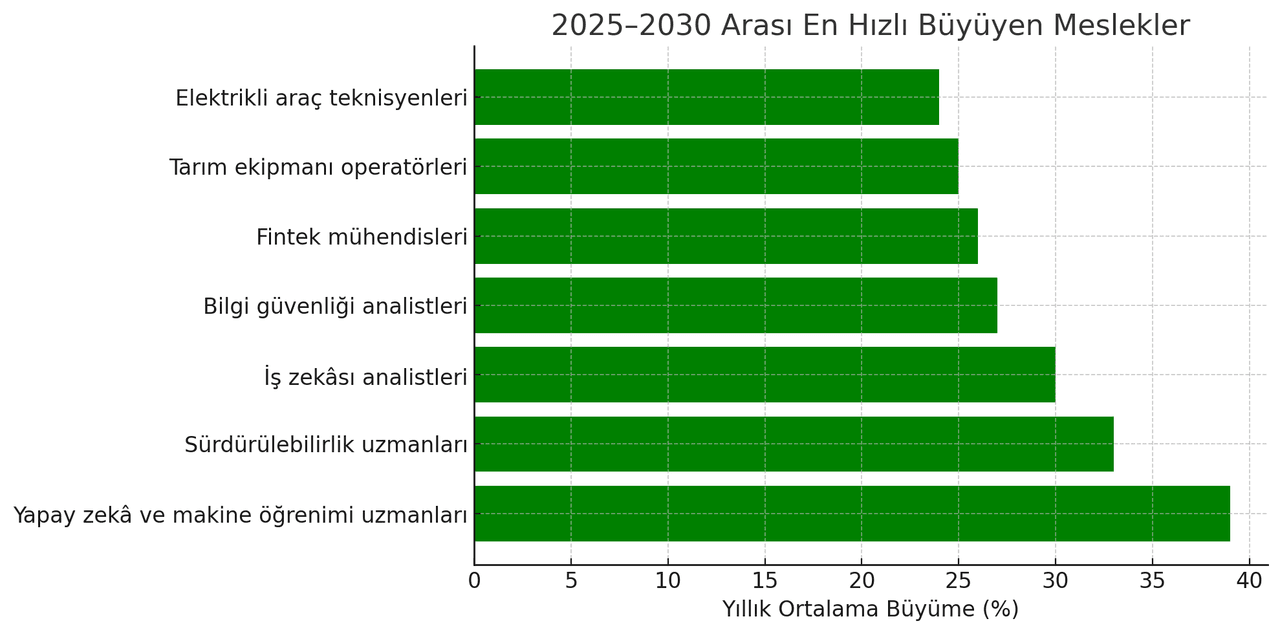
Tabulated with the aid of artificial intelligence.
These occupations are concentrated in service sectors undergoing rapid digitalization and production models reshaped by environmental policies.
The majority of occupations projected to decline are affected by automation, digitalization, and cost optimization. The most impacted areas are administrative support services and traditional information processing roles:
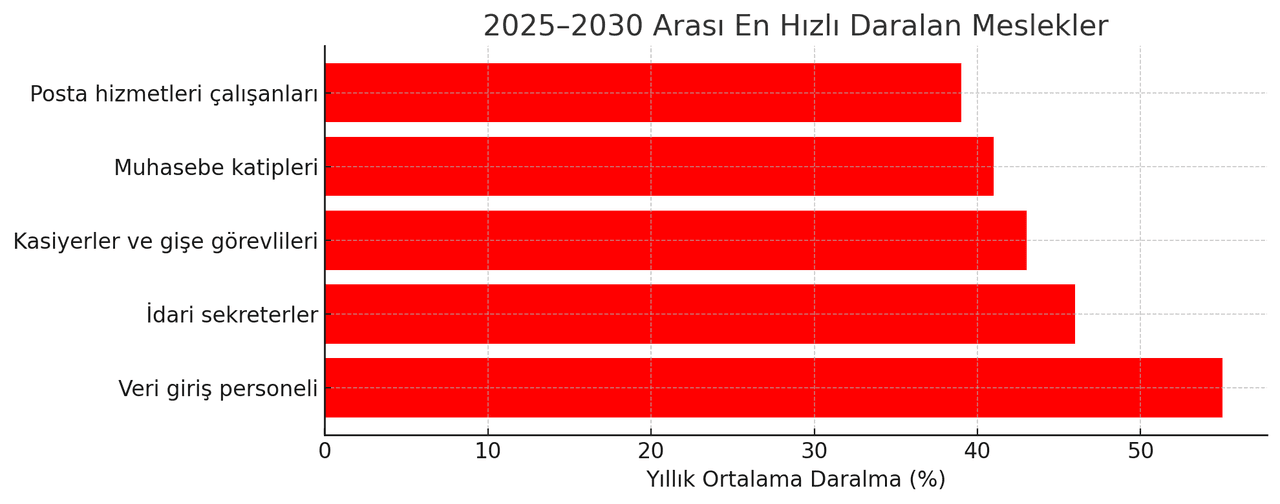
Tabulated with the aid of artificial intelligence.
The decline of these occupations supports a future vision in which low-skill jobs are replaced through automation.
Analysis of employer responses reveals that growing occupations require high skill levels, while declining occupations are predominantly low-skill. This signals a structural transformation in the labor market. For educational institutions and policymakers, this implies:
In this context, employment is being redefined not only quantitatively but also qualitatively.
Future of Jobs Report 2025 demonstrates that the transformation of the labor market is not limited to occupations alone; the required skill profiles for these occupations are also undergoing rapid and continuous change. The report provides a comprehensive analysis of the most in-demand, declining, and most volatile skill groups according to employer expectations.
Projections for the 2025–2030 period show that employers place the highest value on human-centered competencies such as cognitive flexibility, analytical thinking, creativity, resilience, and motivation.
This underscores the need for investment not only in technical knowledge but also in emotional resilience, learning agility, and communication skills. The table below presents the ranking of the most in-demand skills:
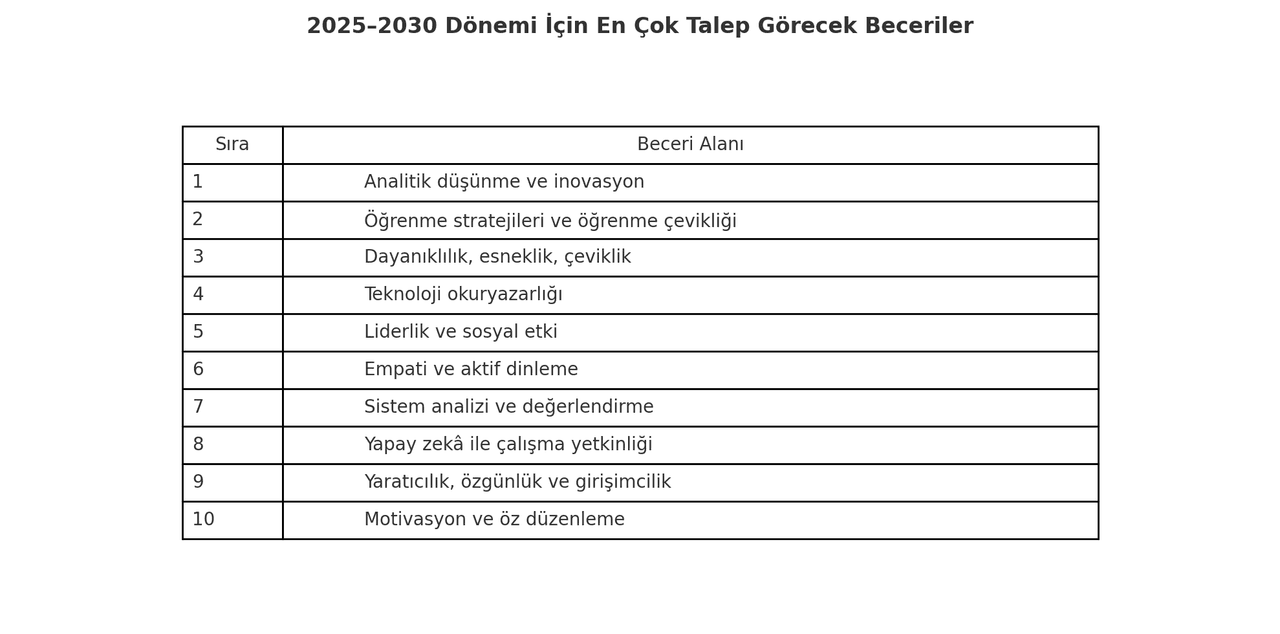
Tabulated with the aid of artificial intelligence.
These skills not only enhance individual employment prospects but also serve as key determinants of organizational transformation capacity.
Conversely, some skills are losing value due to technological progress and widespread automation. In particular, expertise in repetitive routine tasks is increasingly being replaced by artificial intelligence systems. The report highlights declining demand in the following areas:
This trend indicates that individuals must now acquire not only technical but also higher-order cognitive and social skills.
The phenomenon known as “skill instability” is regarded as a key indicator of labor transformation. The report reveals that 44% of employers believe the current skill sets of their workforce will become obsolete within three years. This data makes it imperative to redesign education policies to promote lifelong learning.
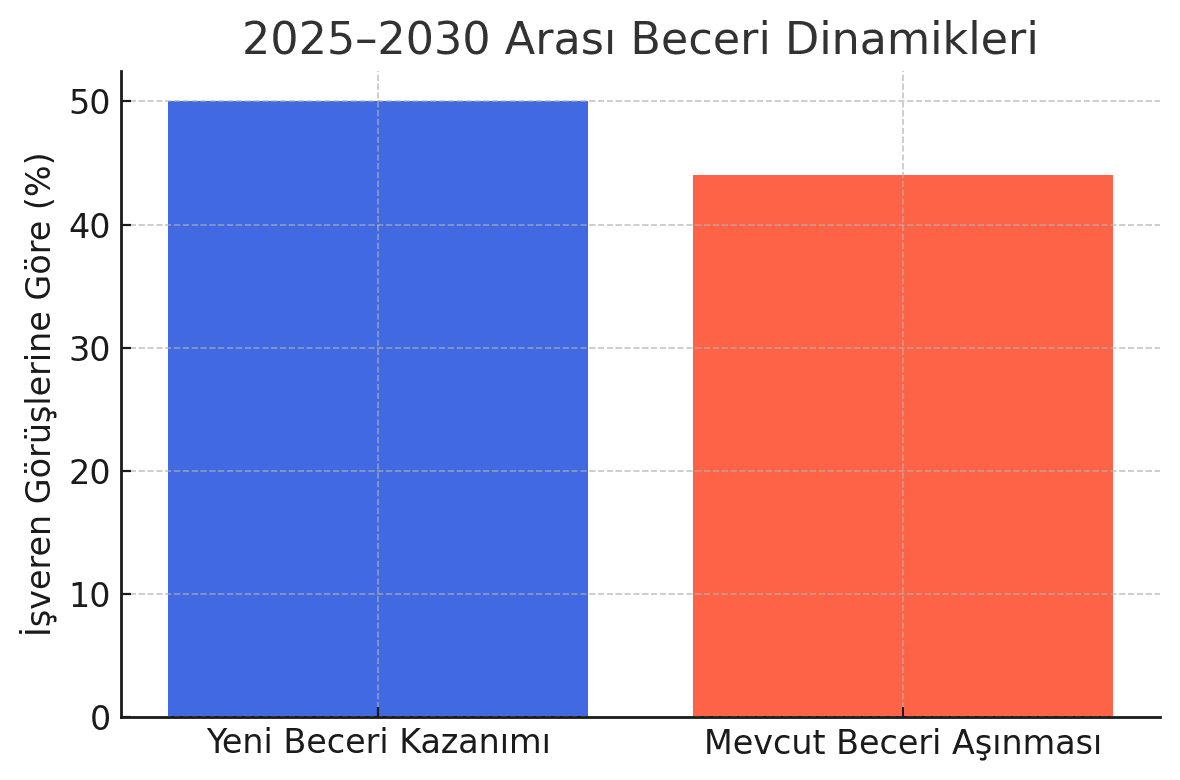
Tabulated with the aid of artificial intelligence.
The findings in this section indicate that future employment policies must shift focus from hiring processes to skill development.
Future of Jobs Report 2025 evaluates employers’ strategic approaches to labor not merely through short-term decisions such as hiring and layoffs, but holistically through long-term structural policies including skill development, diversity, inclusion, and employee well-being.
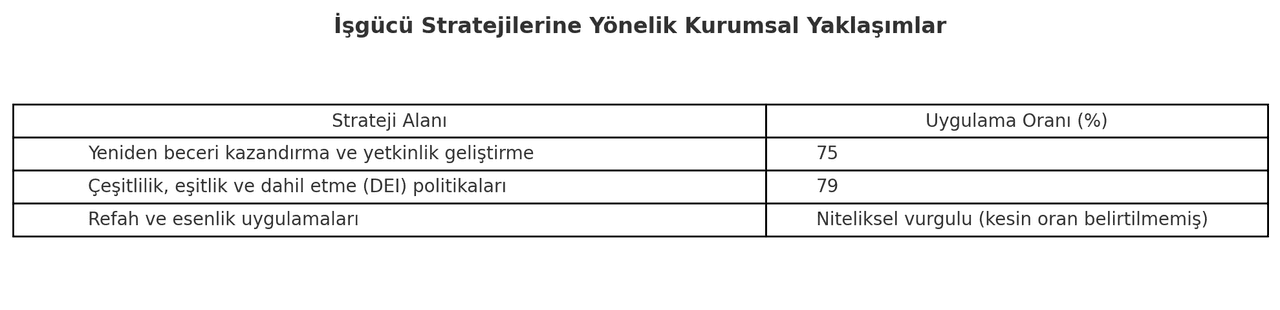
The report focuses on three key strategic areas essential to human capital-driven transformation between 2025 and 2030: reskilling, inclusion policies, and well-being oriented practices.
Tabulated with the aid of artificial intelligence.
Seventy-five percent of employers plan to invest in reskilling and upskilling programs between 2025 and 2030 to meet evolving skill demands.
These strategies are viewed as fundamental tools that strengthen not only individual development but also organizational adaptation capacity. Key reskilling strategies highlighted in the report include:
Employers state that these strategies are functional not only for imparting technical skills but also for enhancing workforce motivation, strengthening employee loyalty, and contributing to cultural transformation.
Another significant strategic area highlighted in the report is the growing adoption of corporate-level inclusion policies. Seventy-nine percent of employers either currently implement or plan to implement diversity and equity-focused strategies. Key focus areas include:
Diversity and inclusion practices are viewed not only as ethical imperatives but also as structures that enhance organizational innovation and enrich decision-making processes.
Another strategic focus rising since the pandemic is employee well-being and psychosocial wellness. Employers emphasize that talent attraction and retention strategies now require more than wage policies—they also require flexible work models, work-life balance practices, and programs supporting emotional resilience. The report draws attention to the following factors directly influencing employee engagement and productivity:
These strategies form the foundational pillars of sustainable corporate models that respond not only to today’s workforce expectations but also shape the design of future labor.
Future of Jobs Report 2025 reveals that human-machine collaboration has become one of the most critical transformation axes shaping the future labor structure. The report emphasizes that automation should not be viewed solely as a threat or job-displacing tool but as a complementary factor that enhances human capabilities and productivity.
According to the report, 75% of employers anticipate significant expansion of automation in their sectors over the next five years. However, this figure indicates a slower pace of automation compared to the 2020 report.
While the 2020 report predicted automation would assume 47% of job tasks by 2025, the 2025 report estimates this share will reach 42% by 2030. This decline reflects employers beginning to structure their technology investments more selectively, needs-based, and in integration with human roles. The job types most susceptible to automation include:
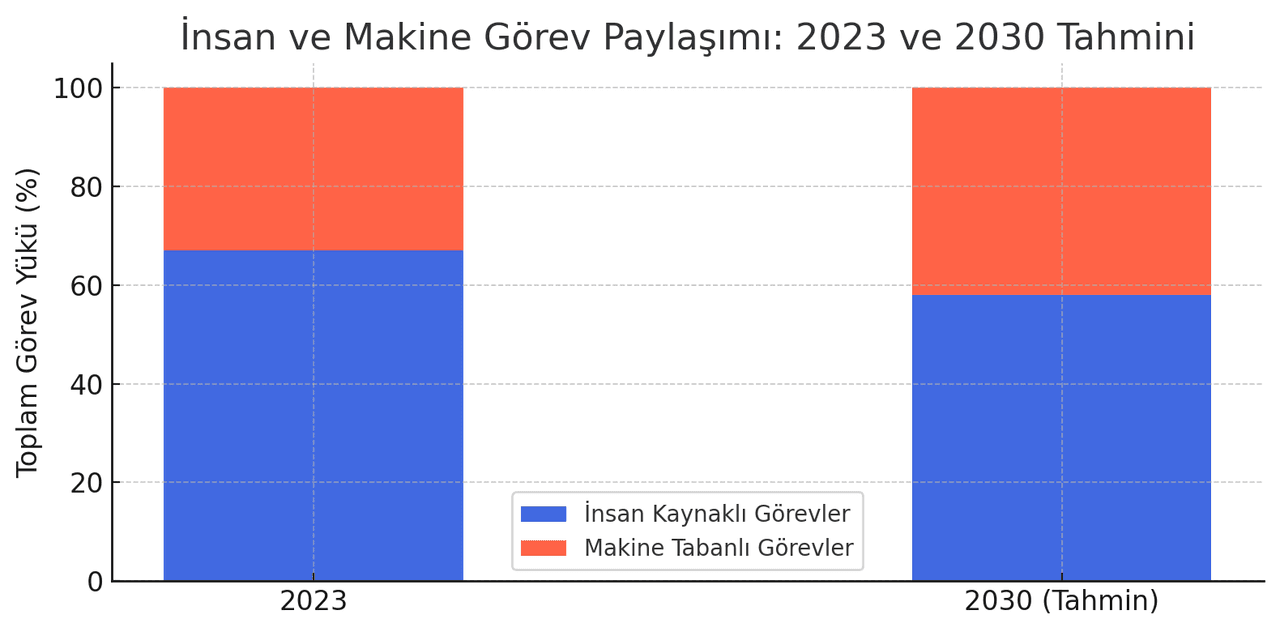
The report highlights the growing prevalence of “hybrid models” in which machines and humans share tasks. As of 2023, human-led tasks accounted for 67% of total workload, while machines handled 33%. By 2030, these proportions are projected to shift to 58% and 42% respectively. This indicates a future in which routine tasks are increasingly automated, while humans assume more central roles in analytical, creative, and interpersonal tasks.
Tabulated with the aid of artificial intelligence.
The above graph visualizes the projected human and machine task-sharing ratios for 2023 and 2030 based on Future of Jobs Report 2025 data. This transformation implies not only increased automation but also the realignment of human skills.
Barriers to the widespread adoption of automation include not only technical but also structural challenges such as organizational resistance and skill gaps. Approximately one-third of employers identify the following key challenges:
In this context, human-machine interaction must be addressed not merely as a technological investment but as a holistic transformation requiring organizational change management, leadership skills, and innovation policies grounded in ethical principles.
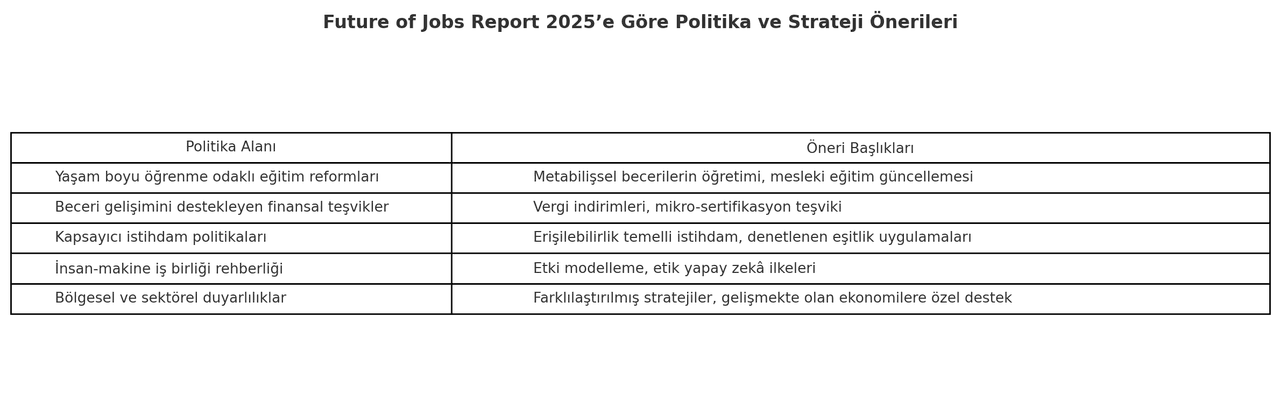
Future of Jobs Report 2025 reveals that global labor markets are entering a multi-dimensional and rapidly evolving transformation process between 2025 and 2030. Macro factors such as technological advancements, climate change, geo-economic fragmentation, and demographic shifts are fundamentally redefining not only which jobs will be performed but also how, by whom, and with which skills they will be carried out.
Tabulated with the aid of artificial intelligence.
These findings offer numerous strategic insights for policymakers and education systems.
These findings not only summarize current trends but also provide a framework for constructive interventions. Future of Jobs Report 2025 clearly demonstrates the need for coordinated and long-term transformation planning among policymakers, employers, educational institutions, and individuals.
World Economic Forum. *The Future of Jobs Report 2025*. Geneva: World Economic Forum, 2025. Accessed April 3, 2025.https://reports.weforum.org/docs/WEF_Future_of_Jobs_Report_2025.pdf

Future of Work Report
Original Name | The Future of Jobs Report 2025 | ||||||||
|---|---|---|---|---|---|---|---|---|---|
Type | Policy document Global analysis report | ||||||||
Prepared by Institution | World Economic Forum | ||||||||
Publication Year | 2025 | ||||||||
Publication Place | Switzerland Cologny/Geneva | ||||||||
Number of Pages | 296 | ||||||||
ISBN | 978-2-940631-90-2 | ||||||||
Language | English | ||||||||
No Discussion Added Yet
Start discussion for "The Future of Work Report (2025)" article
Content and Publication Information
Publication Details
Purpose and Scope
Purpose
Scope
Strategic Significance
Methodology and Participant Profile
Methodological Framework
Participant Profile
Additional Data Layers
Methodological Limitations
Global Labor Market Landscape (2025)
General Overview
Unemployment and Participation Rates
Labor Shortages and Gender Gap
Macro Trends Shaping Labor Transformation
Digitalization and Technological Advancements
Economic Uncertainty and Cost of Living
Green Transition
Demographic Shifts
Geo-economic Fragmentation
Macro Trends Perceived as Most Transformative by Employers
Employment Outlook (2025–2030)
General Assessment
Fastest-Growing Occupations
Fastest-Shrinking Occupations
Net Impact and Strategic Implications
Skills and Competency Trends
Emerging Skill Demand Trends
Declining Skills
Skill Instability and Adaptation Pressure
Labor Strategies and Corporate Approaches
Reskilling and Upskilling
Diversity, Equity, and Inclusion (DEI) Policies
Well-being, Wellness, and Talent Attraction Strategies
Human-Machine Collaboration and Automation Trends
Speed of Automation Development and Impact Areas
Human-Machine Task Sharing
Corporate Challenges in Adopting New Technologies
Report Findings and Policy Recommendations
Summary of Key Findings
Policy and Strategy Recommendations
1. Education Reforms to Promote Lifelong Learning
2. Financial Incentives for Skill Development
3. Inclusive Employment Policies
4. Guidance for Human-Machine Collaboration
5. Regional and Sectoral Sensitivity