


This article was automatically translated from the original Turkish version.
I decided to write this blog post after a brief conversation I had. I am someone who enjoys reading in my free time; therefore, even when I am out, I try to read short snippets whenever I get a chance. While reading something again, a friend approached me and said, “How boring you are—go scroll through some reels instead.”
After hearing this, I carefully observed my surroundings and noticed that both I and other people, whenever we find even the smallest gap in our day, instinctively reach for our phones. Even when we are doing nothing, we tend to check for notifications, messages, or updates from our favorite apps.
Smartphones are no longer merely devices for communication; they have become our shops, cinemas, banks, and unfortunately, our greatest addiction. Data from March 2026 shows that 5.78 billion people worldwide use smartphones. This accounts for 70.1 percent of the global population of approximately 8.25 billion. The number of devices has surpassed the number of users, reaching 7.58 billion.
The most startling finding in the report is that 99.2 percent of smartphone users exhibit symptoms of nomophobia (fear of being without a mobile phone). According to this report, the Philippines leads the world in daily screen time at an average of 5 hours and 47 minutes, while my country, Türkiye, averages 4 hours and 16 minutes—above the global average of 3 hours and 43 minutes.【1】
According to research, parents spend an average of 303.7 minutes (about 5 hours) daily on their smartphones, receive an average of 293.5 notifications per day, and pick up their phones 93.3 times daily. When notifications prompt parents to interact more frequently with their devices, studies have concluded that they experience higher levels of stress【2】.
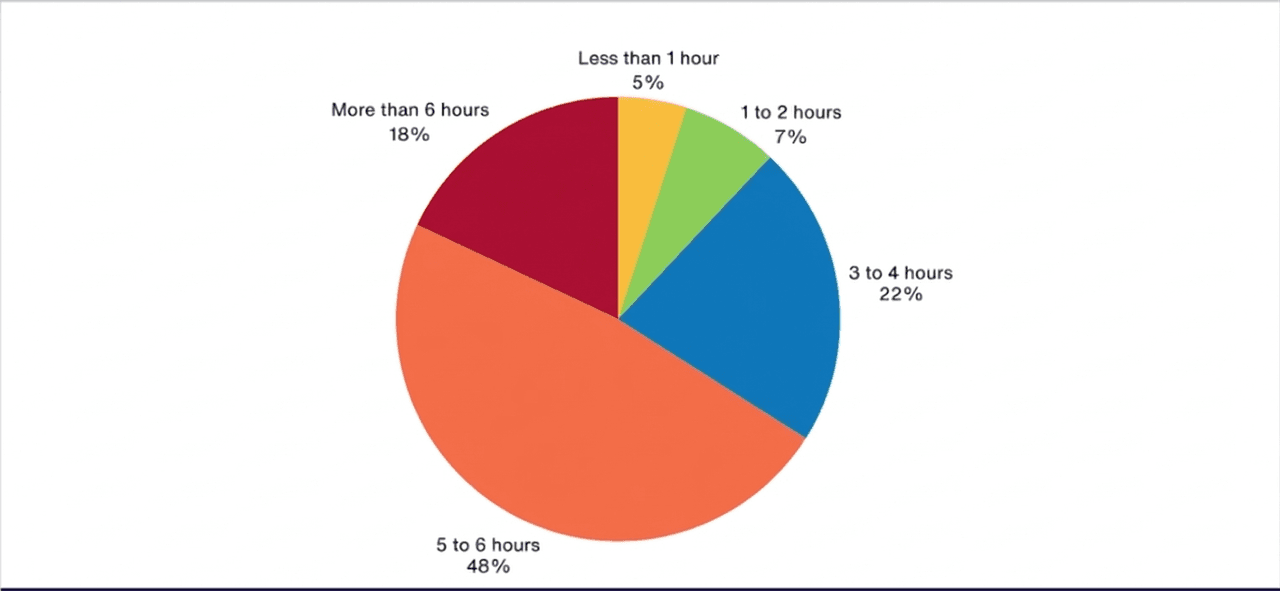
Daily Smartphone Usage in the United States (DemandSage)
Today, the gradual shortening of our attention span is one of the most striking consequences of our relationship with technology. Psychologist Dr. Gloria Mark from the University of California noted in a podcast that while the average attention span on any screen was two and a half minutes in 2004, it has now declined to an average of 47 seconds (40 seconds as the median). Podcast’s most compelling point for me was this: “We are talking about access to the world’s largest candy store and wanting to sample every single product. You can speed up the podcast to consume more and quickly move to your next favorite podcast.” Constantly and rapidly shifting our attention between different activities, as measured by heart rate monitors, increases stress and reduces performance while increasing error rates due to the “transition cost” of refocusing. To break this exhausting cycle, it is crucial to pause not at random moments but at natural stopping points—“break points”—and to recognize that accumulated sleep debt shortens attention span, making adequate sleep essential. Beyond individual efforts, laws such as the “right to disconnect” being implemented in countries like France and Ireland offer a societal solution by allowing workers to disengage from electronic communication outside working hours, enabling mental renewal.【3】
Every time we consume a short-term digital stimulus, we are essentially subtracting a little from the pleasure we will experience in the future. Dr. Anna Lembke explains this phenomenon through the concept of anhedonia, framing it as a pleasure-pain balance. Each dose of dopamine pushes the scale toward pleasure. However, because our brains strive to maintain balance (homeostasis), they counteract by pulling the scale back toward pain.
To maintain equilibrium, the brain reduces the availability of dopamine receptors. This creates a process known as dopamine down-regulation, which represents the “pain” side. Literally, as the number of active dopamine receptors decreases, our brains become less sensitive to pleasure.
This leads to anhedonia (the inability to experience pleasure). Anhedonia then compels individuals to repeatedly return to the same behaviors, as the brain seeks to regain the pleasure it once associated with those actions.【4】
Rewards from effortful behaviors—such as exercising, learning, creative activities, or building social connections—produce a slower but more sustained increase in dopamine. The subsequent drop is also milder.
In contrast, low-effort digital rewards like scrolling or watching videos trigger faster and more aggressive dopamine spikes. The crashes that follow are sharper and intensify the dull, empty feeling that comes afterward.
Each repetition strengthens this reinforcement cycle:
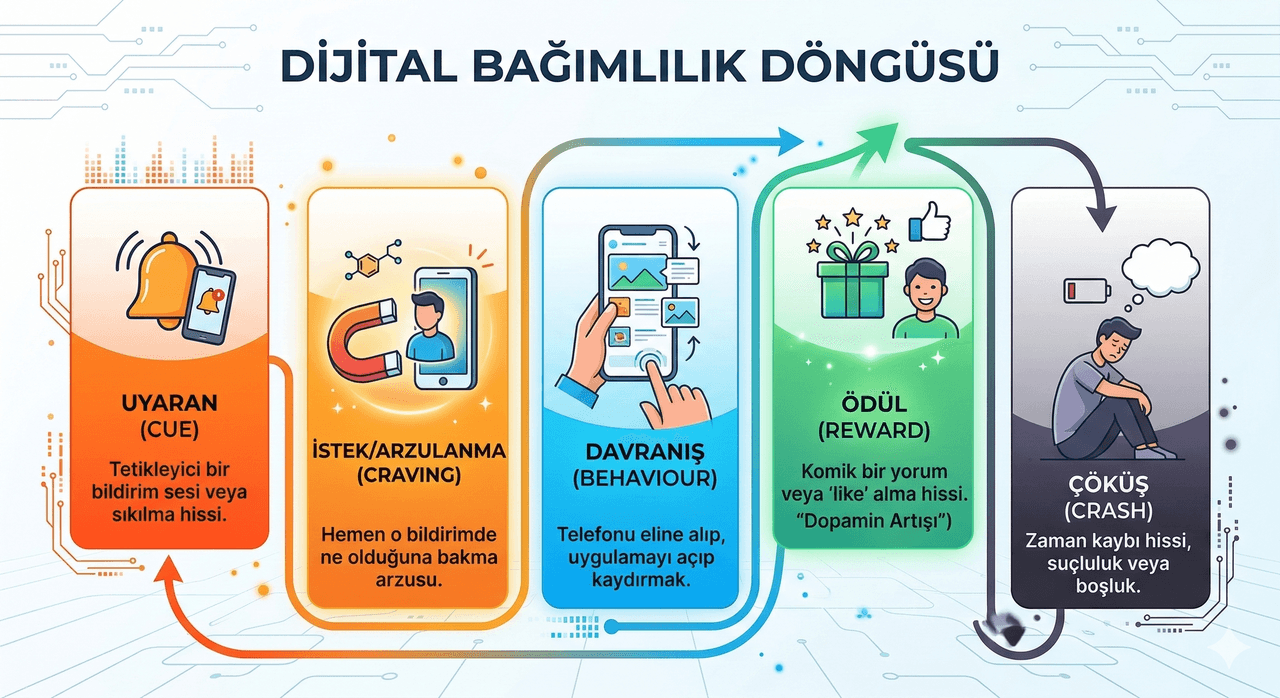
Addiction Cycle Template (Generated by YZ)
In a study on addiction, rats given prolonged access to cocaine chose cocaine over food and water, continuing to do so even until death from starvation【5】. The dopamine deficiency has become so severe that behaviors essential for survival no longer produce sufficient feelings of reward.
This situation closely resembles certain modern addictions, particularly smartphone addiction. As a result, our capacity for interest and motivation is collapsing before our eyes.
I believe a post I saw on Twitter (X) is exceptionally sincere and realistic, especially point number five. Today’s widespread social media addiction profoundly influences our thoughts, desires, and perspectives. Perhaps you have noticed people around you—think of Buzz Lightyear from Toy Story memes—who are indistinguishable from one another, holding clichéd opinions and devoid of individuality.
I believe we must establish our own boundaries to solve this problem. By boundaries, I mean digital hygiene. We must pay attention to the content we consume and be aware of its impact on us—in short, cultivate a critical mindset. I have not yet had the chance to read Jenny Odell’s book, recommended in point 16 of the post, but I found a YouTube talk by her. I recommend watching it.
Instead of reaching for your phone to relieve momentary boredom, try resisting your mind’s impulse to seek easy distractions. Put aside the habit of staring at screens while eating, focus on that unfinished book, or step outside for a simple walk. These real-world actions requiring effort may not initially deliver the rapid dopamine spikes you are used to. But consciously resisting this unhealthy reward mechanism of the digital world and persistently maintaining this effort over time enables us to transform our entrenched habits into healthier patterns. Research shows that maintaining this discipline without interruption for 60 days is sufficient to break the unhealthy neural pathways in our brains and build entirely new, healthier ones【6】. Although we may miss those artificial dopamine spikes at first, overcoming this process will free us from unproductive activities and reconnect us with our authentic selves.
Demand Sage. "Smartphone Usage Statistics 2026 (Worldwide Data)." Demand Sage, 2026. Accessed April 8, 2026. https://www.demandsage.com/smartphone-usage-statistics/
Dopamine Nation: Finding Balance in the Age of Indulgence. New York: Dutton, 2021 Accessed April 8, 2026.
Lally, Philippa, Cornelia H. M. van Jaarsveld, Henry W. W. Potts, and Jane Wardle. "How Are Habits Formed: Modelling Habit Formation in the Real World." European Journal of Social Psychology 40, no. 6 (2010): 998-1009. Accessed April 8, 2026. https://onlinelibrary.wiley.com/doi/10.1002/ejsp.674
Mark, Gloria. "Speaking of Psychology: Why Our Attention Spans Are Shrinking, with Gloria Mark, PhD." Interview with Kim Mills. American Psychological Association, 2023. Accessed April 8, 2026. https://www.apa.org/news/podcasts/speaking-of-psychology/attention-spans
Oleson, Erik B., and David C. S. Roberts. "Cocaine Self-Administration in Rats: Threshold Procedures." Methods in Molecular Biology 829 (2012): 303-319. Accessed April 8, 2026. https://pubmed.ncbi.nlm.nih.gov/22231823/
Tiffany G. Munzer, Alison L. Miller. "Greater mobile device-prompted phone pickups are associated with daily parent stress." 2024 Aug;113(8):1868-1875. Accessed April 8, 2026. https://pubmed.ncbi.nlm.nih.gov/38698532/
[1]
Demand Sage. "Smartphone Usage Statistics 2026 (Worldwide Data)." Demand Sage, 2026. Erişim tarihi: 8 Nisan 2026.
[2]
Tiffany G. Munzer, Alison L Miller "Greater mobile device-prompted phone pickups are associated with daily parent stress" 2024 Aug;113(8):1868-1875 Erişim tarihi: 8 Nisan 2026.
[3]
Mark, Gloria. "Speaking of Psychology: Why Our Attention Spans Are Shrinking, with Gloria Mark, PhD." Interview with Kim Mills. American Psychological Association, 2023. Erişim tarihi: 8 Nisan 2026.
https://www.apa.org/news/podcasts/speaking-of-psychology/attention-spans
[4]
Dopamine Nation: Finding Balance in the Age of Indulgence. New York: Dutton, 2021 Erişim tarihi: 8 Nisan 2026.
[5]
Oleson, Erik B. ve David C. S. Roberts. "Cocaine Self-Administration in Rats: Threshold Procedures." Methods in Molecular Biology 829 (2012): 303-319. Erişim tarihi: 8 Nisan 2026.
[6]
Lally, Phillippa, Cornelia H. M. van Jaarsveld, Henry W. W. Potts ve Jane Wardle. "How Are Habits Formed: Modelling Habit Formation in the Real World." European Journal of Social Psychology 40, no. 6 (2010): 998-1009. Erişim tarihi: 8 Nisan 2026.
Smartphone Addiction by the Numbers
The Focus Crisis and Our Ever-Shrinking Attention Span
The Pleasure-Pain Balance: How Dopamine Controls Us
Digital Rewards and the Downward Cycle
The Dark Side of Addiction and Digital Hygiene
Conclusion
