

This article is not approved yet.
+1 More
“The Brutalist”: Rethinking Modernist Architecture through Exile and Capitalism
Title(s) | The Brutalist | ||||||||
|---|---|---|---|---|---|---|---|---|---|
Screenplay(s) | Brady Corbet | ||||||||
Release Date(s)(Text) | 31 January 2025 | ||||||||
Language(s) | English | ||||||||
Director(s) | Brady Corbet | ||||||||
Cast(s) | Adrien Brody Stacy Martin. Raffey Cassidy Joe Alwyn Guy Pearce Felicity Jones | ||||||||
Genre | Drama | ||||||||
Production | UNITED INTERNATIONAL PICTURES | ||||||||
Running Time | 215 minutes | ||||||||
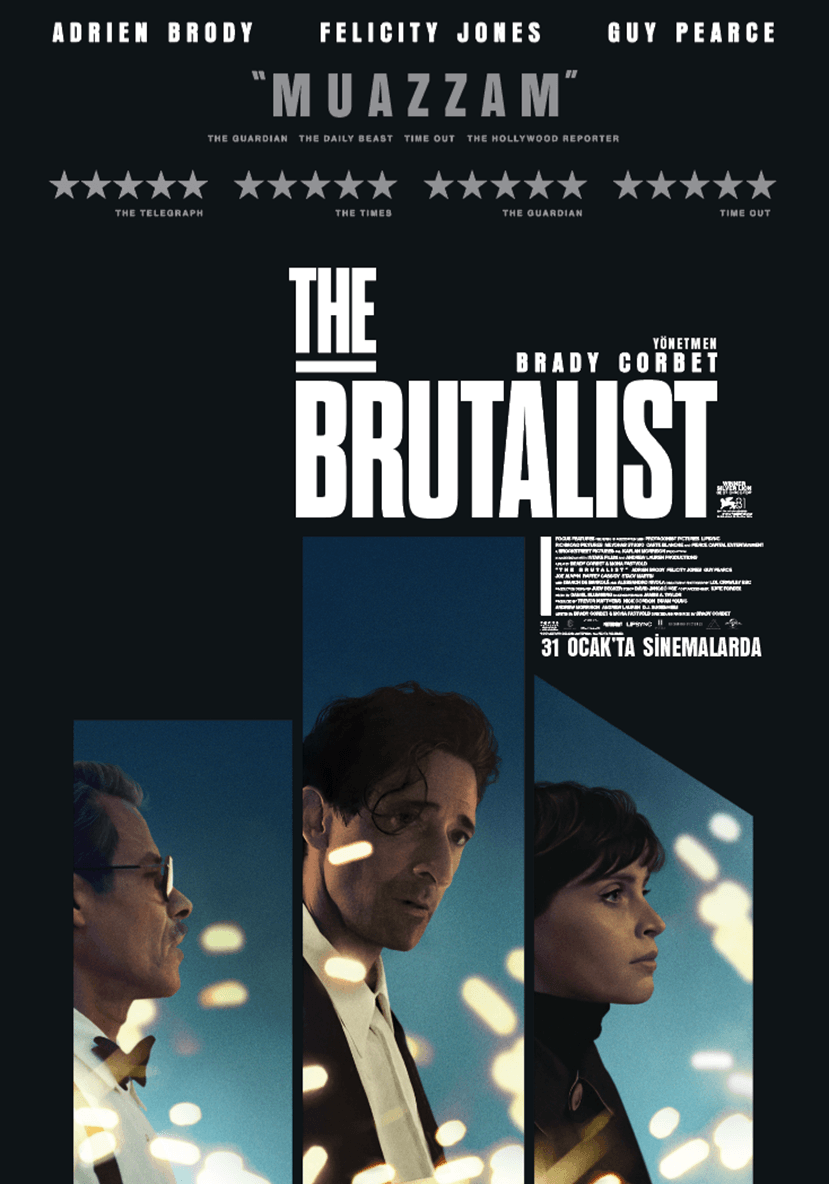
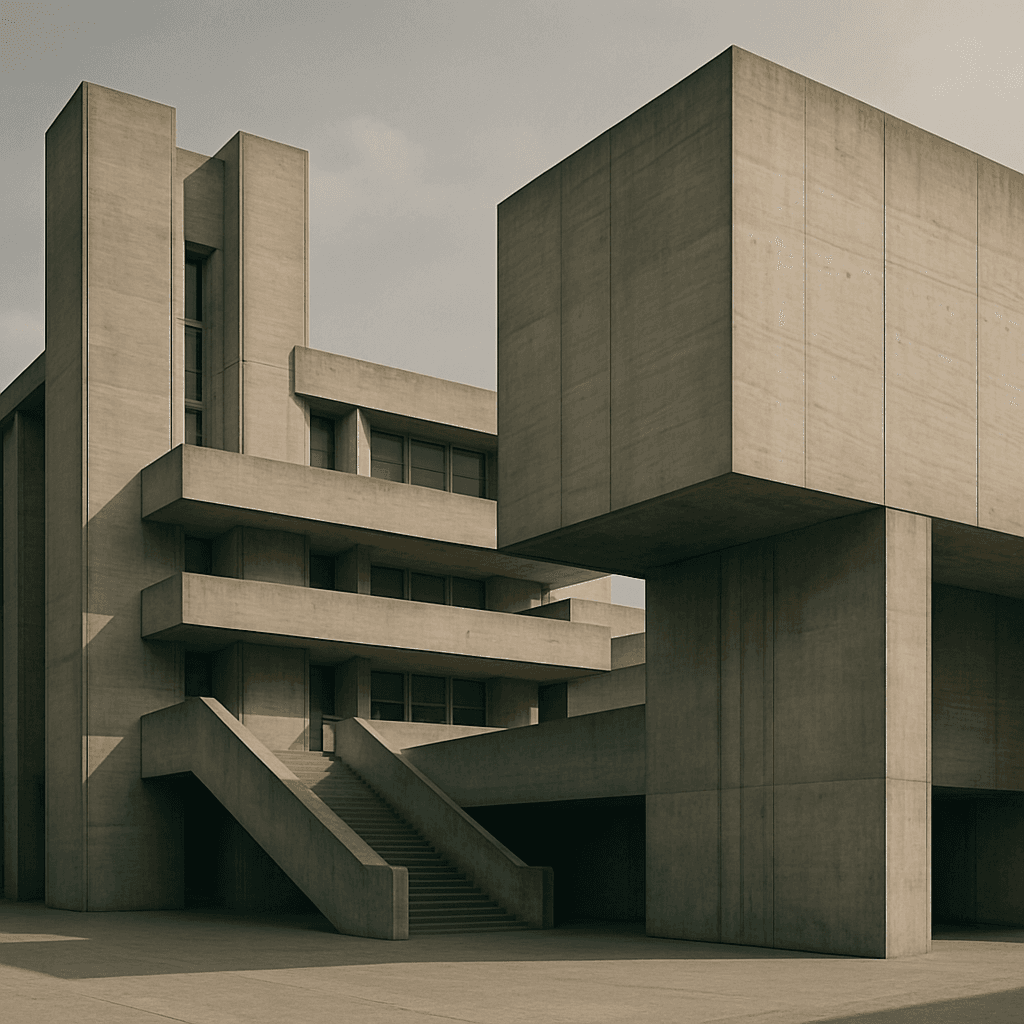
A review of The Brutalist (film), directed by Brady Corbet, 2024, which delves into the intricate relationship between modernist architecture and exile. The film centers on the fictional story of László Tóth, a Jewish architect from the Bauhaus school who experiences exile in post-Holocaust America. The film takes place within a context shaped by capitalist structures and cultural displacement and explores how modernist ideals are reshaped in response to these new socio-political and economic conditions. While the narrative emphasizes the individual struggles of an architect caught between artistic vision and patronage pressures, it diverges from historical realities by overlooking the collective and often institutionally supported experiences of real Bauhaus-trained architects who relocated to the United States. Through a critical analysis of both the film’s narrative construction and its visual language, this review questions the historical simplifications it presents, while also acknowledging its compelling cinematic portrayal of the tensions between architecture, memory, and capitalist power. The Brutalist invites a reconsideration of modernist architecture not just as a formal style, but as a site of contested identity, ideology, and representation.
The Brutalist, Modernism, Exile, Capitalism, Architectural History, Bauhaus.
Brady Corbet’s 2024 film The Brutalist is a striking and multi-layered cinematic work that explores the complex relationship between modernist architecture and exile. Visually compelling, the film engages this theme not only through its narrative content but also through its cinematic language. However, the film’s treatment of the Bauhaus architect’s modernist transformation in America as an individual drama raises questions about its impact on the collective structure of modern architecture.
Although modern architecture is often perceived as the result of individual creativity, its origins and development are essentially collective, as David Leatherbarrow notes: "Modern architecture was not 'spoken into the void,' even if Adolf Loos, who published essays under this title, said things and invented configurations that had not been said or seen before. Only by accepting the idea that modern projects adhered to inherited conditions as much as they rejected them can we understand why Loos admitted, 'I am a modern architect because I build in the manner of the ancient Viennese'" (Leatherbarrow, 2017, p. 1).
This perspective emphasizes that modern architecture is not only shaped as the innovation of isolated individuals, but also by collective efforts and historical continuities. While the collective nature of modernist architecture was shaped in this way, the challenges faced by the exile architects transformed this structure.
The film, however, constructs a narrative in which László, the protagonist, becomes trapped in a system of individual patronage, thereby sidelining the collective ethos of modernist architecture. László in The Brutalist, as an architect trapped in a system of individual patronage, stands out as a narrative that ignores the collective structure inherent in modernist architecture.
The film centers on the exile of László Tóth, a Jewish architect from the Bauhaus school to America after the Holocaust, where he struggles for both artistic and personal existence. While tracing László’s architectural practice and the transformation of modernism in this new geography, the film also reveals his search for identity as an exiled figure.
In his work Modern und Exil, Bernd Nicolai emphasizes that modernist architects' efforts to preserve their modernist principles in different geographies after exile inevitably clashed with the new social and economic context in which they found themselves. Nicolai makes the following statements while describing the exile experiences of modernist architects: “The condition of exile can be seen as a decisive factor in overcoming the ‘Weiße Moderne’ in the context of European modernity.” (Nicolai, 2009, p. 16).
This statement highlights the transformative effect of exile on modernist architecture and draws attention to the fragility of European modernity in the process of adaptation in other geographies. The concept of Weiße Moderne represents the Eurocentric, pure, aesthetic and rational aspects of modernism. According to Nicolai, when this understanding of modernity was transferred to other regions, it could not be preserved in its original form due to the social, cultural and climatic conditions of the host countries, and was inevitably transformed.
In this context, exile modernism struggled to preserve its ideals while adapting to new contexts. Some modernist architects who migrated to America, such as Walter Gropius, developed new forms of modernism adapted to local cultural codes, adopting Kenneth Frampton's concept of “critical regionalism” (Nicolai, 2009, p. 16). Therefore, the experience of exile should be considered not only as a process of conflict but also as a process of adaptation and transformation in modernist architecture.
In the film, László is portrayed as an exiled architect who strives to protect his artistic authenticity while also conforming to the structural and economic demands of American capitalism. Yet an important contrast becomes apparent here: whereas Bauhaus-trained figures like Walter Gropius and Mies van der Rohe established prestigious academic positions or successful architectural practices after their arrival in the U.S., The Brutalist presents László as a character trapped within an individualized system of patronage. This may seem to reduce the history of modernist architecture to an individual tragedy and may be considered as a departure from historical accuracy.
Łukasz Stanek notes: “Despite circulating within state-socialist networks, few among those architects identified with Cold War confrontations. Rather than exporters of the socialist path of development, they saw themselves as members of one world of the international culture of modern architecture.” (Stanek, 2020, p. 31). This statement reveals that architects who were displaced or migrated did not see themselves only as political or ideological representatives, but also as active members of the global culture of modernism. This historical perspective notably contrasts with the way László is depicted in The Brutalist, who is trapped in a system of individual isolation and patronage.
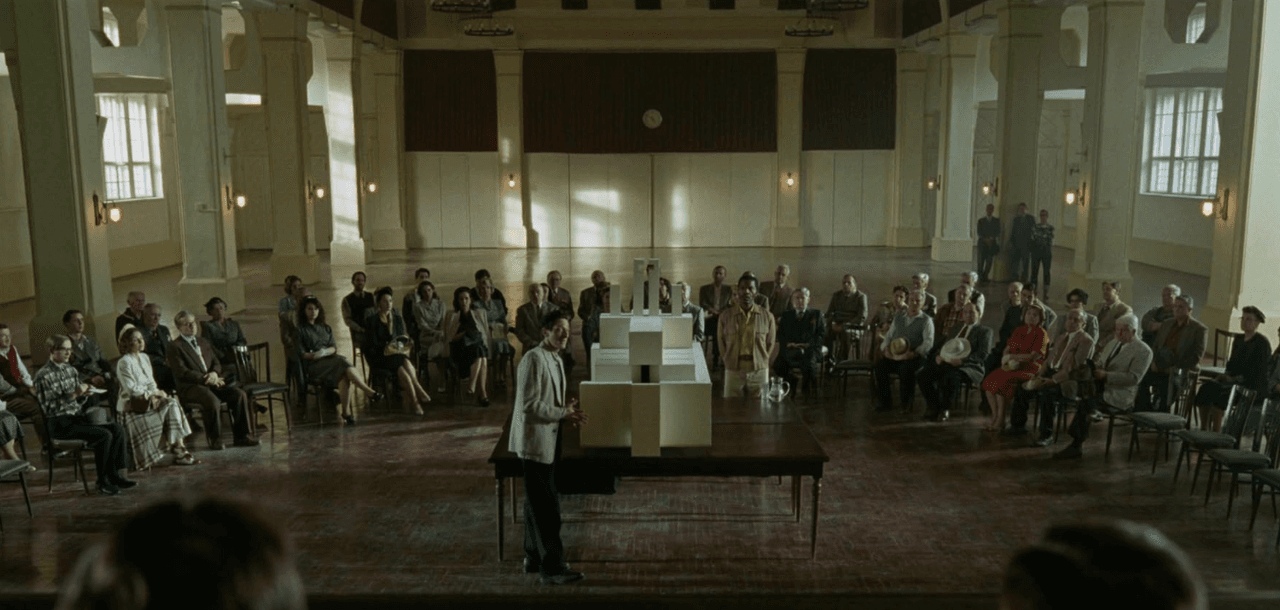
This is especially tangible in one of the film’s most visually charged scenes, where László presents his architectural model to a patronage jury. Standing alone in a large space, László appears physically and symbolically dwarfed by the environment, reinforcing the film’s critique of how architectural ideals are constrained by capitalist hierarchies (figure 1).
Director Brady Corbet has stated that he was inspired by brutalist and modernist architects such as Marcel Breuer, Paul Rudolph, Louis Kahn and Ludwig Mies van der Rohe while creating the character of László. However, this inspiration brings certain inconsistencies. While the film visually references the monumental power of Brutalist and modernist architecture, it overlooks the professional realities these architects experienced in America. In the historical context, such figures were not confined by individual patronage but became part of collective and institutional success stories.
In this context, Corbet's reduction of the story to an individual tragedy, which deviates from historical reality despite being inspired by architectural figures, creates an important disconnect in the film's narrative. By isolating László from the broader historical context of postwar architectural migration, the film undermines the collaborative and internationally supported realities of many displaced modernists.
Brady Corbet's directorial approach creates an aesthetic that deepens the atmosphere of the film while expressing the fragile structure of modernism through a visual language. The division of the film into two main sections is a choice that strengthens the dramatic structure of the narrative. While the first part deals with László's first arrival in America, his hopeful beginnings and idealistic approach, the second part reveals the disappointments that come after thirty years and the erosion of modernist ideals over time.
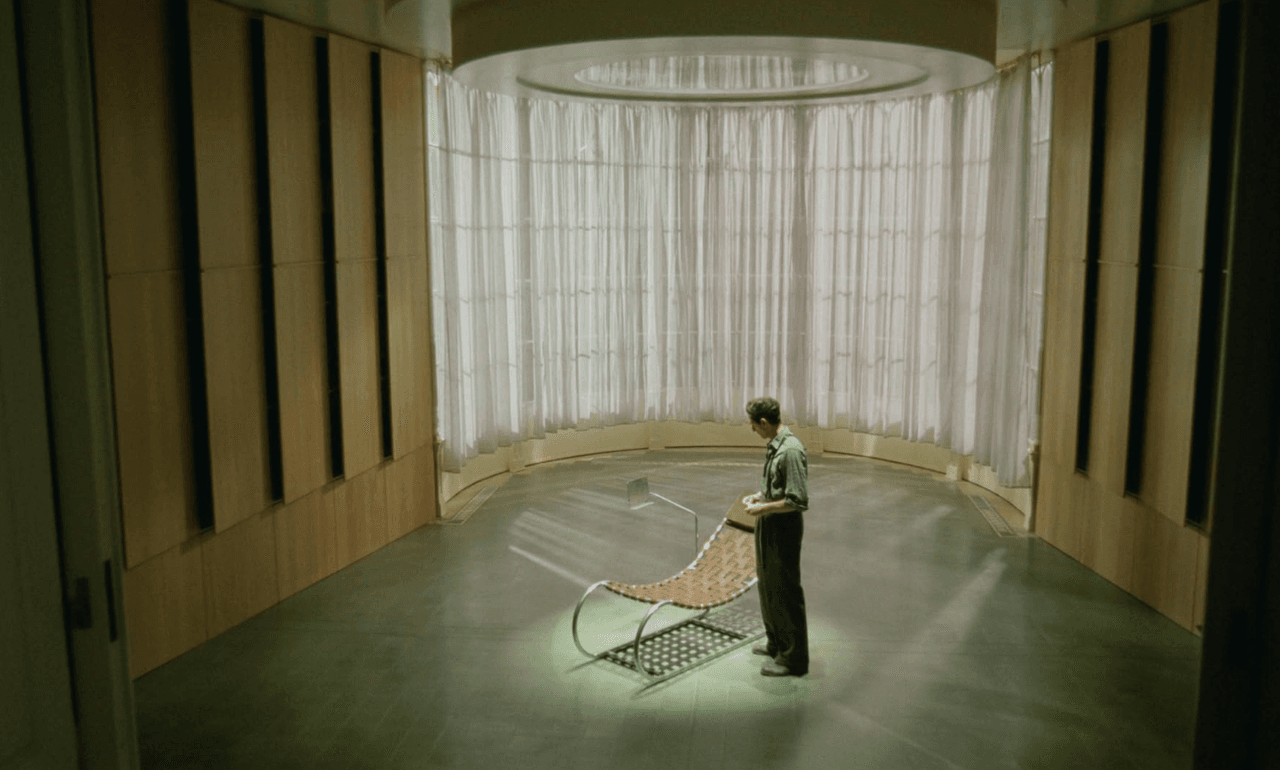
Corbet makes the transition between these two periods evident not only narratively but also visually. The brighter, wide-angle shots, used in the first part, reflect the sense of freedom and new beginnings that America promises. The creative processes involved in the creation of László's architectural projects are supported by wide frames, emphasizing the libertarian nature of architectural practice. The bright lighting and the play of natural light used in this section visually evokes László's dreams and the purity of the modernist aesthetic.
This aesthetic is most powerfully embodied in a key moment when László stands in the middle of the library he has designed for his first client Van Buren—an open, luminous space filled with natural light (Figure 2). The harmony of light and form not only reflects modernist values of clarity and rationality but also symbolizes the ideological optimism of his architectural philosophy.
However, the visual tone shifts markedly in the second half. The staging becomes darker, the use of space more cramped and narrower. This visual transformation mirrors the ruptures in László’s life and reflects the pressures that capitalist systems impose on individual architectural expression. These darker tones are not only an aesthetic choice, but also a visual strategy that critically reflects how the idealistic discourses of modernism have become fragile in the face of capitalist reality.
The use of space also reflects the fragile nature of modernism. While the modernist buildings designed by László were spacious and open, evoking a sense of collective purpose, Van Buren’s buildings appear congested, ostentatious, and visually overwhelming. This contrast visualizes the tension between modernist architecture's sense of collective production and the capitalist patronage system's quest for individual prestige.
Corbet’s use of long plan sequences and static camera movements reflect the depth of the narrative and the inner conflicts of the characters. These choices establish a visual parallel with the strong and distinct structural arrangements of modern architecture. The close-up shots used to capture his emotional solitude underscore that architecture, in this film, is not merely the production of space but also the representation of existential struggle.
The use of music in the film also supports the narrative structure. In the first part, classical music is used as a reference to the artistic ideals of modernism, while in the second part, more gloomy and industrial sounds make one feel the pressure created by the capitalist order. This musical transition serves not only as a background element but also as a component that complements the thematic structure of the film.
Corbet’s careful use of visual and spatial language does more than showcase a stylistic preference, it critiques an era. His cinematographic choices elevate the narrative by interpreting modernism not solely as an aesthetic movement, but as a political and social battleground. In this sense, the film becomes a layered reflection of the tension between architectural idealism and its eventual compromise within capitalist frameworks.
The Brutalist discusses the fragility of modern architecture within the capitalist system not only through individual stories, but also through the way architecture is represented, the relations of production, and the social meaning of buildings. As László's architectural practice is caught between aesthetic ideals and the demands of capital, this conflict can be read not only as a conflict of characters, but also as a symbol of the transformation of modernist architecture within a historical framework. In the film, this transformation is conveyed to the viewer not only at the narrative level, but also through forms of visual representation: the presentation of architecture, the movement of the camera over the buildings and the lighting of the spaces become strategies that directly reflect the interventions of the capitalist system on aesthetics.
In The Brutalist, the impact of capitalism on architecture is portrayed not only as an external pressure that restricts creative freedom, but also as a mechanism that transforms the meaning of the architectural product. The function of László's designs moves gradually away from producing public utility and becomes an “object of prestige”. This is related to the Bauhaus notion of collective production and social utility being replaced by symbolic value determined by capital. The transformation of architecture into a status indicator rather than a means of communication means the evisceration of the basic principles of modernism, and in this context, the community center project, which is a striking narrative element in the film, is noteworthy. László's project, inspired by concentration camp architecture, raises ethical questions about the architectural re-representation of a traumatic past. Considering that architecture is not only a formal aesthetic production, but also a practice that bears responsibility for memory, history and representation, this choice becomes problematic. Corbet's dramatic choice to reproduce the architectural memory of the Holocaust as an element of fiction can be considered as an approach far from a sense of historical responsibility.
The film also interrogates how architecture is perceived and used as an instrument of ideological control. Van Buren's desire to establish social power and control through buildings underlines the function of architecture as an ideological tool. In this context, László's oppression marks a transformation that affects not only his economic but also his professional position: the architect is transformed from a creative thinker and decision-maker into a practitioner who mostly serves the expectations of the investor. The clash between László's desire for independent production and capital-backed institutional expectations opens a tense space between the individual and institutional identities of modern architecture. This conflict is captured vividly in a confrontation scene between László and Van Buren.
Therefore, The Brutalist constructs a multilayered narrative that addresses not only the aesthetic and economic dimensions of architectural production but also its social positioning and representational politics. It prompts a rethinking of modernist architecture beyond style, toward its ethical and societal implications under shifting ideological regimes.
As discussed at the beginning, the tension between collective modernism and individual representation, emerges as a thematic structure that spreads throughout the film. While The Brutalist addresses the historical and ideological layers of modernist architecture through an exile narrative, it poses various questions about how this architecture has transformed in the capitalist context. Through the experience of an individual architect, the film makes visible the tensions between the collective production ideals of modernism and capital relations.
Although this narrative sometimes strays from historical reality, it manages to create a powerful atmosphere with its cinematographic choices and encourages the rethinking of architecture not only as a formal production area but also as a field of identity, memory, and representation. In particular, the visual narrative language and spatial strategies are among the important elements that support the emotional depth of the themes in the film.
In this context, The Brutalist can be evaluated as a production that opens up space for rethinking the social, political, and aesthetic dimensions of architecture rather than presenting a singular and absolute narrative about the history of architecture. Despite its shortcomings, the film provides a rich basis for discussion on the representation of modernist architecture in different contexts.
Leatherbarrow, David. Architecture Oriented Otherwise. New York: Princeton Architectural Press, 2017.
Nicolai, Bernd. “Modern und Exil: Architektur und Raumproduktion im Kontext von Migration und Emigration.” In Exil, Forschung, Perspektiven, edited by Claus-Dieter Krohn, Patrik von zur Mühlen, and Jutta Dick, 15–28. München: edition text + kritik, 2009.
Stanek, Łukasz. Architecture in Global Socialism: Eastern Europe, West Africa, and the Middle East in the Cold War. Princeton: Princeton University Press, 2020.
Leatherbarrow, David. Architecture Oriented Otherwise. New York: Princeton Architectural Press, 2017.
Nicolai, Bernd. “Modern und Exil: Architektur und Raumproduktion im Kontext von Migration und Emigration.” In Exil, Forschung, Perspektiven, edited by Claus-Dieter Krohn, Patrik von zur Mühlen, and Jutta Dick, 15–28. München: edition text + kritik, 2009.
Stanek, Łukasz. Architecture in Global Socialism: Eastern Europe, West Africa, and the Middle East in the Cold War. Princeton: Princeton University Press, 2020.

“The Brutalist”: Rethinking Modernist Architecture through Exile and Capitalism
Title(s) | The Brutalist | ||||||||
|---|---|---|---|---|---|---|---|---|---|
Screenplay(s) | Brady Corbet | ||||||||
Release Date(s)(Text) | 31 January 2025 | ||||||||
Language(s) | English | ||||||||
Director(s) | Brady Corbet | ||||||||
Cast(s) | Adrien Brody Stacy Martin. Raffey Cassidy Joe Alwyn Guy Pearce Felicity Jones | ||||||||
Genre | Drama | ||||||||
Production | UNITED INTERNATIONAL PICTURES | ||||||||
Running Time | 215 minutes | ||||||||
No Discussion Added Yet
Start discussion for "The Brutalist: Rethinking Modernist Architecture through Exile and Capitalism" article
“The Brutalist”: Rethinking Modernist Architecture through Exile and Capitalism
Abstract
Keywords
Introduction
Exile and Architectural Identity
Visual and Spatial Language
Modernism and Capitalism
Conclusion
References
This article was created with the support of artificial intelligence.