


This article was automatically translated from the original Turkish version.

Testing Effect – The Power of Learning Through Testing
Defining | Roediger & Karpicke | ||||||||
|---|---|---|---|---|---|---|---|---|---|
Year(s) | 2006 | ||||||||
Key Concept | Retrieval, Long-term Memory | ||||||||
Application Area(s) | Education Exam Preparation Language Learning | ||||||||
Testing Effect is a cognitive phenomenon indicating that individuals achieve more durable and deeper learning by actively retrieving information through testing, compared to merely reading or engaging in passive review. This effect demonstrates that the practice of retrieval during learning strengthens the retention of information in long-term memory.
The concept of the Testing Effect was first proposed in the early 20th century by psychologist Edward L. Thorndike and later systematically investigated by Henry L. Roediger and Jeffrey D. Karpicke. In experiments conducted by Roediger and Karpicke in 2006, it was shown that the Testing Effect not only enhances recall of learned material but also improves the overall quality of learning.
The Testing Effect operates through the process of retrieval, which involves re-accessing stored information. During retrieval, information is not merely encoded into memory but is repeatedly recalled, thereby strengthening synaptic pathways in the brain. While passive review aids short-term recall, active testing reinforces long-term memory.
The direct strengthening of learning through the act of testing itself. For example, when information is tested, learning is immediately enhanced.
The improved focus in subsequent review that occurs when individuals identify gaps in their knowledge after being tested.
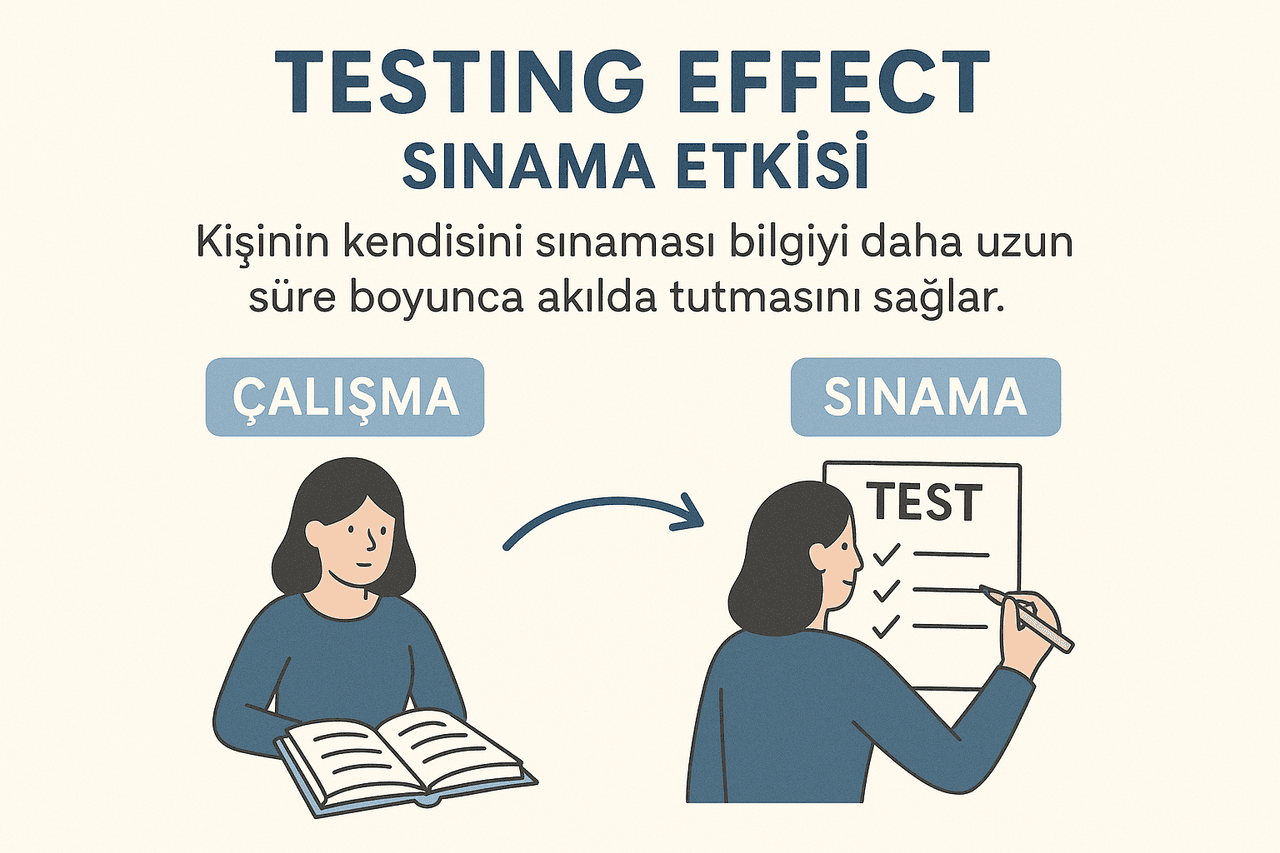
(Generated by Artificial Intelligence.)
In Roediger and Karpicke’s experiment, two groups of students were given a text to read. One group was allowed to reread the text, while the other group was tested on it. In the long term, the group that was tested demonstrated significantly higher recall of the text than the group that had merely reread it.
Some researchers have noted that the Testing Effect does not operate equally across all types of information. In particular, the learning of abstract and conceptual material through testing may show limited effectiveness in certain cases. Additionally, the anxiety induced by testing may produce counterproductive effects in some individuals.

Testing Effect – The Power of Learning Through Testing
Defining | Roediger & Karpicke | ||||||||
|---|---|---|---|---|---|---|---|---|---|
Year(s) | 2006 | ||||||||
Key Concept | Retrieval, Long-term Memory | ||||||||
Application Area(s) | Education Exam Preparation Language Learning | ||||||||
No Discussion Added Yet
Start discussion for "Testing Effect (Sınama Etkisi)" article
History and Theoretical Foundations
Mechanism of the Effect
Types of Testing Effect
Direct Effect
Indirect Effect
Experimental Evidence
Applications of the Testing Effect in Education
Testing Effect and Memory
Criticisms and Limitations
Testing Effect in Everyday Life