


This article was automatically translated from the original Turkish version.
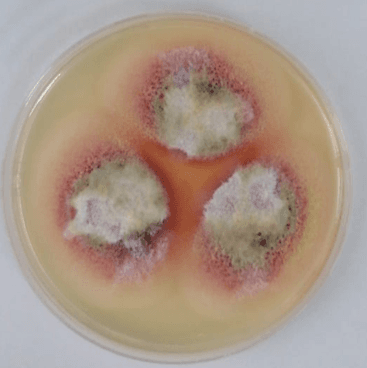
Talaromyces Purpurogenus (Pınar Güner)
Scientific Name(s) | Spierenburg & Seifert Houbraken Yilmaz Talaromyces purpurogenus (S. Abe) Samson | ||||||||
|---|---|---|---|---|---|---|---|---|---|
Synonyms | Penicillium purpurogenum S. Abe | ||||||||
Class | Eurotiomycetes | ||||||||
Habitat | Soil Stored foods Plant residues Grains | ||||||||
Pigment Types | Azaphilone derivatives, Purpurogenin, Rubropunktatin | ||||||||
Metabolite Characteristics | Antimicrobial, Antioxidant, Anticancer | ||||||||
Talaromyces purpurogenus is a filamentous mold belonging to the phylum Ascomycota, class Eurotiomycetes, and family Trichocomaceae. This species was first isolated in 1901 and named “purpurogenus” (purple-producing) due to its production of purplish-red pigments. This fungus exhibits broad ecological tolerance and is frequently isolated from soil, air, plant material, and food products. Its capacity for natural pigment production has attracted particular attention in biotechnological applications.
Colonies typically grow rapidly and exhibit a velvety or powdery surface appearance. Their color begins as white or yellowish and becomes characterized by the production of pigments that shift from red to purple over time. The reverse side of the colony is often dark red or purplish. Microscopically, conidiophores are smooth, branched, and produce terminal chains of conidia. Conidia are generally round or ellipsoidal in shape. During the teleomorph stage, asci produce eight ascospores each.
Talaromyces purpurogenus is widely distributed across tropical, subtropical, and temperate regions worldwide. It is commonly isolated from soil samples, cereals, hazelnuts, maize, and other agricultural products. It also appears as a secondary contaminant in stored food products. This fungus thrives readily in organic matter-rich environments, particularly under moist conditions.
This species is particularly known for producing natural pigments in red and purple tones. The majority of these pigments belong to the “azaphilone” class of compounds and hold potential as natural colorants in the food, cosmetic, and textile industries. In addition, T. purpurogenus synthesizes secondary metabolites such as purpurogenin, rubropunctatin, and monascorubramin. Some of these metabolites exhibit antimicrobial, antioxidant, and anticancer properties.
In recent years, Talaromyces purpurogenus has been investigated as a promising source for the production of natural food colorants, biopigments, and pharmaceutical compounds. It also possesses industrial potential due to its ability to produce enzymes such as amylase, cellulase, and lipase. As an alternative to classical Monascus species used in pigment production, it is considered safer due to its low potential for mycotoxin production.
Generally non-pathogenic to humans and animals, it may rarely cause opportunistic infections in individuals with compromised immune systems. Although some Talaromyces species produce mycotoxin-like metabolites, T. purpurogenus has a low toxicity profile. Nevertheless, careful evaluation is recommended in cases of food contamination.
This species was originally described as Penicillium purpurogenum but was later reclassified into the genus Talaromyces based on molecular phylogenetic analyses. It is one of the most prominent species within the genus and shows close genetic affinity to Talaromyces marneffei and Talaromyces pinophilus. Phylogenetic analyses based on the ITS, β-tubulin, and calmodulin gene regions have clearly distinguished this species.
Bhatnagar, S., T. Kobori, D. Ganesh, K. Ogawa, and H. Aoyagi. “Biosynthesis of Silver Nanoparticles Mediated by Extracellular Pigment from Talaromyces purpurogenus and Their Biomedical Applications.” Nanomaterials 9, no. 7 (2019): 1042. Accessed October 19, 2025.https://doi.org/10.3390/nano9071042
Wang, W., X. Wan, J. Liu, J. Wang, H. Zhu, C. Chen, and Y. Zhang. “Two New Terpenoids from Talaromyces purpurogenus.” Marine Drugs 16, no. 5 (2018): 150. Accessed October 19, 2025. https://doi.org/10.3390/md16050150

Talaromyces Purpurogenus (Pınar Güner)
Scientific Name(s) | Spierenburg & Seifert Houbraken Yilmaz Talaromyces purpurogenus (S. Abe) Samson | ||||||||
|---|---|---|---|---|---|---|---|---|---|
Synonyms | Penicillium purpurogenum S. Abe | ||||||||
Class | Eurotiomycetes | ||||||||
Habitat | Soil Stored foods Plant residues Grains | ||||||||
Pigment Types | Azaphilone derivatives, Purpurogenin, Rubropunktatin | ||||||||
Metabolite Characteristics | Antimicrobial, Antioxidant, Anticancer | ||||||||
No Discussion Added Yet
Start discussion for "Talaromyces purpurogenus" article
Morphological Characteristics
Ecological Distribution and Habitat
Pigment and Metabolite Production
Biotechnological and Industrial Significance
Toxicological and Pathological Properties
Taxonomic Information and Phylogenetic Position