


This article was automatically translated from the original Turkish version.
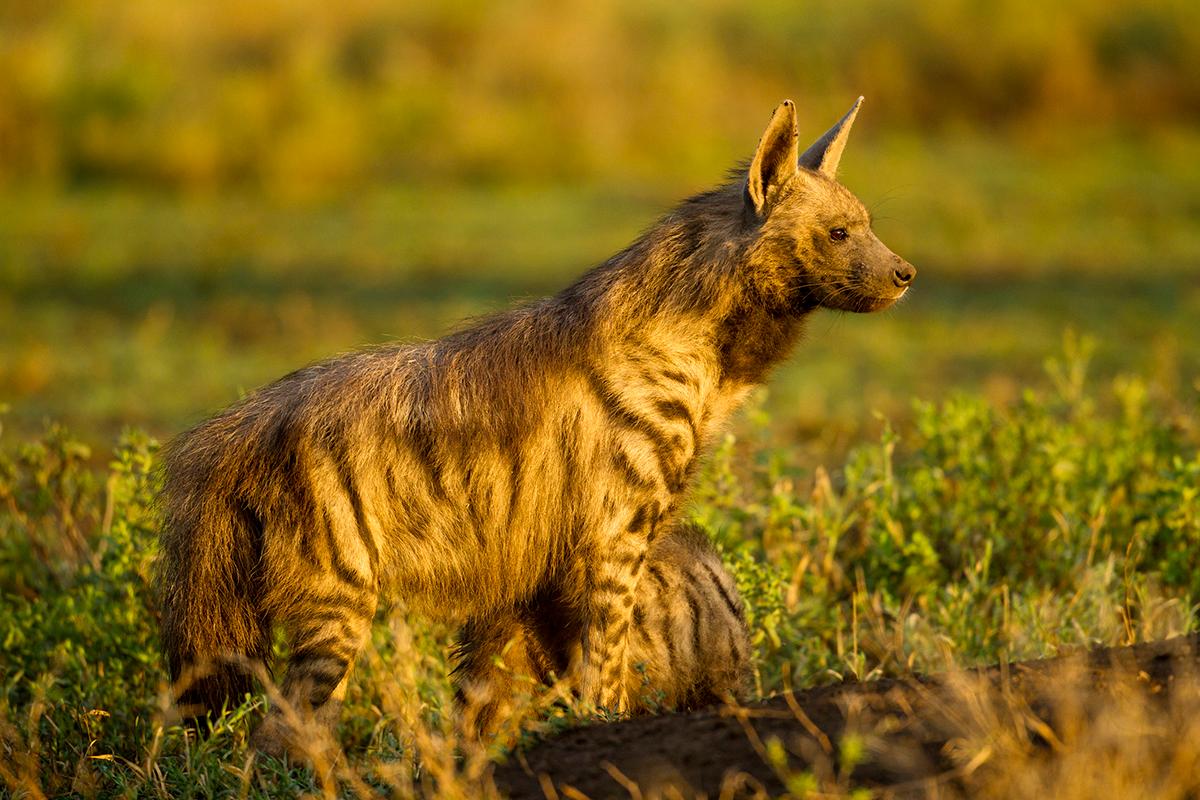
Striped Hyena (Hyaena hyaena)
Scientific Name | Hyaena hyaena | ||||||||
|---|---|---|---|---|---|---|---|---|---|
Taxonomy | Spotted hyenas (Hyaenidae) | ||||||||
Definition | Smaller in size than other hyena species in Africa; distinguished by a dirty pale yellow-white coat with dark stripes. The mane on its back stands erect in times of danger, making it appear 38% larger. | ||||||||
Lifespan | 12–15 years | ||||||||
The striped hyena (Hyaena hyaena) is a smaller species of hyena compared to other hyena species found in Africa. Its dirty pale yellow-white coat is marked with variable-width dark stripes, making it easily distinguishable by this striped pattern. The mane along its back stands erect during fights or fear situations, making the animal appear up to 38 percent larger. Body weight ranges from 25 to 45 kilograms. Gestation lasts 88 to 92 days, and both males and females reach sexual maturity at 800 days. Pups weigh approximately 700 grams at birth and are nursed by their mother for the first four months; they are weaned by the age of one year. Average lifespan is 12 to 15 years. The species is resident in its range and does not migrate. It is known as the only hyena species present in Türkiye.
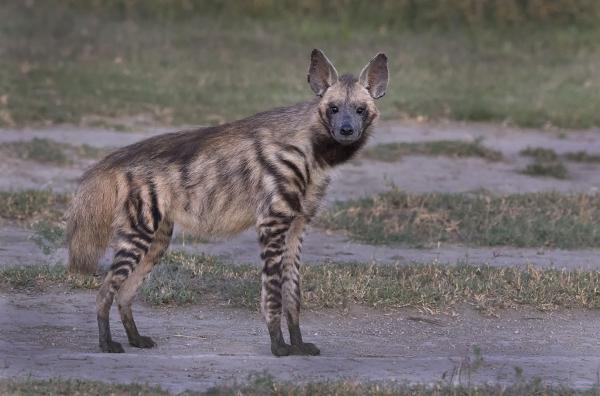
Striped Hyena (TÜBİTAK)
The evolutionary origins of the striped hyena may trace back to H. namaquensis, a species that lived in Africa during the Pliocene epoch (5 to 2 million years ago). Fossil records from Africa extend as far back as the Middle Pleistocene and are widespread. However, no fossil evidence has been found in the Mediterranean region, suggesting that the species’ dispersal into Eurasia occurred relatively late, likely after the extinction of spotted hyenas in Asia at the end of the last glacial period. During the Pleistocene, the species was distributed across Europe, particularly in regions such as France, Germany, Austria (Hollabrunn), Portugal (Furninha Cave), and Gibraltar (Genista Caves). Individuals from these ancestral populations resembled modern striped hyenas in appearance but were larger and are believed to have shared similarities with the brown hyena.
The striped hyena has a wide distribution across North and East Africa, the Middle East, Caucasus, Central Asia, India, and southern Siberia. In Türkiye, it is found in southern Marmara, the Aegean, the Mediterranean, southeastern Anatolia, and eastern Anatolia. Records exist from the provinces of Çanakkale, Bursa, Balıkesir, Kütahya, Afyon, İzmir, Denizli, Aydın, Muğla, Antalya, Burdur, Mersin, Adana, Niğde, Hatay, Kahramanmaraş, Gaziantep, Kilis, Şanlıurfa, Mardin, Adıyaman, Batman, Siirt, Şırnak, and Hakkari. However, it has not been observed in Kütahya and Afyon for a long time. It typically nests in steppe (semi-desert) areas, steep cliffs, sparsely wooded slopes, fissures, crevices, and deep valleys. Dry regions with shrubland and forested areas, as well as mountainous terrain, are also part of its habitat.
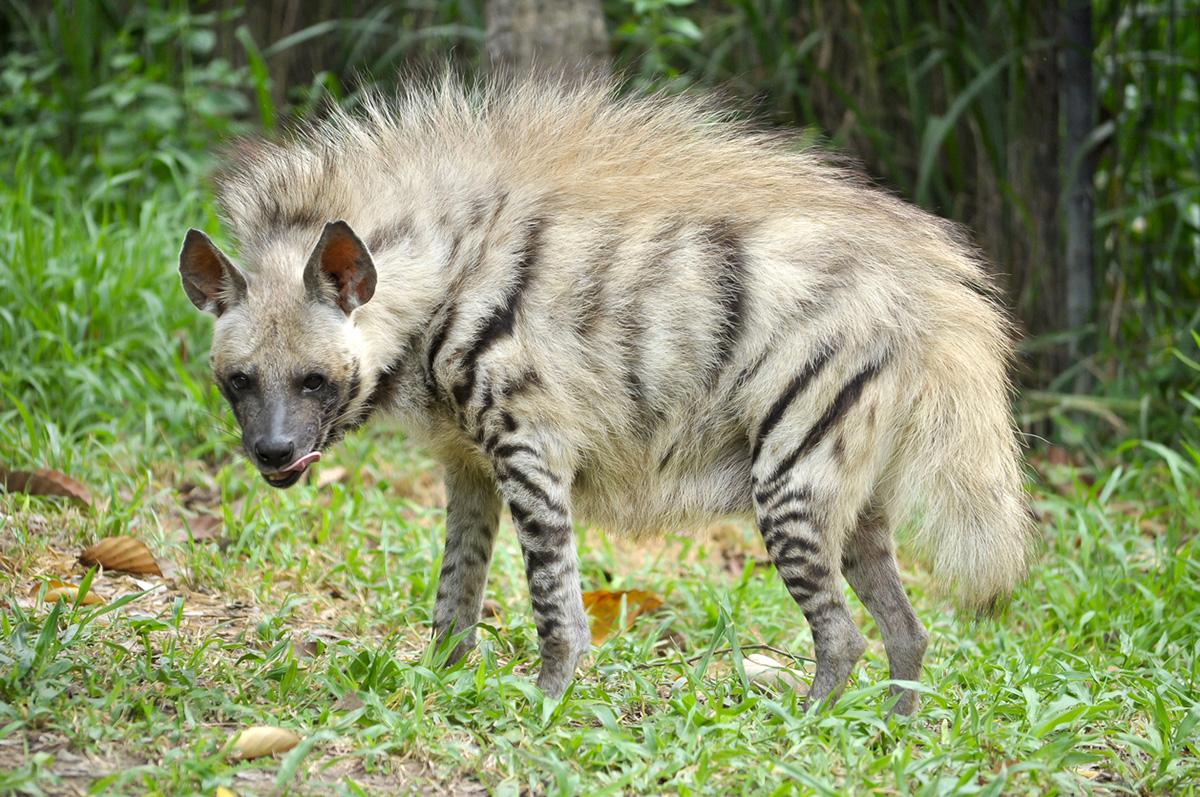
Striped Hyena (TÜBİTAK)
The International Union for Conservation of Nature (IUCN) classifies the striped hyena as “Near Threatened” (NT), with its global population showing a declining trend. The total number of individuals is estimated between 5,000 and 14,000. In Türkiye, it is very rarely observed and is protected from hunting due to its endangered status.
The striped hyena is a master of camouflage and is difficult to distinguish from a distance in rocky terrain. It is a highly shy species that prefers to flee when encountering humans and poses no threat unless approached. It typically roams alone but may form small social groups near denning areas. Occasional observations of group movement have been recorded. When encountering other large felids or predators such as the spotted hyena, it avoids competition for food and retreats rather than defending its territory aggressively.
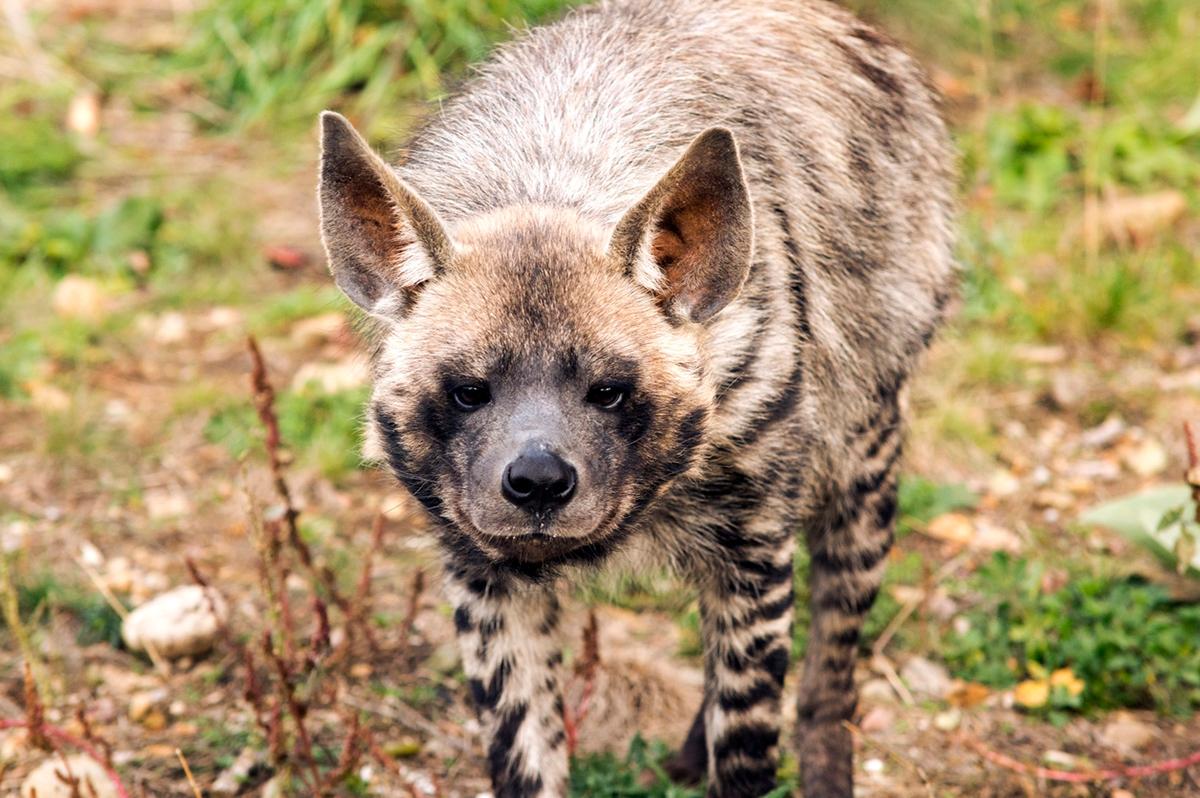
Striped Hyena (TÜBİTAK)
The striped hyena has an omnivorous diet. In the wild, it feeds on carrion, weak or injured animals, and small mammals it can catch. It also consumes fruits such as watermelon, cantaloupe, and grapes, as well as wild berries. When hungry, it may approach human settlements and attack domestic animals. In Türkiye, it is known to visit carcasses left in forested areas during Kurban Bayramı (Eid al-Adha).
In Türkiye, its presence is unknown to many people, and population decline is significantly influenced by roadkill, habitat destruction, and direct killing by humans. It is known locally by various names such as “Andık”, “Yeleli Kurt”, “Aftar”, “Aptar”, “Heftar”, “Alacanavar”, “Öcü”, and “Dab’a”. In Anatolia, it is commonly referred to as the “Anatolian hyena” and leads a life away from human settlements.
The striped hyena derives its name from the prominent stripes on its coat. In Turkish, it is called “Çizgili Sırtlan”, and in English, “Striped Hyena”. In Türkiye, due to its presence in Anatolia, it is also referred to as the “Anatolian hyena”. This naming is based on its most distinctive physical feature.
Okatan, Ayşenur. “Türkiye’nin Çizgili Sırtlanı.” *Bilim Genç*, TÜBİTAK, March 3, 2021.https://bilimgenc.tubitak.gov.tr/yerbilim-gokbilim/turkiyenin-cizgili-sirtlani. Accessed April 2, 2025.
“Kırmızı Liste’deki Tür: Çizgili Sırtlan.” *Türk Tarım*, April 14, 2021.http://www.turktarim.gov.tr/Haber/332/kirmizi-listedeki-tur-cizgili-sirtlan-. Accessed April 2, 2025.
“Çizgili Sırtlan Gözlemleri Sürüyor.” *Tarım TV*, 2023.http://www.tarimtv.gov.tr/tr/video-detay/cizgili-sirtlan-gozlemleri-suruyor-18032. Accessed April 2, 2025.

Striped Hyena (Hyaena hyaena)
Scientific Name | Hyaena hyaena | ||||||||
|---|---|---|---|---|---|---|---|---|---|
Taxonomy | Spotted hyenas (Hyaenidae) | ||||||||
Definition | Smaller in size than other hyena species in Africa; distinguished by a dirty pale yellow-white coat with dark stripes. The mane on its back stands erect in times of danger, making it appear 38% larger. | ||||||||
Lifespan | 12–15 years | ||||||||
No Discussion Added Yet
Start discussion for "Striped Hyena (Hyaena hyaena)" article
Evolutionary History and Taxonomy
Ecological Distribution and Habitat
Population and Conservation Status
Behavior and Ethology
Diet and Metabolism
Human Interactions and Cultural References
Etymology