


This article was automatically translated from the original Turkish version.
A stepper motor is a type of electric motor that rotates in specific angular increments in response to electrical signals. Each electrical pulse (step) corresponds to a precise angular displacement of the motor’s rotor, enabling the motor to move the driven load with high precision. Stepper motors are widely used in applications requiring precise control, such as 3D printers, robots, CNC machines, and automation systems.
Stepper motors operate through interaction between a rotor, typically driven by magnetic fields within the motor, and the stator. The rotor has a structure that allows it to remain in specific positions, ensuring it rotates by a fixed amount with each step. This characteristic enables stepper motors to achieve highly precise and controlled movements, unlike continuous-rotation motors.
Stepper motors are generally classified into four main types: bipolar stepper motors, unipolar stepper motors, hybrid stepper motors, and piezoelectric stepper motors. Each type has its own distinct operating principles and application areas.
Stepper motors are a type of motor that rotates in specific angular increments in response to electrical signals. Each electrical pulse causes the motor’s rotor to rotate by a defined angle, allowing precise movement of the load. The fundamental operating principle of stepper motors involves the rotor interacting with magnetic fields to rotate in precise angular steps.
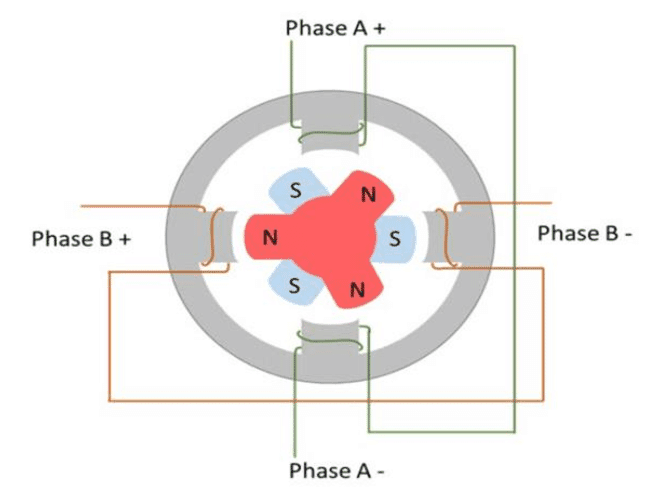
Step Motor Faz Besleme Şeması (researchgate.net)
Stepper motors operate using external digital signals. These signals are applied to coils in the motor’s stator, generating magnetic fields. Each electrical pulse causes the rotor to rotate by one step. In stepper motors, each step typically corresponds to a specific angle—for example, 1.8 degrees. These steps enable precise control of the motor’s motion.
For a motor to complete one full revolution, its rotor is typically designed to take 200 steps (with a step angle of 1.8 degrees). This angle can vary among different stepper motor types; some motors operate with smaller steps, such as 0.9 degrees.
Stepper motors have two main components: the rotor and the stator. The stator forms the stationary part of the motor, while the rotor is the rotating part.
Each electrical pulse causes the rotor to move one step. The rotor’s motion is directly related to the direction and magnitude of the electrical current applied to the stator coils.
Each step of a stepper motor is limited to a specific angular displacement. The most common step angle is 1.8 degrees per step, meaning 200 steps are required for one full revolution. This angle can vary among different stepper motor types; some motors operate with smaller steps, such as 0.9 degrees.
The step angle can be selected based on application requirements. A smaller step angle allows for finer motion control, which is a significant advantage in applications demanding high precision.
One of the most important features of stepper motors is that each step brings the rotor to a specific, well-defined position. This makes stepper motors an ideal choice for applications requiring precise position control. With each electrical signal, the motor advances one step, positioning the rotor accurately. This feature is particularly useful in robotic and automation systems, where loads must be positioned with accuracy.
Stepper motors can be classified into different types based on their operating principles and construction. These types significantly influence the motor’s performance, efficiency, torque production, and application suitability. There are three primary types of stepper motors: Bipolar, Unipolar, and Hybrid. Each type offers distinct advantages and limitations for different applications.
Bipolar stepper motors allow the direction of current through their coils to be reversed. In this type, the current direction in each coil can be switched, enabling the generation of the magnetic fields required to rotate the rotor. Bipolar stepper motors typically produce higher torque and operate more efficiently. However, they require more complex driver circuits because the current direction in each coil must be precisely controlled.
The high torque performance of bipolar motors makes them a preferred choice in applications such as industrial automation, robotic systems, and CNC machines.
Unipolar stepper motors generate magnetic fields in only one direction per coil. In this type, each coil produces a magnetic field in a single direction, and the current direction is not reversed. Unipolar motors can be driven with simpler driver circuits but produce lower torque compared to bipolar motors. Their design makes them easier to control.
Unipolar motors are commonly used in applications requiring low torque and in simpler systems. They are also preferred in desktop devices and small automation systems due to their lower cost.
Hybrid stepper motors combine the advantages of both bipolar and unipolar designs. These motors deliver high torque and efficient operation. Hybrid motors typically feature a smaller step angle, making them suitable for applications requiring precise positioning and high performance. Their rotors often generate sinusoidal magnetic fields, resulting in smoother motor operation.
Hybrid stepper motors are widely preferred in 3D printers, CNC machines, robotic systems, and other precision control applications. By combining the benefits of both bipolar and unipolar designs, they offer a broader range of usability.
The two main components of a stepper motor—stator and rotor—are critical parts that define its fundamental operating principle and directly affect its performance. These two components enable the rotor to rotate in discrete steps through magnetic interaction.
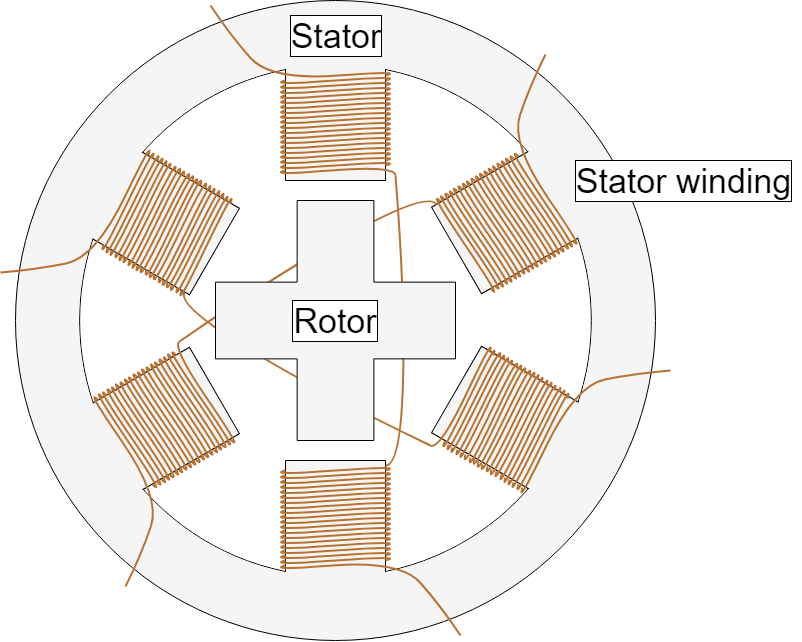
Step Motor Yapısı-monolithicpower
Stator is the stationary component of the stepper motor and is located on the outer part of the motor. The stator consists of coils that generate magnetic fields when energized by electrical current. These coils create the magnetic fields that control the rotor’s motion, causing it to rotate in response to these fields.
Stator Components:
Role of the Stator:
Rotor is the rotating component of the stepper motor and moves in response to the magnetic fields generated by the stator. The rotor performs the motor’s power generation function and carries the driven load. The internal structure of the rotor varies depending on the motor type but typically includes magnets or magnetic materials.
Rotor Components:
Role of the Rotor:
Stepper motors are precise and reliable motors suitable for a wide range of applications requiring high accuracy and controlled motion. Below are their common application areas along with their advantages and disadvantages:
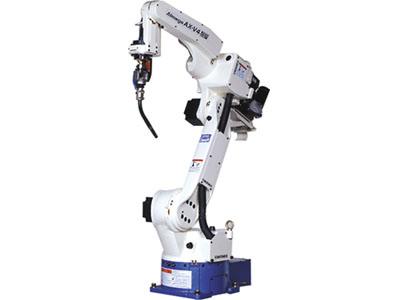
Step Motor Endüstriyel Robot Kol Uygulaması-ato.com
ElProCus. "Stepper Motor: Construction, Working, Types and Its Applications." Accessed May 9, 2025.https://www.elprocus.com/stepper-motor-types-advantages-applications/.
Faradyi Motors. "Comprehensive Analysis of the Advantages and Disadvantages of Stepper Motors." Accessed May 9, 2025.https://faradyi.com/comprehensive-analysis-of-the-advantages-and-disadvantages-of-stepper-motors/.
Lammotor. "What Is Stepper Motor: Types, Applications, and Working Principle." Accessed May 9, 2025.https://lammotor.com/what-is-stepper-motor/.
Robotiksistem. "Step Motor Çeşitleri." Accessed May 9, 2025.https://www.robotiksistem.com/step_motor_cesitleri.html.

Operating Principle
Electrical Signals and Step Motion
Rotor and Stator Interaction
Step Angles and Precision
Step Motion and Position Control
Types of Stepper Motors
Bipolar Stepper Motors
Unipolar Stepper Motors
Hybrid Stepper Motors
Stepper Motor Structure
Stator (Stationary Part)
Rotor (Rotating Part)
Applications and Advantages/Disadvantages of Stepper Motors
Application Areas
Advantages
Disadvantages