

This article was automatically translated from the original Turkish version.
+2 More
Title(s) | Spring (Primavera) | ||||||||
|---|---|---|---|---|---|---|---|---|---|
Subject(s) | Mythological – Allegorical | ||||||||
Dimension(s) | 207 × 319 cm | ||||||||
Date(s) | Approximately 1480–1482 | ||||||||
Location | Florence Uffizi Gallery | ||||||||
Theme(s) | Spring Love Fertility Awakening of Nature | ||||||||
Figures | Venus, Mercury, The Three Graces, Flora, Chloris, Zephyrus, Cupid | ||||||||
Medium | Wood Panel | ||||||||
Technique | Tempera | ||||||||
Period / Movement | Early Renaissance (Florentine Renaissance) | ||||||||
Artist | Sandro Botticelli | ||||||||
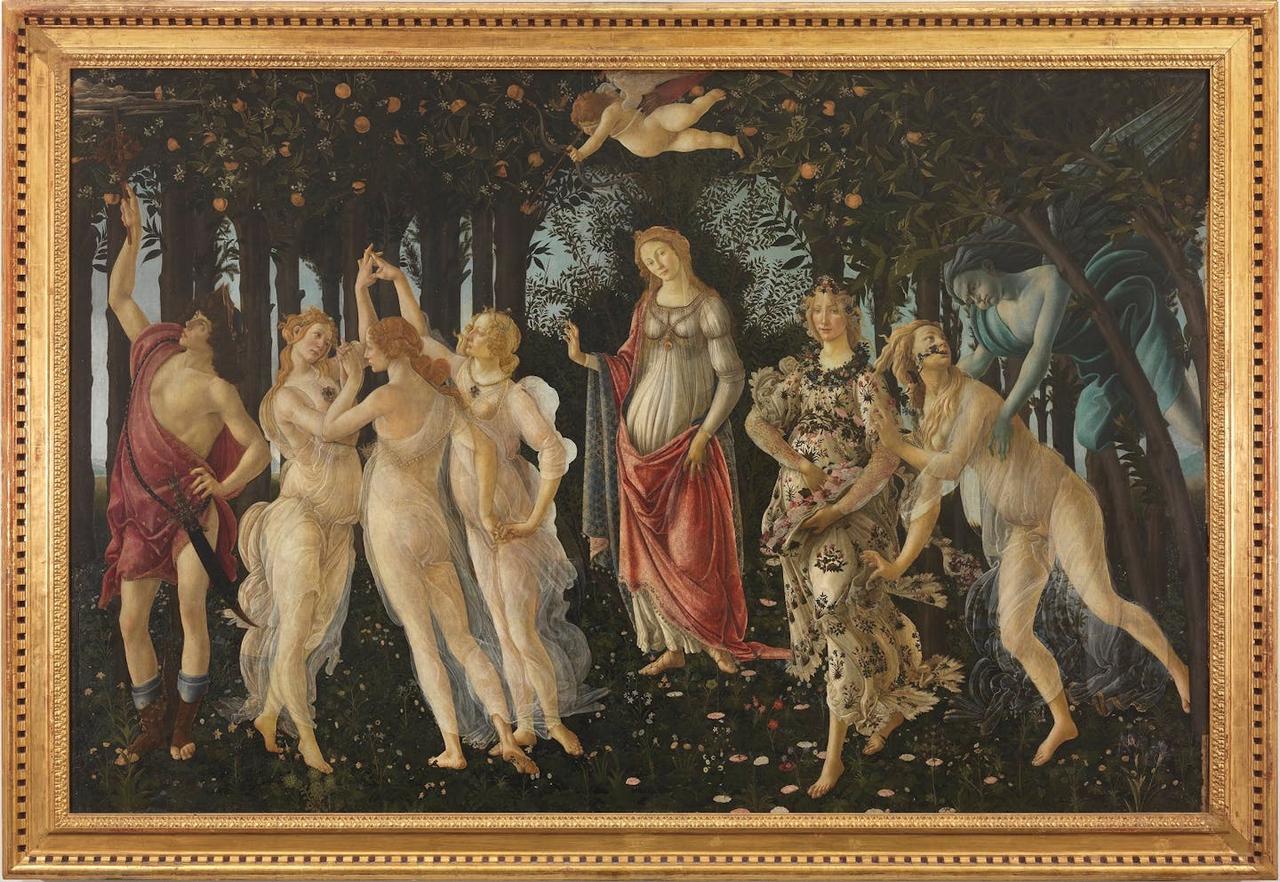
Spring (Primavera) is a painting created by Renaissance artist Sandro Botticelli in the last quarter of the 15th century using tempera on wood panel. It is distinguished by its mythological and allegorical content. The work brings together figures drawn from classical mythology within a symbolic arrangement centered on the theme of nature’s awakening and the arrival of spring. The composition presents a structure in which narrative and symbolism are interwoven through the relationship between human figures and plant elements.
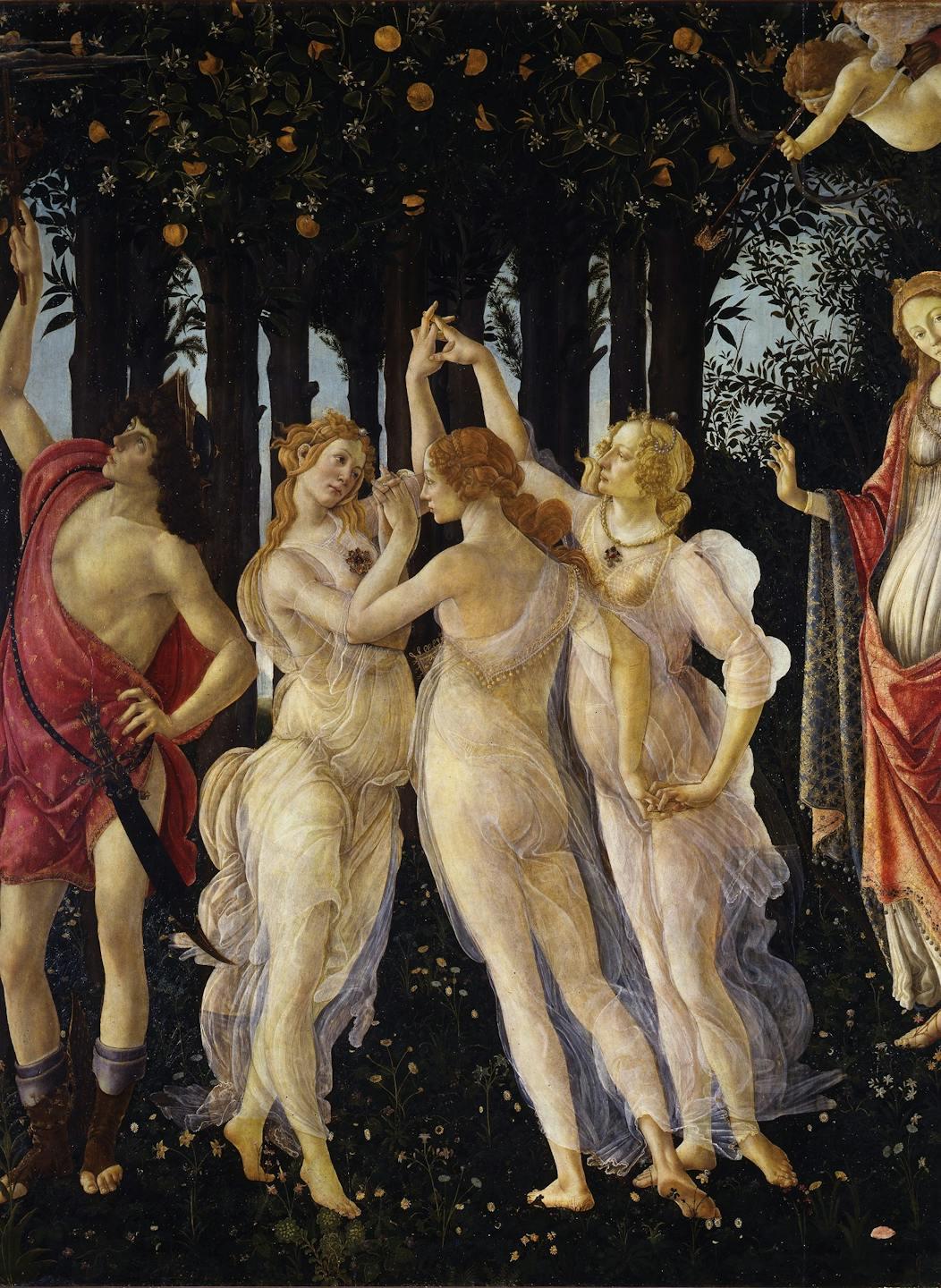
Spring Close-up (Le Gallerie Degli Uffizi)
The painting Spring was produced within the intellectual and artistic environment of Renaissance Florence. During this period, interest in classical Greek and Roman mythology, alongside humanist thought, became widespread in artistic works. Botticelli’s painting is regarded as an example of allegorical expression informed by the philosophical and literary texts of the era.【1】
It has been suggested that the painting was commissioned for the bridal chamber of Lorenzo di Pierfrancesco de’ Medici and Semiramide Appiani upon their marriage. It is known that the painting was later moved to Villa di Castello and was mentioned by Giorgio Vasari alongside The Birth of Venus.
The figures in the painting are arranged horizontally within a garden enclosed by orange trees. The central female figure forms the compositional balance point. The figures on the right and left sides determine the flow of the narrative through their movement and posture. The relationship between the figures and space is established not through perspective but through rhythmic arrangement and linear harmony. Nine figures are depicted on a flower-strewn meadow, with a dense grove of orange and laurel trees visible above.
The figures in the painting are identified with deities and allegorical entities from classical mythology. The central figure of Venus and the surrounding mythological characters are arranged in a structured order. On the right, Zephyrus is depicted seizing Chloris, who is shown transforming into Flora. On the left, the Three Graces and Mercury are present. Above Venus, Cupid is shown with his eyes blindfolded, preparing to launch his arrow. The gestures, body postures, and gaze directions of the figures contribute visually to the narrative conveyed in the composition.
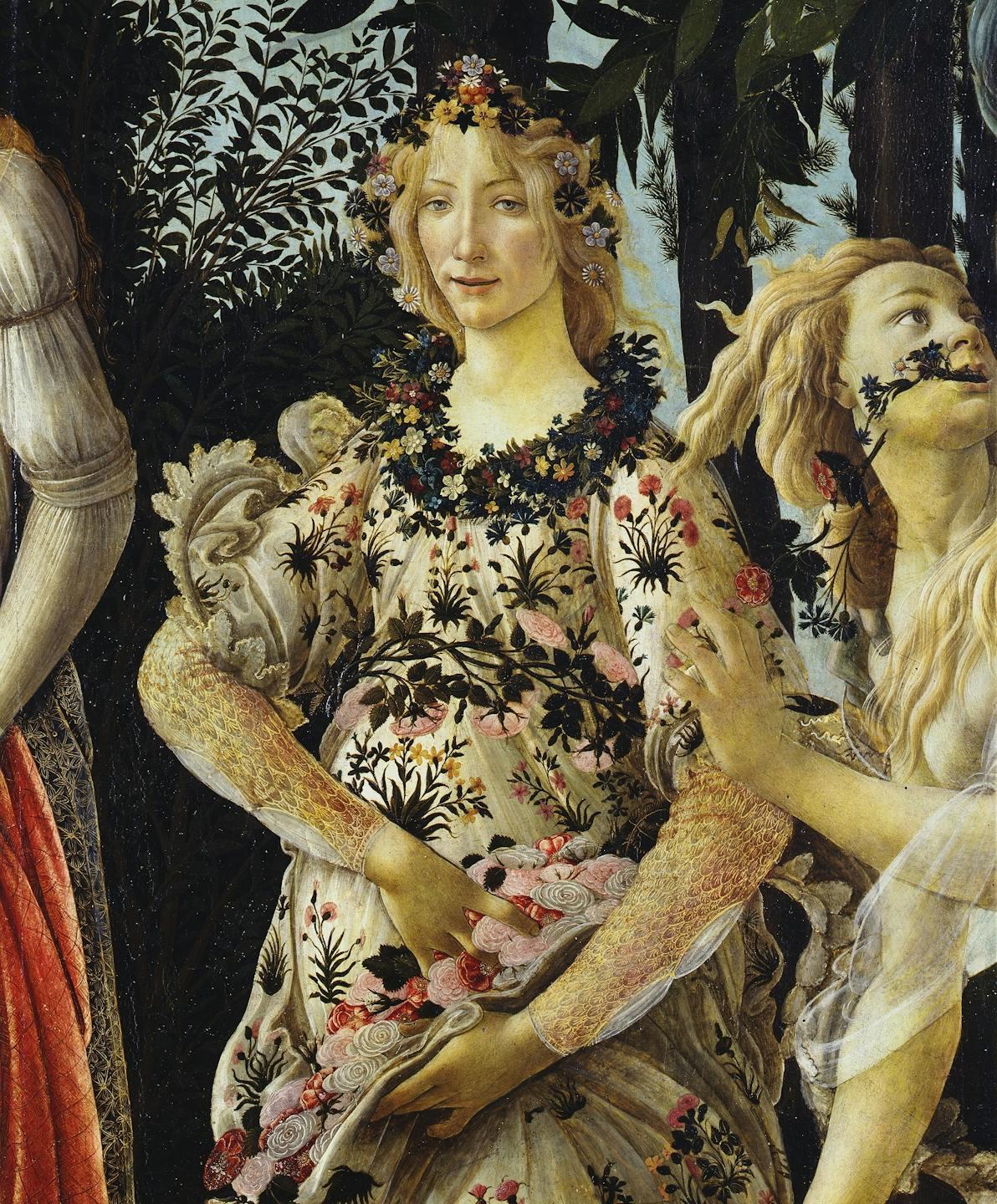
Spring Detail (Le Gallerie Degli Uffizi)
The painting’s iconography is linked to themes of nature, love, and fertility. The trees in the background and the plants and flowers throughout the composition are rendered in intricate detail. These botanical elements serve as symbolic representations of nature’s renewal and productivity, forming an integral part of the composition’s overall meaning. The diversity of plant life and the meticulous rendering are prominent features of the painting’s iconographic structure. The full meaning of the composition has not been definitively resolved; it has also been interpreted as a celebration of love, peace, and prosperity.【2】
The work was executed in tempera on a wood panel. The colors are applied to create a matte surface effect, while linear contours enhance the definition of the figures. The use of light and shadow is restrained, with volume suggested through line and color transitions. The support is poplar wood. This technical approach aligns with Botticelli’s artistic vision, which prioritizes narrative and symbolism. Some of the darker tones in the vegetation are attributed to the aging of the original pigments.
Primavera is one of the most important paintings by Sandro Botticelli featuring mythological subjects. It is recognized as a key example of the allegorical tradition that emerged in 15th-century Florentine art. The idealized proportions of the figures, the prominent contour lines, and the decorative approach to surface design reflect formal characteristics typical of painting in that period. These features have led to the work being cited as a representative example of the artistic style of the Florentine Renaissance.
Uffizi Galleries. "Spring (La Primavera)." Accessed March 5, 2026. https://www.uffizi.it/en/artworks/botticelli-spring
Yavuz, Nuri, and Ayhan Özer. “Çok Yönlü Bir Eser İncelemesi Örneği: Sandro Botticelli’nin ‘İlkbahar Alegorisi’.” *Avrasya Sosyal ve Ekonomi Araştırmaları Dergisi* 6, no. 4 (2019): 403–419. Accessed March 5, 2026. https://dergipark.org.tr/en/download/article-file/703428
Özdemir, Gülşah. “Botticelli’nin İlkbaharı.” Cumhuriyet Üniversitesi Fen-Edebiyat Fakültesi Sosyal Bilimler Dergisi 40, no. 1 (2016): 377–388. Accessed March 5, 2026. http://cujos.cumhuriyet.edu.tr/tr/pub/article/258300
[1]
Gülşah Özdemir, “Botticelli’s Spring,” Cumhuriyet University Faculty of Arts and Sciences Journal of Social Sciences 40, no. 1 (2016): 380. http://cujos.cumhuriyet.edu.tr/tr/pub/article/258300
[2]
LE GALLERIE DEGLI UFFIZI, ‘‘Spring (La Primavera),’’ Uffizi Galleries, Accessed: 5 March 2026, https://www.uffizi.it/en/artworks/botticelli-spring

Title(s) | Spring (Primavera) | ||||||||
|---|---|---|---|---|---|---|---|---|---|
Subject(s) | Mythological – Allegorical | ||||||||
Dimension(s) | 207 × 319 cm | ||||||||
Date(s) | Approximately 1480–1482 | ||||||||
Location | Florence Uffizi Gallery | ||||||||
Theme(s) | Spring Love Fertility Awakening of Nature | ||||||||
Figures | Venus, Mercury, The Three Graces, Flora, Chloris, Zephyrus, Cupid | ||||||||
Medium | Wood Panel | ||||||||
Technique | Tempera | ||||||||
Period / Movement | Early Renaissance (Florentine Renaissance) | ||||||||
Artist | Sandro Botticelli | ||||||||
Historical Context
Composition and Figure Arrangement
Mythological Figures
Iconographic Features
Technical Features
Place in Art History