This article was automatically translated from the original Turkish version.
+1 More
Total Height | 120–122 meters | ||||||||
|---|---|---|---|---|---|---|---|---|---|
Diameter | 9 meters | ||||||||
Payload Capacity | In reusable mode: 100–150 tons, in expendable mode: up to 250 tons | ||||||||
Crew Capacity | Up to 100 people for interplanetary flights | ||||||||
Fuel Type | Liquid methane and liquid oxygen mixture | ||||||||
Number of Engines | 33 units | ||||||||
Thrust | Approximately 74 meganewtons | ||||||||
Producer | SpaceX | ||||||||
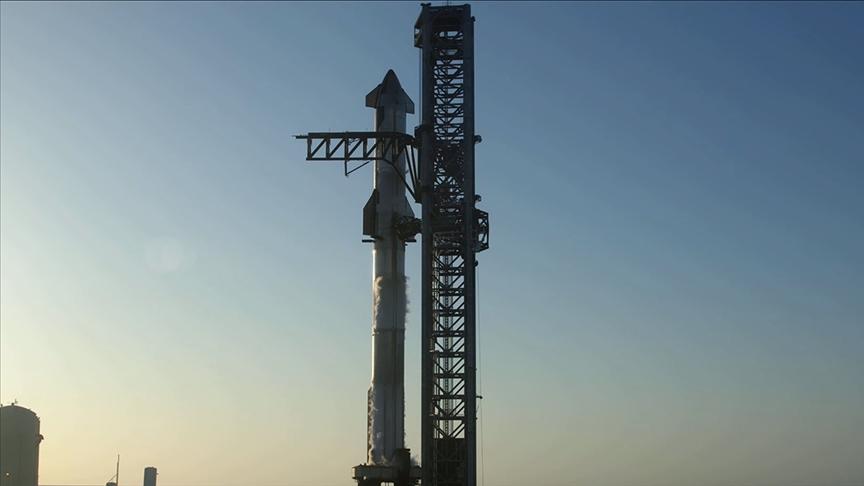
SpaceX Starship is a fully reusable super heavy-lift launch vehicle and spacecraft system developed by the American aerospace company SpaceX. It is designed to enable human travel to the Moon, Mars and beyond, as well as to transport cargo and crew into orbit. It is the largest and most powerful rocket system ever built. The system is configured for both cargo and crew missions and is based on the principle of full reusability.
The Starship system is an integrated structure consisting of two main stages: the first stage booster called "Super Heavy" and the second stage spacecraft known as "Starship" (Ship). The total height of the system exceeds 120 meters and its diameter is 9 meters.
The Super Heavy, forming the lower part of the rocket, provides the thrust necessary to escape Earth's atmosphere. This booster is equipped with 33 engines and generates approximately 74 meganewtons of thrust, equivalent to about 700 times the thrust produced by a typical commercial passenger aircraft. Super Heavy has roughly twice the thrust of NASA's most powerful rocket, the SLS rocket used in the Artemis program, and the Saturn V rocket that carried astronauts to the Moon. After launch, the booster is designed to return to Earth and be caught by the launch tower.
The upper stage, referred to as the "Ship", is responsible for carrying cargo and passengers into orbit. This section is approximately 50 meters long. Starship has a payload capacity of 100 to 150 tons to low Earth orbit in reusable mode and up to 250 tons in expendable mode. The vehicle is configured to carry up to 100 crew members. Both the booster and the ship use a mixture of liquid methane and liquid oxygen, known as "methalox", as fuel.
Starship's launch and test operations are conducted from SpaceX's "Starbase" facility in Boca Chica, Texas. The launch site features a massive launch tower called "Mechazilla", which has two giant mechanical arms known as "Chopsticks". These arms position the rocket components (booster and ship) before launch and catch the returning Super Heavy booster in mid-air after launch. One of the system's most important features is its ability to capture the rocket in mid-air above the launch pad using these arms, rather than allowing it to land in the ocean or on a platform. This method reduces the need for complex landing equipment and significantly shortens the turnaround time for relaunch.
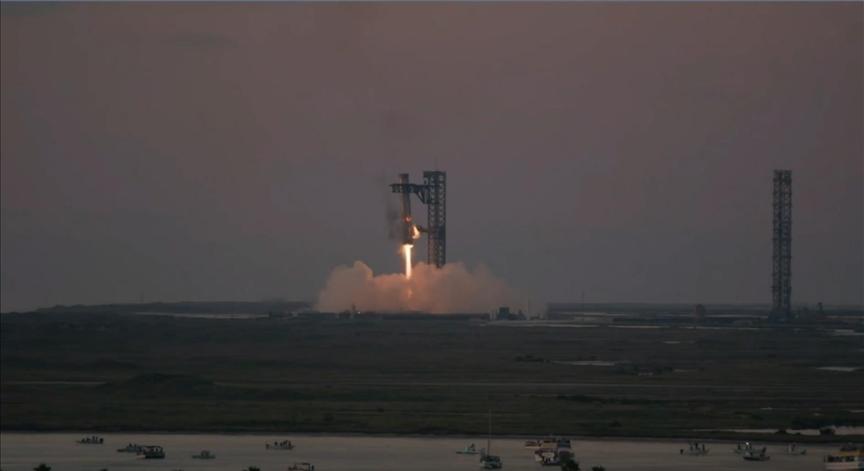
The Starship rocket completed its 10th test flight (
Starship's flight profile is designed for rapid reusability. During launch, approximately 2.5 minutes after liftoff, the Super Heavy booster separates from the upper stage (Ship). The post-separation sequence proceeds as follows:
Starship's applications span a broad range from low Earth orbit to interplanetary travel:
The development of Starship is monitored by the U.S. Federal Aviation Administration (FAA) due to environmental concerns. The FAA has imposed penalties on SpaceX for noncompliance with licensing conditions. According to the FAA's draft environmental report, if 25 launches occur annually, a total of 97,342 tons of carbon dioxide equivalent emissions would be generated, equating to approximately 3,894 tons per launch. Experts note that the liquid methane used as rocket fuel and the "black carbon" produced during launch may persist longer in the upper atmosphere than emissions from aircraft, potentially contributing to climate change. SpaceX disputes claims that the rocket causes significant air pollution. Additionally, sonic booms generated during launch and reentry are considered an environmental noise factor.
Anadolu Ajansı. "SpaceX'in Starship hamlesi: Geleceğin uzay yolculuğuna doğru." Accessed January 17, 2026.https://www.aa.com.tr/tr/analiz/spacex-in-starship-hamlesi-gelecegin-uzay-yolculuguna-dogru/3369880
BBC News Türkçe. "Musk'a ait Space X'in Starship roketi nasıl tarih yazdı?" Accessed January 17, 2026.https://www.bbc.com/turkce/articles/cn8yk3zd5vro
BBC News. "What's next for Elon Musk's SpaceX Starship rocket?" Accessed January 17, 2026.https://www.bbc.com/news/articles/cx2lk2mwwnxo.
SpaceX. "SpaceX - Starship." SpaceX. Accessed January 17, 2026.
Total Height | 120–122 meters | ||||||||
|---|---|---|---|---|---|---|---|---|---|
Diameter | 9 meters | ||||||||
Payload Capacity | In reusable mode: 100–150 tons, in expendable mode: up to 250 tons | ||||||||
Crew Capacity | Up to 100 people for interplanetary flights | ||||||||
Fuel Type | Liquid methane and liquid oxygen mixture | ||||||||
Number of Engines | 33 units | ||||||||
Thrust | Approximately 74 meganewtons | ||||||||
Producer | SpaceX | ||||||||
Technical Specifications and Design
Super Heavy Booster
Starship (Upper Stage)
Launch Infrastructure and Capture System
Mission Profile and Operating Principle
Applications and Future Goals
Environmental Impacts and Regulations