


This article was automatically translated from the original Turkish version.
Space debris is a long-lasting accumulation of objects consisting of defunct satellites, rocket bodies, fragmentation fragments, and components discarded during operational processes. Due to their high velocities, even small fragments can cause serious damage, and as density increases, collisions may trigger a self-sustaining cascade of fragmentation known in the literature as the Kessler syndrome. Space debris forms the core of a sustainability issue with technical, economic, and governance dimensions that threaten the common-pool nature of orbital regimes. Space debris mitigation techniques are evaluated as a holistic framework integrating monitoring, protection, reduction, and active cleanup approaches. It is emphasized that space debris is not merely an engineering problem but a complex systemic issue linked to the management of common goods, economic externalities, and global governance.
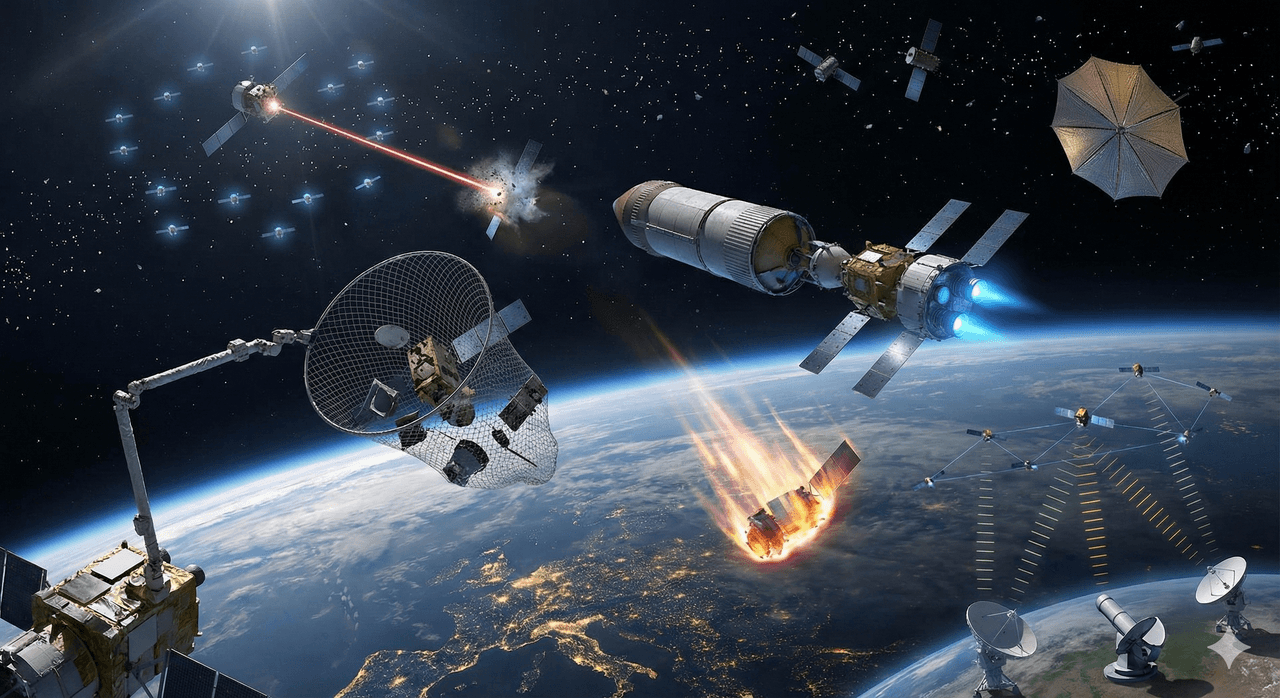
Uzay Çöpleri (Yapay Zeka ile Oluşturulmuştur.)
The socio-ecological systems approach conceptualizes orbits as a limited but universally accessible resource and space debris as an externality within this system. Under this framework, national agencies, commercial companies, and new space ventures share the same orbital paths, yet the costs of debris are dispersed across all actors and future generations. This situation sharpens the tension between individual incentives and collective interests, mirroring classic “tragedy of the commons” scenarios.
In the literature, combating space debris is typically addressed through four fundamental methods. The first method involves monitoring objects in orbit and calculating collision risks using space situational awareness systems. The second method focuses on reducing impact effects through structural protection of spacecraft and mission planning. The third method comprises passive mitigation techniques that prevent new debris generation through design and end-of-life disposal measures. The fourth method consists of active debris removal systems targeting large and collision-critical objects for deorbiting.
International guidelines and national standards recommend policy packages based on varying combinations of these approaches. Within this scope, principles commonly emphasized include time limits for end-of-life disposal, selection of flight profiles to reduce collision probability, restrictions on components released during operations, and control of explosion risks.
For space debris mitigation measures to function effectively, it is essential to maintain as complete and up-to-date an inventory as possible of objects in orbit. Systems such as the U.S. Space Surveillance Network and ESA’s DISCOS database collect position and orbital data for objects across different size ranges, providing the foundational input for collision probability analyses.
Recently, under the headings of “space traffic management” and “space situational awareness,” transparent infrastructures are being developed that integrate commercial and public data, share maneuver intentions, and rapidly transmit collision warnings to relevant operators. Such systems not only reduce physical collision risks but may also provide the technical foundation for future regulatory tools such as orbital usage fees, capacity allocation, and compliance monitoring.
Another dimension of the space debris mitigation ecosystem is the protection of current and future spacecraft against impact effects. For human-rated platforms and critical mission satellites, multi-layered shielding systems are designed to cause impacting fragments to shatter in the outer layer and dissipate their energy through subsequent layers. ESA and NASA have extensively documented shielding principles based on experimental and numerical analyses of hypervelocity impacts.
Filho and colleagues conceptualize risk reduction strategies within a four-stage framework. This framework encompasses designing spacecraft to withstand impacts, employing advanced ground- and space-based monitoring infrastructure for precise debris tracking, integrating detection and maneuvering capabilities on spacecraft for collision avoidance, and defining impact mitigation strategies to limit damage should a collision occur.【1】
The International Space Station and large satellites perform avoidance maneuvers when collision probability exceeds a predefined risk threshold. Although these maneuvers incur costs in terms of fuel consumption and mission planning, they are considered a fundamental protective measure for ensuring the safe operation of critical platforms.
Passive mitigation techniques focus on preventing or reducing the generation of new debris. A significant portion of these measures is implemented during the design phase of satellites and launch systems. Designers develop standards to minimize component release during normal operations, reduce explosion risks in fuel tanks and batteries, and lower the likelihood of uncontrolled breakups at end-of-life. NASA and the European Space Agency have systematized such design measures under principles of “energy disposal,” “explosion prevention,” and “controlled disposal.”
End-of-life disposal is a critical component of passive mitigation. In low Earth orbit, spacecraft are designed to reenter and burn up in the atmosphere after a specified time. In higher altitudes, a strategy known as a “graveyard orbit” is employed, moving the spacecraft to a disposal orbit farther from operational regions. Literature emphasizes guidelines requiring objects in low Earth orbit and defunct satellites to be removed from orbit or transferred to a disposal orbit within a defined period after mission completion.
Drag enhancement systems represent another technique aimed at shortening the passive disposal period. Deploying inflatable structures, deployable panels, or sail-like surfaces increases atmospheric drag on the satellite, accelerating its natural deorbit. These techniques are emerging as low-cost and simple disposal solutions, particularly for small satellites and CubeSat constellations.
There are also planning-based mitigation measures that appear passive during operations. These include selecting less congested altitudes based on orbital population models, favoring constellation geometries that reduce collision risk, and adopting operational policies that avoid unnecessarily extending mission lifetimes.
Active debris removal refers to the deliberate deorbiting of existing objects in orbit that pose high collision risks. Large rocket bodies and nonfunctional satellites are prioritized targets due to their potential to trigger future fragmentation events. Active removal methods are generally categorized as contact and non-contact techniques.
Contact capture methods require a service satellite to establish a mechanical connection with the debris. These include robotic arms, gripping claws, capture rings, nets, harpoon systems, and flexible “tentacle” robotic solutions. Typical mission phases involve approaching the target, estimating its dynamics, stabilizing its rotation, and then performing a joint deorbit maneuver. Projects such as “RemoveDEBRIS,” “ELSA-d,” and various European clean space initiatives have demonstrated practical applications of net deployment, harpoon use, and magnetic capture concepts.
Flexible or virtual connection techniques use intermediary elements such as tethers, nets, adhesive surfaces, or climbing structures instead of rigid mechanical links between the debris and the service satellite. Methods studied in detail in the literature include using electrodynamic tethers to leverage Lorentz forces for orbit lowering, engaging with high-adhesion surfaces, wrapping large objects with flexible nets, and subsequently executing an orbit change maneuver.
Non-contact methods aim to influence debris without physical contact. These include momentum transfer via ion beams or plasma thrusters, applying prolonged “soft” forces through electrostatic attraction or repulsion, and generating small impulses by vaporizing surface material using ground-based or orbit-based lasers. These systems are particularly advantageous for objects with rapid rotation or structural weaknesses, as they reduce the risk of generating new fragments during capture.
Although the technical benefits of active debris removal are clear, current studies emphasize that these systems are costly, complex to design, and operate within unclear legal liability frameworks. Nevertheless, various agencies and commercial companies, notably in Europe and Japan, are working to mature these technologies through demonstration missions.
The feasibility of space debris mitigation techniques depends less on technical feasibility than on economic incentives and governance frameworks. Debris generation typically appears as an uninternalized externality for satellite operators; the costs of collision risks are borne by other operators and future user generations. Economic models show that under free-market conditions, launch and satellite numbers tend to exceed the socially optimal level.
Dynamic integrated space economy models quantitatively examine the long-term impacts of space debris on the global economy. The DISE model is one such approach that simulates the global economy alongside orbital debris stock. It demonstrates that end-of-life deorbiting and debris-free launch systems alone are insufficient; over the long term, collisions themselves become the primary source of debris. Under no-mitigation scenarios, space debris is projected to cause significant welfare losses to global production.
Potential policy instruments include launch taxes, orbital usage fees, debris generation charges, slot allocation mechanisms, and self-enforcing agreement systems. These tools aim to internalize the costs of space debris production into launch and operational decisions, thereby incentivizing cleaner designs and end-of-life disposal practices. Nomura and colleagues emphasize that although active debris removal is technically effective, under current market and governance structures, such activities may not be sufficiently attractive; therefore, technological solutions must be addressed alongside institutional regulations.【2】
Examining space debris mitigation techniques in isolation offers a limited perspective given the scale and complexity of the problem. Physical models and socio-ecological approaches indicate that long-term sustainability of the orbital environment requires the coordinated and consistent application of monitoring, protection, passive mitigation, and active removal measures within a unified policy framework.
Within this framework, design principles that minimize debris generation for new missions, technical and legal obligations ensuring end-of-life disposal, priority active cleanup programs targeting large and hazardous objects, and supporting economic incentive mechanisms are viewed as complementary elements. Simultaneously, institutionalizing space traffic management through data sharing, transparency, and confidence-building measures is crucial for both reducing collision risks and ensuring the legitimacy of future regulatory tools.
Space debris mitigation techniques are not merely a collection of engineering solutions but emerge as part of a comprehensive governance challenge that treats orbits as a common resource. To avoid potential tipping points such as the Kessler syndrome and the crossing of economic thresholds, technological capacity must be developed in tandem with compatible economic and legal frameworks. This represents a long-term collective action problem directly affecting the safety of existing space infrastructure and the sustainability of future space-based services.
Aghili, F. "Active Debris Removal (ADR): A Remedial Strategy for Sustainable Satellite Operations." *18th International Conference on Space Operations*. May 26–30, 2025, Montreal, Canada. 2025. Accessed December 2, 2025.https://www.researchgate.net/publication/392658219_Active_Debris_Removal_ADR_A_Remedial_Strategy_for_Sustainable_Satellite_Operations
Bigdeli, Mohammad, Rajat Srivastava, and Michele Scaraggi. “Dynamics of Space Debris Removal: A Review.” arXiv, Cornell University (2023). Accessed December 2, 2025.https://arxiv.org/abs/2304.05709
Bigdeli, Mohammad, Rajat Srivastava, and Michele Scaraggi. “Mechanics of Space Debris Removal: A Review.” *Aerospace* 12, no. 4 (2025): 277. Accessed December 2, 2025.https://doi.org/10.3390/aerospace12040277
Bongers, A., C. Ortiz, and J. L. Torres. “DISE: A Dynamic Integrated Space-Economy Model for Orbital Debris Mitigation Policy Evaluation.” *Environmental and Resource Economics* 88 (2025): 2125–2156. Accessed December 2, 2025.https://doi.org/10.1007/s10640-025-01003-y
Filho, W. Leal, Ismaila Rimi Abubakar, Julian D. Hunt, and Maria Alzira Pimenta Dinis. “Managing Space Debris: Risks, Mitigation Measures, and Sustainability Challenges.” *Sustainable Futures* 10 (2025): 100849. Accessed December 2, 2025.https://doi.org/10.1016/j.sftr.2025.100849
Kessler, Donald J., and Burton G. Cour-Palais. “Collision Frequency of Artificial Satellites: The Creation of a Debris Belt.” *Journal of Geophysical Research* 81, no. 46 (1978): 2637-2646. Accessed December 2, 2025.https://web.archive.org/web/20110515132446/http://webpages.charter.net/dkessler/files/Collision%20Frequency.pdf
Liou, J.-C. and Nicholas L. Johnson. “A Sensitivity Study of the Effectiveness of Active Debris Removal in LEO.” *The International Astronautical Congress*, 2007. Accessed December 2, 2025.https://ntrs.nasa.gov/api/citations/20070013702/downloads/20070013702.pdf
Liou, J.-C. “An Assessment of the Current LEO Debris Environment and the Need for Active Debris Removal.” *ISTC Space Debris Mitigation Workshop*. April 26–27, 2010. Moscow, Russia. Accessed December 2, 2025.https://ntrs.nasa.gov/api/citations/20100017146/downloads/20100017146.pdf
Nomura, K., S. Rella, H. Merritt, et al. “Tipping Points of Space Debris in Low Earth Orbit.” *International Journal of the Commons* 18, no. 1 (2024): 17–31. Accessed December 2, 2025.https://www.researchgate.net/publication/377352019_Tipping_Points_of_Space_Debris_in_Low_Earth_Orbit
Svotina, V. V. “Space Debris Removal – Review of Technologies and Techniques. Rigid Coupling Between Space Debris and Service Spacecraft.” *Journal of Space Safety Engineering* 11, no. 2 (2024). Accessed December 2, 2025.https://www.sciencedirect.com/science/article/abs/pii/S246889672400048X
White, Adam E. and Hugh G. Lewis. “Quantifying the Benefits of Active Debris Removal in a Range of Scenarios.” *Proceedings of the 6th European Conference on Space Debris*. April 22–25, 2013. Darmstadt, Germany. Accessed December 2, 2025.https://conference.sdo.esoc.esa.int/proceedings/sdc6/paper/26/SDC6-paper26.pdf
[1]
W. Leal Filho, Ismaila Rimi Abubakar, Julian D. Hunt ve Maria Alzira Pimenta Dinis. “Managing Space Debris: Risks, Mitigation Measures, and Sustainability Challenges.” Sustainable Futures 10 (2025): s. 3. Erişim Tarihi: 2 Aralık 2025. https://doi.org/10.1016/j.sftr.2025.100849
[2]
K. Nomura, S. Rella, H. Merritt, vd. “Tipping Points of Space Debris in Low Earth Orbit.” International Journal of the Commons 18, no. 1 (2024): s. 25. Erişim Tarihi: 2 Aralık 2025. https://www.researchgate.net/publication/377352019_Tipping_Points_of_Space_Debris_in_Low_Earth_Orbit

General Framework of Space Debris Mitigation Approaches
Space Situational Awareness and Traffic Management
Shielding, Collision Avoidance, and Impact Mitigation
Passive Mitigation Techniques
Active Debris Removal Techniques
Economic and Governance Dimensions
Holistic Strategies