This article was automatically translated from the original Turkish version.
Today, social media has evolved into a digital ecosystem that goes far beyond being mere platforms for sharing content—it has become the fundamental "social infrastructure" of our lives. With the widespread adoption of smartphones, the concepts of space and time have disappeared; we are online at all times and in all places. In fact, TÜİK data shows that eight out of every ten people who go online do so primarily to access social networks.
So what is the true cost of this digital world on our mental health? Let us examine this two-way relationship more closely.
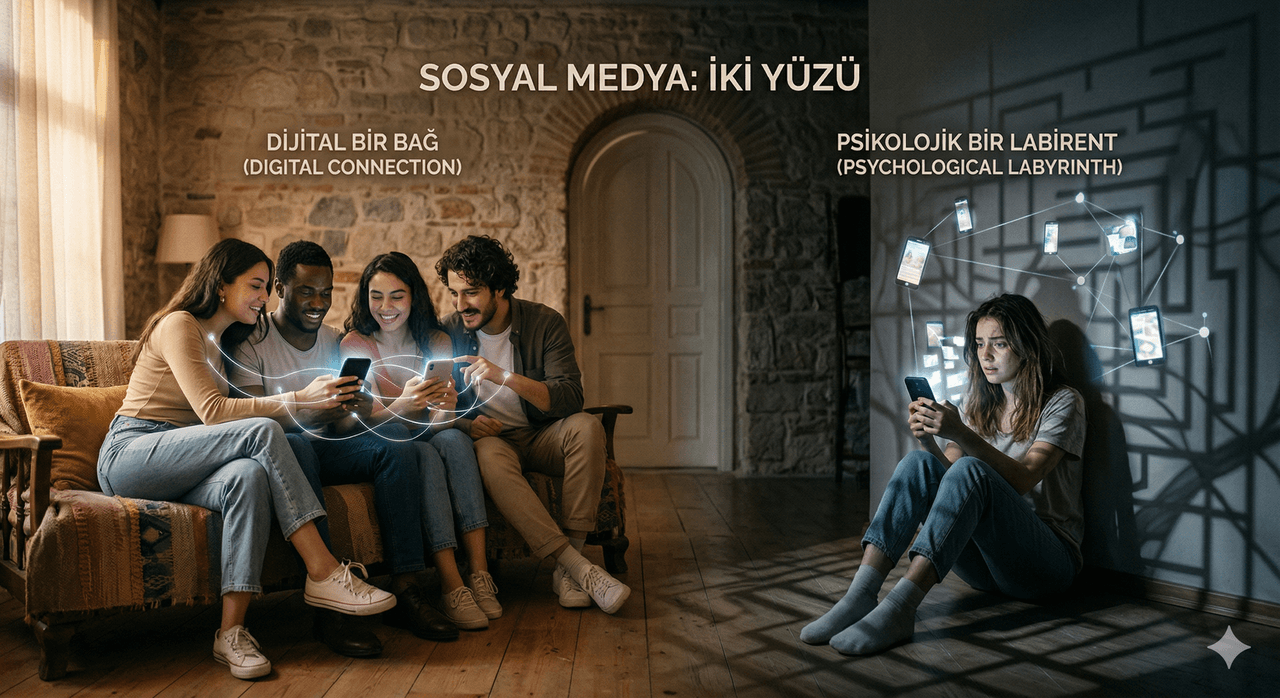
Social Media: A Digital Bond or a Psychological Labyrinth? (Generated by Artificial Intelligence.)
When used appropriately, social media use can become a mechanism for psychological support. It offers a safe harbor for individuals who struggle with face-to-face communication, enabling them to express themselves. Active participation and positive interactions enhance a person’s sense of social support and contribute to overall wellbeing.
However, the other side of the coin is far darker:
Research clearly establishes a link between time spent in front of screens and mental health. There is a direct correlation between increased time spent on platforms such as Facebook and Instagram and higher levels of depression.
Not only depression, but also FoMo (Fear of Missing Out), a condition characterized by the persistent feeling that others are experiencing rewarding events without you, is one of the greatest sources of modern anxiety. This constant sense of being left behind keeps individuals perpetually on edge and mentally tense.
Social media addiction is now recognized as one of the most critical subtypes of internet addiction. If you experience any of the following symptoms, you may need to reassess your relationship with the digital world:
Adolescence and university years, during which brain development is ongoing and identity formation is most intense, represent the most vulnerable period to the negative effects of social media. Paranoid thoughts and anxiety observed during this stage further increase the risk of addiction. Additionally, studies indicate that women, who tend to use social media more intensively for communication and sharing purposes, may be more susceptible to addiction.
Remember: social media is a tool, and keeping control over it is the key to your mental health.
Psychological Wellbeing or an Endless Comparison?
The Silent Threat: Mood Disorders and FoMo
In the Grip of Addiction: Who Is in Control?
Who Is at Risk?