This article was automatically translated from the original Turkish version.
Origin(s) | Phrygian Civilization (8th century BCE) | ||||||||
|---|---|---|---|---|---|---|---|---|---|
Region(s) | Phrygia Ankara Kütahya Afyonkarahisar Eskişehir | ||||||||
Category | Traditional and Historical Dish | ||||||||
Main Ingredients | Goose Meat, Siyez Wheat | ||||||||
Cooking Time | Approximately 3 to 4 hours | ||||||||
Serving Suggestion | On a copper plate, served with Şebit (flatbread), cherry compote or apple juice | ||||||||
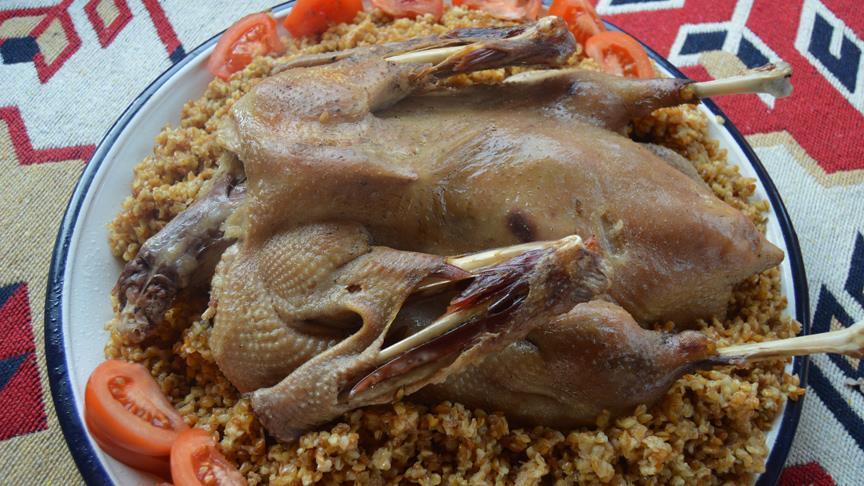
Siyez Wheat and Goose Stew is a regional dish whose origins trace back to the Phrygian civilization, which ruled Anatolia in the 8th century BCE. Investigations of pottery fragments and bird-shaped artifacts unearthed during archaeological excavations in the Phrygia region—encompassing Eskişehir, Afyonkarahisar, Kütahya, and Ankara—have revealed that the Phrygians extensively used siyez wheat and goose meat in their culinary traditions. The dish was reintroduced to public awareness in 2019 through a collaboration between the İhsaniye District Governorship and Afyon Kocatepe University, and has since been served in community centers as part of efforts to promote regional tourism.
The Phrygians sustained their livelihood through agriculture and animal husbandry in the continental climate of the Phrygia region, relying on staples such as wheat, barley, and goose meat. Archaeological findings demonstrate that their diet was predominantly based on cereals and meat, with widespread use of ceramic and metal kitchen utensils. Studies within the discipline of gastroarchaeology have uncovered evidence of Phrygian culinary practices, supporting the conclusion that siyez wheat and goose stew was an integral part of their food culture. The dish’s renewed popularity has been driven by contributions from local producers and tourism enterprises in the region.
Siyez wheat is a nutrient-rich food, high in protein and dietary fiber, and abundant in functional compounds such as polyphenols, lutein, and tocopherols. Goose meat provides B vitamins, iron, phosphorus, and selenium, offering nutritional value comparable to red meat.
Siyez wheat and goose stew is being promoted in the Phrygia region as a means of preserving cultural heritage and local culinary values. Efforts to ensure its sustainability include applying for a geographical indication, featuring the dish on restaurant menus, and promoting it at food festivals. However, research has shown that local communities have limited awareness of the dish and that promotional activities remain insufficient. To ensure its transmission to future generations, recommendations include establishing master-apprentice relationships, creating written documentation, and incorporating the dish into gastronomy education programs.
· 1 whole goose (cleaned, with internal organs removed and the fatty part beneath the tail extracted)
· 4 glasses of siyez wheat (approximately 320 g)
· 2 onions
· 4 tablespoons of butter (approximately 60 g)
· 2 tablespoons of vegetable oil (approximately 24 g)
· 10 glasses of water (approximately 2 liters)
· 1 tablespoon of salt (approximately 24 g)
· 1 tablespoon of black pepper (approximately 12 g)
After cleaning and washing the goose meat, the fatty portion beneath the tail—the akyürek—is specifically removed to prevent the broth from becoming cloudy or bitter. The meat is then seared over an open flame. The seared goose is placed in a pot with enough water to cover it and simmered over low heat for 2 to 3 hours.
For the pilaf, diced onions are sautéed in a pot with melted butter and vegetable oil. The siyez wheat is added and stirred, followed by 8 glasses of the strained goose broth.
The pilaf is seasoned with salt and black pepper, covered, and cooked over low heat for 15 to 20 minutes until all the liquid is absorbed. Separately, the cooked goose is brushed with butter and baked in an oven for approximately 20 minutes until lightly browned. In the final stage, the cooked pilaf is arranged on a serving platter, and the whole goose is placed on top. Traditionally, it is garnished with tomatoes, peppers, and thin flatbread (şebit) before serving.
Anadolu Ajansı. "Frigya’nın yeni lezzeti: 'Siyez buğdaylı kaz yemeği.'" Accessed October 5, 2025. https://www.aa.com.tr/tr/yasam/frigyanin-yeni-lezzeti-siyez-bugdayli-kaz-yemegi/1382930.
Ertoy, Serhat, Gün, Aleyna, and Polat, Eray. "Unutulmaya Yüz Tutmuş Yöresel Yemek Kültürü: Siyez Buğdaylı Kaz Yemeği Örneği." *Gümüşhane Üniversitesi Sosyal Bilimler Dergisi*, Volume 16, Issue 2, pp. 555-567. Accessed October 5, 2025. https://dergipark.org.tr/en/download/article-file/4290490.

Origin(s) | Phrygian Civilization (8th century BCE) | ||||||||
|---|---|---|---|---|---|---|---|---|---|
Region(s) | Phrygia Ankara Kütahya Afyonkarahisar Eskişehir | ||||||||
Category | Traditional and Historical Dish | ||||||||
Main Ingredients | Goose Meat, Siyez Wheat | ||||||||
Cooking Time | Approximately 3 to 4 hours | ||||||||
Serving Suggestion | On a copper plate, served with Şebit (flatbread), cherry compote or apple juice | ||||||||
No Discussion Added Yet
Start discussion for "Siyez Wheat with Goose Stew" article
Historical and Cultural Context
Nutritional Value
Evaluation within Tourism and Cultural Heritage
Ingredients
Preparation