


This article was automatically translated from the original Turkish version.
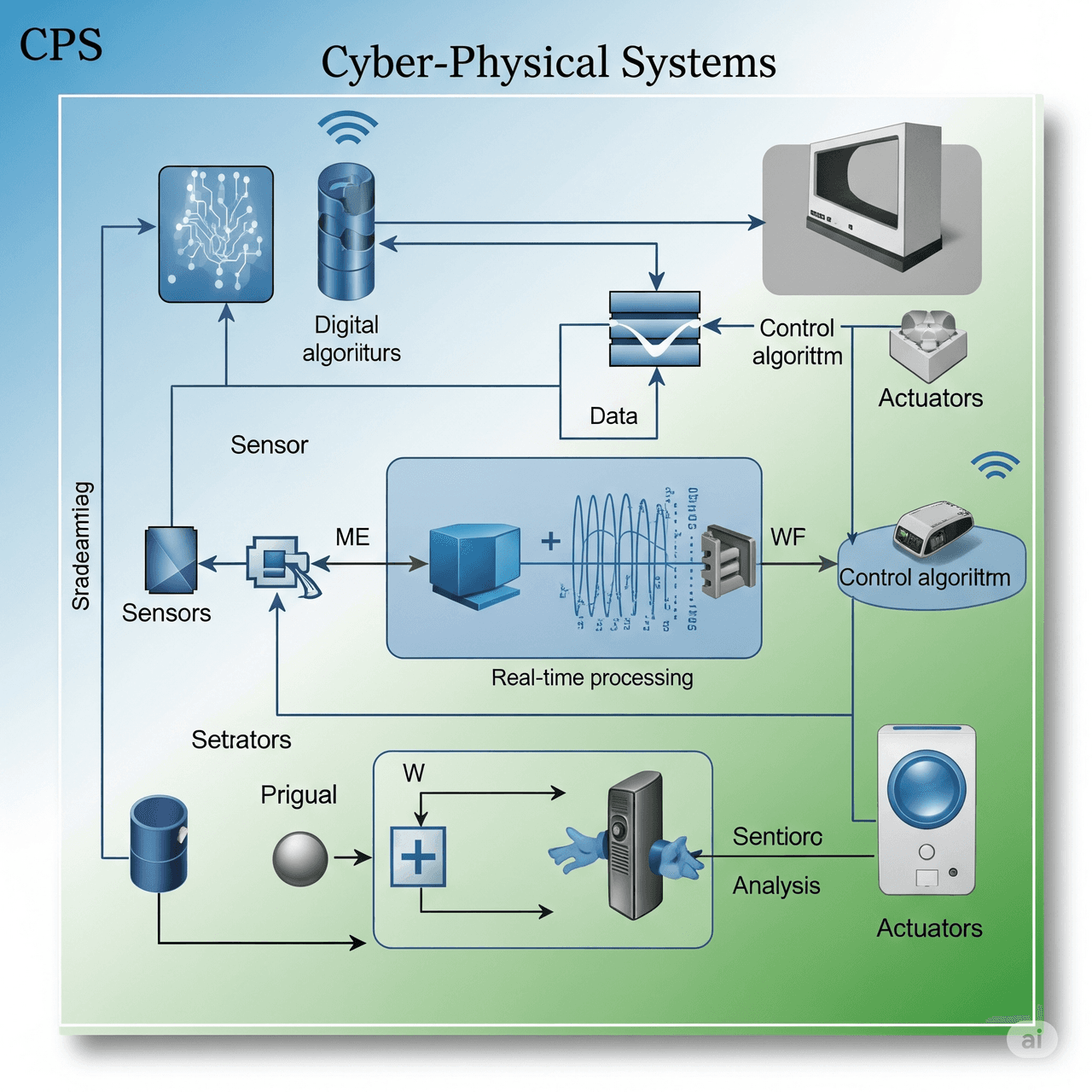
Siber Physical Systems
Basic Component | Communication modules Sensors Actuators Embedded processors Control algorithms | ||||||||
|---|---|---|---|---|---|---|---|---|---|
Related Field | Smart manufacturing Health technologies Energy management Transportation systems Automation | ||||||||
Security | System behavior modeling Dynamic-based attack detection Special protocols | ||||||||
Scheduling | Time synchronization Deterministic response times Real-time control | ||||||||
Cyber-Physical Systems (CPS) are integrated structures in which physical processes interact in real time with digital computing systems. In these systems, the physical world is monitored, analyzed, and intervened upon through embedded sensors, actuators, and control algorithms. CPS are widely used in numerous domains such as modern production lines, transportation infrastructure, smart energy grids, and medical devices, playing a critical role in the digital representation and management of physical events. This field, which unites disciplines such as embedded systems, communication networks, control theory, and physical modeling, requires a holistic approach in engineering and information technology.
Siber Fiziksel Sistemler (Yapay Zeka İle Oluşturulmuştur.)
Cyber-physical systems are structures that combine computer-based algorithms with physical processes to provide real-time control and feedback mechanisms. These systems consist of components such as sensors, actuators, communication modules, embedded processors, and control mechanisms. The system captures environmental data and transmits it to digital processors, then generates commands to induce changes in the physical world based on the resulting analysis.
The defining characteristic of these structures is the tight integration of physical and cyber components. This integration enables the fulfillment of requirements such as timing, accuracy, deterministic response times, and fault tolerance. According to Lee and Seshia, CPS can be viewed as an evolution of embedded systems; however, the key distinction is that CPS actively control physical processes, not just digital environments.
Embedded systems are fundamental building blocks of cyber-physical systems. They are defined as structures in which hardware and software operate in an integrated manner to perform specific functions. CPS extend this structure by incorporating environmental interaction, complex control systems, and networked communication. Thus, every CPS includes embedded systems, but not every embedded system is a CPS.
In embedded systems, time management is addressed at the software level, whereas in CPS, time is directly tied to physical reality. Timing errors can affect the entire system performance, making time sensitivity one of the most critical parameters. This difference also necessitates real-time computing requirements.
Real-time performance, a defining feature of CPS, means not only responding quickly but also responding at the correct time in a deterministic manner. Real-time requirements demand that systems react to specific events within millisecond-level precision. This requirement directly impacts the performance, safety, and stability of control systems.
Managing timing constraints influences both software architecture and hardware design. Real-time operating systems are critical in such scenarios. Additionally, time synchronization protocols such as the IEEE 1588 Precision Time Protocol ensure that CPS components operate in synchrony and with consistency.
The architecture proposed by Lee, Bagheri, and Kao includes a four-layer structure in the context of industrial production systems. This architecture begins with the layer of smart sensors and devices, extends through the network communication layer and the cyber services layer, and culminates in the decision-making and management layer. This multi-layered structure enables each component to interact with the physical world as well as communicate with centralized or distributed computing resources.
Furthermore, the concept of the digital twin holds a critical position in this architectural framework. A digital twin is a digital representation of a physical system. These representations allow simulation of production processes, prediction of faults, and system optimization. Digital twins play a particularly important role within the framework of Industry 4.0.
CPS lie at the heart of the Industry 4.0 concept. Smart manufacturing facilities, integrated with data analytics and the Internet of Things (IoT), possess autonomous decision-making capabilities beyond mere automation. Each machine on a production line can collect its own data, analyze it, and communicate with the rest of the system to optimize the production process.
This structure enables flexible manufacturing capabilities and makes high-variability scenarios such as personalized production feasible. It also provides benefits in critical areas such as resource utilization efficiency, maintenance planning, fault prevention, and energy management. Thanks to CPS, factories are becoming not only automated but also intelligent and self-adapting.

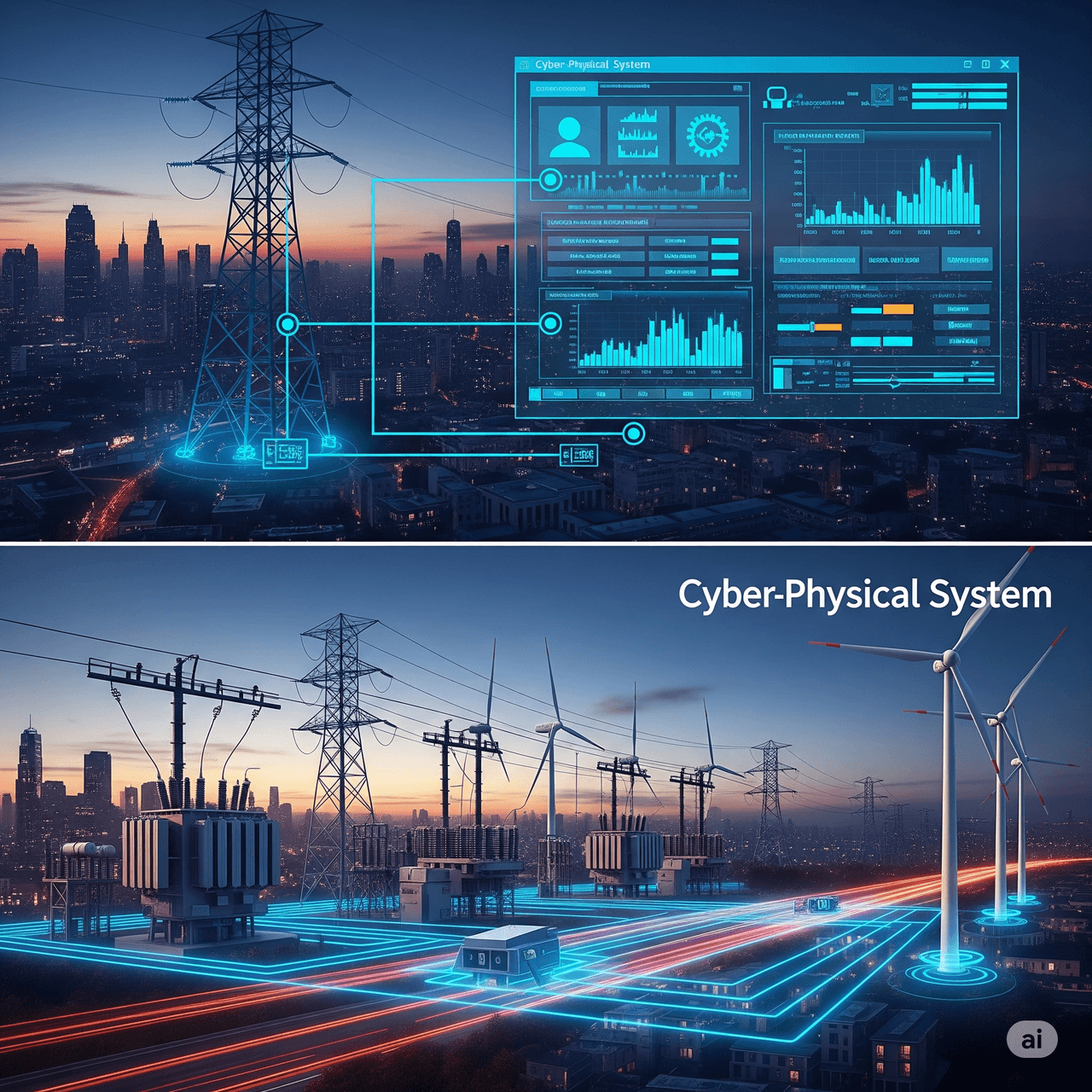
Akıllı Şehir Ağı (Yapay Zeka İle Oluşturulmuştur.)
The security perspective addressed by Pasqualetti, Dorfler, and Bullo holds special significance for CPS. Because cyber-physical systems are directly connected to physical infrastructure, cyberattacks on these systems are not limited to data breaches; they can cause physical damage, service disruptions, and even endanger human safety.
In this context, intrusion detection systems are developed by modeling the normal behavior of physical systems to identify anomalies. For example, voltage values exceeding predefined limits in an energy grid may indicate a cyberattack. Algorithms integrated with system dynamics analyze data integrity and evaluate inconsistencies to determine whether an attack has occurred.
Traditional IT security solutions such as encryption, authentication, and secure communication protocols may prove insufficient against cyber threats. Therefore, specialized security solutions have been developed using control theory, network science, and statistical methods.
Effective design of CPS requires mathematical modeling. Rajkumar and colleagues emphasize that computation, control, and communication disciplines must be addressed in an integrated manner during CPS design. A system model must encompass physical processes expressed through differential equations, software processes represented by finite state machines, and timing factors on the network.
In modeling processes, linear time-varying systems, hybrid systems, and automata-based configurations are employed. These approaches enable integrated analysis of both continuous and discrete-time components of the system. Furthermore, verification and validity analyses allow the system’s reliability and stability to be tested in advance.
The application domains of cyber-physical systems are extensive. In transportation, examples include autonomous vehicles, adaptive traffic management, and flight control systems. In healthcare, they include robotic surgery, patient monitoring systems, and drug delivery devices. In energy, examples include smart grids, load balancing, and renewable energy integration.
Additionally, smart buildings, disaster management systems, agricultural automation, and wearable technologies are other areas where these systems are effectively deployed. CPS applications enable process optimization, cost reduction, and enhanced safety.
Ongoing research in cyber-physical systems focuses on developing integrated systems with technologies such as artificial intelligence, machine learning, and quantum computing. Concepts such as adaptive control, self-improving systems, and multi-CPS networks will shape the evolution of this field.
Lee, Edward A., and Sanjit A. Seshia. Introduction to Embedded Systems: A Cyber-Physical Systems Approach. LeeSeshia, 2011.
Lee, Jay, Behrad Bagheri, and Hung-An Kao. “A Cyber-Physical Systems Architecture for Industry 4.0-Based Manufacturing Systems.” *Manufacturing Letters* 3 (2014): 18–23. Accessed June 11, 2025.https://doi.org/10.1016/j.mfglet.2014.12.001
Pasqualetti, Fabio, Florian Dörfler, and Francesco Bullo. “Attack Detection and Identification in Cyber-Physical Systems.” *IEEE Transactions on Automatic Control* 58, no. 11 (2013): 2715–2729. Accessed June 11, 2025.https://doi.org/10.1109/tac.2013.2266831
Rajkumar, Ragunathan, Insup Lee, Lui Sha, and John Stankovic. “Cyber-Physical Systems.” In Proceedings of the 34th Design Automation Conference, 2010. 731–736. Accessed June 11, 2025.https://doi.org/10.1145/1837274.1837461

Siber Physical Systems
Basic Component | Communication modules Sensors Actuators Embedded processors Control algorithms | ||||||||
|---|---|---|---|---|---|---|---|---|---|
Related Field | Smart manufacturing Health technologies Energy management Transportation systems Automation | ||||||||
Security | System behavior modeling Dynamic-based attack detection Special protocols | ||||||||
Scheduling | Time synchronization Deterministic response times Real-time control | ||||||||
No Discussion Added Yet
Start discussion for "Siber Physical Systems" article
Definition and Components of Cyber-Physical Systems
Relationship with Embedded Systems
Timing and Real-Time Performance
Cyber-Physical System Architecture
Industry 4.0 and Cyber-Physical Systems
Cybersecurity and Intrusion Detection Systems
Design Principles and System Modeling
Application Areas
Future Developments