This article was automatically translated from the original Turkish version.
First Describer | Carl Seyfert (1943) | ||||||||
|---|---|---|---|---|---|---|---|---|---|
Definition | A type of galaxy with an active galactic nucleus (AGN) of lower luminosity than quasars, whose core exhibits quasar-like properties but whose host galaxy is clearly observable | ||||||||
Appearance and Morphology | They appear like normal spiral galaxies in visible light; however, they have a central core with star-like, high surface brightness | ||||||||
Basic Classification | Type I: Have both narrow and broad emission lines. Type II: Contain only narrow emission lines. | ||||||||
Radiation Properties | They resemble normal galaxies in visible light, emit significant amounts of infrared radiation, some emit X-rays, and their radio luminosities are generally low although some produce radio jets | ||||||||
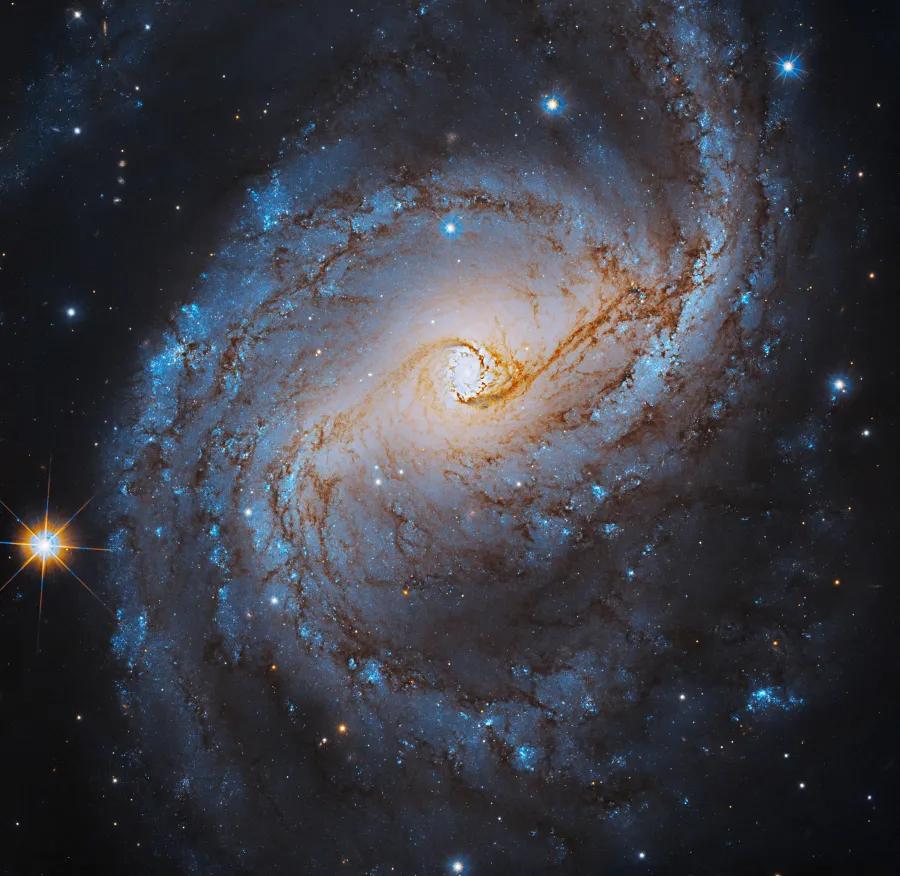
Seyfert galaxies are celestial objects that were first identified in 1943 by American astronomer Carl Seyfert. Although they appear as normal spiral galaxies, they harbor regions of quasar-like high surface brightness at their centers【1】. These galaxies constitute the most common and lowest-energy class of active galactic nuclei (AGN). Their defining characteristic is the presence of strong and highly ionized emission lines originating from their nuclei【2】. When observed in visible light, they resemble normal galaxies with what appears to be a star at their center; however, they emit significant radiation in the infrared wavelength and some also exhibit X-ray emission【3】. Seyfert galaxies are distinguished from quasars by the fact that their host galaxies can be clearly identified despite the presence of an active nucleus【4】.
The classification of Seyfert galaxies is based on the characteristics of emission lines in their nuclear spectra【5】. Khachikian and Weedman (1974) divided these galaxies into two main categories—Type I and Type II—according to the width and structure of their emission lines【6】. Although the exact origin of this distinction is not fully understood, the unification theory suggests that it may arise from differences in viewing angle or the orientation of the dense gas torus surrounding the nucleus relative to the observer【7】.
The spectra of Type I Seyfert galaxies contain two distinct sets of emission lines that overlap【8】. In this type, permitted lines are quite broad, with widths corresponding to velocities of up to 10,000 km/s【9】. These broad lines indicate the presence of high-density gas and rapid motion around the nucleus【10】. In contrast, forbidden lines (such as [OIII]) are narrower【11】.
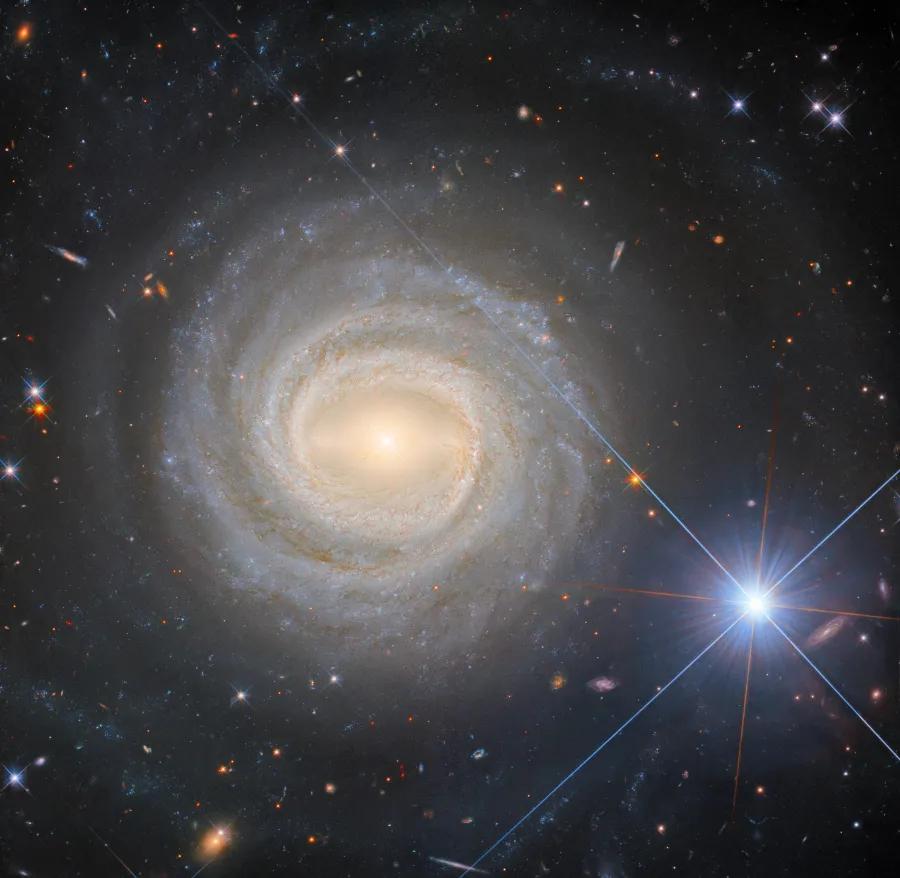
Type I Seyfert Galaxy (NASA/ESA Hubble)
In Type II Seyfert galaxies, broad emission lines are absent; both permitted and forbidden lines are narrow【12】. These spectral features are interpreted as indicating either slower motion around the nucleus or the obscuration of broad lines by dense dust clouds【13】.
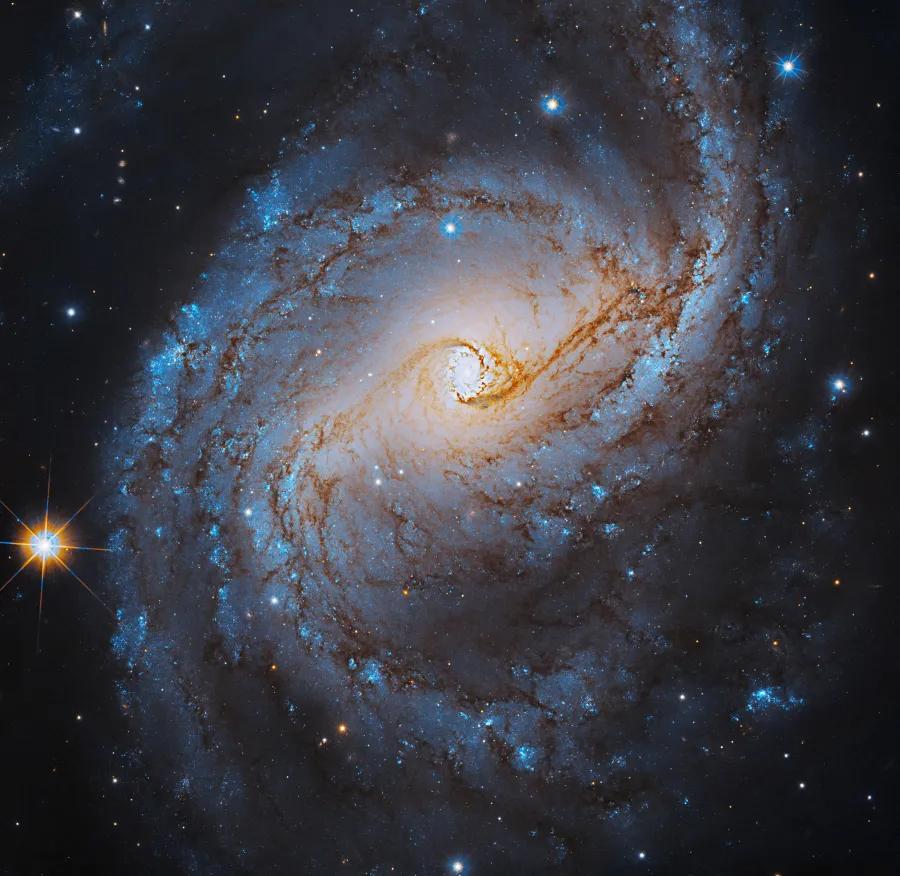
Type II Seyfert Galaxy (NASA/Hubble)
Seyfert galaxies are not always strictly classified as Type I or Type II; some exhibit properties of both types and are considered intermediate forms. Osterbrock (1977, 1981) subdivided these galaxies into subclasses—Seyfert 1.2, 1.5, 1.8, and 1.9—based on the ratio of broad to narrow components of the beta and alpha emission lines in their optical spectra【14】.
Narrow-Line Seyfert 1 (NLS1) galaxies are a special subclass of Type I Seyfert galaxies and are powerful X-ray sources. Although they resemble Type 1.9 Seyferts in having broad beta lines and narrow alpha lines, they are distinguished by strong iron (FeII) emission. In NLS1 galaxies, the ratio of the FeII line to the beta line is approximately twice as high as in other Seyfert galaxies. Additionally, the black hole at their center has a lower mass compared to other Seyfert types, and the rate of matter accretion onto the black hole approaches the Eddington limit【18】.
Morphological studies show that the vast majority of Seyfert galaxies reside in spiral galaxiesgalaksi-2. Observations with large telescopes reveal a strong featureless continuum at their centers that overwhelms the light from normal stars【19】. Infrared observations, in particular, have revealed the presence of a donut-shaped structure (torus) at the center of some Seyfert galaxies, emitting bright radiation. Seyfert galaxies typically have low radio emission power, although radio jets have been observed in some cases【20】.
NASA Hubble Mission Team. "Hubble Captures a Bright Galactic and Stellar Duo." NASA Science. April 19, 2024. Updated March 28, 2025. Accessed January 10, 2026.https://science.nasa.gov/missions/hubble/hubble-captures-a-bright-galactic-and-stellar-duo/
NASA Hubble Mission Team. "Stellar Sights in this New Hubble Galaxy Snapshot". NASA Science. October 4, 2023. Updated March 28, 2025. Accessed January 10, 2026.https://science.nasa.gov/missions/hubble/stellar-sights-in-this-new-hubble-galaxy-snapshot/
NASA/IPAC Extragalactic Database (NED). "Seyfert Galaxies." Accessed January 10, 2026.https://ned.ipac.caltech.edu/level5/Glossary/Essay_seyfert.html
National Aeronautics and Space Administration. "Types of Galaxies". NASA Science. Last updated December 8, 2025. Accessed January 10, 2026.https://science.nasa.gov/universe/galaxies/types/#seyfert-galaxies
İlhan, Muhammed Diyaddin. "Aktif Galaksi Çekirdeklerinin X ve Gama Işınlarında Gözlenen Zamansal Özellikleri." Master's thesis, İstanbul Üniversitesi, 2016. Accessed January 10, 2026.https://nek.istanbul.edu.tr/ekos/TEZ/54922.pdf
[1]
NASA/IPAC Extragalactic Database (NED). "Seyfert Galaxies". Erişim 10 Ocak 2026. https://ned.ipac.caltech.edu/level5/Glossary/Essay_seyfert.html.
[2]
NASA/IPAC Extragalactic Database (NED). "Seyfert Galaxies". Erişim 10 Ocak 2026. https://ned.ipac.caltech.edu/level5/Glossary/Essay_seyfert.html
[3]
National Aeronautics and Space Administration. "Types of Galaxies". NASA Science. Son güncelleme 8 Aralık 2025. Erişim 10 Ocak 2026. https://science.nasa.gov/universe/galaxies/types/#seyfert-galaxies.
[4]
NASA/IPAC Extragalactic Database (NED). "Seyfert Galaxies". Erişim 10 Ocak 2026. https://ned.ipac.caltech.edu/level5/Glossary/Essay_seyfert.html.
[5]
İlhan, Muhammed Diyaddin. "Aktif Galaksi Çekirdeklerinin X ve Gama Işınlarında Gözlenen Zamansal Özellikleri". Yüksek Lisans Tezi, İstanbul Üniversitesi, 2016. Erişim 10 Ocak 2026. https://nek.istanbul.edu.tr/ekos/TEZ/54922.pdf.
[6]
NASA/IPAC Extragalactic Database (NED). "Seyfert Galaxies". Erişim 10 Ocak 2026. https://ned.ipac.caltech.edu/level5/Glossary/Essay_seyfert.html.
[7]
NASA/IPAC Extragalactic Database (NED). "Seyfert Galaxies". Erişim 10 Ocak 2026. https://ned.ipac.caltech.edu/level5/Glossary/Essay_seyfert.html.
[8]
NASA/IPAC Extragalactic Database (NED). "Seyfert Galaxies". Erişim 10 Ocak 2026. https://ned.ipac.caltech.edu/level5/Glossary/Essay_seyfert.html.
[9]
NASA/IPAC Extragalactic Database (NED). "Seyfert Galaxies". Erişim 10 Ocak 2026. https://ned.ipac.caltech.edu/level5/Glossary/Essay_seyfert.html.
[10]
NASA/IPAC Extragalactic Database (NED). "Seyfert Galaxies". Erişim 10 Ocak 2026. https://ned.ipac.caltech.edu/level5/Glossary/Essay_seyfert.html.
[11]
İlhan, Muhammed Diyaddin. "Aktif Galaksi Çekirdeklerinin X ve Gama Işınlarında Gözlenen Zamansal Özellikleri". Yüksek Lisans Tezi, İstanbul Üniversitesi, 2016. Erişim 10 Ocak 2026. https://nek.istanbul.edu.tr/ekos/TEZ/54922.pdf.
[12]
NASA/IPAC Extragalactic Database (NED). "Seyfert Galaxies". Erişim 10 Ocak 2026. https://ned.ipac.caltech.edu/level5/Glossary/Essay_seyfert.html.
[13]
National Aeronautics and Space Administration. "Types of Galaxies". NASA Science. Son güncelleme 8 Aralık 2025. Erişim 10 Ocak 2026. https://science.nasa.gov/universe/galaxies/types/#seyfert-galaxies.
[14]
NASA/IPAC Extragalactic Database (NED). "Seyfert Galaxies". Erişim 10 Ocak 2026. https://ned.ipac.caltech.edu/level5/Glossary/Essay_seyfert.html.
[15]
NASA/IPAC Extragalactic Database (NED). "Seyfert Galaxies". Erişim 10 Ocak 2026. https://ned.ipac.caltech.edu/level5/Glossary/Essay_seyfert.html.
[16]
NASA/IPAC Extragalactic Database (NED). "Seyfert Galaxies". Erişim 10 Ocak 2026. https://ned.ipac.caltech.edu/level5/Glossary/Essay_seyfert.html.
[17]
NASA/IPAC Extragalactic Database (NED). "Seyfert Galaxies". Erişim 10 Ocak 2026. https://ned.ipac.caltech.edu/level5/Glossary/Essay_seyfert.html.
[18]
İlhan, Muhammed Diyaddin. "Aktif Galaksi Çekirdeklerinin X ve Gama Işınlarında Gözlenen Zamansal Özellikleri". Yüksek Lisans Tezi, İstanbul Üniversitesi, 2016. Erişim 10 Ocak 2026. https://nek.istanbul.edu.tr/ekos/TEZ/54922.pdf.
[19]
NASA/IPAC Extragalactic Database (NED). "Seyfert Galaxies". Erişim 10 Ocak 2026. https://ned.ipac.caltech.edu/level5/Glossary/Essay_seyfert.html.
[20]
National Aeronautics and Space Administration. "Types of Galaxies". NASA Science. Son güncelleme 8 Aralık 2025. Erişim 10 Ocak 2026. https://science.nasa.gov/universe/galaxies/types/#seyfert-galaxies.

First Describer | Carl Seyfert (1943) | ||||||||
|---|---|---|---|---|---|---|---|---|---|
Definition | A type of galaxy with an active galactic nucleus (AGN) of lower luminosity than quasars, whose core exhibits quasar-like properties but whose host galaxy is clearly observable | ||||||||
Appearance and Morphology | They appear like normal spiral galaxies in visible light; however, they have a central core with star-like, high surface brightness | ||||||||
Basic Classification | Type I: Have both narrow and broad emission lines. Type II: Contain only narrow emission lines. | ||||||||
Radiation Properties | They resemble normal galaxies in visible light, emit significant amounts of infrared radiation, some emit X-rays, and their radio luminosities are generally low although some produce radio jets | ||||||||
Classification and Spectral Properties
Type I and Type II Seyfert Galaxies
Type I Seyfert Galaxy:
Type II Seyfert Galaxy:
Intermediate Types
Narrow-Line Seyfert 1 (NLS1) Galaxies
Morphology and Observation