This article was automatically translated from the original Turkish version.
Astronomical Definition | Planetary nebula | ||||||||
|---|---|---|---|---|---|---|---|---|---|
Catalog Name | NGC 7009 | ||||||||
Position | Aquarius constellation | ||||||||
Distance | Approximately 5,200 light years (±300) | ||||||||
Apparent Magnitude (V-Band) | +8.0 magnitude | ||||||||
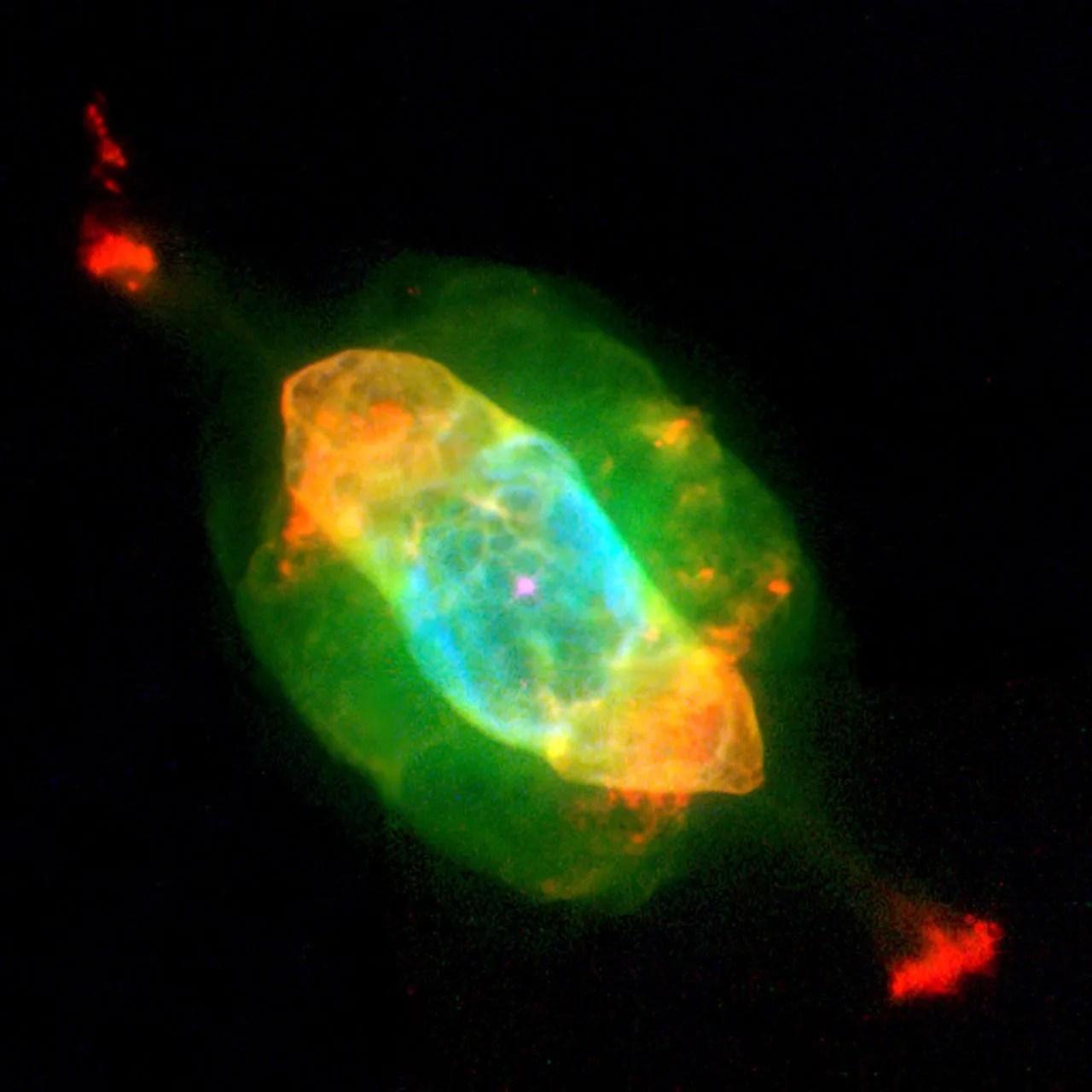
NGC 7009, commonly known as the Saturn Nebula, is a planetary nebula located in the direction of the Aquarius constellation. It derives its name from its structural protrusions, which resemble the rings of the planet Saturn when observed. The nebula was discovered by William Herschel on 7 September 1782. Due to its visibility and intricate structure, it is frequently studied in astrophysical research.
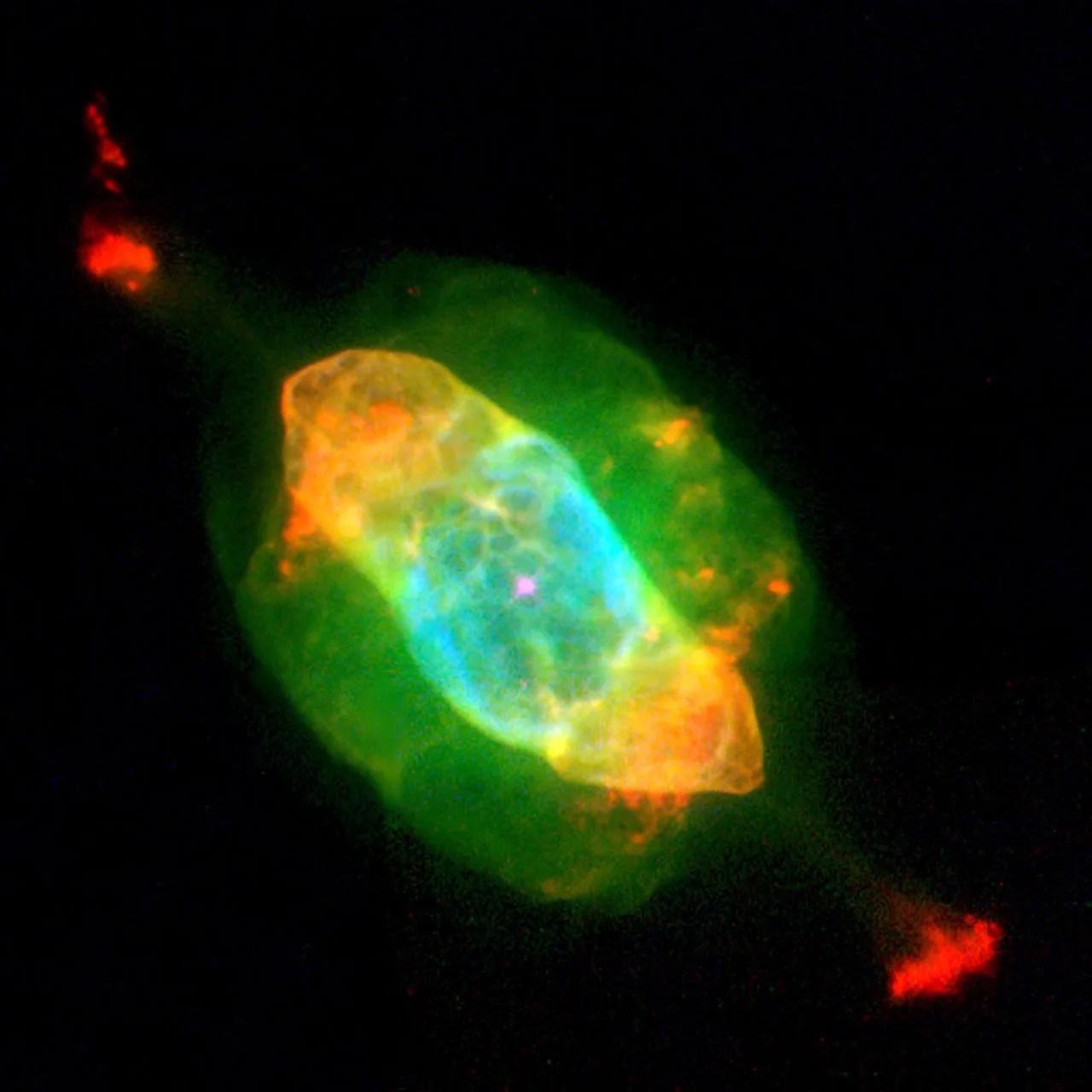
Saturn Nebula. (NASA)
The Saturn Nebula has a complex structure consisting of a central core and extended features known as ansae, or "ear-like protrusions." At its center lies a white dwarf star that has shed its outer layers during the final stages of its evolution.
NGC 7009 contains layered ionized gas that glows due to ultraviolet radiation emitted by the hot central white dwarf. Some of the prominent gases observed in the nebula include:
The distribution of these elements provides insights into the nebula’s evolutionary history. In particular, the [O III] emission lines make the Saturn Nebula visible even through amateur telescopes.
One of the characteristic features of NGC 7009 is the presence of ansae—symmetrical, outward-extending structures named after the Latin word for "handles." These protrusions are associated with high-velocity jets of ionized gas ejected from the central region.
Spectroscopic analyses provide information on the nebula’s density, temperature, and chemical composition. The Saturn Nebula exhibits high levels of ionization. Measured technical parameters include:
NGC 7009 has been studied in high resolution by numerous professional observatories, including the Hubble Space Telescope. Its morphological structure, ionization zones, symmetric features, and ejected gas masses reveal signs of a dynamic evolutionary process.
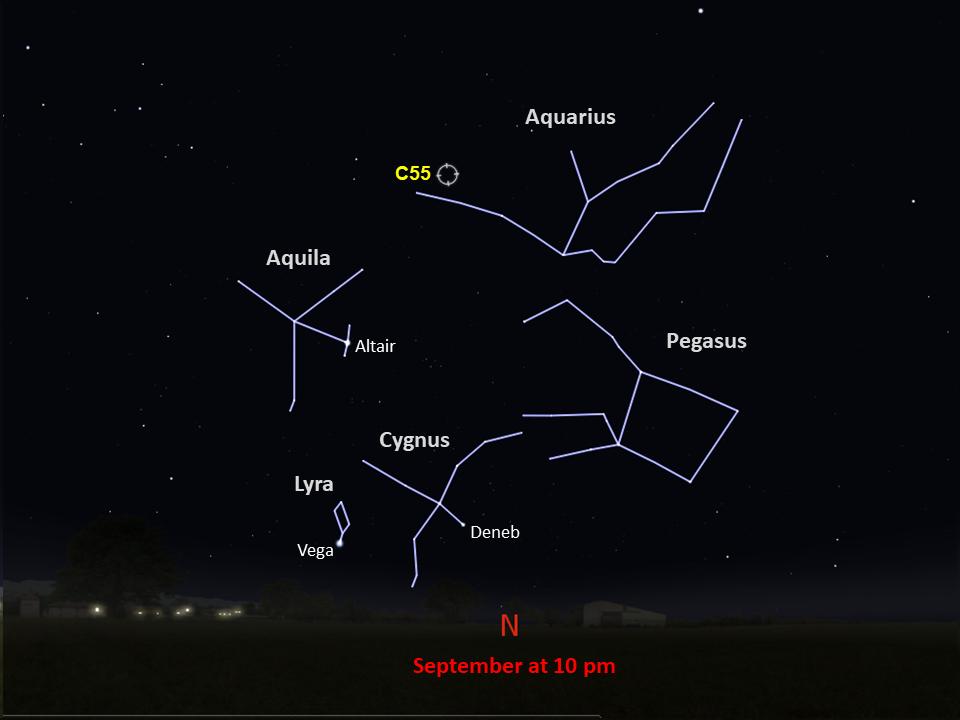
Position of the Saturn Nebula. (NASA)
Modern interferometric studies have determined that the stellar winds from the central star have shaped the nebula’s structure. Although it does not exhibit a bipolar morphology, its internal structure contains multi-axial symmetry elements.
The Saturn Nebula is a structure formed during the late stages of evolution of a star similar to the Sun. After passing through the red giant phase, the central star expels its outer layers and its core collapses into a white dwarf. Planetary nebulae like this one disperse over several thousand years.
The current state of NGC 7009 represents a transient but significant phase in stellar evolution. Such nebulae are important for understanding how stars return matter and energy to their surrounding environment.
NGC 7009 (Saturn Nebula) is an important example for studying the structural and evolutionary properties of planetary nebulae, due to its physical structure, spectral composition, and observable details. Its high ionization levels, symmetric extensions, and the hot white dwarf at its center continue to contribute valuable data to astronomical research.
ESA/Hubble. “Planetary Nebula NGC 7009 (Saturn Nebula) – OPO9738M.” ESA/Hubble – European Space Agency. Accessed July 17, 2025.https://esahubble.org/images/opo9738m/
NASA. "Planetary Nebula NGC 7009." NASA Science. Accessed July 17, 2025.https://science.nasa.gov/asset/hubble/planetary-nebula-ngc-7009/
NASA. “C55-1.” NASA Science. Accessed July 17, 2025.https://science.nasa.gov/image-detail/c55-1/
NASA. “Caldwell 55.” NASA Science – Hubble Caldwell Catalog. Accessed July 17, 2025.https://science.nasa.gov/mission/hubble/science/explore-the-night-sky/hubble-caldwell-catalog/caldwell-55/
NASA. “Hubble’s Planetary Nebula Gallery: A View of NGC 7009.” NASA Science. Accessed July 17, 2025.https://science.nasa.gov/image-detail/hubbles-planetary-nebula-gallery-a-view-of-ngc-7009/

Astronomical Definition | Planetary nebula | ||||||||
|---|---|---|---|---|---|---|---|---|---|
Catalog Name | NGC 7009 | ||||||||
Position | Aquarius constellation | ||||||||
Distance | Approximately 5,200 light years (±300) | ||||||||
Apparent Magnitude (V-Band) | +8.0 magnitude | ||||||||
No Discussion Added Yet
Start discussion for "Saturn Nebula (NGC 7009)" article
Physical and Observational Properties
Structural Features
Central Star
Gas and Dust Structure
Ansae (Ear-like Protrusions)
Spectroscopic Properties
Observational History and Studies
Evolutionary Process