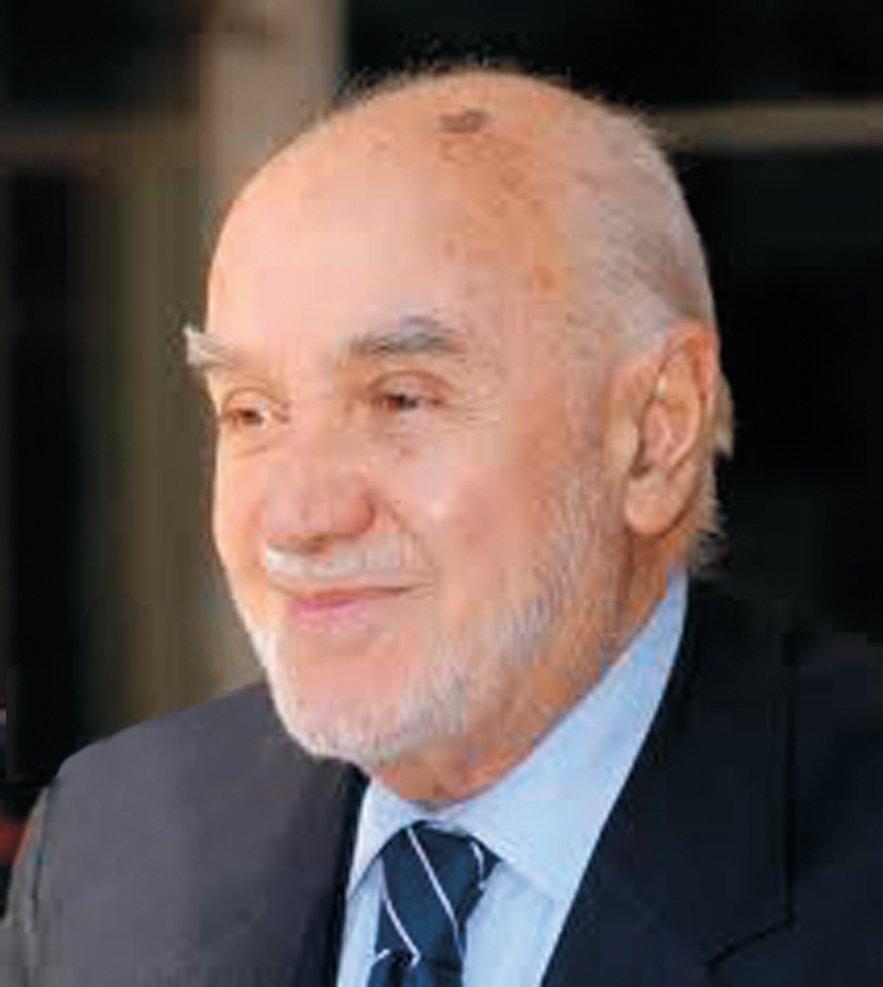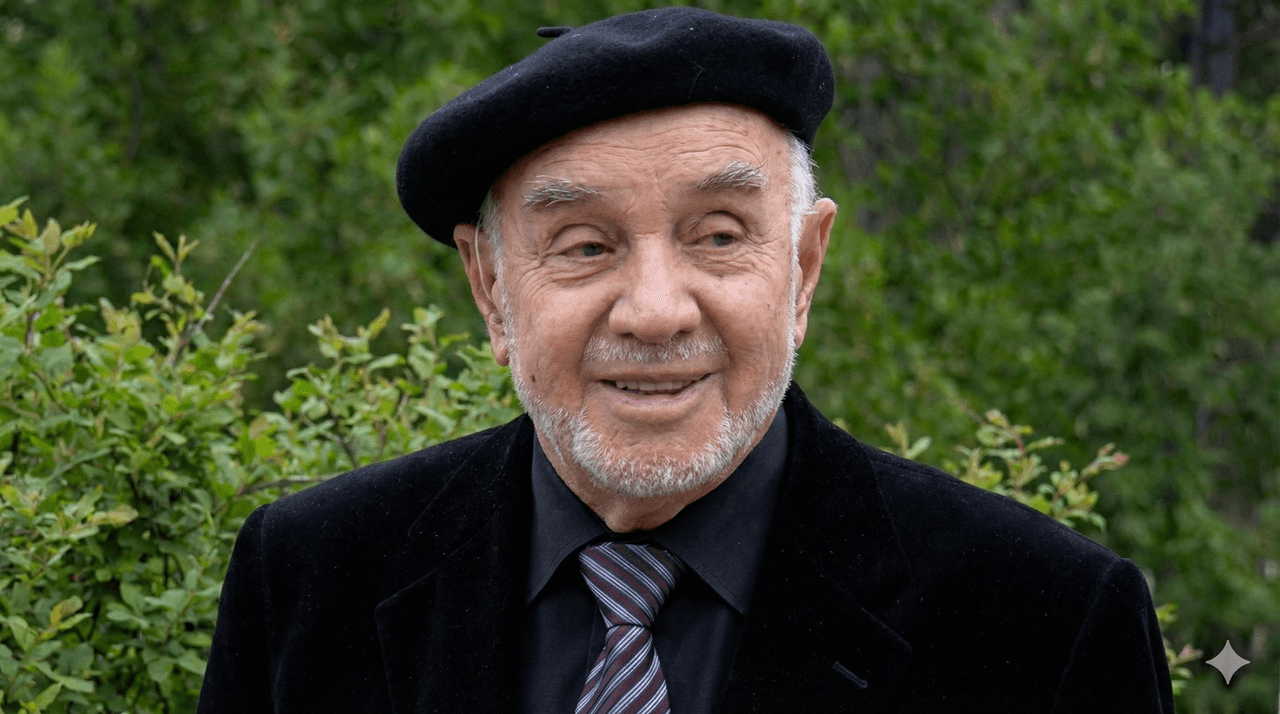
+2 More

Birth | 1926 | ||||||||
|---|---|---|---|---|---|---|---|---|---|
Place of Birth | İştip Skopje Macedonia | ||||||||
Family Migration | 1934 | ||||||||
Education | Ankara University Faculty of Political Sciences (1947) | ||||||||
Doctorate | Istanbul University (1955) | ||||||||
Associate Professorship | 1957 | ||||||||
Professorship | 1965 | ||||||||
Academic Beginning | Social Policy Chair (1953) Istanbul University Faculty of Economics | ||||||||
Areas of Expertise | Labor economics Islamic economics Social policy | ||||||||
Overseas Assignments | King Abdulaziz University, Jeddah Cornell University University of Munich | ||||||||
Administrative Positions | Member of YÖK (1998–2000) Founding Dean, Sakarya University Faculty of Economics and Administrative Sciences | ||||||||
Civil Society | Founding member of the Science Dissemination Foundation and various foundations/societies | ||||||||
Number of Works | 20 books 174 articles | ||||||||
Death | 10 December 2007 | ||||||||
Burial | Edirnekapı Cemetery family cemetery | ||||||||
Institution That Preserves His Name | Istanbul Sabahattin Zaim University (2010) etc. | ||||||||
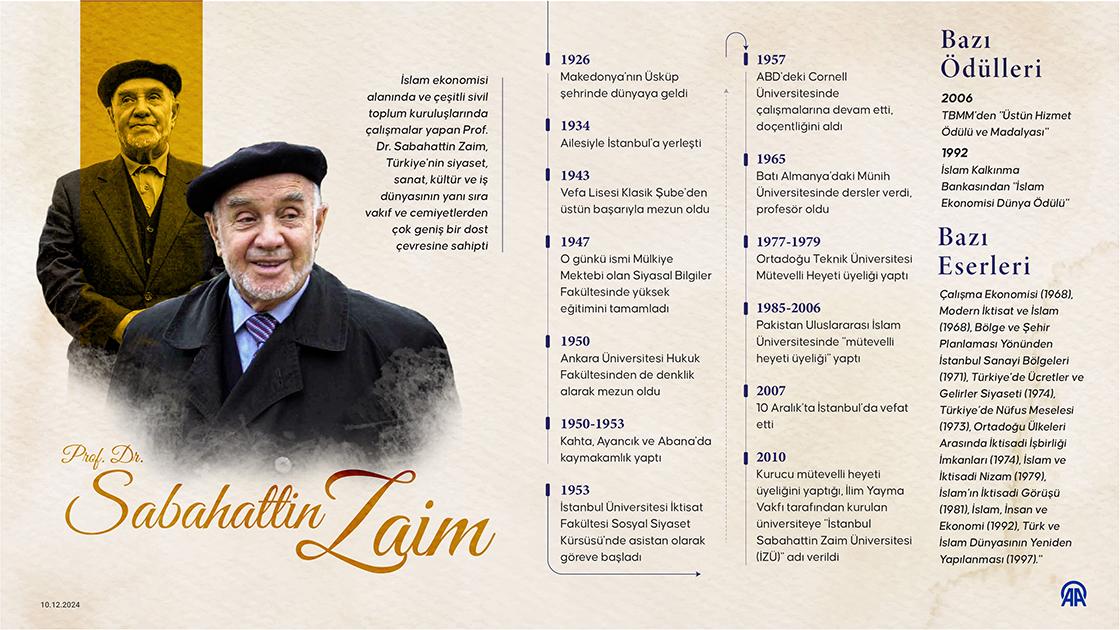
Sabahattin Zaim was an academic, economist, and educator who made significant contributions in the fields of labor economics, social policy, and Islamic economics in Türkiye. Born in 1926 in the town of İştip, within the Üsküp region of Macedonia, Zaim migrated to Türkiye with his family in 1934 and settled in Istanbul. He completed his higher education in 1947 at the Faculty of Political Sciences of Ankara University and began his academic career in 1953 at the Chair of Social Policy at the Faculty of Economics of Istanbul University. Throughout his nearly half-century-long academic career, Zaim held various positions in public and civil society organizations and played a key role in institutionalizing economic and social policy studies in Türkiye. Sabahattin Zaim passed away on December 10, 2007, at the age of 81. Since his death, his name has been preserved through various educational institutions, including the Istanbul Sabahattin Zaim University, established in 2010.
class=\
Sabahattin Zaim was born in 1926 in the district of İştip, within the city of Üsküp in Macedonia. His father’s name was Mehmed Efendi and his mother’s name was Saime Hanım. On his father’s side, the family lineage traces back to Aslan Zaîm, who migrated from Konya to the Balkans in the 17th century and was granted a position of authority in İştip due to his participation in regional conquests; the surname “Zaim” originated from this appointment. On his mother’s side, the family lineage extends to Âyan Ahmed Ağa, son of Kara Otmanlı Ali Ağa, who settled in Köprülü from the Caucasus during the same century.
Following increased pressure against Turks and Muslims in Yugoslavia after World War I, Zaim’s family migrated to Türkiye in 1934 and settled in Istanbul.
Sabahattin Zaim began his education at the age of five in İştip. After his family’s migration to Türkiye in 1934, he continued his primary education at Fethiye Primary School in Istanbul’s Fatih district. He completed primary school in 1937 and graduated from Fatih Middle School in 1940. He continued his secondary education at Istanbul Vefa High School, from which he graduated in 1943 from the classical division; his curriculum included Latin and English courses.
In 1943, Zaim passed the university entrance examination and enrolled in the Administrative Branch of the Faculty of Political Sciences at Ankara University, graduating in 1947. After completing his undergraduate studies, he received a degree equivalence from the Faculty of Law at Ankara University in 1950.
After completing his higher education, Sabahattin Zaim entered public service in 1947 as a personal secretary in Istanbul. Between 1947 and 1949, he served as acting district governor in the districts of Fatih and Eyüp. Following his tenure as personal secretary and acting governor, he was appointed as full district governor in 1950 and assigned to Kâhta district of Malatya (today part of Adıyaman). After his service in Kâhta, he served as district governor in Ayancık (Sinop) and Abana (Kastamonu), holding these positions between 1950 and 1953.
During this period, Zaim conducted studies on the administrative structures of the districts where he served; his years as district governor constituted his first official experience in public administration. His transition to an academic career occurred at the end of this period.
class=\
In 1953, Sabahattin Zaim left his position as district governor and began his academic career as an assistant at the Chair of Social Policy at the Faculty of Economics of Istanbul University. He continued his doctoral studies at the same faculty and earned his doctorate in 1955. Among the scholars who taught him during his doctoral period were Gerhard Kessler, Fritz Neumark, and Alfred Isaac, academics who had come from Germany to Türkiye.
In the same year he completed his doctorate, 1955, Zaim traveled to the United States of America and conducted academic research at Cornell University. There, he prepared his associate professorship thesis and, upon returning to Türkiye, passed the associate professorship examination. In 1957, he became a tenured faculty member at the Chair of Social Policy at the Faculty of Economics of Istanbul University. He continued his academic activities at the same chair as an associate professor from 1957 to 1965. His work during this period focused intensively on social policy, labor force, productivity, and industrial structures, laying the groundwork for more comprehensive research in these areas in subsequent years.
In 1963, Zaim traveled to West Germany to learn a second foreign language required for professorship. Between 1963 and 1964, he served as a visiting faculty member at the University of Munich. Upon his return to Türkiye, he was granted the title of professor in 1965 and began serving as a professor at the Faculty of Economics of Istanbul University. Throughout his professorship, he continued teaching and conducting research in the fields of social policy, labor economics, and labor markets.
In 1979, Zaim was appointed head of the Chair of Social Policy, a position he held until his retirement from Istanbul University. His fundamental academic duties at Istanbul University included teaching at undergraduate, graduate, and doctoral levels, directing research projects, and managing the chair. Additionally, he served as a faculty member at the Institute of Business Economics of Istanbul University between 1973 and 1980 and again between 1983 and 1993.
Sabahattin Zaim completed his primary faculty position at Istanbul University in July 1993 upon retiring at the mandatory retirement age.
Sabahattin Zaim’s first academic appointment abroad was his research at Cornell University in the United States between 1955 and 1957. His second academic appointment abroad was as a visiting faculty member at the University of Munich in West Germany between 1963 and 1964.
Between 1980 and 1982, he served as a visiting faculty member at the Department of Socio-Technical Studies, Faculty of Engineering, King Abdulaziz University in Jeddah, Saudi Arabia. During this period, he was on leave from Istanbul University and taught courses in the department for two years.
Zaim’s highest-level administrative academic position abroad was as founding rector of the International University of Sarajevo, a role he held between 2003 and 2004.
Additionally, until 2006, he served as a member of the board of trustees of the International Balkan University in Üsküp, Macedonia.
After retiring from Istanbul University in July 1993 at the mandatory retirement age, Zaim was appointed as founding dean of the Faculty of Economic and Administrative Sciences at the newly established Sakarya University, in accordance with a legislative change to the Higher Education Council’s regulations that same year. During his tenure as dean of the Faculty of Economic and Administrative Sciences from 1993 to 1996, he also continued his academic activities at the university as a professor from 1993 to 1998. During this period, he taught courses at both undergraduate and graduate levels and also attended graduate courses at the Department of Labor Economics, Faculty of Economics, Istanbul University.
Zaim retired for the second time from Sakarya University in 1998. In the same year, he was appointed as a member of the Higher Education Council (YÖK), a position he held from 1998 to 2000. His membership in YÖK represented one of the highest national administrative roles he undertook during the period when Türkiye’s higher education policies were being shaped.
class=\
Sabahattin Zaim’s academic work focused on numerous fields including labor economics, social policy, labor markets, productivity, industrial regions, population, income policies, and Islamic economics. It is noted that Zaim is recognized as one of the founders of labor economics as a discipline in Türkiye, and his pioneering research covered topics such as labor force, productivity, labor markets, industrial regions, migration patterns, and urban planning. During his time in the United States, he examined the emerging literature on labor economics and introduced this approach to Türkiye, contributing to the institutional development of the Chair of Social Policy.
【1】
Among Zaim’s scientific works, his doctoral thesis İstanbul Mensucat Sanayiinin Bünyesi ve Ücretler (1956) and the book Çalışma Ekonomisi (1968) stand out; the former is described as an example of applying theoretical economics to industrial structure. Other works by Zaim include Modern İktisat ve İslâm (1969), İslâm ve İktisadî Nizam (1979), Türkiye’de Nüfus Meselesi (1973), Türkiye’de Ücret ve Gelirler Siyaseti (1974), İslâm’ın İktisadî Görüşü (1981), İslâm, İnsan ve Ekonomi (1992), and Türkiye’nin İktisadî ve Sosyal Gelişmesinde İşgücü ve Prodüktivite Meselelerinin Önemi ve Tesiri. Additionally, between 1980 and 1981, he served as a representative for Islamic banking within the Organization of the Islamic Conference (OIC), a role that reflected the practical application dimension of his academic work.
In the field of Islamic economics, Sabahattin Zaim is regarded as one of the early researchers who contributed to the development of the international literature in Türkiye. He was among the first to bring Islamic economics topics to public discourse in Türkiye and had the opportunity to study the literature on this subject during his time in the United States. In 1976, he served as deputy chair at the First World Congress of Islamic Economics held in Mecca and later published original and translated works on Islamic economics.
Among Zaim’s articles, the study titled “İktisadî Faaliyetlerde İslâmî Davranış Tarzı” (1978) and the English-language article “Contemporary Turkish Literature on Islamic Economics” (1980) are particularly notable; these works both discuss the Islamic approach within the framework of behavioral economics and introduce the developing Turkish literature to the international academic community.
Sabahattin Zaim produced numerous articles, conference papers, and lecture texts, with his total number of publications estimated to approach 180. These works include academic texts addressing labor policy, wage theories, work ethics, regional development, and economic behavior patterns. He also contributed to the compilation of literature and prepared texts evaluating Türkiye’s social and economic structure.
In addition to his academic work, Sabahattin Zaim held administrative positions in various public institutions and industrial organizations. These roles encompassed activities related to public administration, efficiency policies, and industrial structure during different periods.
His first public service role was as a member of the Social Affairs Civil Committee of the Turkish National Unity Committee between 1960 and 1961. Between 1975 and 1977, he served on the Board of Directors of the National Productivity Center, contributing to studies on labor productivity and productivity policies in Türkiye.
Among his activities in industrial organizations, he served on the Board of Directors of Pancar Motor (Gümüş Motor) between 1958 and 1963. He also served as Chairman of the Board of Directors of SOYTAŞ and SOYTUR A.Ş. between 1975 and 1980, as a member and supervisor of Uzel Tractor Industry between 1977 and 1980, as a member of the Board of Directors of TÜMOSAN between 1977 and 1979, and as a supervisor of Anadolu Glass Industry A.Ş. between 1975 and 1978.
In the financial sector, he served as Vice Chairman of the Board of Directors of Faisal Finance Corporation A.Ş. between 1998 and 2001 and as an advisor and member of the Audit Board of Kuveyt-Türk Finance Corporation from 1995 onward.
Zaim’s administrative activities also extended to institutions outside universities. Between 1977 and 1979, he served as a member of the Board of Trustees of Middle East Technical University. Additionally, from 1985 onward, he served as a member of the Board of Trustees of the International Islamic University in Islamabad.
In addition to his academic and administrative roles, Sabahattin Zaim participated in various civil society organizations over many years.
Internationally, he was a member of the International Industrial Relations Society (Switzerland), the American International Industrial Relations Society, and the International Society of Muslim Social Scientists (USA). He was also among the founding members of the International Society of Islamic Economists in Leicester, England.
In Türkiye, he served as a founding or board member in numerous educational, cultural, and intellectual organizations. He was both a founding member and board member of the Society for the Dissemination of Science and the Society for the Dissemination of Science Foundation. He was a founding member of the Turkish National Culture Foundation, the Turkish Intellectuals’ Hearth, and the Foundation for Research on Islamic Sciences. Additionally, he served as founding president of the Business World Foundation and president of the Anatolia Education Foundation.
In addition, he was a member of the Civil Servants Union (member no: 367) and the Turkish Green Crescent Society (member no: 6985). He also served as a founding member of the Vefa High School Alumni Foundation.
Sabahattin Zaim’s intellectual approach was shaped primarily around the axes of social policy, labor economics, conservative modernization, education, human-centered development, religion-science relations, and East-West comparison.
Zaim’s approach to social policy was based on defining it as a discipline that scientifically examines labor-related issues. He classified social policy according to its connections with disciplines such as sociology, economics, and psychology.
【2】
In Zaim’s intellectual framework, the “human” is clearly positioned as a central element. According to his view, the decisive factor in the development of societies is the human element; the common feature of successful societies is their ability to effectively utilize human resources. In this context, Zaim emphasized that development depends on human cultivation.
His approach to education was based on criticism of the Turkish education system for its failure to develop a curriculum aligned with social dynamics. He argued that direct adoption of Western models had not yielded results and that education must be compatible with societal values. According to him, the uncritical adoption of Western educational models fails to produce cultural and intellectual resonance, and thus the desired outcomes cannot be achieved; he believed the education system must follow both local and universal guidelines.
【3】
Regarding the relationship between religion and science, Zaim is recognized among scholars who reject the notion that modern science must conflict with religion. He argued that the problematic relationship between positivist science and religion does not make religion an unnecessary component of scientific activity. In this context, he noted that he often cited relevant verses at the beginning of chapters in his works to illuminate the subject matter.
【4】
The East-West comparison also holds an important place in Zaim’s intellectual framework. While analyzing the differences created by modernization processes in social structures, he argued that Türkiye’s modernization experience has a distinct social background compared to the West and that discussions of modernization remain incomplete if these differences are not taken into account. According to him, the industrialization process in Ottoman society experienced interruptions, and due to differences in social structure, the pains of Western modernization were not experienced in the same manner.
【5】
Another element influencing Zaim’s intellectual approach is his interpretation of conservative modernization. Sources indicate that Zaim developed a progressive and developmental model within the conservative thought world, serving as an example of conservative modernization through his practices in finance, development, and education. This approach is based on the view that a balance must be struck between adopting Western scientific and technological achievements and preserving cultural values.
【6】
Zaim’s intellectual perspective also emphasizes interdisciplinary thinking and openness to other fields of science. In this context, he argued that a scientist must not only deepen expertise in their own field but also maintain contact with other disciplines.
class=\
Sabahattin Zaim’s academic legacy is evident through the large number of students he educated over many years at various higher education institutions and the positions they later assumed in Türkiye’s public administration, politics, academia, and business world.
Zaim’s relationship with his students was not limited to classroom activities. At various times, he hosted his students at his home for discussions and exchanges of ideas.
Among his students are many prominent figures, including President Recep Tayyip Erdoğan, Abdullah Gül, Nazım Ekren, Beşir Atalay, Kemal Unakıtan, Nevzat Yalçıntaş, and Sami Güçlü.
Sabahattin Zaim passed away on the night of December 10, 2007, at 04:15, at the age of 81, while undergoing treatment for lymphatic cancer. A large number of political and bureaucratic figures attended his funeral prayer held at Fatih Mosque; among those present were President Recep Tayyip Erdoğan, Abdullah Gül, Ahmet Davutoğlu, Nevzat Yalçıntaş, Numan Kurtulmuş, Kemal Unakıtan, Kadir Topbaş, and Ali Coşkun, as well as numerous figures from politics, education, and economics. The funeral prayer was led by Muhammed Emin Saraç, a representative of the religious establishment. Zaim’s body was buried in the family cemetery at Edirnekapı Cemetery following the ceremony. Since his death, commemorative events have been regularly organized by various institutions.
Following Zaim’s death, educational institutions were established in various cities of Türkiye with the aim of institutionalizing his academic and social contributions. In this context, the higher education institution established in 2010 by the Society for the Dissemination of Science Foundation, “İstanbul Sabahattin Zaim University”, is the most comprehensive and institutional structure bearing his name. In addition to Istanbul, educational institutions and dormitories bearing Zaim’s name have been established in Sakarya, Gaziantep, and many other provinces.
“Honor Gift for Service to Turkish National Culture,” Turkish National Culture Foundation, February 7, 1990.
“World Award for Islamic Economics,” Islamic Development Bank, 1992.
“Islamic Bank Award,” LARIBA Banking, Los Angeles, United States of America, 1996.
“Outstanding Service Award and Honorary Membership,” Independent Industrialists and Businessmen Association (MÜSİAD), 2002.
“Outstanding Service Award,” Turkish Writers Union, 2003.
“Gratitude Award to a Person of Foundation,” Birlik Foundation, May 9, 2005.
“Outstanding Service Award and Medal,” Grand National Assembly of Türkiye, May 2, 2006.
【7】
Sabahattin Zaim authored 20 books and 174 articles.
【8】
【9】
【10】
Anadolu Ajansı. "Prof. Dr. Sabahattin Zaim, Vefatının 17. Yılında Hayır Ve Dualarla Yad Ediliyor." Accessed December 7, 2025.https://www.aa.com.tr/tr/kultur/prof-dr-sabahattin-zaim-vefatinin-17-yilinda-hayir-ve-dualarla-yad-ediliyor/3420132
Anadolu Ajansı. “Eğitime Adanan Bir Ömürdü: Sabahattin Zaim...” Accessed December 7, 2025.https://www.aa.com.tr/tr/arsiv/-egitime-adanan-bir-omurdu-sabahattin-zaim/428279
Bursa Uludağ Üniversitesi İktisadi ve İdari Bilimler Fakültesi. “Prof. Dr. Sabahattin Zaim.” Accessed December 7, 2025.https://www.uludag.edu.tr/iibf/prof-dr-sabahattin-zaim-14994
CNN Türk. "Hocaların Hocası Son Yolculuğunda." Accessed December 7, 2025.https://www.cnnturk.com/turkiye/hocalarin-hocasi-son-yolculugunda-179883
Hürriyet. "Prof. Dr. Zaim'in Cenazesine Yoğun Katılım." Accessed December 7, 2025.https://www.hurriyet.com.tr/gundem/prof-dr-zaimin-cenazesine-yogun-katilim-7843726
Istanbul SabahattinZaim Üniversitesi. "Prof. Dr. Sabahattin Zaim." Accessed December 7, 2025.https://www.izu.edu.tr/izu-hakkinda/tarihce/prof-dr-sabahattin-zaim
Istanbul SabahattinZaim Üniversitesi. “Prof. Dr. Sabahattin Zaim Vefatının 10. Yılında Anıldı.” Accessed December 7, 2025.https://izu.edu.tr/ozel-yetenekli-cocuklar-eaum-izucem/anasayfa/2017/12/18/prof.-dr.-sabahattin-zaim-vefat%C4%B1n%C4%B1n-10.-y%C4%B1l%C4%B1nda-an%C4%B1ld%C4%B1
Istanbul SabahattinZaim Üniversitesi. “Sabahattin Zaim Belgeseli – IKDER.” YouTube. Accessed December 7, 2025.https://www.youtube.com/watch?v=8ACbe7QoLNA
Kucur, Fatih. Türkiye’de Sosyal Politika Bilimi’nin Gelişimi ve Sabahattin Zaim Örneği. Master's thesis, İstanbul Üniversitesi Sosyal Bilimler Enstitüsü, 2011.
Milliyet. "Prof. Dr. Zaim Vefat Etti." Accessed December 7, 2025.https://www.milliyet.com.tr/gundem/prof-dr-zaim-vefat-etti-257672
Orman, Sabri. *40 Vakıf İnsan*. Edited by Prof. Dr. Salih Tuğ. İstanbul: Türkiye Millî Kültür Vakfı, 2011. Accessed December 7, 2025.https://www.tmkv.org.tr/kitaplar/detay/40-Vakif-Insan
Sakarya Üniversitesi Sociology Department. "Prof. Dr. Sabahattin Zaim Vefat Etti." Accessed December 7, 2025.https://sosyoloji.sakarya.edu.tr/tr/duyuru/goster/16031/prof-dr-sabahattin-zaim-vefat-etti
Sakarya Üniversitesi. “Bölümümüz Kurucusu Prof. Dr. Sabahattin Zaim’in Özgeçmişi.” Accessed December 7, 2025.https://ceko.sakarya.edu.tr/tr/icerik/17485/8475/bolumumuz-kurucusu-prof-dr-sabahattin-zaim-in-ozgecmisi
Sarı, Buşra. “Glokal Liderlik: Sabahattin Zaim Örneği.” *Uluslararası Liderlik Çalışmaları Dergisi: Kuram ve Uygulama* 3, special issue 1 (2020): 1–12. Accessed December 7, 2025.https://dergipark.org.tr/tr/pub/ijls/issue/57658/749087#article_cite
TRT Avaz. “Hocaların Hocası Prof. Dr. Sabahattin Zaim ve Hayatı - Devrialem - TRT Avaz.” YouTube. Accessed December 7, 2025.https://www.youtube.com/watch?v=DSSzpzyQGxg
TRT Avaz. “Kuzey Makedonya'da 'Sabahattin Zaim Anma Programı' Düzenlendi.” Accessed December 7, 2025.https://www.trtavaz.com.tr/haber/tur/turkistandan/kuzey-makedonyada-sabahattin-zaim-anma-programi-duzenlendi/67680475a73aa39de40915ac
TRT Haber. "TBMM Başkanı Kurtulmuş, Sabahattin Zaim Anma Programı'nda Konuştu." Accessed December 7, 2025.https://www.trthaber.com/haber/gundem/tbmm-baskani-kurtulmus-sabahattin-zaim-anma-programinda-konustu-892326.html
Yeni Şafak. "Sabahattin Zaim Hoca Vefat Etti." Accessed December 7, 2025.https://www.yenisafak.com/gundem/sabahattin-zaim-hoca-vefat-etti-86590
Yorgancılar, Serkan. “Muhafazakâr Modernleşme: Sabahattin Zaim Üzerinden Bir Değerlendirme”. *Uluslararası İnsan Çalışmaları Dergisi* 1, no. 2 (December 2018): 235–45. Accessed December 7, 2025.https://dergipark.org.tr/tr/pub/uicd/issue/41464/459751#article_cite
Zaim, Halil. "Sabahattin Zaim ve Güzel İnsan Modeli." *İş Ahlakı Dergisi* 3, no. 1 (2010): 119-124. Accessed December 7, 2025.https://isahlakidergisi.com/content/7-sayilar/5-3-cilt-1-sayi/b0012/zaim.pdf
Çakır, Coşkun. "ZAİM, Sabahattin." *TDV İslâm Ansiklopedisi*. Accessed December 7, 2025.https://islamansiklopedisi.org.tr/zaim-sabahattin
Ölmez, Üzeyir, and Zeynep Dilara Tınaz. “Sabahattin ZAİM’de Sosyal Siyaset”. *MANAS Sosyal Araştırmalar Dergisi* 13, no. 2 (April 2024): 748-64. Accessed December 7, 2025.https://dergipark.org.tr/tr/pub/mjss/issue/84127/1262434
İlim Yayma Vakfı. “İz Bırakanlar: Prof. Dr. Sabahattin Zaim.” Accessed December 7, 2025.https://www.iyv.org.tr/tr/iz-birakanlar/prof-dr-sabahattin-zaim-623
[1]
Coşkun Çakır. "ZAİM, Sabahattin." TDV İslâm Ansiklopedisi. Erişim 7 Aralık 2025. https://islamansiklopedisi.org.tr/zaim-sabahattin
[2]
Üzeyir Ölmez ve Zeynep Dilara Tınaz. “Sabahattin ZAİM’de Sosyal Siyaset”. MANAS Sosyal Araştırmalar Dergisi 13, sy. 2 (Nisan 2024): 748-64. Sf. 753 Erişim 7 Aralık 2025. https://dergipark.org.tr/tr/pub/mjss/issue/84127/1262434
[3]
Yorgancılar, Serkan. “Muhafazakâr Modernleşme: Sabahattin Zaim Üzerinden Bir Değerlendirme”. Uluslararası İnsan Çalışmaları Dergisi 1, sy. 2 (Aralık 2018) Erişim 7 Aralık 2025. https://dergipark.org.tr/tr/pub/uicd/issue/41464/459751#article_cite
[4]
Üzeyir Ölmez ve Zeynep Dilara Tınaz. “Sabahattin ZAİM’de Sosyal Siyaset”. MANAS Sosyal Araştırmalar Dergisi 13, sy. 2 (Nisan 2024): 748-64. Erişim 7 Aralık 2025. Sf. 750. https://dergipark.org.tr/tr/pub/mjss/issue/84127/1262434
[5]
Yorgancılar, Serkan. “Muhafazakâr Modernleşme: Sabahattin Zaim Üzerinden Bir Değerlendirme”. Uluslararası İnsan Çalışmaları Dergisi 1, sy. 2 (Aralık 2018) Sf. 238. Erişim 7 Aralık 2025. https://dergipark.org.tr/tr/pub/uicd/issue/41464/459751#article_cite
[6]
Yorgancılar, Serkan. “Muhafazakâr Modernleşme: Sabahattin Zaim Üzerinden Bir Değerlendirme”. Uluslararası İnsan Çalışmaları Dergisi 1, sy. 2 (Aralık 2018) Sf. 236. Erişim 7 Aralık 2025. https://dergipark.org.tr/tr/pub/uicd/issue/41464/459751#article_cite
[7]
Sakarya Üniversitesi. “Bölümümüz Kurucusu Prof. Dr. Sabahattin Zaim’in Özgeçmişi.” Erişim 7 Aralık 2025. https://ceko.sakarya.edu.tr/tr/icerik/17485/8475/bolumumuz-kurucusu-prof-dr-sabahattin-zaim-in-ozgecmisi
[8]
Sakarya Üniversitesi. “Bölümümüz Kurucusu Prof. Dr. Sabahattin Zaim’in Özgeçmişi.” Erişim 7 Aralık 2025. https://ceko.sakarya.edu.tr/tr/icerik/17485/8475/bolumumuz-kurucusu-prof-dr-sabahattin-zaim-in-ozgecmisi
[9]
Sakarya Üniversitesi. “Bölümümüz Kurucusu Prof. Dr. Sabahattin Zaim’in Özgeçmişi.” Erişim 7 Aralık 2025. https://ceko.sakarya.edu.tr/tr/icerik/17485/8475/bolumumuz-kurucusu-prof-dr-sabahattin-zaim-in-ozgecmisi
[10]
Sakarya Üniversitesi. “Bölümümüz Kurucusu Prof. Dr. Sabahattin Zaim’in Özgeçmişi.” Erişim 7 Aralık 2025. https://ceko.sakarya.edu.tr/tr/icerik/17485/8475/bolumumuz-kurucusu-prof-dr-sabahattin-zaim-in-ozgecmisi

Birth | 1926 | ||||||||
|---|---|---|---|---|---|---|---|---|---|
Place of Birth | İştip Skopje Macedonia | ||||||||
Family Migration | 1934 | ||||||||
Education | Ankara University Faculty of Political Sciences (1947) | ||||||||
Doctorate | Istanbul University (1955) | ||||||||
Associate Professorship | 1957 | ||||||||
Professorship | 1965 | ||||||||
Academic Beginning | Social Policy Chair (1953) Istanbul University Faculty of Economics | ||||||||
Areas of Expertise | Labor economics Islamic economics Social policy | ||||||||
Overseas Assignments | King Abdulaziz University, Jeddah Cornell University University of Munich | ||||||||
Administrative Positions | Member of YÖK (1998–2000) Founding Dean, Sakarya University Faculty of Economics and Administrative Sciences | ||||||||
Civil Society | Founding member of the Science Dissemination Foundation and various foundations/societies | ||||||||
Number of Works | 20 books 174 articles | ||||||||
Death | 10 December 2007 | ||||||||
Burial | Edirnekapı Cemetery family cemetery | ||||||||
Institution That Preserves His Name | Istanbul Sabahattin Zaim University (2010) etc. | ||||||||
Early Life and Family
Educational Journey
District Governorship Years (1947–1953)
Academic Career
Academic Appointments Abroad
Sakarya University and YÖK Membership Period (1993–2000)
Scientific Works and Academic Contributions
Administrative Roles, Public Services, and Activities in Industrial Organizations
Relationships and Memberships in Civil Society Organizations
Intellectual Approach and Perspective
Students and Academic Legacy
Death and Institutions Preserving His Name
Awards
Works and Publications
Books
Selected Articles
Selected International Seminars and Conferences Presented