


This article was automatically translated from the original Turkish version.
+2 More
Main Component | Selection Markers DNA Ligase Vectors Host Cells | ||||||||
|---|---|---|---|---|---|---|---|---|---|
Application Methods | Transduction Transfection Transformation | ||||||||
Field of Use | Protein and hormone production Gene therapies and biological drug production Basic scientific research Vaccine development | ||||||||
History | 1982: First recombinant human insulin commercially approved 1928: Frederick Griffith's discovery of "genetic transformation" 1973: First recombinant plasmid developed by Cohen and Chang | ||||||||
Recombinant DNA (rDNA) technology is the process of generating artificial DNA molecules by combining DNA fragments from two different species. This technology enables the rearrangement of genetic material to allow specific genes to be amplified or expressed in targeted cells.
The fundamental principles of genetic recombination were first described by Frederick Griffith in 1928, and this process was termed “genetic transformation.” The foundations of recombinant DNA technology were laid in 1973 by Stanley Cohen and Annie Chang through in vitro plasmid production.
Recombinant DNA consists of two main components: a vector plasmid and a DNA fragment containing the target gene. Plasmids are circular, double-stranded DNA molecules found in bacteria, yeasts, and some eukaryotic organisms, separate from chromosomal DNA. Through genetic engineering, these plasmids are modified to serve as carrier vectors.
Vectors are classified into several subtypes based on their constituent elements:
Used for amplifying specific DNA regions.
Designed to function in more than one cell type.
Used to ensure expression of a specific gene.
Used to reduce expression of a specific gene.
Used to study the expression of other genes.
Used for viral capsid production and targeting studies.
All vectors commonly contain structural elements such as antibiotic resistance genes, an origin of replication, and a multiple cloning site. Some vectors also include promoter regions, primer binding sites, and selectable markers.
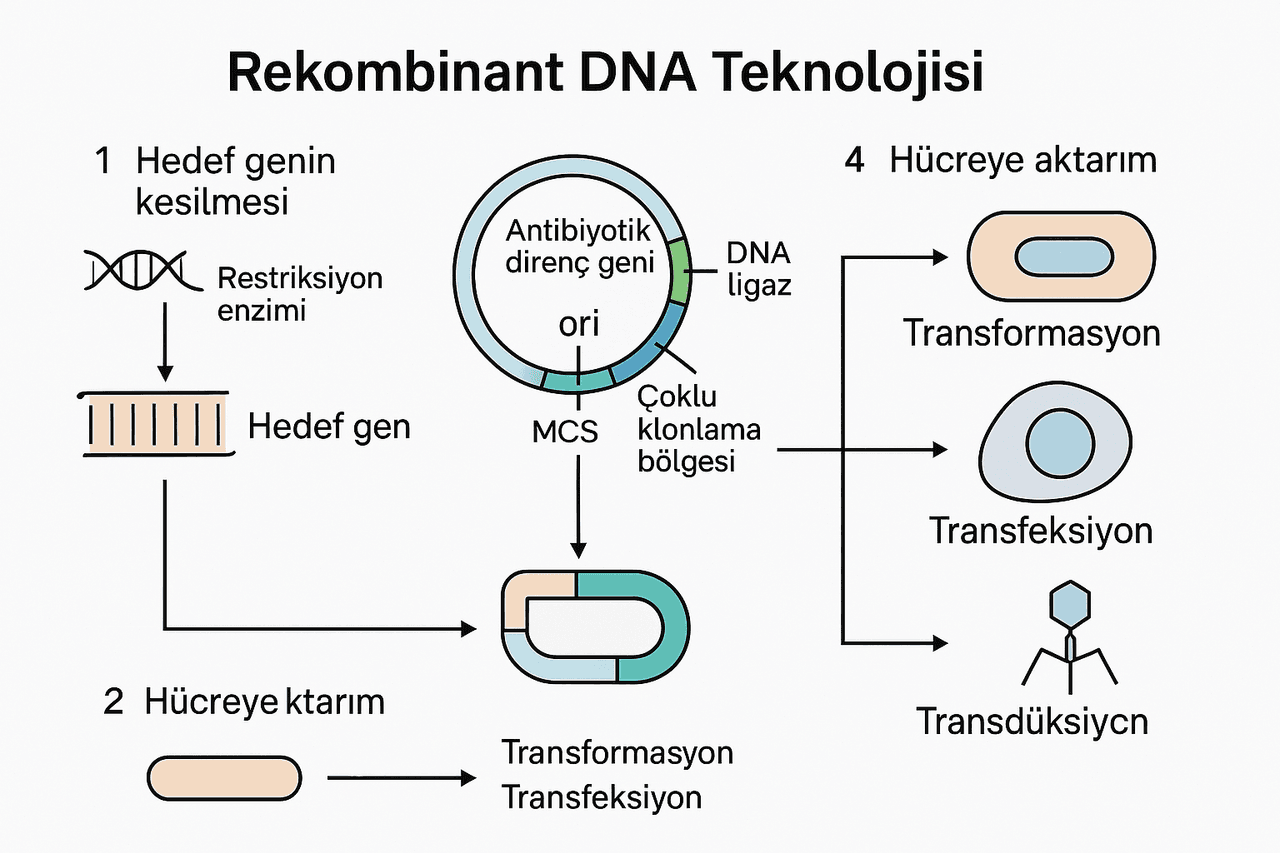
Stages of Recombinant DNA Technology (created by YZ)
The transfer of recombinant DNA into cells occurs through three primary methods:
Transformation: Transfer into bacterial cells.
Transfection: Transfer into eukaryotic cells.
Transduction: Gene transfer mediated by viruses.
Cells resulting from these procedures are called transgenic cells. These cells can amplify, express, or exhibit other genetic properties depending on the vector structure.
Recombinant DNA technology has broad applications in medical research and product development. Human insulin was first expressed using this technology in the bacterium Escherichia coli between 1978 and 1981. In 1981, its interaction with human receptors was demonstrated, and clinical use began in 1982.
It has also been used in vaccine development. For example, the first recombinant vaccine for Hepatitis B virus was produced in 1984 using the HBsAg gene in the yeast Saccharomyces cerevisiae. In 1998, recombinant human serum albumin was first produced in the yeast Pichia pastoris and clinically tested.
This technology is also used in fundamental scientific research. In a 2015 study, proteins binding to human insulin-like growth factors were expressed in the HEK293 cell line to perform functional analysis of these proteins.
Recombinant DNA technology is a comprehensive set of methods used for various purposes in both applied and fundamental molecular biology studies. By enabling the artificial manipulation of genetic material, it plays a key role in the development of numerous products.
Elçin, Y. Murat. *Rekombinant DNA Teknolojisi*. KİM 458: Biyoteknolojinin Temelleri. Ankara Üniversitesi Açık Ders Malzemeleri. Accessed April 11, 2025.https://acikders.ankara.edu.tr/pluginfile.php/7196/mod_resource/content/0/6.%20Hafta.pdf
Soydemir, Ege, and Zeynep Büşra Aksoy. "Rekombinant DNA Teknolojisi ve Günümüzdeki Kullanımı." *Güncel Gastroenteroloji* 21, no. 1 (2021): 14–23. Accessed April 11, 2025.https://guncel.tgv.org.tr/journal/69/pdf/100515.pdf
Yılmaz, Ayşe. "Rekombinant DNA Teknolojisinin Moleküler Temelleri." *Mikrobiyoloji Bülteni* 26, no. 2 (1992): 177–188. Accessed April 11, 2025.https://www.mikrobiyolbul.org/managete/fu_folder/1992-02/1992-26-02-177-188.pdf

Main Component | Selection Markers DNA Ligase Vectors Host Cells | ||||||||
|---|---|---|---|---|---|---|---|---|---|
Application Methods | Transduction Transfection Transformation | ||||||||
Field of Use | Protein and hormone production Gene therapies and biological drug production Basic scientific research Vaccine development | ||||||||
History | 1982: First recombinant human insulin commercially approved 1928: Frederick Griffith's discovery of "genetic transformation" 1973: First recombinant plasmid developed by Cohen and Chang | ||||||||
No Discussion Added Yet
Start discussion for "Recombinant DNA Technology" article
History
Technological Structure and Components
Cloning Plasmids:
Shuttle Vectors:
Expression Vectors:
Gene Knockdown Vectors:
Reporter Plasmids:
Viral Plasmids:
Application Methods
Applications