


This article was automatically translated from the original Turkish version.
Molecular biology and genetics student, when I say this, I usually get reactions like:
“DNA are you studying?”
“CRISPR are you designing babies with?”
“Are you producing mutants in the lab?”
In fact, what we do is both simpler and more fascinating than that: We are trying to understand the software of life.
When I look at the literature from recent years—especially after 2020—I see our field rapidly shifting along three major axes:
And this transformation is not only scientific; it also carries ethical, social and even philosophical dimensions.
CRISPR is no longer just a “cut-and-paste” technology. Recent studies show that more precise editing methods—such as prime editing and base editing—are elevating genome engineering to a new level.【1】 The issue is no longer cutting genes; it is correcting faulty letters. In particular, the therapeutic potential of CRISPR for inherited diseases, cancer genetics, and rare disease models is becoming increasingly realistic.
But here we must pause and ask: Should science do everything it can?
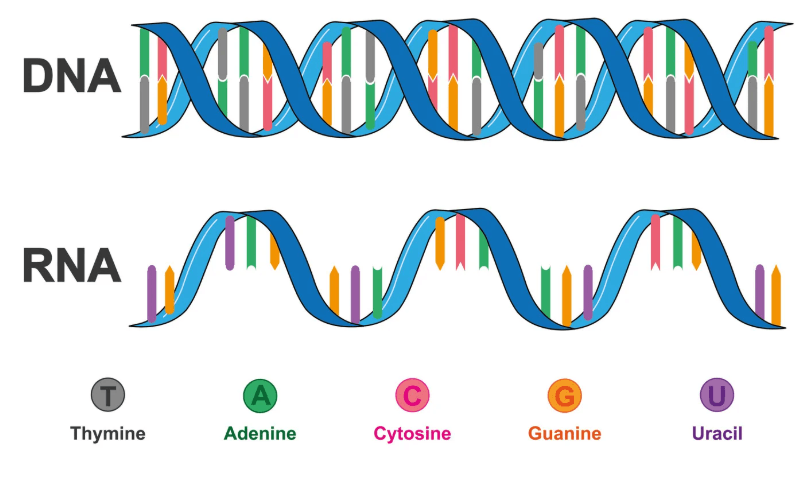
Comparison of DNA and RNA Structures
(Generated by Artificial Intelligence)
Previously, we extracted RNA from tissues and obtained an average expression level. Now we can simultaneously analyze the transcriptome, proteome, and even the epigenome of a single cell. The advancement of single-cell RNA-seq and multi-omics approaches has made cellular heterogeneity visible.【2】 What does this mean? Two cells within the same tissue can have entirely different fates. In cancer biology, this difference explains treatment resistance. In developmental biology, we can now map cellular differentiation. We no longer study cells as a collective; we study them as individuals.
The genome may be fixed, but gene expression is not. Epigenetic modifications—DNA methylation, histone modifications, and chromatin organization—determine the fate of gene expression. In recent years, advances in epigenome mapping technologies have begun to reveal more clearly how environmental factors influence gene regulation.
This means: Genes are not destiny. Conditions can rewrite destiny.
Molecular biology is no longer just about holding a pipette. A biologist who cannot analyze data is falling behind in the genomic era. The revolution brought by AlphaFold in protein structure prediction has shown that bioinformatics is no longer a supporting field but a guiding one. Today, the volume of data we generate in the lab would have been unimaginable two decades ago.【3】
This section taught me just how fascinating molecular biology and genetics are. Life is incredibly complex, yet it unfolds with astonishing order. When one gene is silenced, a phenotype may change; another gene may alter the entire system; yet sometimes nothing changes at all. It is this uncertainty that makes science so exciting. Studying molecular biology and genetics is like learning to live inside a cell; every experiment, every observation sparks a sense of new discovery. And I still feel the same thrill every day, as if I am learning something new in the lab or in the literature.
Andrew V. Anzalone, Peyton B. Randolph, Jessie R. Davis, Alexander A. Sousa, Lucas W. Koblan, Jonathan M. Levy, Peter J. Chen, et al. "Search-and-Replace Genome Editing without Double-Strand Breaks or Donor DNA." *Nature* 576 (2020): 149–157. Accessed March 4, 2026. https://doi.org/10.1038/s41586-019-1711-4
C. David Allis and Thomas Jenuwein, “The Molecular Hallmarks of Epigenetic Control,” *Nature Reviews Genetics* 17, no. 8 (2016): 487–500. Accessed March 4, 2026. https://doi.org/10.1038/nrg.2016.59
David R. Liu, Andrew V. Anzalone, Jessie R. Davis, Alexander A. Sousa, Lucas W. Koblan, Jonathan M. Levy, Peter J. Chen, et al. "Search-and-Replace Genome Editing without Double-Strand Breaks or Donor DNA." *Cell* 184, no. 19 (2021): 4947–4960. Accessed March 4, 2026. https://www.cell.com/cell/fulltext/S0092-8674(21)00583-3
Hainan Zhang, Meiling Zhang, Yingsi Zhou, and Hui Yang, “An Engineered xCas12i with High Activity, High Specificity, and Broad PAM Range,” *Protein & Cell* 14, no. 7 (2023): 540–545. Accessed March 4, 2026. https://doi.org/10.1093/procel/pwac052
Jennifer A. Doudna, “The Promise and Challenge of Therapeutic Genome Editing,” *Nature* 578 (2020): 229–236. Accessed March 4, 2026. https://doi.org/10.1038/s41586-020-1978-5
John Jumper et al., “Highly Accurate Protein Structure Prediction with AlphaFold,” *Nature* 596 (2021): 583–589. Accessed March 4, 2026. https://doi.org/10.1038/s41586-021-03819-2
[1]
Hainan Zhang, Meiling Zhang, Yingsi Zhou ve Hui Yang, “An Engineered xCas12i with High Activity, High Specificity, and Broad PAM Range,” Protein & Cell 14, no. 7 (2023): 540–545, accessed 4 March 2026, https://doi.org/10.1093/procel/pwac052
[2]
David R. Liu ve diğerleri, “Search-and-Replace Genome Editing without Double-Strand Breaks or Donor DNA,” Cell 184, no. 19 (2021): 4947–4960, accessed 4 March 2026, https://www.cell.com/cell/fulltext/S0092-8674(21)00583-3
[3]
John Jumper et al., “Highly Accurate Protein Structure Prediction with AlphaFold,” Nature 596 (2021): 583–89, accessed 4 March 2026, https://doi.org/10.1038/s41586-021-03819-2
Dialoguing with the Genome
The Single-Cell Revolution: The Average Is Misleading
Epigenetics: DNA Is Not Everything
Artificial Intelligence and Computational Biology
What I See as a Student
