This article was automatically translated from the original Turkish version.
+1 More
Type(s) | Symbiotic binary star system | ||||||||
|---|---|---|---|---|---|---|---|---|---|
Component(s) | Mira-type red giant + white dwarf | ||||||||
Distance(s) | Approximately 710 light years | ||||||||
Location | Aquarius Constellation | ||||||||
Observed Properties | Bipolar jets, Accretion disk, Expanding gas shells | ||||||||
Observation Instruments | Hubble Telescope, Chandra Telescope, ESO telescopes | ||||||||
Explosion History | A nova-like outer shell eruption in the 11th century | ||||||||
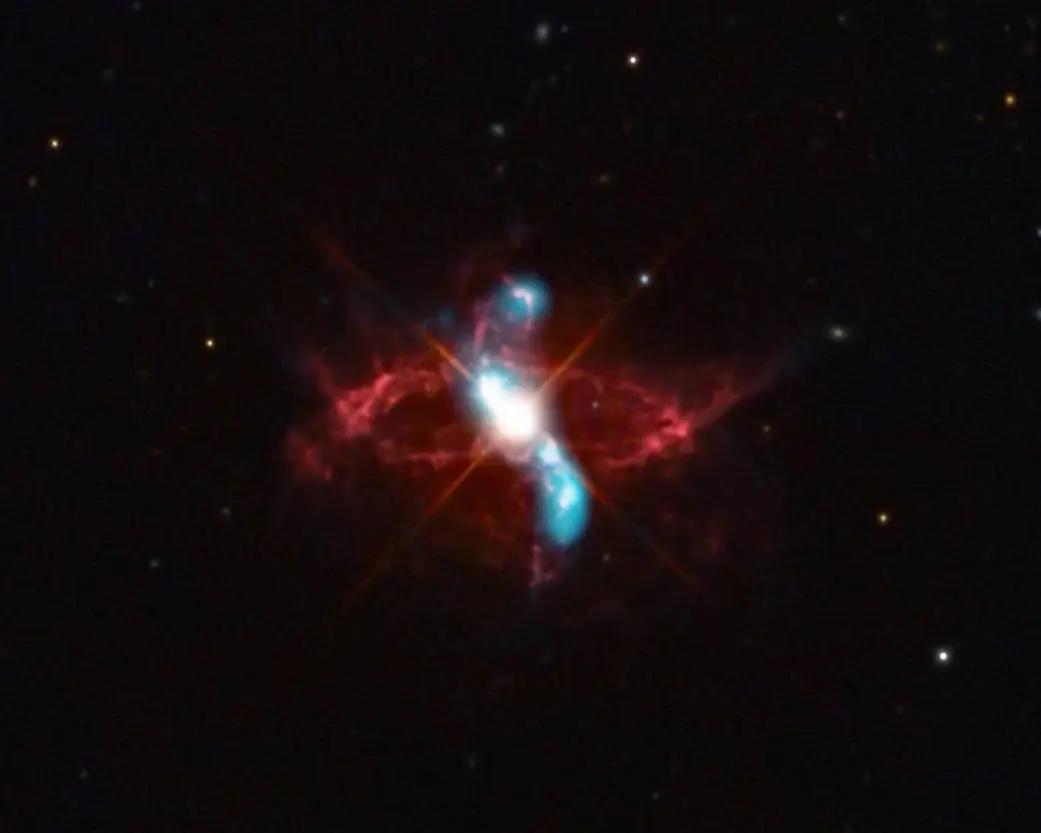
R Aquarii (R Aqr) is a symbiotic binary star system located approximately 710 light years away, observed in the direction of the constellation Aquarius. The system consists of a Mira variable star that has reached the red giant phase and a white dwarf that is accreting mass from its companion. In terms of both physical and dynamic interactions, R Aqr is an important observational target for astronomers. Particularly notable for its material interactions, neutral gas emissions, and complex surrounding nebula structure, the system is one of the fundamental examples for understanding the evolution of symbiotic star systems.
R Aqr Star System (HubbleWebbESA)
The primary component of the R Aquarii system is a Mira variable star classified spectrally as M7 III, characterized by periodic changes in brightness and large surface oscillations. This star is a red giant nearing the end of its life, losing significant amounts of material from its outer atmosphere into space. The secondary component is a white dwarf, which uses its strong gravitational pull to draw matter from the expanding atmosphere of the red giant. This mass transfer process forms a bright and hot gas disk around the stars, known as an accretion disk.
One of the most prominent features observed in the R Aqr system is the bipolar jet structures ejected outward from the white dwarf component. These jets have been studied in detail in X-ray wavelengths by the Chandra X-ray Observatory and in optical and infrared wavelengths by the European Southern Observatory (ESO). The jet structures are defined as streams of hot ionized gas directed outward by magnetic fields. Over time, this process results in irregular shell structures and filament-like gas distributions surrounding the system.
Traces of a nova-like eruption that occurred approximately 900 years ago are also present around the R Aqr system. The outer shell structures formed by this explosion continue to expand, forming a low-density nebula. Data from the European Southern Observatory indicate that the layered structure of this nebula is linked to mass ejections from multiple eruptive episodes.
Data from the Hubble Space Telescope and the Chandra X-ray Observatory have revealed a detailed profile of the system across both low- and high-energy electromagnetic spectra. Hubble provides high-resolution images of the shape, orientation, and motion of the jet structures over time, while Chandra observes the hot gas structures around the white dwarf, accretion disk activity, and shock effects. Images released by the European Space Agency clearly show the binary star system at the center surrounded by an extensive structure of gas and dust.
Through long-term observations, R Aquarii is considered a candidate system for a potential nova eruption. The white dwarf continues to accumulate matter from the red giant until it reaches a critical threshold. Once this limit is exceeded, a thermonuclear explosion may occur on the surface of the white dwarf. Such an event could result in a short-lived but extremely bright nova eruption. This possibility necessitates continuous monitoring of the system and makes it a key example for studying the evolution of symbiotic star systems.
To better understand the structural and dynamic properties of the system, NASA, Chandra, and ESA have developed interactive animations and three-dimensional models. These visual materials present processes such as mass transfer between the stars, jet formation mechanisms, and the expansion of the surrounding nebula based on scientific data. These works enable visual tracking of the system and serve as educational resources.
R Aqr Star System (ESO)
Bilim Genç. "Simbiyotik Yaşama Kozmik Örnek: R Aqr Yıldız Sistemi." TÜBİTAK Bilim Genç. Accessed July 15, 2025. https://bilimgenc.tubitak.gov.tr/makale/simbiyotik-yasama-kozmik-ornek-r-aqr-yildiz-sistemi.
Chandra X-ray Observatory. "R Aquarii: Animations." NASA. Accessed July 15, 2025. https://chandra.si.edu/photo/2017/raqr/animations.html.
Chandra X-ray Observatory. “R Aquarii: A Star’s Dramatic History.” NASA. Accessed July 15, 2025. https://chandra.harvard.edu/photo/2017/raqr/.
DijitalX. "Nova Patlamasına Hazırlanan Simbiyotik Yıldız Sistemi R Aquarii." Accessed July 15, 2025. https://www.dijitalx.com/nova-patlamasina-hazirlanan-simbiyotik-yildizi-sistemi-r-aquarii/.
ESA/Hubble. “R Aquarii (heic2413a).” ESA. Accessed July 15, 2025. https://esahubble.org/images/heic2413a/.
ESA/Hubble. “R Aquarii - Video.” ESA. Accessed July 15, 2025. https://esahubble.org/videos/v-r-aquarii_1/.
ESO. “A Cosmic Dance: Observations of the Binary System R Aquarii.” ESO. Accessed July 15, 2025. https://www.eso.org/public/news/eso1840/.
European Southern Observatory (ESO). "The ever-changing R Aquarii." European Southern Observatory (ESO) YouTube Channel. Accessed July 21, 2025. https://www.youtube.com/watch?v=PCsaD-cCcmo&t=3s
HubbleWebbESA. “Time-lapse: Evolution of R Aquarii (2014 to 2023).” ESA Youtube Kanalı. Accessed July 15, 2025. https://www.youtube.com/watch?v=RitmphJZQKM.
In-The-Sky. "R Aquarii (TYC 6404-77-1)." In-The-Sky. Accessed July 15, 2025. https://in-the-sky.org/data/object.php?id=TYC6404-77-1.
NASA. "Watching a Volatile Stellar Relationship." NASA. Accessed July 15, 2025. https://www.nasa.gov/image-article/watching-volatile-stellar-relationship/.

Type(s) | Symbiotic binary star system | ||||||||
|---|---|---|---|---|---|---|---|---|---|
Component(s) | Mira-type red giant + white dwarf | ||||||||
Distance(s) | Approximately 710 light years | ||||||||
Location | Aquarius Constellation | ||||||||
Observed Properties | Bipolar jets, Accretion disk, Expanding gas shells | ||||||||
Observation Instruments | Hubble Telescope, Chandra Telescope, ESO telescopes | ||||||||
Explosion History | A nova-like outer shell eruption in the 11th century | ||||||||
Components and Structure
Jets and Nebula Structure
Spectral and Visual Observations
Potential Eruption Risk
Visual and Cinematic Representations