


This article was automatically translated from the original Turkish version.
Probability is commonly used to express the chance of an event occurring. Probability theory is a mathematical modeling tool that helps predict the future states or events of a specific system. Fundamentally, probability theory consists of three main components: events, probability distributions and random variables.
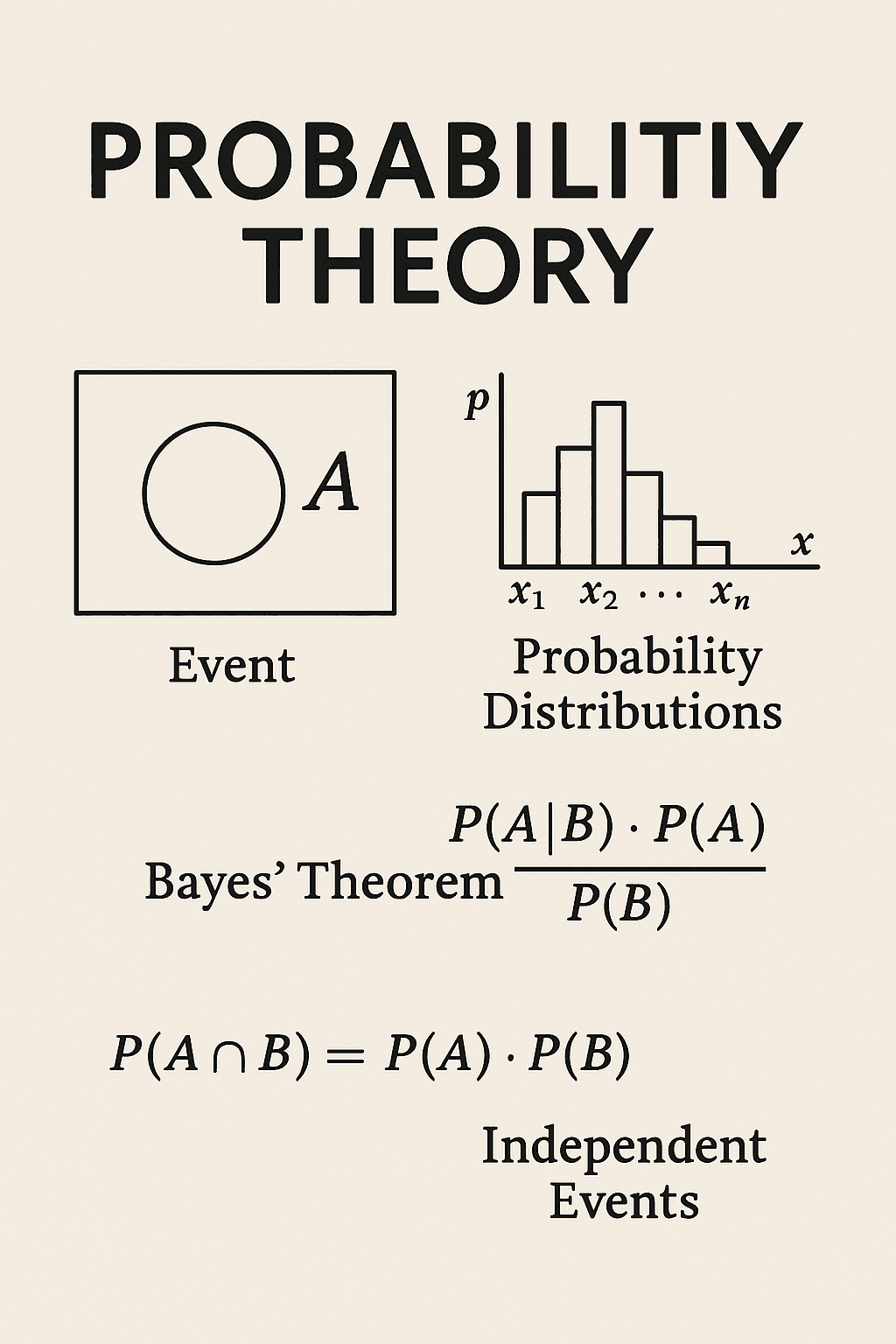
A visual representing Probability Theory (generated by artificial intelligence.)
An event is the occurrence of a specific condition. For example, rolling a die and obtaining a particular number is such an event.
A probability distribution is a list of the possible values a random variable can take and the probabilities associated with those values. For instance, when rolling a die, the probability of each face appearing is 1/6.
A random variable is a number that varies depending on the outcome of an experiment. It can generally be either continuous or discrete. Discrete random variables take on specific, countable values, while continuous random variables can take any value within a given interval.
The fundamental rules of probability theory focus on examining the union, intersection and conditional probabilities of events.
The law of total probability states that the total probability of a set of mutually exclusive events is equal to the sum of the probabilities of each individual event. Mathematically, for two events A and B:
P(A∪B)=P(A)+P(B)−P(A∩B)
Here, P(A∪B) is the probability of the union of events A and B. P(A) and P(B) are the individual probabilities of events A and B respectively. P(A∩B) is the probability of the intersection of A and B.
Bayes’ Theorem plays a central role in calculating conditional probabilities and allows updating the probability of an event based on prior information and data. Bayes’ Theorem is expressed as:
=
Here, is the probability of event A occurring given that event B has occurred.
Two events A and B are independent if the occurrence of one does not affect the probability of the other. Mathematically, independence is expressed as:
P(A∩B)=P(A)⋅P(B)
Probability distributions describe how the probabilities of random variables are distributed. They are generally classified into two main types: discrete and continuous.
Discrete probability distributions apply to random variables that take on specific, countable values. Examples include the Bernoulli distribution, the Poisson distribution and the Binomial distribution place.
Continuous probability distributions apply to random variables that can take any value within a specified range. Examples include the Normal distribution, the Exponential distribution and the Uniform distribution.
Probability theory has wide-ranging applications across many fields. Some of these include:
Probability is a fundamental tool for statistical modeling and data analysis. For example, the Normal distribution can be used to model the distribution of data points.
Insurance companies assess the likelihood of events and associated risks. Such analyses are conducted using probability theory.
Financial markets use probability theory to predict future movements of stock prices and to evaluate risks.
Probability theory is a powerful tool that helps us understand uncertainty and randomness. It is applicable in numerous theoretical and practical domains. Probability rules, distributions and conditional probabilities hold an important place in modern mathematical analysis.
Feller, William. An Introduction to Probability Theory and Its Applications. Vol. 1. New York: Wiley, 1971.
Grimmett, Geoffrey, and David Stirzaker. Probability and Random Processes. 3rd ed. Oxford: Oxford University Press, 2001.
Ross, Sheldon M. A First Course in Probability. 9th ed. Boston: Pearson, 2014.

Events
Probability Distributions
Random Variables
Basic Probability Rules
Law of Total Probability
Bayes’ Theorem
Independent Events
Probability Distributions
Discrete Probability Distributions
Continuous Probability Distributions
Applications of Probability
Statistical Modeling
Risk Analysis and Insurance
Financial Applications