This article was automatically translated from the original Turkish version.
+1 More
Primary Function | To Carry Water | ||||||||
|---|---|---|---|---|---|---|---|---|---|
River Location | Gardon River | ||||||||
Architectural Feature | Arches Foot System | ||||||||
Building Type | Aqueduct Bridge | ||||||||
Number of Floors | 3 | ||||||||
Location | France | ||||||||
Primary Material | Stone Blocks | ||||||||
Period | Roman Period | ||||||||
Protection Status | Historical Structure UNESCO World Heritage Site | ||||||||
Elevation | 50 m | ||||||||
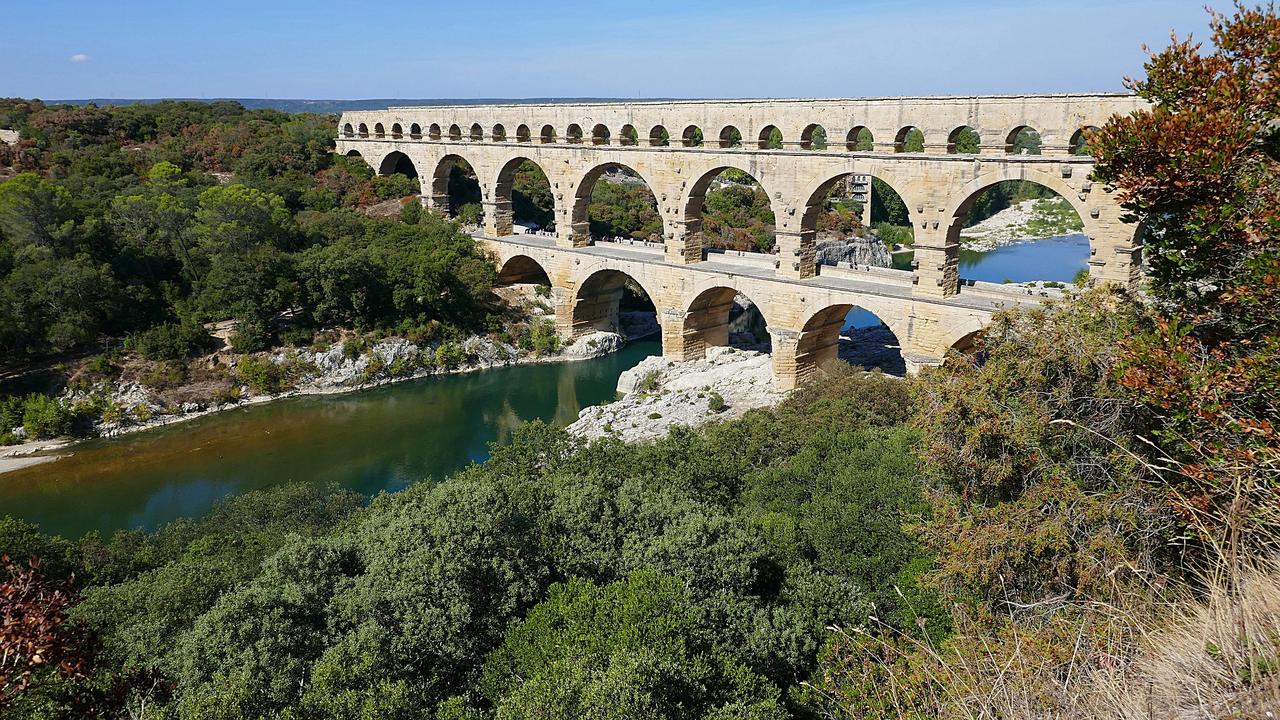
Pont du Gard Aqueduct is an ancient Roman aqueduct located in southern France. It spans the Gard River with a three-tiered structure and serves as a concrete example of ancient Roman engineering techniques. The primary function of the structure was to transport water from higher elevations to lower target areas through the force of gravity. The stone materials used in its construction, along with the arrangement of arches and piers, ensure both its durability and its water conveyance function. During its construction, the arch geometry and load distribution were carefully considered in the design, and gradients and gravitational calculations were precisely calibrated to ensure a continuous and controlled flow of water.
The Pont du Gard Aqueduct was constructed during the Roman Empire under the reign of Emperor Claudius (approximately 40–60 CE).【1】 This aqueduct was designed to supply water to the city of Nîmes (known as Nemausus in Roman times). In its construction, critical details such as gradient and pressure control were carefully considered to ensure stable flow; the arch structure, particularly the ten main pipelines, was designed to meet critical or semi-critical flow conditions.【2】 Roman engineers developed a design that maximized the water flow capacity required by the city while minimizing potential leaks and pressure issues at pipe joints.【3】
Pont du Gard Aqueduct (Pixabay)
Pont du Gard is also recognized as a cultural heritage site on the UNESCO World Heritage List, reflecting human-made waterways and landscape integration. Its preservation over centuries demonstrates the structural resilience of ancient Roman aqueduct systems. The structure is not merely composed of stone arches but also includes pipeline networks and reservoir systems essential for long-distance water conveyance. Roman engineers implemented precise adjustments in the design, including sluice gates and accurate gradient calculations, to maintain critical flow conditions from inlet to outlet.【4】 Thanks to this structure, the city of Nîmes achieved high flow stability in its internal water distribution and maintained an aesthetically regulated water surface, demonstrating the integration of Roman water engineering into urban planning that endures to this day.
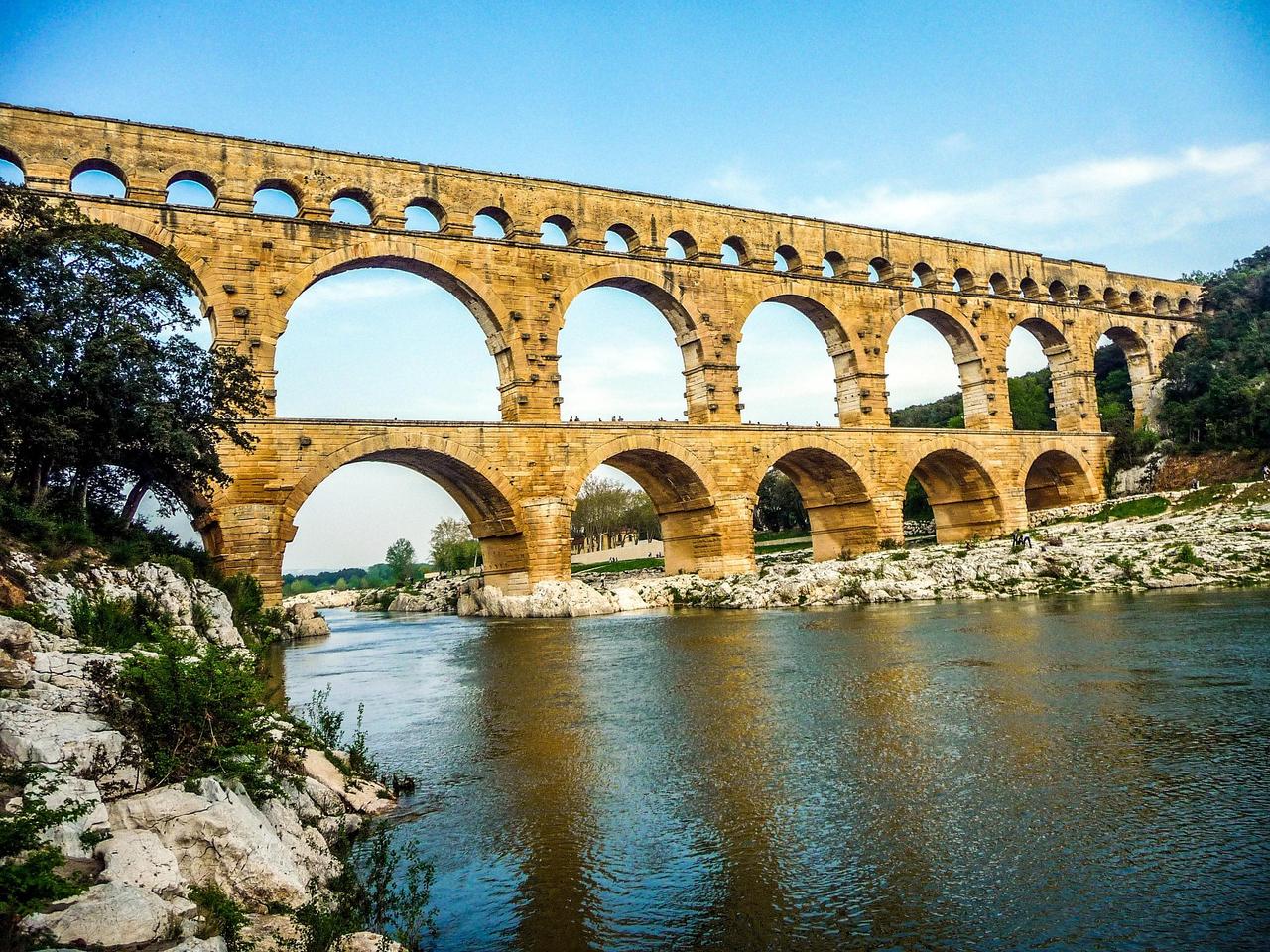
The Pont du Gard Aqueduct was constructed within an architectural framework that integrates structural and aesthetic elements. The total length of the structure is approximately 275 meters and its height reaches 50 meters, forming a balanced aqueduct system over the Gard River. The arches and piers arranged across its three levels are designed to optimize water conveyance and load-bearing capacity; the lower-level arches have the widest spans, reaching up to 24.5 meters.【5】 The design was shaped to ensure both functionality and long-term durability; the selection of stone materials and the geometry of the arches enabled the structure to safely carry both vertical and horizontal loads.
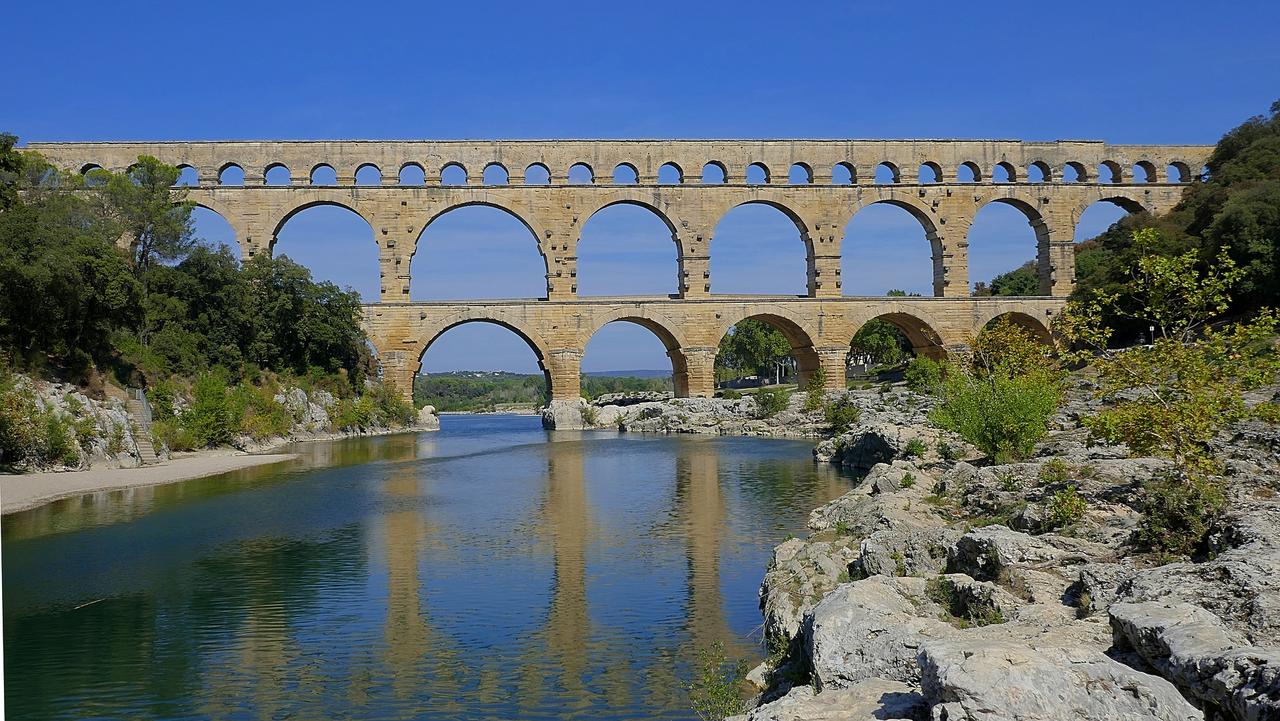
The Pont du Gard Aqueduct features a three-level structure, with each level serving distinct functional and structural roles. The lower level rests on broad, robust piers and bears the primary load of the aqueduct. It was designed to withstand the water pressure of the Gard River and surrounding environmental forces. The middle level supports the load of the lower level while simultaneously providing support for the upper-level aqueduct channels, ensuring balanced vertical load transfer. The upper level is specifically designed to house the arches that directly carry the water. The height and width of each level were determined to optimize structural balance, and the spacing between piers was calculated to account for both static load distribution and water flow capacity.
The piers ensure static stability through their cross-sectional shapes and material density. The lower-level piers are constructed from large stone blocks, placed thickly and uniformly to resist intense pressure and river currents. The middle and upper-level piers, though lighter, are carefully positioned to bear the load transferred from the lower piers. The base widths of the piers and their contact with the ground were determined according to the load-bearing capacity of the underlying soil, with each pier functioning independently to enhance structural safety. This arrangement has enabled the aqueduct to remain stable over centuries.
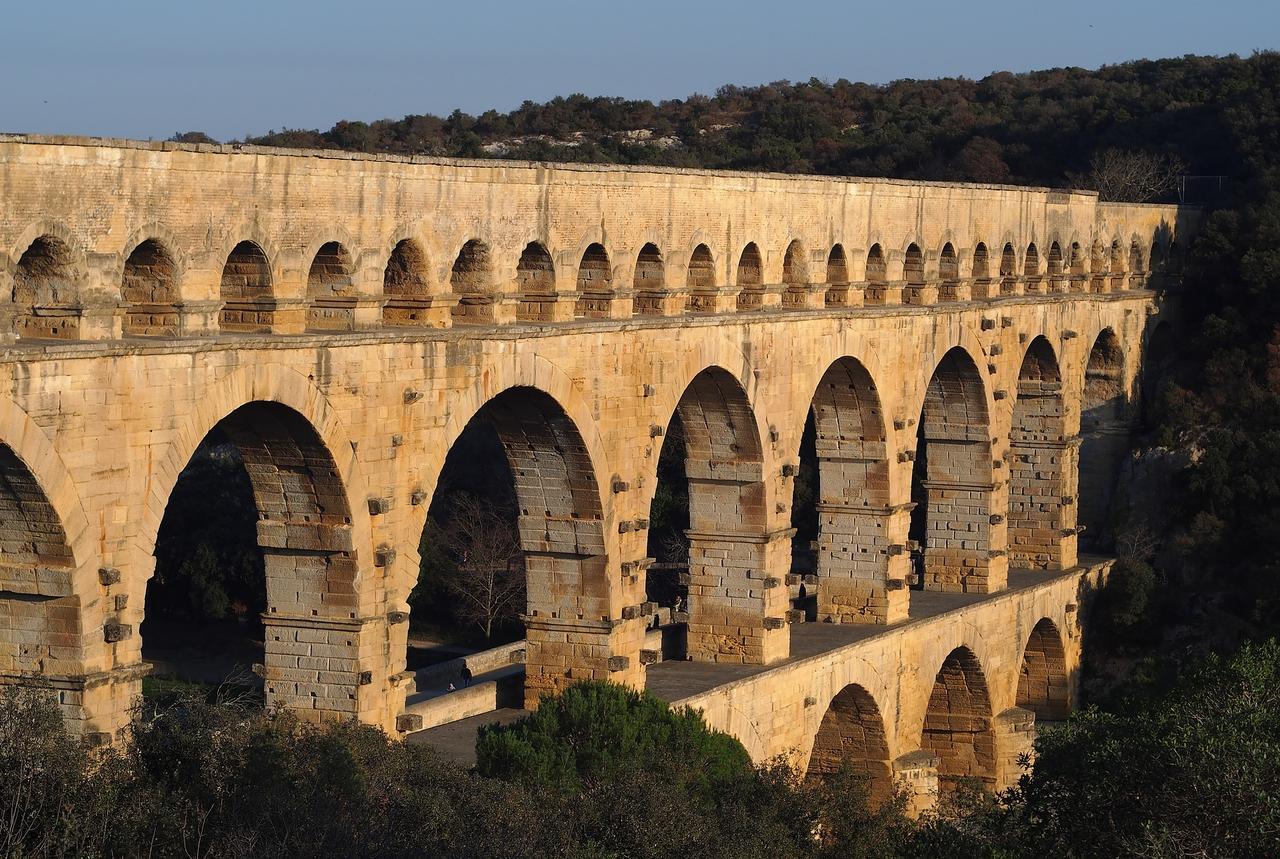
The arches of the Pont du Gard Aqueduct are designed to carry both vertical and horizontal loads. The lower-level arches, with the widest spans, transfer the loads from the river to the piers. Each arch is semicircular and positioned to ensure uniform load distribution along its curve. The middle-level arches balance the loads transferred from the lower arches, while the upper-level arches support the water channel. The height and span ratios of the arches were determined to maximize structural stability. Each level’s arches carry their own load while collectively maintaining overall structural balance with adjacent arches.
Pont du Gard Aqueduct (Pixabay)
The use of stone for the arches provides high resistance under compression and minimizes tensile stresses. The lower-level arches, particularly when bearing loads from river currents and environmental forces, have their arch heads and stone block junctions positioned to optimize load transfer. In the middle and upper levels, loads are gradually transferred to the lower levels and piers, preventing excessive pressure at any single point. The geometry of the arches and the arrangement of the stones form a stress distribution system that ensures the structure’s longevity by providing uniform pressure transmission along the arches and reducing the risk of deformation.
The Pont du Gard Aqueduct was designed as part of a hydraulic system that transports water from higher to lower elevations. Its gradient was precisely calculated to ensure a continuous and controlled flow of water under the force of gravity. The arches and levels balance the loads imposed by the water while supporting its efficient delivery to target areas. This hydraulic function is one of the fundamental elements that ensure both the structural and operational integrity of the aqueduct.
The water channels of the Pont du Gard Aqueduct were constructed using precise gradient calculations to enable natural flow under gravity. Variations in the horizontal and vertical gradients of the channel regulate water velocity, minimizing risks of overflow or stagnation. The three-tiered structure facilitates the gradual transfer of water from higher to lower elevations, preventing sudden pressure changes. The stone paving and connection methods used along the channel were selected to reduce energy loss and ensure continuous, controllable flow. This design enhances flow efficiency and guarantees the long-term functionality of the aqueduct.
Structural adjustments were implemented in the Pont du Gard Aqueduct’s water conveyance system to control water velocity and direction. The channel floor and side walls were designed to minimize friction and turbulence, thereby maintaining stable flow. This design reduces unnecessary kinetic energy losses and increases energy efficiency. Measurements and alignments along the water channels optimize the flow profile, ensuring balanced discharge and limiting flood risks. Furthermore, the three-tiered structure enables controlled redirection of the water’s potential and kinetic energy, ensuring consistent performance in water conveyance.
Pont du Gard Aqueduct (Pixabay)
The Pont du Gard Aqueduct was designed to ensure long-term durability against various load types. Its load-bearing elements are positioned to transmit not only vertical loads but also horizontal forces and environmental influences. The cross-sections and placement patterns of the stone blocks were optimized to prevent deformation under pressure. The arches and piers transfer loads in a balanced manner, preventing excessive stress at any single point, allowing the aqueduct to remain stable under river currents, wind, and temperature variations. The three-tiered structure and arch geometry ensure continuous structural integrity and contribute to the long-term preservation of the structure.
The Pont du Gard Aqueduct is a tangible manifestation of Roman engineering and ancient societal life. Its design served not only to convey water but also functioned as part of Roman urban planning and public space utilization. For centuries, the aqueduct played a central role in meeting the water needs of Nîmes and surrounding settlements, providing essential services such as drinking water, sanitation, and agricultural irrigation.
Its cultural significance is documented by its recognition by UNESCO as a heritage of universal value.【6】 Pont du Gard provides evidence of ancient Roman engineering practices through its structural integrity, architectural order, and environmental integration. The preserved structure and its surrounding landscape offer insights into the technologies and urban infrastructure used in ancient Roman civilization. As such, it is studied as part of historical heritage and cultural memory.
Billie196812. "Su Kemeri, Fransa, Yaz Görseli." Pixabay. Accessed February 28, 2026. https://pixabay.com/tr/photos/su-kemeri-fransa-yaz-pont-du-gard-1051650/
Gayulo. "Anıt, Pont du Gard, Su Kemeri Görseli." Pixabay. Accessed February 28, 2026. https://pixabay.com/tr/photos/an%c4%b1t-pont-du-gard-su-kemeri-miras-2114702/
Guy_dugas. "Pont du Gard, Su Kemeri, Roma Görseli." Pixabay. Accessed February 28, 2026. https://pixabay.com/tr/photos/pont-du-gard-su-kemeri-roma-fransa-1739534/
Guy_dugas. "Pont du Gard, Su Kemeri, Roma Görseli." Pixabay. Accessed February 28, 2026. https://pixabay.com/tr/photos/pont-du-gard-su-kemeri-roma-unesco-1742029/
Ministère de la Culture. "Les biens français inscrits sur la Liste du patrimoine mondial de l’Unesco." Accessed February 28, 2026. https://www.culture.gouv.fr/thematiques/monuments-sites/monuments-historiques-sites-patrimoniaux/les-biens-francais-inscrits-sur-la-liste-du-patrimoine-mondial-de-l-unesco
Ortloff, Charles R. "Roman Hydraulic Engineering: The Pont du Gard Aqueduct and Nemausus (Nîmes) Castellum." *Water* 13, no. 1 (2021): 1–24. Accessed February 28, 2026. https://www.mdpi.com/2073-4441/13/1/54
Paillet, Jean-Louis. "Réflexions sur la construction du Pont du Gard." *Gallia* 62, no. 1 (2005): 49–68. Accessed February 28, 2026. https://www.persee.fr/doc/galia_0016-4119_2005_num_62_1_3220
Pont du Gard Site. "Discover – The Pont du Gard, an Ancient Masterpiece in the Heart of Provence." Accessed February 28, 2026. https://pontdugard.fr/en/discover.
Ridoe. "Pont du Gard, Nîmes, Arles Görseli." Pixabay. Accessed February 28, 2026. https://pixabay.com/tr/photos/pont-du-gard-nimes-arles-ales-2493763/
UNESCO World Heritage Centre. "Pont du Gard." Liste du patrimoine mondial, sy. 344. Accessed February 28, 2026. https://whc.unesco.org/fr/list/344/.
[1]
Charles R. Ortloff, "Roman Hydraulic Engineering: The Pont du Gard Aqueduct and Nemausus (Nîmes) Castellum," Water 13, no. 1, 54, (2021): 1, Last Access: 28 February 2026, https://www.mdpi.com/2073-4441/13/1/54
[2]
A.e., p. 1
[3]
A.e., p. 24
[4]
A.e., p. 23
[5]
UNESCO World Heritage Centre, “Pont du Gard,” Liste du patrimoine mondial, no. 344, Last Access: 28 February 2026, https://whc.unesco.org/fr/list/344/
[6]
A.e., p. 1

Primary Function | To Carry Water | ||||||||
|---|---|---|---|---|---|---|---|---|---|
River Location | Gardon River | ||||||||
Architectural Feature | Arches Foot System | ||||||||
Building Type | Aqueduct Bridge | ||||||||
Number of Floors | 3 | ||||||||
Location | France | ||||||||
Primary Material | Stone Blocks | ||||||||
Period | Roman Period | ||||||||
Protection Status | Historical Structure UNESCO World Heritage Site | ||||||||
Elevation | 50 m | ||||||||
No Discussion Added Yet
Start discussion for "Pont du Gard Aqueduct" article
Historical Context
Architectural Design
Levels and Piers
Arches and Stress Distribution
Hydraulic Function
Gradient and Gravity-Based Water Transfer
Flow Stability and Energy Efficiency
Structural Durability
Cultural Significance