


This article was automatically translated from the original Turkish version.
+1 More
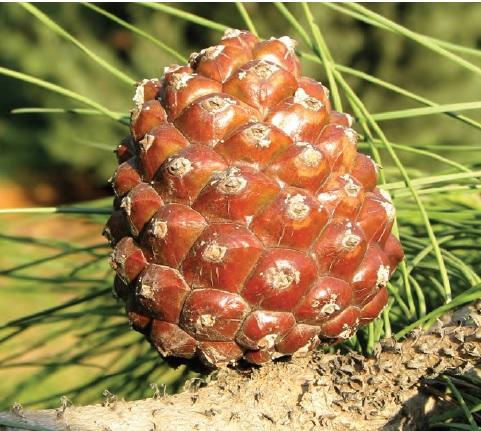
Pine Nut Tree
Scientific Name | Pinus pinea L. | ||||||||
|---|---|---|---|---|---|---|---|---|---|
Family | Coniferous (needle-leaved) Pinaceae (pine family) | ||||||||
Natural Distribution Area | It is distributed along the Mediterranean coastal belt extending from Portugal to Anatolia. | ||||||||
Species Grown in Türkiye | It is the only pistachio pine species native to Türkiye. Pistachio pine (Pinus pinea L.) | ||||||||
Height | It can grow up to 25 (–30) meters in height. | ||||||||
Leaf Characteristics | Type: Needle-leaved Sheath (glume): The sheath surrounding the base of the leaves is 10–12 mm long and pale brown in color. Surface characteristics: Numerous stomata (pores) are present on both surfaces. Lifespan: The leaves remain alive for 2–4 years. Shape and structure: Thick, hard, with finely toothed margins and slightly recurved tips, but not incurved. Color: Ranges from bluish-green to bright green. Length: Each needle leaf varies between 6–20 cm (typically 8–16 cm). Arrangement: Needle leaves occur in pairs (two needles per sheath). | ||||||||
Stone pine (Pinus pinea L.) is a coniferous tree species belonging to the Pinaceae family, distributed across the Mediterranean climatic zone and valued for its high economic and ecological importance. Its Latin species name, pinea, means “female,” referring to its large and conspicuous female cones.
Stone Pine Introduction Video - (YouTube)
Stone pine naturally occurs across the Mediterranean basin, ranging from Portugal to Anatolia. In Türkiye, it is found locally or widely in the provinces of Artvin, Trabzon, Bartın, Bursa, İzmir, Aydın, Muğla, Antalya, and Kahramanmaraş. It grows naturally in areas under the influence of the Mediterranean climate, up to 600 meters above sea level. The species can extend up to 70 kilometers inland from the coast and has been recorded at elevations up to 860 meters.
Stone pine is a long-lived tree reaching heights of 25–30 meters and diameters of up to 1.5 meters. Its crown has a parasol-like, broad, and dome-shaped structure. The trunk is straight and covered with thick, reddish-gray bark. Shoots vary from yellowish-brown to grayish-brown and are glabrous. Its resin-free buds measure 6–12 mm in length. Needles are arranged in pairs, each 8–16 cm long, thick, slightly curved, and toothed along the margins. Leaves remain alive for 2–4 years and bear numerous stomata on both surfaces. Cones are 8–15 cm long, spherical in shape, and short-stalked. Each cone contains 50–100 large seeds. Cones mature over 2–3 years and open upon maturity to release their seeds. Seeds are typically 1.5–2 cm long and possess a small wing remnant. The seed surface is covered with a dark purplish powder. Locally, these seeds are known as “pine nut.”
Fıstık Çamı Hasat Zamanı Ormandan Görüntüsü - (OGM)
The stone pine is primarily cultivated for its edible oily seeds, with timber being a secondary product. Pine nuts are used in a variety of food products such as stuffed dishes, pilaf, desserts, and halva. They are also utilized in various industrial sectors due to their medicinal and nutritional value. Although more than twenty species of pine produce edible nuts, Pinus pinea is the principal commercial species in this regard.
The stone pine is notable for its resilience to dry conditions and poor soils. Thanks to its deep root system, it is highly drought-tolerant and thus plays a significant role in erosion control, desertification mitigation, and reforestation efforts. In southeastern regions of Türkiye, successful stone pine plantations have been established in areas prone to desertification.
A low correlation has been observed between annual diameter growth and nut yield. However, a high correlation has been identified between nut yield and precipitation and humidity levels during the vegetation periods of one and two years prior (R² ≈ 0.79–0.81). This indicates that environmental factors indirectly influence the species’ productivity. Both the quantity and timing of rainfall are decisive for yield.
Stone pine production is a labor-intensive and multi-stage process. Cones, which reach several meters in height, are collected using traditional methods or specialized harvesting machinery. The nuts are then extracted from the cones, their shells are cracked, and the product is marketed. Harvesting methods include traditional poles (keye), platform plus pole systems, and mechanical branch shakers. In Türkiye, pine nut production is concentrated primarily in forested areas of İzmir, Balıkesir, Bursa, Adana, and Muğla. According to the General Directorate of Forestry’s inventory, a usable nut stock of 27,880 tons exists across 84,809 hectares. Production in 2022 reached 1,141 tons, of which 85 percent was exported. Based on the average of the last three years, annual nut exports of 565 tons generate approximately 33 million US dollars in foreign exchange revenue.
Stone pine harvesting is carried out using traditional methods, and those who perform this work are known as “pine nut harvesters.” This profession relies on local knowledge and practices passed down through generations; however, the number of practitioners has been declining over time. Due to the limited use of personal protective equipment, the risk of occupational accidents is high. The species is now included under forestry standards for “non-timber product collection.” It has been emphasized that, within a lifelong learning framework, the preservation of the traditional harvesting profession and support for its professional development are essential.
Akgül, Hüseyin Nail. *Fıstık Çamında Hasat Mekanizasyonu Üzerine Bir Araştırma*. Master's thesis, Aydın Adnan Menderes Üniversitesi, 2016. Accessed May 29, 2025.http://adudspace.adu.edu.tr:8080/xmlui/bitstream/handle/11607/2899/Hüseyin%20Nail%20AKGÜL.pdf?sequence=1&isAllowed=y
Batur, Mustafa. “Kozak Yöresi Fıstıkçamı (Pinus pinea L.) Ormanlarında Fıstık Verimi ile Artım ve Bazı Meteorolojik Olaylar Arasındaki İlişkiler.” *Ormancılık Araştırma Dergisi* 1, no. 2A (2015): 29–34. Accessed May 29, 2025.https://dergipark.org.tr/tr/pub/ogmoad/issue/24673/260958
Bugday, Seda Erkan, Taner Okan, Coşkun Köse, and Sezgin Özden. “Kozak Yöresinde Fıstıkçamı (Pinus pinea L.) Geleneksel Kozalak Hasadı ve Kozalak İndiricilerin Profili.” *Bartın Orman Fakültesi Dergisi* 26, no. 1 (2024): 72–85. Accessed May 29, 2025.https://dergipark.org.tr/tr/pub/barofd/issue/80996/1382679.
Doğu, A. Dilek. “Fıstıkçamı (Pinus pinea L.) Odununda Anatomik Yapı ve Hava Kurusu Yoğunluk Değerinin Türkiye’de Doğal Olarak Yetişen Diğer Çam Türlerimiz ile Karşılaştırmalı İncelemesi.” *İstanbul Üniversitesi Orman Fakültesi Dergisi* 51, no. 1 (2001): 83–100. Accessed May 29, 2025.https://dergipark.org.tr/tr/download/article-file/176278
Joban, Hajir Dawood Sulaiman, and Serra Hepaksoy. “Aydın / Koçarlı’da Fıstık Çamı Ağaçlarının Bazı İbre Özelliklerinin Belirlenmesi.” *Mustafa Kemal Üniversitesi Tarım Bilimleri Dergisi* 29, no. 1 (2024): 62–70. Accessed May 29, 2025.https://dergipark.org.tr/en/download/article-file/3380322
Orman Genel Müdürlüğü. "Fıstık Çamı Hasadı Orman Köylüsünün Yüzünü Güldürüyor – Görseller." Accessed May 29, 2025.https://www.ogm.gov.tr/tr/haberler/fistik-cami-hasadi-orman-koylusunun-yuzunu-gulduruyor#images-7.
Orman Genel Müdürlüğü. "Fıstık Çamı." Accessed May 29, 2025.https://www.ogm.gov.tr/tr/yararli-bilgiler/haftanin-agaci/fistik-cami.
Orman Genel Müdürlüğü. “Fıstık Çamı Hasadı Orman Köylüsünün Yüzünü Güldürüyor.” Date Published March 10, 2023. Accessed May 29, 2025.https://www.ogm.gov.tr/tr/haberler/fistik-cami-hasadi-orman-koylusunun-yuzunu-gulduruyor
T.C. Ministry of Agriculture and Forestry. "Fıstık Çamı Hasadı veOrman Köylüsü." YouTube. Accessed May 29, 2025.https://www.youtube.com/watch?v=qxnKOBGRMLY.

Pine Nut Tree
Scientific Name | Pinus pinea L. | ||||||||
|---|---|---|---|---|---|---|---|---|---|
Family | Coniferous (needle-leaved) Pinaceae (pine family) | ||||||||
Natural Distribution Area | It is distributed along the Mediterranean coastal belt extending from Portugal to Anatolia. | ||||||||
Species Grown in Türkiye | It is the only pistachio pine species native to Türkiye. Pistachio pine (Pinus pinea L.) | ||||||||
Height | It can grow up to 25 (–30) meters in height. | ||||||||
Leaf Characteristics | Type: Needle-leaved Sheath (glume): The sheath surrounding the base of the leaves is 10–12 mm long and pale brown in color. Surface characteristics: Numerous stomata (pores) are present on both surfaces. Lifespan: The leaves remain alive for 2–4 years. Shape and structure: Thick, hard, with finely toothed margins and slightly recurved tips, but not incurved. Color: Ranges from bluish-green to bright green. Length: Each needle leaf varies between 6–20 cm (typically 8–16 cm). Arrangement: Needle leaves occur in pairs (two needles per sheath). | ||||||||
Distribution and Habitat Characteristics
Morphological and Botanical Characteristics
Uses
Ecological and Forestry Importance
Environmental Impacts
Production, Harvesting, and Economic Value
Conservation