


This article was automatically translated from the original Turkish version.

For Muhsin, the world was like a crowded marketplace where sounds blended into one another and colors were stained a dirty gray. He was twelve years old, but his soul had grown heavy, like an ancient oak worn out and longing to withdraw to a quiet corner and rest. People were like sharp-edged gears spinning endlessly in his mind; every time he brushed against them, something bled, leaving scars on his soul that could not easily be healed. The school bell’s ring was not an invitation to go home but an alarm to escape. The shouts in the courtyard, the laughter of children chasing each other, and the teachers’ voices crashed over him like a massive wave. In those moments, Muhsin would close his eyes and try to listen to the silence within. Yet even that inner silence no longer brought peace, because as he grew older, it too filled with grievances.
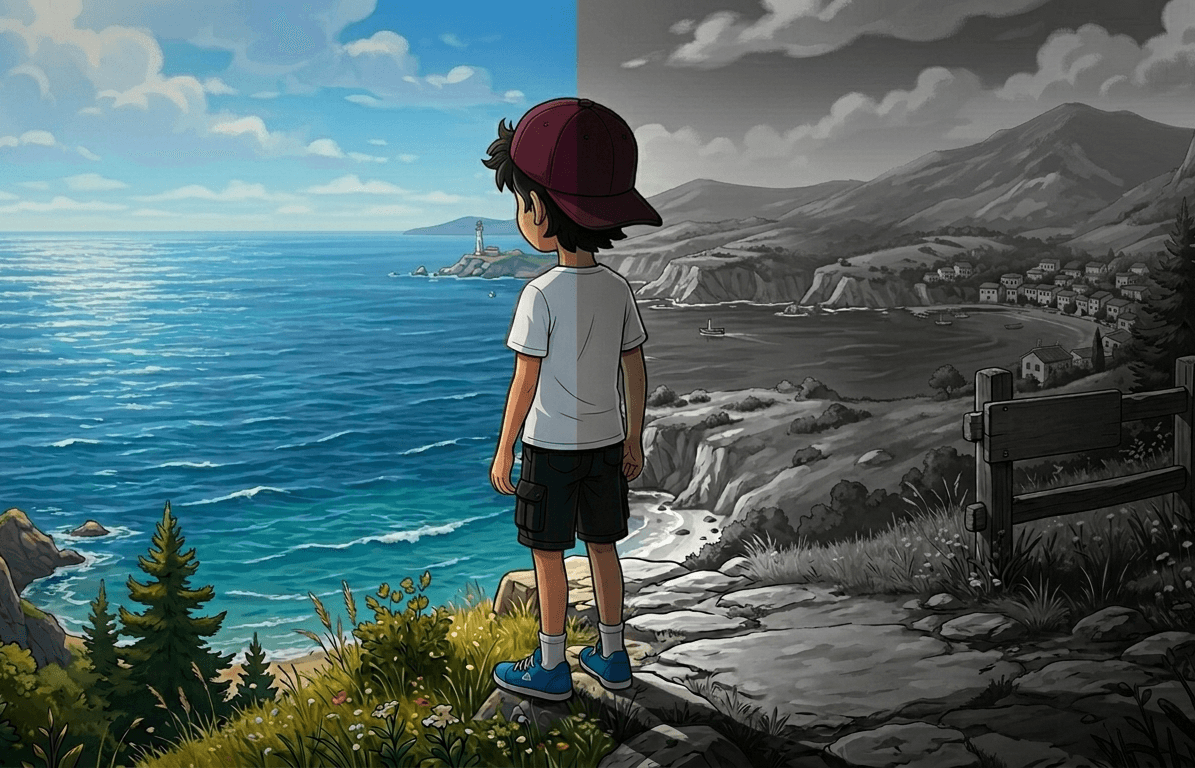
Muhsin's World (Image Generated by Artificial Intelligence)
One Saturday morning, his father decided to force him to the city’s most famous viewpoint, saying, “You need some fresh air.” While sitting in the back seat and watching the world pass by the window, Muhsin heard his father’s voice—cheerful on the surface but actually tired. His father believed Muhsin’s withdrawal was just a “passing phase” or “adolescent angst.” But Muhsin’s pain was not the ache of growing up; it was the pain of being unable to fit into the world.
When they reached the summit, a sharp wind struck Muhsin’s face the moment he stepped out of the car. This was the famous spot where the entire city lay spread beneath them, embraced by green forests and a brilliant blue sea. His father opened his arms with excitement: “Look, Muhsin, look there! Isn’t it an incredible view? People travel kilometers just to see this.” But Muhsin did not look where his father pointed—he looked at the crowd surrounding that “incredible view.” People pushing each other with selfie sticks, posing with forced smiles for the perfect shot, snacking loudly while noise filled the air, and voices drowning out the wind... Wanting to escape the crowd, Muhsin thought to himself: “Incredible views attract people, and I don’t like people very much.”
When his father went to help a group take photos, Muhsin began walking down a narrow path away from the crowd. He veered onto a slightly steep slope overgrown with bushes where no one else had gone. The crunch of dry twigs beneath his feet sounded more genuine to his ears than human voices. A little farther on, he found a small flat area hidden in the shadow of a massive rock, unnoticed by anyone. He sat down, pulled his knees to his chest, and wrapped his arms around his legs. The view was still breathtaking, but here, no one was around. The sea stretched below like an endless sheet. He closed his eyes and let the wind whistle in his ears. That whistle was gentler than any human asking, “How are you?” Muhsin had burdens he could never tell anyone: why he stayed silent in school, why he counted only the peas on his plate at dinner, why he lay awake for hours staring at the ceiling at night. He could not speak of them because words lost their meaning the moment they left his lips, changing shape before reaching the other person.
“They don’t understand me,” he whispered to the wind. “They pretend they want to understand, but all they want is for me to be quiet.”
His sadness sat in his throat like a clenched fist. In this loneliness, Muhsin had found a fragment of peace, but even that peace was washed in sorrow. At that moment, he noticed a small, pale yellow flower growing at the edge of the slope. The flower stretched its head between the rocks, swaying constantly against the wind. It had no visitors and no one took its picture. It simply existed in silence. Muhsin touched its petal with the tip of his finger. “Are you sad too?” he asked. The flower did not answer, but it swayed slightly in the wind. Muhsin took that as an affirmation. People came here to consume beauty and love. But Muhsin only wanted to feel beauty, to disappear into it. The view was beautiful not because of the people there, but because nature itself was magnificent. Yet people could not resist tainting every beautiful thing with their own noise.
After a while, he heard his father’s voice from above: “Muhsin. Where are you, son? Let’s go.”
Muhsin stood up, brushed the dust off his clothes, and gave the small yellow flower one last look. He would return to the noisy classrooms, the endless questions, and the people’s incomprehending stares... But now he had a secret. He knew that within that incredible view, there was a small shelter no one else had reached.
As he walked back up the path toward the crowd, his face still bore that distant, sorrowful expression. When he reached his father, his father looked at him and said, “Where did you disappear to? You missed the view—the light was so beautiful.” Muhsin looked out toward the sea through the crowd. He squinted and smiled faintly. “I saw my view, Father,” he whispered. “But now I want to leave.”
As the car glided back toward the city, Muhsin leaned his head against the window. The city’s lights began to turn on one by one. People returned to their homes, their noise, and their endless rush. But Muhsin had hidden within his heart that quiet slope, the yellow flower between the rocks, and the wind’s whisper...【1】
Cabadak, Gözde. "Dünyaya Sığamayan Bakışlar Yayımlanmamış Öykü." Date Published March 30, 2026.
[1]
Cabadak, Gözde. "Dünyaya Sığamayan Bakışlar Yayımlanmamış Öykü." Yazım Tarihi 30 Mart 2026.