


This article was automatically translated from the original Turkish version.
+1 More
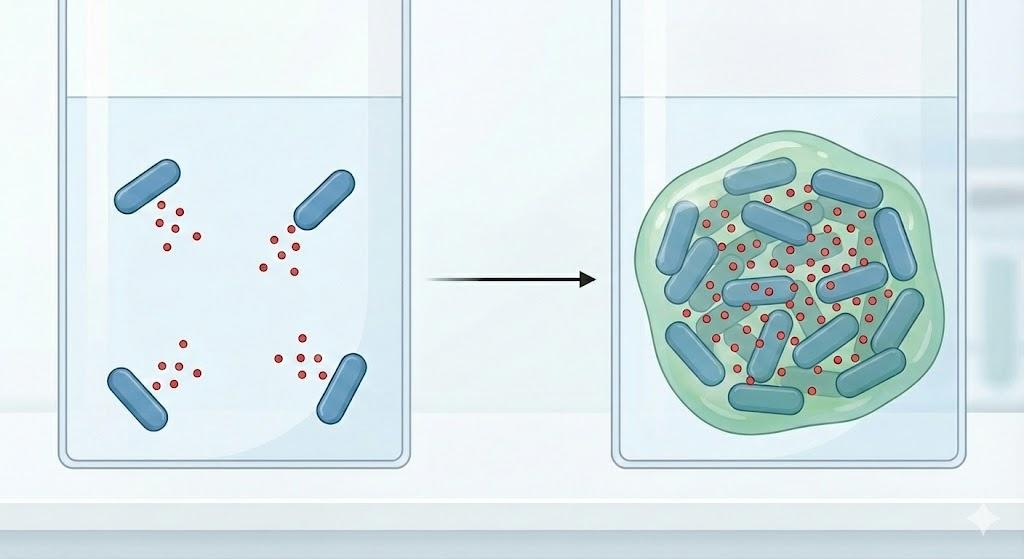
Generated by artificial intelligence.
Therapeutic Approach | Quorum Quenching (Signal Quenching) | ||||||||
|---|---|---|---|---|---|---|---|---|---|
Mechanism | Cell density-dependent activation | ||||||||
Related Processes | Biofilm, Virulence, Bioluminescence, Resistance | ||||||||
Key Molecules | Autoinducers (AHL, AI-2, Peptides) | ||||||||
Function(s) | Intercellular communication and gene regulation | ||||||||
Discovered Organism | Vibrio fischeri (Aliivibrio fischeri) | ||||||||
Environmental Sensing System(Quorum Sensing) is a cell-density-dependent gene regulation mechanism that enables microorganisms to communicate with each other through chemical signaling molecules called autoinducers, which they continuously secrete into the external environment. This system allows bacteria to detect their own population density in the environment and, upon reaching a specific threshold (quorum), simultaneously alter gene expression to exhibit collective behavior. This mechanism enables single-celled organisms to coordinate their actions much like multicellular organisms, controlling physiological processes such as biofilm formation, virulence factor production, sporulation, conjugation, bioluminescence, and antibiotic production.
The concept of quorum sensing, known as an environmental sensing mechanism, marked a turning point in microbiology by challenging the classical view that bacteria are solitary and independent organisms. The first clues to this phenomenon emerged in the 1970s through experimental studies on the marine symbiotic bacterium Vibrio fischeri (currently known as Aliivibrio fischeri). Researchers Kenneth Nealson, Terry Platt, and J. Woodland Hastings observed that these bacteria did not produce light when free-living but suddenly began exhibiting bioluminescence once a critical cell density was reached. This finding demonstrated that light production was not governed solely by individual metabolism but was regulated by population density.
Subsequent biochemical analyses revealed that this behavior is controlled by autoinducer signaling molecules synthesized by the bacteria and secreted into the environment, with their concentration increasing proportionally to cell density. When the signal molecule reaches a critical threshold concentration, the genes responsible for light production are collectively activated. Thus, bacteria synchronize their behavior using a system that chemically measures the number of neighboring cells of the same species. This discovery is regarded as one of the first experimental evidences that microorganisms can exhibit social behavior.
Research conducted throughout the 1980s and 1990s demonstrated that this communication mechanism is not limited to bioluminescence but also regulates many complex behaviors such as virulence factor production, biofilm formation, sporulation, antibiotic production, and gene transfer. During this period, the term “quorum sensing” became established in the literature and was recognized as one of the fundamental regulatory systems in bacterial physiology. Today, this mechanism has become a central research topic in microbial ecology, infection biology, and biotechnology, and is regarded as a critical target for developing novel antimicrobial therapies.
The core function of the system is based on a cycle of signal molecule production, secretion, and detection. Bacteria continuously secrete their signaling molecules at low basal levels into the extracellular environment. At low bacterial density, these molecules diffuse widely and become diluted, rendering them ineffective. However, as the bacterial population increases, the concentration of the signaling molecule in the environment reaches a critical threshold.
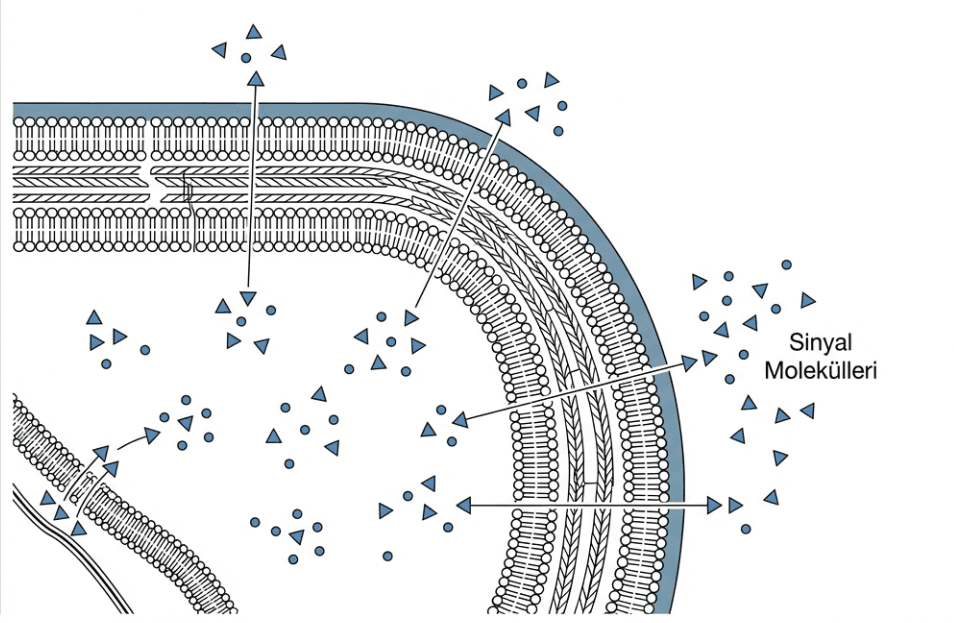
Autoinducer Communication in Bacteria (Generated by Artificial Intelligence)
Once the threshold is exceeded, the signaling molecules bind to specific receptor proteins inside or on the surface of the bacterial cell. This binding activates the transcription of target genes. The system typically operates via a positive feedback loop (autoinduction): once activated, the system enhances the expression of the gene responsible for producing the signaling molecule, thereby accelerating signal production and communication.
Microorganisms use signaling molecules with distinct chemical structures depending on their cellular architecture and species. These communication networks are generally classified into three main categories.
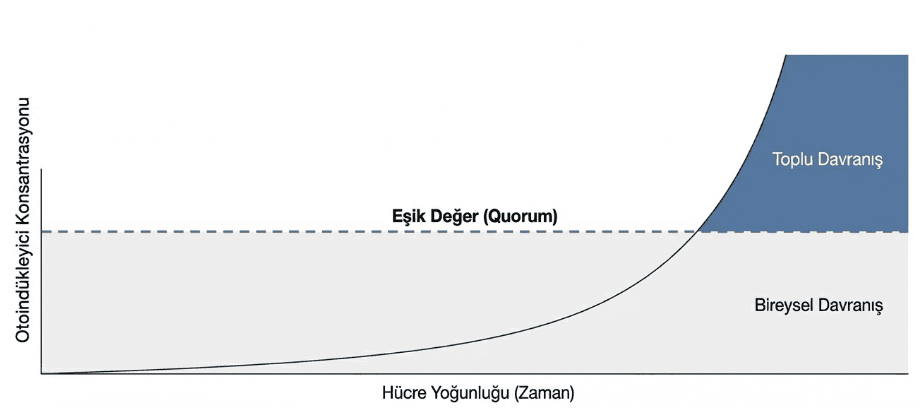
Critical Threshold and Sensing Schema in Bacteria (Generated by Artificial Intelligence)
Communication in Gram-Negative Bacteria: The most commonly used signaling molecules in Gram-negative bacteria are acyl-homoserine lactones (AHLs). This system primarily involves LuxI (signal-synthesizing enzyme) and LuxR (signal-receptor protein) homologs. The signaling molecules can diffuse through the cell membrane. In opportunistic pathogens such as Pseudomonas aeruginosa, multiple AHL-based systems (e.g., Las and Rhl systems) operate hierarchically to control virulence factors.
Communication in Gram-Positive Bacteria: Gram-positive bacteria typically use small peptides (oligopeptides) synthesized on ribosomes and subsequently processed as signaling molecules. Due to the structure of their cell wall, these peptides are exported out of the cell via specialized ATP-dependent transporters. Detection occurs through “two-component signaling systems” located on the cell membrane. The signaling molecule does not enter the cell; instead, it binds to a sensor protein on the membrane, triggering a phosphorylation cascade that transmits the signal to an intracellular response regulator.
Communication in Fungi and Interspecies Communication: The quorum sensing system is not exclusive to bacteria; it is also observed in dimorphic fungi such as Candida albicans. In these fungi, signaling molecules known as farnesol and tyrosol have been identified. Farnesol inhibits the transition from the yeast form to the pathogenic hyphal form, while tyrosol promotes this transition and accelerates growth. Additionally, it is known that bacteria can communicate across species via the “Autoinducer-2” (AI-2) molecule, which has been described as the “esperanto of bacteria.”
The quorum sensing system plays a central role in the development of biofilms—structured communities of bacteria adhering to surfaces and embedded in an extracellular polysaccharide matrix. Biofilm formation involves stages of attachment, microcolony development, maturation, and detachment/dispersal. When bacteria reach sufficient population density, quorum sensing upregulates the synthesis of polymers that form the biofilm matrix. Biofilms protect bacteria from antibiotics, disinfectants, and immune system cells (phagocytosis). Furthermore, the production of virulence factors such as toxins, proteases, and hemolysins by pathogenic bacteria is also controlled by this system. Bacteria remain “silent” until their numbers reach a sufficient threshold, then launch a coordinated attack.
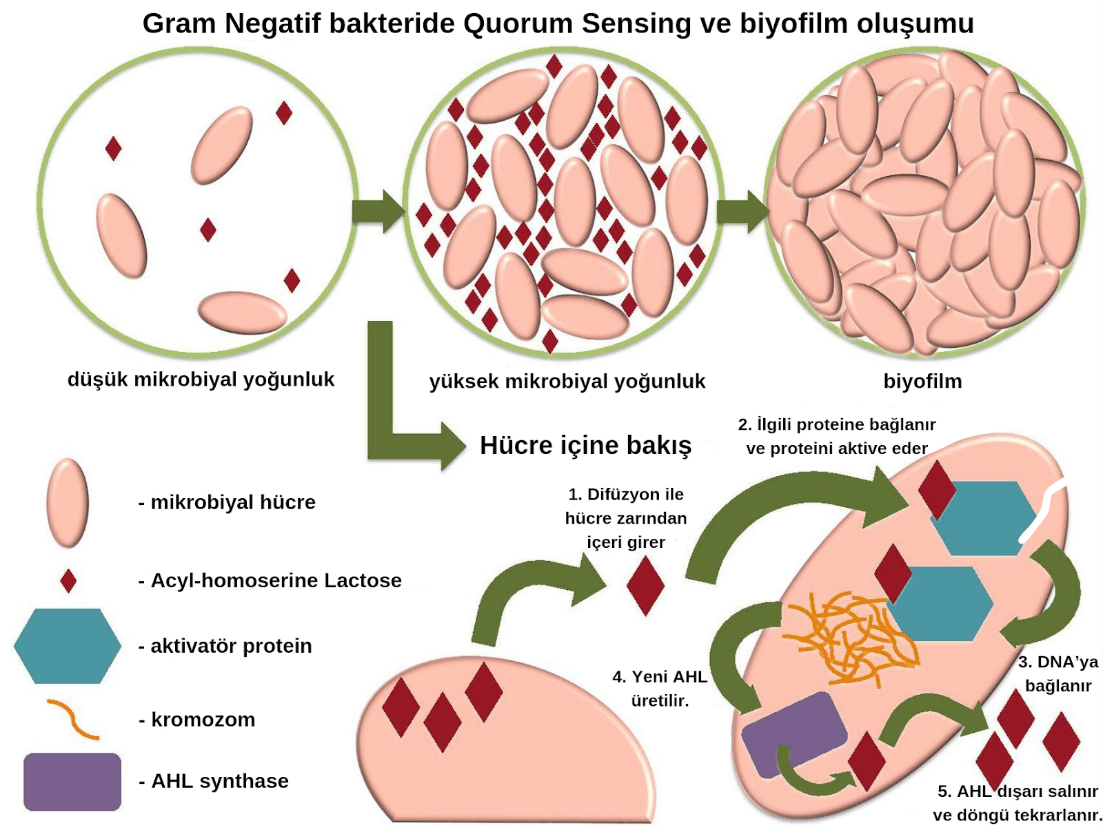
Quorum Sensing and Biofilm Formation in Gram-Negative Bacteria (ITU)
The quorum sensing (QS) system, which enables bacteria to detect population density through intercellular chemical signals, plays a critical role not only in regulating virulence factors but also in coordinating antimicrobial resistance mechanisms. Through this communication network, bacteria can collectively sense antibiotic threats and simultaneously reprogram gene expression, thereby developing a collective defense strategy rather than an individual one.
One of the most important effects of QS is the upregulation of efflux pump systems that expel antibiotics from the cell. In opportunistic pathogens such as the multidrug-resistant Pseudomonas aeruginosa, QS signaling molecules (e.g., AHL derivatives) trigger the activation of genes encoding these pumps. As a result, even if antibiotic molecules enter the cell, they are rapidly expelled, reducing their cytoplasmic concentration below the therapeutic threshold. This allows bacteria to develop phenotypic resistance without requiring genetic mutations.
Quorum sensing is also one of the key mechanisms regulating biofilm formation. Within biofilms, bacteria physically restrict antibiotic diffusion through their dense polysaccharide matrix. Moreover, QS signals deliberately reduce the metabolic rate of some cells in the biofilm community, inducing them into a dormant state known as “persister cells”. These cells do not actively divide, so the biochemical processes targeted by antibiotics are inactive, granting them high tolerance to treatment. After therapy ends, these persister cells can reactivate and cause recurrent infection.
Beyond this, QS regulates bacterial stress response systems, DNA repair mechanisms, and the production of protective enzymes against oxidative damage, forming a multi-layered resistance network. Therefore, current antimicrobial research focuses not only on killing bacteria but also on developing “quorum quenching” strategies that block QS signaling pathways. This approach aims to neutralize virulence and resistance factors by disrupting bacterial communication rather than directly killing the organisms, and is regarded as a promising method for future antibacterial therapies.
The mechanisms of classical antibiotics, which aim to kill or inhibit bacterial growth, have led to the rapid emergence of resistant strains. In response, a strategy called “Quorum Quenching” (signal disruption) has been developed to interfere with bacterial communication. This approach seeks not to kill bacteria but to block their communication, thereby eliminating their virulence traits and ability to form biofilms.
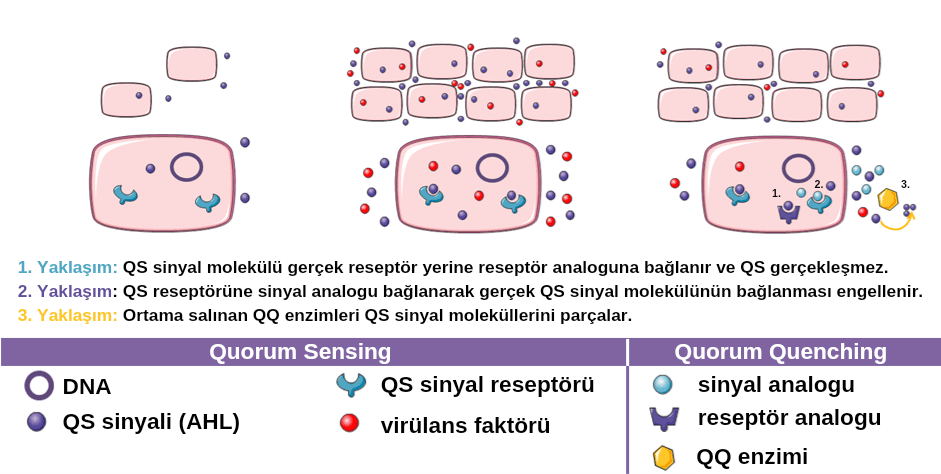
Quorum Sensing Mechanism and Three Different Quorum Quenching Approaches (ITU)
Three main strategies are employed to disrupt signal communication.
Inhibition of Signal Synthesis targets the enzymes (e.g., LuxI) that produce signaling molecules using substrate analogs to block their activity.
Degradation of Signal Molecules involves breaking down secreted signaling molecules (e.g., AHLs) using enzymes such as lactamases, acylases, or oxidoreductases.
Receptor Antagonism employs synthetic molecules structurally similar to the natural signal but incapable of activating the receptor, thereby occupying the receptor and blocking communication. These methods are expected to carry a lower risk of resistance development because they do not impose lethal pressure on bacteria.
The common advantage of these strategies is their ability to suppress pathogenic behavior without exerting lethal pressure on bacteria. Therefore, it is believed that evolutionary resistance will develop more slowly compared to classical antibiotics. Currently, experimental and clinical studies are underway to evaluate the use of quorum quenching agents alone or in combination with antibiotics. This approach is regarded as a promising innovative antimicrobial strategy for controlling chronic infections, biofilm-associated diseases, and multidrug-resistant pathogens.
Research on quorum sensing and the development of intervention strategies targeting this system constitute an area that requires careful consideration not only from scientific and medical perspectives but also from ethical and biosafety standpoints. Quorum quenching approaches, which aim to alter bacterial behavior without directly killing pathogens, are considered “softer interventions” compared to classical antibiotics. This is viewed ethically favorably because they have the potential to cause less disruption to microbial ecosystems, as they may help preserve beneficial microbiota unlike broad-spectrum antibiotics.
However, the development and application of these technologies raise certain ethical questions. Interfering with microbial communication systems introduces uncertainty regarding their long-term effects on natural microbial balances. In particular, the impact of quorum quenching agents released into environmental settings on non-target microorganisms and ecosystem functioning must be carefully evaluated. Therefore, risk analysis, ecotoxicity testing, and long-term monitoring programs are considered indispensable components of ethical research standards for biological agents intended for environmental release.
Another important ethical dimension is the dual-use potential of this knowledge. A detailed understanding of bacterial communication systems can facilitate the development of novel therapies but may also theoretically enable manipulation to enhance pathogen virulence. Therefore, research in the field of quorum sensing must be conducted within the framework of international biosafety principles, transparency, responsible publishing, and controlled laboratory standards.
While quorum sensing technologies represent one of the innovations in modern microbiology, they require maintaining a balance between scientific progress and ethical responsibility. Research must be conducted under the oversight of interdisciplinary ethics committees to ensure both the development of innovative therapies that protect human health and the safe and responsible use of this powerful biological knowledge.
Gülgör, Gökşen, and Mihriban Korukluoğlu. “Mikroorganizmalar Arasında Çoğunluk Algılanması (Quorum Sensing).” *Bursa Uludağ Üniversitesi Ziraat Fakültesi Dergisi* 28, no. 2 (2014): 83–92. Accessed February 3, 2026. https://dergipark.org.tr/tr/pub/ziraatuludag/article/174310.
Kaya, İnci Başak, and Hakan Yardımcı. “Quorum Sensing.” *Etlik Veteriner Mikrobiyoloji Dergisi* 25, no. 1 (2014): 25–31. Accessed February 3, 2026. https://vetkontrol.tarimorman.gov.tr/merkez/Belgeler/EnsituDergisi/EtlikDergi-c25s1-2014.pdf.
Saraçlı, Mehmet Ali, Dolunay Gülmez, and Hümeyra Öktem. “Quorum sensing: Mikroorganizmalar iletişim mi kuruyor?” *Gülhane Tıp Dergisi* 48, no. 4 (2006): 244–250. Accessed February 3, 2026. https://gulhanemedj.org/pdf/37eae217-e8b5-4f55-976f-35df98003e83/articles/33077/GMJ-48-244.pdf.
Tınaz, Gülgün. “Quorum Sensing (Çevreyi Algılama Sistemi) İnhibitörleri: Bakteriyel Enfeksiyonların Kontrolü.” Türk Mikrobiyoloji Cemiyeti. Accessed February 3, 2026. https://www.tmc-online.org/userfiles/file/AKG_Sunumlar/21nisan/gulgun_tinaz_cevreyi_algilama_sistemi.pdf.
Zhao, Xin, J. Liu, J. Zhang, and V. Thompson. "Quorum-Sensing Regulation of Antimicrobial Resistance in Bacteria." Microbial Drug Resistance 26, no. 12 (2020). Accessed February 3, 2026.
https://www.researchgate.net/publication/392608953_Metabolic_Rewiring_of_Bacterial_Pathogens_in_Response_to_Antibiotic_Pressure-A_Molecular_Perspective

Generated by artificial intelligence.
Therapeutic Approach | Quorum Quenching (Signal Quenching) | ||||||||
|---|---|---|---|---|---|---|---|---|---|
Mechanism | Cell density-dependent activation | ||||||||
Related Processes | Biofilm, Virulence, Bioluminescence, Resistance | ||||||||
Key Molecules | Autoinducers (AHL, AI-2, Peptides) | ||||||||
Function(s) | Intercellular communication and gene regulation | ||||||||
Discovered Organism | Vibrio fischeri (Aliivibrio fischeri) | ||||||||
No Discussion Added Yet
Start discussion for "Perception of Sufficient Quantity" article
Historical Development
Working Principle and Molecular Mechanism
Communication Systems by Microorganism Groups
Biofilm Formation and Virulence
Antimicrobial Resistance Mechanisms
Therapeutic Approach
Ethical Dimensions and Biosafety