


This article was automatically translated from the original Turkish version.
+1 More
Parody, also known as mimicry, refers to the creation of a humorous, satirical, or critical effect by preserving the formal characteristics of a work or cultural production while altering its content, meaning, or context. Parody imitates a text, style, genre, discourse, or cultural practice; however, this imitation is constructed through a deliberate distance that highlights the difference between the imitation and the original. In this sense, parody is not a simple copy of the targeted text but a transformative relationship established with it.
The term parody derives from the Greek word parodia. Etymologically, the prefix para carries dual meanings: both closeness and togetherness, as well as opposition and distortion. This duality explains parody’s structure, which simultaneously embodies its connection to the original text and its divergence from it. The term entered Latin as parodia and over time in European languages came to signify mockery, comic exaggeration, and satirical imitation. However, in its historical usage, the boundaries of the term have remained unclear, with parody often overlapping with concepts such as burlesque, satire, and comic mimicry.
The historical origins of parody extend back to Ancient Greece. From the time of Aristotle, parody has existed as a form of expression that references and transforms a prior text or discourse through imitation. In antiquity, parody brought serious and revered artistic works into everyday, ordinary, or satirical contexts to engage audiences.
Throughout history, parody has been employed across various artistic fields, especially literature. In the modern era, it became more pronounced with the growing emphasis on original style and individual artistic expression. Modern literature and art, in which each artist develops a unique language and style, made the imitation of these styles possible; thus, parody came to be regarded as a method that renders the distinctive features of originality visible.
Parody first imitates another text or cultural production and then disrupts or transforms this imitation to establish a new layer of meaning. This transformation can occur at the level of form, content, style, narrative technique, syntax, or central idea. One of parody’s distinguishing features is the effect generated by the discrepancy between the original text and the parodic text. This discrepancy produces humor or a sense of satire. Parody often employs exaggeration, incongruity, and unexpected contrasts to create comic effects. However, not every parody necessarily involves direct attack or overt criticism.
One of parody’s fundamental components is irony. The contrast that reveals the difference between parody and the original work is often established through ironic opposition. Irony involves using an expression in a way that conveys its opposite meaning; parody extends this opposition across the entire text. Thus, while irony operates at the level of meaning, parody can be defined as a textual transformation.
In this context, parody and irony are closely related but functionally distinct modes of expression. Irony inverts meaning through individual expressions, whereas parody targets an entire text or discourse. When used together, both elements create a structure that intensifies the critical or satirical impact of the text.
One concept frequently associated with parody is pastiche. Pastiche involves imitation of a particular style or voice; however, this imitation rarely generates a critical or satirical distance. In parody, by contrast, establishing and making visible a distance between the imitated text and the parodic text is a defining feature. Thus, while parody assumes a critical and transformative function, pastiche may remain limited to adopting a stylistic mask.
Parody is directly related to the concept of intertextuality. Intertextuality is defined as the totality of explicit or implicit relationships a text establishes with other texts. In parody, the connection between the prior text and the parodic text gains meaning through intertextuality. The parodic text re-creates the preceding text through transformation, and this transformation is completed when the reader or viewer recognizes the relationship between the texts.
From this perspective, parody can be viewed not as an independent production but as the recirculation of cultural and historical accumulation. A text’s meaning is shaped not only within its own boundaries but within the network of relationships it establishes with preceding and subsequent texts.
Parody has been employed not only in literature but also in numerous artistic fields such as painting, graphic design, sculpture, cinema, music, and architecture. Artworks that have become canonical in art history have been re-produced through parody, often becoming more visible than the original works. Particularly famous artworks and culturally iconic figures serve as frequent sources for parody. In this context, parody is regarded as a form of production that reveals the permeability of boundaries between high art and popular culture.
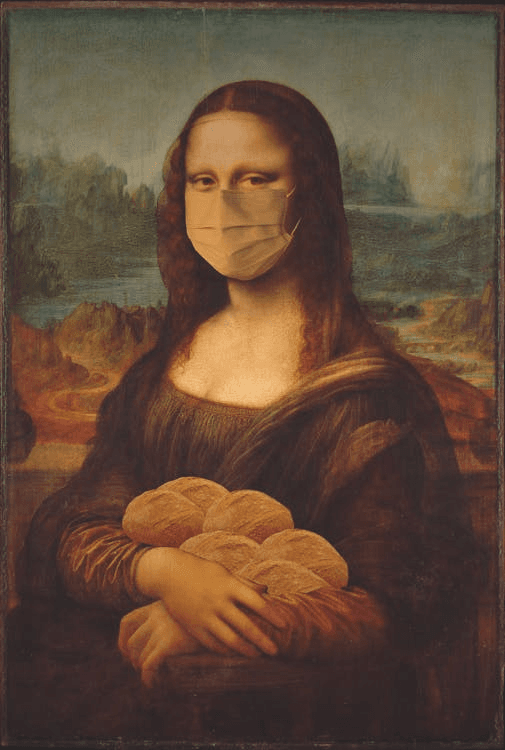
Mona Lisa Depicted as a Parody (Pexels)
With technological advancements, parody has entered visual culture with greater speed and prevalence. Techniques such as collage, quotation, and recontextualization have become central methods in parodic production.
In the postmodern era, parody has become one of the key elements of an aesthetic understanding grounded in intertextuality. In this period, texts derive their existence through references to earlier texts. Parody reorganizes these references within a critical distance. Postmodern texts, through parody, generate plural meanings by disrupting both their own coherence and the coherence of other texts. In this process, parody contributes to the dissolution of singular meanings and fixed identities.
Parody is not confined to literary texts; it also engages with news discourse. News language is structured around claims of seriousness, objectivity, and truth. Parody imitates the formal features of this discourse, subjecting its language and structure to comic and satirical transformation. In this process, the form of the news is preserved, but a deviation is introduced at the level of content and meaning.
Satire and parody-generated news-like texts make visible the rules of news discourse. The aim of parodic news is not to produce news itself but to expose the discursive structure that news represents. In such parodies, the intertextual distance is established through the difference between the news text and its parodic repetition. Thus, the seriousness and credibility claims of news are reconsidered through parody.
New media environments have expanded the production and circulation of parody. Social media platforms and video-sharing sites enable users to re-produce popular texts. Television series, music videos, game characters, and cultural icons from traditional media are recirculated in new media through parodic content. This process gives rise to a form of production grounded in user participation within a culture of convergence.

Parody (Generated by Artificial Intelligence)
Parodies produced on social media platforms incorporate elements of imitation and pastiche that reference popular texts. These parodies often rely on simple plot structures, repeatable gags, and familiar character archetypes. In new media, parody constructs a structure based on recognizability, transforming texts familiar to the audience and presenting them anew. In this context, parody fulfills a functional role in the re-production of popular culture within new media environments.
Göksel, Nil. "Unutma, Parodi ve İroni." *FLSF Felsefe ve Sosyal Bilimler Dergisi* 1 (2006): 131-140. Accessed January 24, 2026.https://dergipark.org.tr/en/pub/flsf/issue/48600/617456
Koç, Okan. "Komik Olanın Peşinde: Parodi." Türk Dili (2015): 233-238. Accessed January 24, 2026.https://tdk.gov.tr/wp-content/uploads/2015/12/20151227Okan%20Ko%C3%A7%20-%20Komik%20Olan%C4%B1n%20Pe%C5%9Finde%20Parodi.pdf
Koç, Çilem Tuğba, and Deniz Elif Yavalar. "Çocukların Değişen Mizah Kültürü: Youtube Parodi Hikâyelerinde Çocukların Tüketim Öyküleri." *Folklor/Edebiyat* 30, no. 118 (2024): 311-336. Accessed January 24, 2026.https://dergipark.org.tr/en/download/article-file/3895937
Pexels. Accessed January 24, 2026.https://www.pexels.com/tr-tr/fotograf/ekmek-boyama-resim-yapma-resim-4658409/
Saygın, Arda Umut. "Haberin Mizahla İmtihanı: Hiciv-Parodi Haberler." *Kastamonu İletişim Araştırmaları Dergisi* 12 (2024): 27-55. Accessed January 24, 2026.https://dergipark.org.tr/en/pub/kiad/article/1344801
Vardar, Turan. *Günümüz Sanatsal Tasarımlarında Patiş ve Parodi.* Master's thesis, Necmettin Erbakan Üniversitesi, 2019. Accessed January 24, 2026.https://tez.yok.gov.tr/UlusalTezMerkezi/TezGoster?key=npGs9H39x7G6401x51yqpObdY_jeFi-aNX81TNf6l3b5kbQwfkdBRRXF1OniZjQS

Etymology and Conceptual Origins
Historical Development
Key Features of Parody
Relationship with Irony
Distinction Between Parody and Pastiche
Parody in the Context of Intertextuality
Parody in Art and Visual Culture
Parody in the Postmodern Context
Relationship with News Discourse
Parody in Social Media and New Media