


This article was automatically translated from the original Turkish version.
+1 More
A palimpsest is a parchment or other writing surface on which a text has been erased so that a second text can be written over it, yet traces of the original writing remain visible. In antiquity, parchment was made from the skin of lamb, calf, or kid, and was expensive and not always readily available. Parchments that had already been used were reused for new writings to conserve writing surfaces. The original text was removed by scraping or washing. In everyday usage, the term palimpsest also refers to an object that was originally constructed or worked for one purpose and later repurposed for another, as in the case of a monumental brass plaque with its reverse side blank and subsequently re-engraved.
The English word palimpsest derives from the Latin palimpsestus, which in turn comes from the Greek palimpsestos. The Greek word means “scratched again” or “erased again.” The Greek palin means “again” or “once more,” while psao means “to scrape” or “to rub off.” In the West, a reused manuscript is known as a codex rescriptus; in Arabic, it is called tırs or tıls.
The erased original text is called the “lower text” (Scriptio inferior), while the newer text written over it is called the “upper text” (Scriptio superior). The upper text may be in a different language or written in a different or the same script tradition, and the lower text may be older than or contemporary with the upper text. Evidence exists that some Arabic papyrus palimpsests have survived to the present day, along with a few reused parchment examples. The two oldest known parchment palimpsests are believed to contain fragments of the Kur’ân and were sold at an auction in London between 1992 and 2000. Recent analysis by Alba Fedeli of these two palimpsests reveals differences between both the lower text and the standard Osman Mushaf.
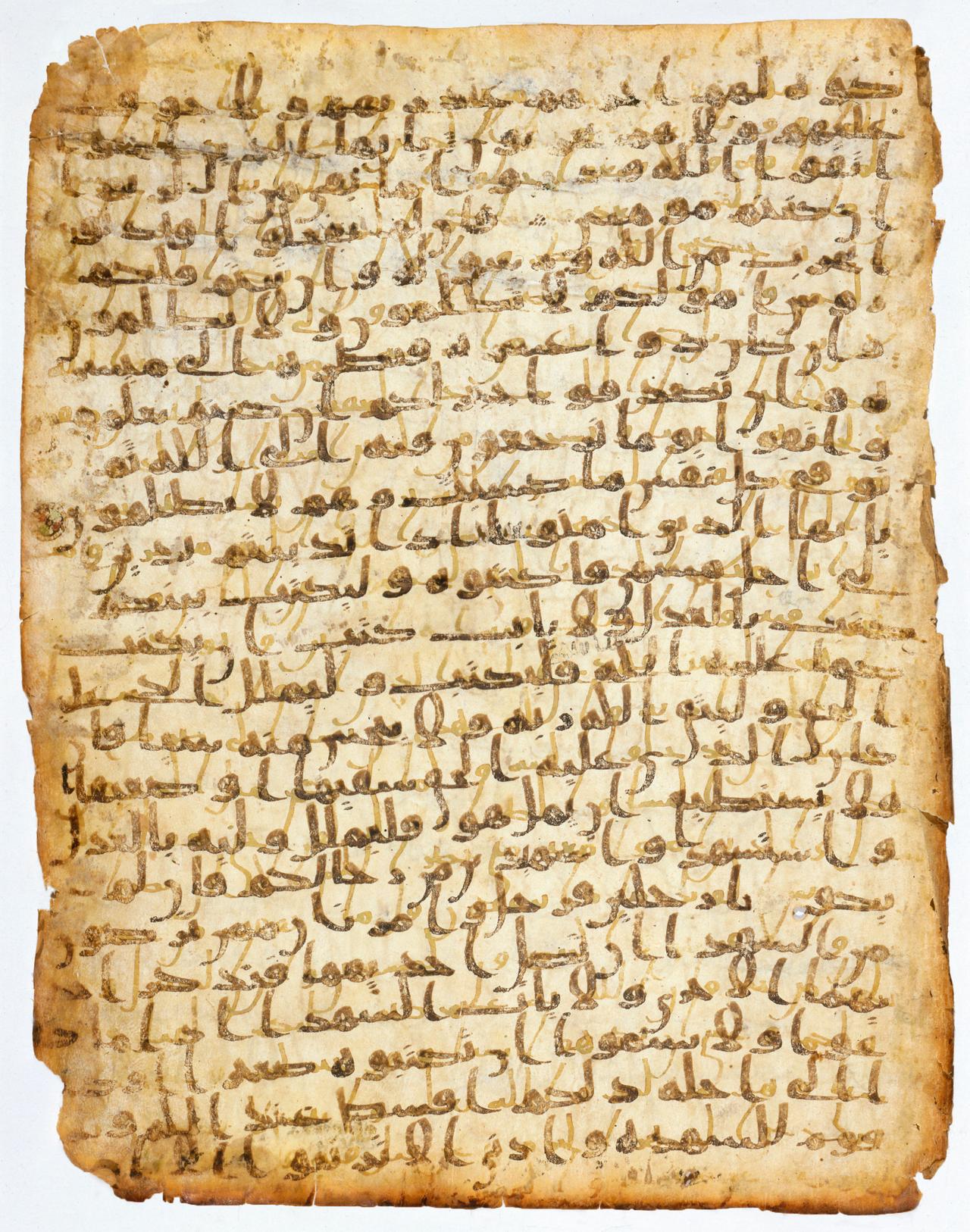
(A fragment of one of the earliest surviving copies of the Qur’an is written on a palimpsest parchment. Both the lower and upper texts belong to Surah Al-Baqarah.)
Apaydın, Banu. 2019. Palimpsest kavramı ve mekansal dönüşüm.
Déroche, François. 2006. Islamic codicology: an introduction to the study of manuscripts in Arabic script. London.
Fedeli, Alba. 2007. Early evidences of variant readings in Qur'anic manuscripts. Berlin.
Fendall, Ramsey. 2003. Islamic calligraphy. London.
Frase, Marcus and Kwiatkowski, Will. 2006. Ink and gold: Islamic calligraphy. London.
Gacek, Adam. 2001. The Arabic manuscript tradition: a glossary of technical terms and bibliography. Leiden/Chicago.
Gacek, Adam. 2020. Arapça El Yazmaları İçin Rehber. Klasik Yayınları.
Page-Phillips, John. 1980. Palimpsests - the backs of monumental brasses.

Etymology
Usage and examples