

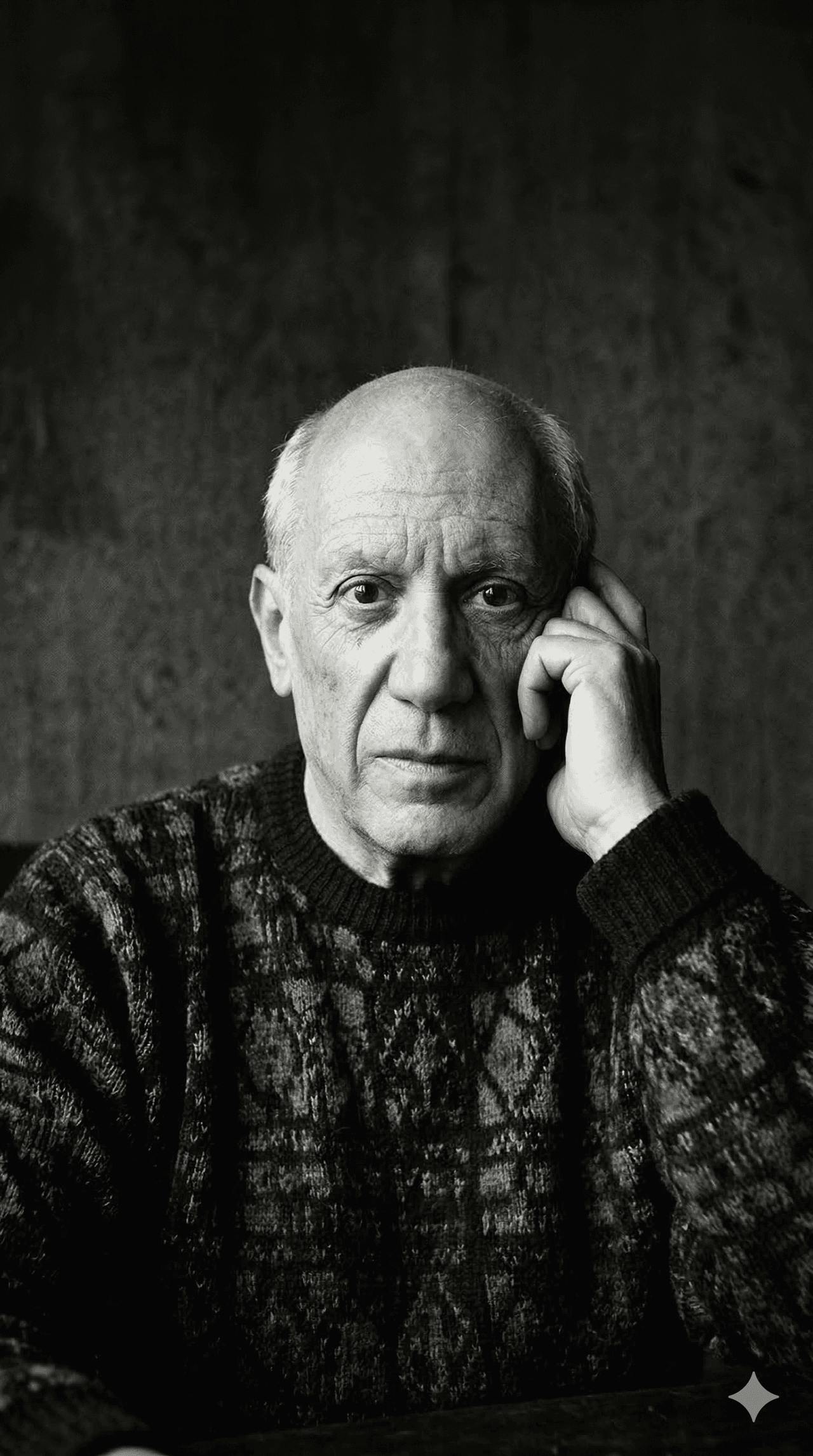

(Generated with Artificial Intelligence.)
Pablo Picasso
Art Movements | Cubism (Founder), Surrealism, Neoclassicism, Expressionism | ||||||||
|---|---|---|---|---|---|---|---|---|---|
Iconic Works | Les Demoiselles d'Avignon (1907), Guernica (1937), The Weeping Woman (1937) | ||||||||
Birth | 25 October 1881 (Málaga) | ||||||||
Death | 8 April 1973 (Mougins) | ||||||||
Child | Maya Widmaier-Picasso Claude Ruiz-Picasso Paloma Picasso Paulo Ruiz-Picasso | ||||||||
Spouse | Olga Khokhlova (1918–1955) Jacqueline Roque (1961–1973) | ||||||||
Full Name | Pablo Diego José Francisco de Paula Juan Nepomuceno María de los Remedios Cipriano de la Santísima Trinidad Ruiz y Picasso | ||||||||
Date of Birth | 25 October 1881 (Málaga) | ||||||||
Date of Death | 8 April 1973 (Mougins) | ||||||||
Art Movements | Cubism (Founder) Surrealism Neoclassicism Expressionism | ||||||||
Notable Works | Les Demoiselles d'Avignon (1907) Guernica (1937) The Weeping Woman (1937) | ||||||||
Father | Don José Ruiz y Blasco (Painter and Art Professor) | ||||||||
Mother | María Picasso y López | ||||||||
Marriages | Jacqueline Roque (1961–1973) Olga Khokhlova (1918–1955) | ||||||||
Children | Paulo Ruiz-Picasso Paloma Picasso Claude Ruiz-Picasso Maya Widmaier-Picasso | ||||||||
Pablo Ruiz Picasso is a Spanish artist born in 1881 in Málaga, Spain, who was active as a painter, sculptor, printmaker, ceramicist, stage designer, poet, and playwright. Spending most of his life in France, Picasso is recognized as a co-founder of Cubism alongside Georges Braque and is also noted for inventing constructed sculpture and collage. With a body of work exceeding 20,000 pieces, he is regarded as one of the defining figures of 20th century art.【1】
Picasso and Modern British Art (Tate)
Pablo Ruiz Picasso was born in 1881 in Málaga, in the Andalusia region of Spain, to José Ruiz Blasco and Maria Picasso. His father taught drawing at the Málaga School of Fine Arts, served as curator of the city’s municipal museum, and sold his own paintings. His mother, Doña Maria, was a homemaker. Picasso adopted his mother’s surname as his artistic name; the double S in the surname reflects the family’s Genoese origins, an unusual practice in Spain. Pablo had two younger sisters, Dolores ("Lola", b. 1884) and Conception ("Conchita", b. 1887).【2】
His father guided him toward art from an early age; Picasso regularly accompanied him to museums and observed his work. According to his mother, Picasso’s first word was “piz,” a shortened form of “lápiz,” meaning pencil. Picasso struggled to adapt to school, spending class time drawing figures on paper. At age eight, he completed his first oil painting, titled “The Little Yellow Picador,” depicting bullfighting—a subject he inherited from his father.【3】
In 1891, the family moved to La Coruña after his father was appointed to a position there. At age thirteen, his younger sister Conchita died of diphtheria. Picasso recounted this event decades later to his companion Françoise Gilot, stating that he had wished to abandon painting if she had recovered.【4】
Pablo Ruiz Picasso 1903. (The Art Story)
Picasso continued his classical training at the School of Fine Arts in La Coruña from 1892, experimenting with new media such as pastel and pencil. During this period, recurring themes emerged, including pigeons, hands, and his sister Lola; he also produced small illustrated newspapers titled “La Coruña” and “Azul y Blanco.”【5】
After his father was appointed professor at the La Lonja School of Fine Arts in Barcelona, Picasso continued his education there. In 1897, he moved to Madrid and briefly attended art schools there, gaining the opportunity to closely study the works of Spanish Old Masters at the Prado Museum.【6】
Barcelona became Picasso’s first significant environment for developing his artistic identity. He frequently visited Els Quatre Gats (The Four Cats), a haunt of bohemians, anarchists, and modernists, where he encountered Art Nouveau, Symbolism, and the works of leading artists of the time. It was also in this milieu that he met Jaime Sabartés, who would later become his loyal secretary.【7】
In 1904, Picasso settled in Paris, moving into the artists’ quarter of Bateau-Lavoir, where he formed a circle with the poet Guillaume Apollinaire (1880–1918) and the writer Max Jacob (1876–1944). The American siblings Gertrude (1874–1946) and Leo (1872–1947) Stein became important patrons; their Saturday salons at 27 rue des Fleurus served as a meeting point for modern art and thought.【8】
After meeting Georges Braque (1882–1963) in 1907, one of modern art’s most remarkable collaborations began. Picasso described their partnership as “like two mountain climbers roped together”; they visited each other daily and jointly formulated the foundational principles of Cubism. According to biographer Alex Danchev, this period was the most concentrated and productive of Picasso’s entire career. Around 1916, his meeting with Jean Cocteau introduced a new direction, leading him through Cocteau to Sergei Diaghilev, where he began creating set designs for the Ballets Russes. In the late 1920s, he collaborated with sculptor Julio González, resulting in welded metal sculptures that left a lasting legacy on subsequent generations.【9】
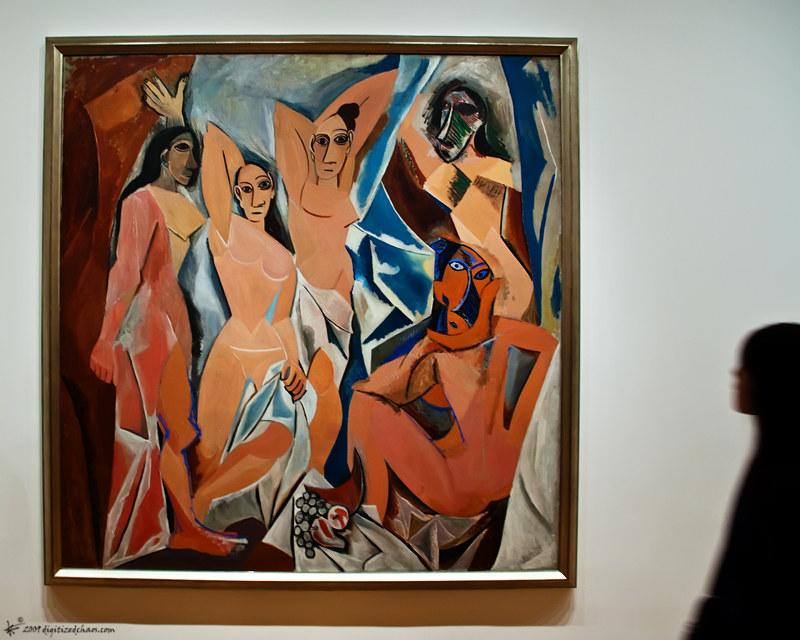
Les Demoiselles d'Avignon 1907 (Flickr)
Major exhibitions were held in London, Venice, and Paris; comprehensive retrospectives took place in Tokyo in 1951 and in Lyon, Rome, Milan, and São Paulo in 1953. The 1957 retrospective at the Museum of Modern Art in New York attracted over 100,000 visitors in its first month, solidifying Picasso’s position among museums and private collectors in America, Europe, and Japan. Fifteen of Picasso’s paintings were included in MoMA’s inaugural exhibition in 1930; Alfred Barr’s exhibitions Cubism and Abstract Art (1936) and Fantastic Art, Dada, Surrealism (1936–37) also devoted extensive space to Picasso’s work. Due to this strong association with the museum, MoMA has occasionally been referred to as “the house that Picasso built.”【10】
Picasso is recognized, alongside Georges Braque, as a co-founder of Cubism; his invention of constructed sculpture and collage are among his most significant technical innovations in art history (Dalí Museum Library). In Analytic Cubism (1910–12), three-dimensional forms were deconstructed on a two-dimensional plane; in Synthetic Cubism (1912–14), Picasso and Braque jointly developed the collage technique and papier collé, adhering newspaper clippings, colored paper, and fabric fragments onto canvas to create trompe-l’œil illusions of real objects. His costume and theater designs, sculptures, ceramics, prints, and public commissions expanded the scope of artistic practice.【11】
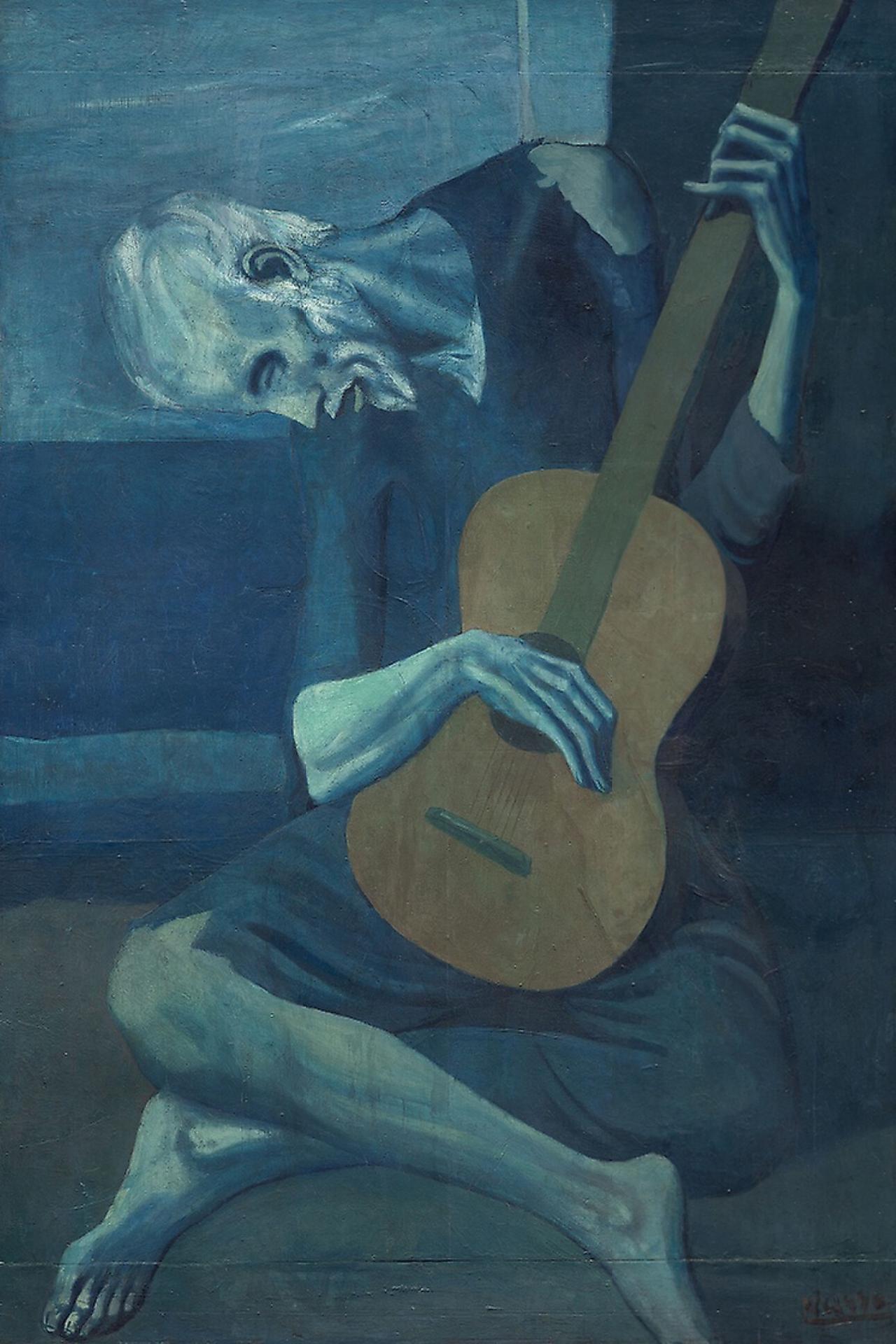
Old Guitarist (flickr)
Picasso’s output encompasses over 20,000 paintings, prints, drawings, sculptures, ceramics, theater sets, and costumes. His Blue Period (1901–1904) works, such as The Meal of the Blind Man, reflect poverty, loneliness, and despair through somber blue tones, showing the influence of El Greco’s elongated figures. During his Rose Period (1904–1906), Picasso portrayed himself as a harlequin in At the Lapin Agile, embracing vibrant red tones; Acrobat on a Ball is also among the works of this period.【12】
The masterpiece of his African-Influenced Period (1907–1909), Les Demoiselles d'Avignon (Museum of Modern Art, New York), is regarded as heralding the beginnings of Cubism. The figure arrangement draws on Cézanne’s compositions of bathers, achieving plastic volume through angular planes and pronounced contours. Key works from his Analytic Cubist phase include Still Life with a Glass Bottle and from his Synthetic Cubist phase, Bottle and Glass on a Table.【13】
During the Neoclassical Period (1920s), White Woman exemplifies figures centered on motherhood; in the Surrealist Period (mid-1920s), Nude Standing by the Sea merges classical poses with distorted forms. His most important work from the Spanish Civil War period, Guernica (Reina Sofía National Museum, Madrid), is a monumental wall painting in gray tones that powerfully conveys an anti-war symbolism; it was created as a contribution to the Spanish Pavilion at the 1937 Paris Exposition Universelle.【14】
In his later years, Faun and Stars symbolized a return to mythological themes; his final decade featured reinterpretations of masterpieces by Poussin, Velázquez, Le Nain, Rembrandt, and Manet, which became defining projects of his late career.【15】
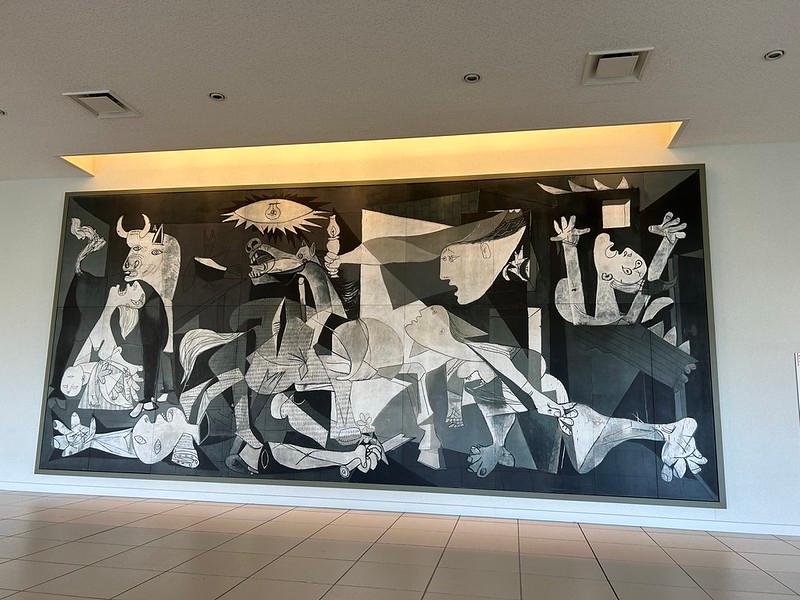
Guernica 1937 (Flickr)
From childhood, Picasso showed a fascination with pigeons and bullfighting; his first oil painting depicted a picador. Mythology remained a persistent interest, with centaurs, minotaurs, nymphs, and fauns recurring as motifs in his work. Ballet was also among his interests; his stage design projects for the Ballets Russes represent a tangible expression of this passion.【16】
Key influences on Picasso’s style include El Greco’s elongated and distorted figures, Symbolism’s dark themes, and Art Nouveau’s flowing lines. Cézanne’s compositions of bathers, ancient Iberian sculpture, and the formal language of African and Oceanic art served as decisive references. Personal losses, such as the suicide of his friend Carlos Casagemas and the death of his sister, are regarded as direct catalysts for shifts in his stylistic periods.【17】
Artists such as Poussin, Velázquez, Le Nain, Rembrandt, and Édouard Manet were foundational sources for his late-period production.【18】
Picasso married twice. His first marriage, to dancer Olga Khokhlova, coincided with his intense focus on dance and theater design. In 1961, at age seventy-nine, he married Jacqueline Roque (1927–1986). His first son, Paulo, was born in 1921; Picasso had four children: Claude, Paloma, Maia, and Paulo.【19】
Throughout the 1950s and 1960s, Picasso created his own interpretations of masterpieces by great artists such as Poussin, Velázquez, and El Greco. During this period, his work focused largely on portraiture, with his palette reduced almost to tonal variations; critics initially regarded these works as inferior to his earlier periods, but in recent years they have been more favorably assessed. While living in southern France, he continued painting, producing ceramics, and experimenting with printmaking techniques, maintaining his productivity into advanced age and accumulating a substantial personal fortune and distinguished collection.【20】
Pablo Picasso died in southern France in 1973 from a heart attack.【21】
Picasso’s influence possesses both depth and breadth, with each phase of his life standing as a lasting contribution in its own right. His early Symbolist works remain iconic, while his pioneering innovations in Cubism continued to serve as a defining reference point in painting until the 1950s. Although Abstract Expressionists are said to have transformed certain dimensions of Cubism, the movement is widely acknowledged as being nourished by Picasso’s legacy. By the 1960s, Picasso had achieved widespread public recognition, and this interest continued to fuel curiosity about his work.【22】
Salvador Dalí first visited Picasso’s studio in 1926; this relationship profoundly influenced Dalí’s own artistic development, and both artists responded artistically to the horror created by the Spanish Civil War.【23】
Castillo, Rian. "a demoiselle du MoMA." Flickr. Accessed June 30, 2026. https://flic.kr/p/79sdSq
Gandalf's Gallery. "Pablo Picasso - Old Guitarist [1903-04]." Flickr. Accessed June 30, 2026. https://flic.kr/p/2iN5w7c
Kanesue. "Guernica." Flickr. Accessed June 30, 2026. https://flic.kr/p/2puGK5z
Metropolitan Museum of Art. "Pablo Picasso (1881–1973)." *metmuseum.org.* Accessed June 30, 2026. https://www.metmuseum.org/essays/pablo-picasso-1881-1973
Musée National Picasso-Paris. "Picasso's Childhood." Musée National Picasso-Paris. Accessed June 30, 2026. https://www.museepicassoparis.fr/en/picassos-childhood
National Gallery of Art. "Pablo Picasso." *nga.gov.* Accessed June 30, 2026. https://www.nga.gov/artists/1783-pablo-picasso
Tate. "Picasso and Modern British Art | TateShots." YouTube, 3:39. Accessed June 30, 2026. https://youtu.be/Zef2bkqd9aQ?si=qyMSH2ZjzE2kjMFW
The Art Story. "Pablo Picasso)." The Art Story. Accessed June 30, 2026. https://www.theartstory.org/artist/picasso-pablo/
The Dalí Museum. "Dali Library Guide: Pablo Picasso." thedali.org. Accessed June 30, 2026. https://thedali.org/dali-library-guide-1/pablo-picasso/
[1]
Salvador Dalí Museum, "Pablo Picasso," tehdali.org, access date: 30 June 2026, https://thedali.org/dali-library-guide-1/pablo-picasso/.
[2]
Musée National Picasso-Paris, "Picasso's Childhood." Musée National Picasso-Paris, Access date: 30 June 2026, https://www.museepicassoparis.fr/en/picassos-childhood
[3]
Musée National Picasso-Paris. "Picasso's Childhood."
[4]
Musée National Picasso-Paris. "Picasso's Childhood."
[5]
Musée National Picasso-Paris. "Picasso's Childhood."
[6]
Metropolitan Museum of Art,"Pablo Picasso (1881–1973)," The Metropolitan Museum of Art, Access date: 30 June 2026, https://www.metmuseum.org/essays/pablo-picasso-1881-1973
[7]
The Art Story, "Pablo Picasso," theartstory.org, access date: 30 June 2026, https://www.theartstory.org/artist/picasso-pablo/.
[8]
Metropolitan Museum of Art, "Pablo Picasso (1881–1973)."
[9]
The Art Story, "Pablo Picasso."
[10]
Metropolitan Museum of Art, "Pablo Picasso (1881–1973)."
[11]
Metropolitan Museum of Art, "Pablo Picasso (1881–1973)."
[12]
Metropolitan Museum of Art, "Pablo Picasso (1881–1973)."
[13]
Metropolitan Museum of Art, "Pablo Picasso (1881–1973)."
[14]
Metropolitan Museum of Art, "Pablo Picasso (1881–1973)."
[15]
National Gallery of Art, "Pablo Picasso," National Gallery of Art, Access date: 30 June 2026, https://www.nga.gov/artists/1783-pablo-picasso
[16]
The Art Story, "Pablo Picasso."
[17]
Musée National Picasso-Paris. "Picasso's Childhood."
[18]
National Gallery of Art, "Pablo Picasso."
[19]
The Art Story, "Pablo Picasso."
[20]
The Art Story, "Pablo Picasso."
[21]
The Art Story, "Pablo Picasso."
[22]
The Art Story, "Pablo Picasso."
[23]
Salvador Dalí Museum, "Pablo Picasso."
(Generated with Artificial Intelligence.)
Pablo Picasso
Art Movements | Cubism (Founder), Surrealism, Neoclassicism, Expressionism | ||||||||
|---|---|---|---|---|---|---|---|---|---|
Iconic Works | Les Demoiselles d'Avignon (1907), Guernica (1937), The Weeping Woman (1937) | ||||||||
Birth | 25 October 1881 (Málaga) | ||||||||
Death | 8 April 1973 (Mougins) | ||||||||
Child | Maya Widmaier-Picasso Claude Ruiz-Picasso Paloma Picasso Paulo Ruiz-Picasso | ||||||||
Spouse | Olga Khokhlova (1918–1955) Jacqueline Roque (1961–1973) | ||||||||
Full Name | Pablo Diego José Francisco de Paula Juan Nepomuceno María de los Remedios Cipriano de la Santísima Trinidad Ruiz y Picasso | ||||||||
Date of Birth | 25 October 1881 (Málaga) | ||||||||
Date of Death | 8 April 1973 (Mougins) | ||||||||
Art Movements | Cubism (Founder) Surrealism Neoclassicism Expressionism | ||||||||
Notable Works | Les Demoiselles d'Avignon (1907) Guernica (1937) The Weeping Woman (1937) | ||||||||
Father | Don José Ruiz y Blasco (Painter and Art Professor) | ||||||||
Mother | María Picasso y López | ||||||||
Marriages | Jacqueline Roque (1961–1973) Olga Khokhlova (1918–1955) | ||||||||
Children | Paulo Ruiz-Picasso Paloma Picasso Claude Ruiz-Picasso Maya Widmaier-Picasso | ||||||||
Childhood and Youth
Education
Career Development
Major Achievements
Contributions
Works and Projects
Hobbies and Interests
Sources of Inspiration
Personal Life
Later Years and Death
Legacy and Influence