


This article was automatically translated from the original Turkish version.
Yatağan is a short, slightly curved, single-edged close-combat weapon that was widely used in the Ottoman Empire from the 16th century until the end of the 19th century. Distinctive in form, it differs from both swords and polesarms. In addition to its function as an offensive weapon, it also held symbolic importance as an indicator of the owner’s social status and wealth. Capable of both cutting and thrusting, this weapon is particularly associated with the Janissaries.
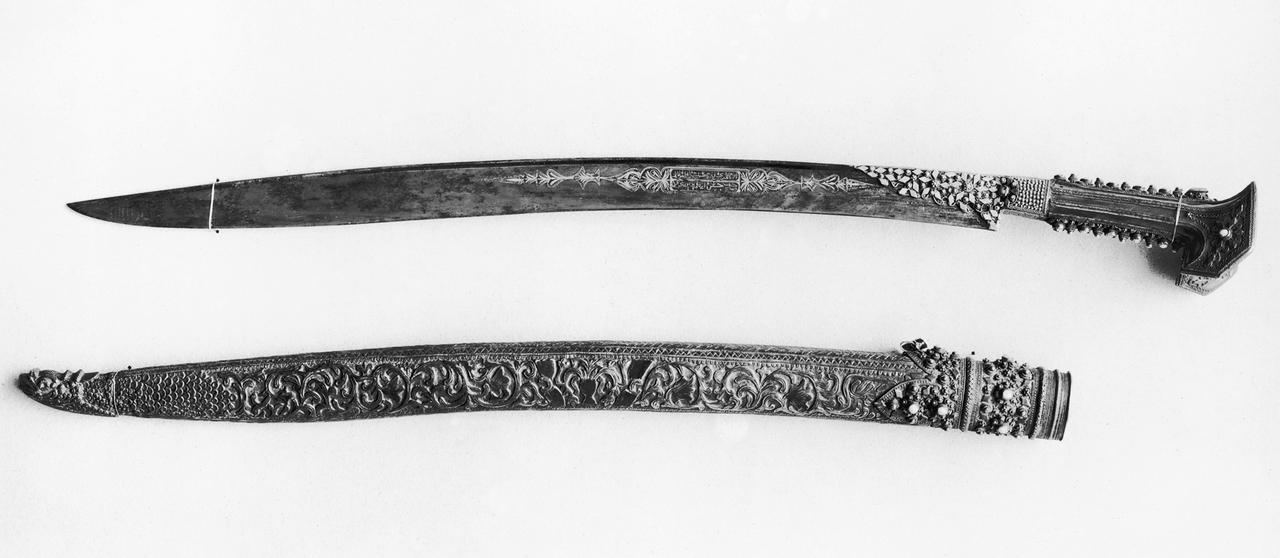
Engraved Yatağan Blade – 19th Century (The Walters Art Museum)
A clear evolution in Ottoman sword forms can be observed from the second half of the 15th century onward. Starting with the reign of Fatih Sultan Mehmed (1451–1481), Ottoman swords began to develop a distinct character in both form and functionality. The yatağan, with its unique design, emerged in the second half of the 16th century and continued to be used with little change in form until the 19th century.
The popularity of the yatağan increased significantly due to its association with the Janissary Corps, from which it became recognized as one of their symbolic weapons. It was used not only within the Ottoman army but also across the empire’s vast territories including the Near East, the Balkans and the Caucasus. However, with the growing effectiveness of firearms, particularly muskets, from the 1800s onward, the importance and use of traditional swords such as the yatağan gradually declined.
Due to its distinctive shape, the yatağan does not fit neatly into either the sword or the polesarm category; as a result, it is studied as a separate category in scholarly literature. The name is believed to derive from the way the weapon was stored in its scabbard, as if lying down (“yatar gibi”). In classifications of Ottoman weapons, the yatağan is listed as a distinct type alongside curved, double-edged, straight and polesarm forms.
The yatağan consists of three main components: the blade, the hilt and the scabbard.
The production of the yatağan began with the forging of the blade from steel or iron using hammering techniques. The manufacture involved not only swordsmiths but also specialized artisans such as engravers (nakkaş), inlay craftsmen (zernişan), and scabbard makers (niyamgeran).
Various techniques were employed in the decoration of yatağans:
Decorations frequently feature floral motifs (rumi, hatayi, leaf), geometric patterns, and inscriptions containing the names of masters, owners, or verses from the Quran.
The World’s Largest Sword Belonging to Kanuni Sultan Süleyman (117 cm) - Tarihte Yürüyen Adam (Man Walking Through History and Our Waqf Works)
"Kanuni Sultan Süleyman’a Ait Dünyanın En Büyük Yatağan Kılıcı (117 Santim) - Tarihte Yürüyen Adam." YouTube video, 3:59. June 8, 2021. http://www.youtube.com/watch?v=UW9l9Sxm_qU.
Boşdurmaz, Nurcan. “Bosna-Hersek’te 15.-16. Yüzyıllarda Osmanlı Dönemi Müslüman Mezar Taşları.” *Sanat Tarihi Yıllığı* 17 (March 2011): 13–26. Accessed June 7, 2025. https://dergipark.org.tr/en/pub/iusty/issue/24951/263374
Elmacıoğlu, Esra, and Sonnur Aktay. “Rus Edebiyatında Tarihî Kültürel Bir Sembol Olarak Yatağan Kılıcı.” *Karadeniz Araştırmaları* 19, no. 76 (December 2022): 1233–1243. Accessed June 7, 2025. https://doi.org/10.56694/karadearas.1220647
Kara, Hacer, and İlker Mimiroğlu. “Koyunoğlu Şehir Müze ve Kütüphanesinde Bulunan Osmanlı Dönemi Kılıçları.” *History Studies* 12, no. 4 (August 2020): 1915–1953. Accessed June 7, 2025. https://www.researchgate.net/publication/347344138_Koyunoglu_Sehir_Muze_ve_Kutuphanesinde_Bulunan_Osmanli_Donemi_Kiliclari
Kılıç Ustası. "TRT HABER Kılıçlarımız Hakkında Yaptıkları Haber İçin Teşekkür Ediyoruz." YouTube, Accessed June 11, 2025. https://www.youtube.com/watch?v=ObKA-65mGNI
Sarıkaya, Erdem. “Bağdatlı Rûhî Divanı’nda Osmanlı Savaş Kültürüne Ait Kavramlar / In Ruhi of Baghdad’s Divan Concepts of the Ottoman War Culture.” *Akademik Hassasiyetler* 4, no. 7 (May 2017): 121–146. Accessed June 7, 2025. https://dergipark.org.tr/tr/pub/akademik-hassasiyetler/issue/29493/297772
Sword ("Yataghan") and Scabbard. The Walters Art Museum. Accessed June 11, 2025. https://art.thewalters.org/object/51.428/
Uysal, Zeynep. “Topkapı Sarayı Müzesi’nde Bulunan 15. ve 16. Yüzyıl Osmanlı Padişahlarına Ait Bazı Kılıçların Tezyînat Açısından İncelenmesi.” 2023. Accessed June 7, 2025. https://acikerisim.selcuk.edu.tr/items/31ff45a5-b469-40da-938a-2f86ba7a2839
Vahabova, Sevinç. “Azerbaycan Milli Tarih Müzesi Koleksiyonundaki Osmanlı Silahları.” VIII. Uluslararası Türkoloji Kongresi, 125. Accessed June 7, 2025. https://akademiye.org/tr/wp-content/uploads/2020/12/Eski-Uygurlar-neyi-nasil-ve-neden-kiraliyordu.pdf#page=134
Yakar, Mustafa Haki. “Tarihe Yön Veren Silah Kılıç.” *Tarih Kritik Dergisi* 6, no. 3 (July 2020): 260–263. Accessed June 7, 2025. https://dergipark.org.tr/tr/pub/tarihkritik/issue/55798/763997

No Discussion Added Yet
Start discussion for "Ottoman Yatağan Sword" article
Historical Development
Theoretical Approaches and Classification
Physical Characteristics and Construction
Manufacturing Processes and Decoration
Examples