


This article was automatically translated from the original Turkish version.
Orthotropic materials are a type of material that exhibits distinct mechanical properties along three mutually perpendicular axes (Cartesian coordinate system: x, y, z).
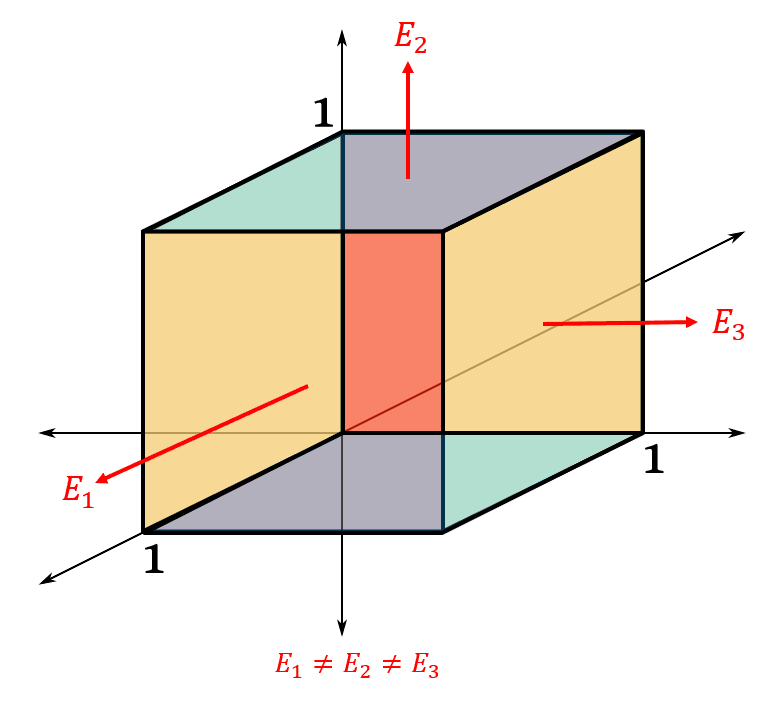
Example Element with Different Elasticity in All Directions
【1】
In orthotropic materials, mechanical properties may differ along three perpendicular axes (x, y, z directions), but each direction has a constant value. That is:
Orthotropic materials have wide applications in civil engineering and aerospace engineering. In particular, composite materials are preferred in aircraft fuselages, wing designs, and automotive components due to their high strength-to-weight ratio.
While orthotropic materials exhibit different properties along three mutually perpendicular axes (Cartesian coordinate system: x, y, z), anisotropic materials exhibit different properties in all directions.
Beer, Ferdinand P., E. Russell Johnston Jr., John T. Dewolf, and David F. Mazurek. Cisimlerin Mukavemeti. 6. basımdan çeviri. Çev. Ayşe Soyuçok ve Özgün Soyuçok. İstanbul: Literatür Yayıncılık, 2019.
Madier, Dominique. Practical Finite Element Analysis for Mechanical Engineers. 2021.
[1]
In2Infinity. “Polyhedra I: Prisms and Pyramids.” In2Infinity. Accessed 1 March 2025. https://in2infinity.com/ultimate-guide-to-geometry/polyhedra-i-prisms-and-pyramids/.

No Discussion Added Yet
Start discussion for "Orthotropic Material" article
How Is an Orthotropic Material Identified?
1. Elastic Modulus (Young's Modulus) → E₁, E₂, E₃
2. Poisson’s Ratios (ν₁₂, ν₂₃, ν₃₁)
3. Shear Modulus → G₁₂, G₂₃, G₃₁
Applications in Engineering
Examples of Orthotropic Materials
Difference from Anisotropic Materials