This article was automatically translated from the original Turkish version.
Date of Death | 24 June 2012 | ||||||||
|---|---|---|---|---|---|---|---|---|---|
Place of Death | Charles Darwin Research Station | ||||||||
Discoverer | Jozsef Vagvolgy | ||||||||
Gender | Male | ||||||||
Natural Habitat | Pinta Island, Galapagos | ||||||||
Species | Pinta Island Giant Tortoise | ||||||||
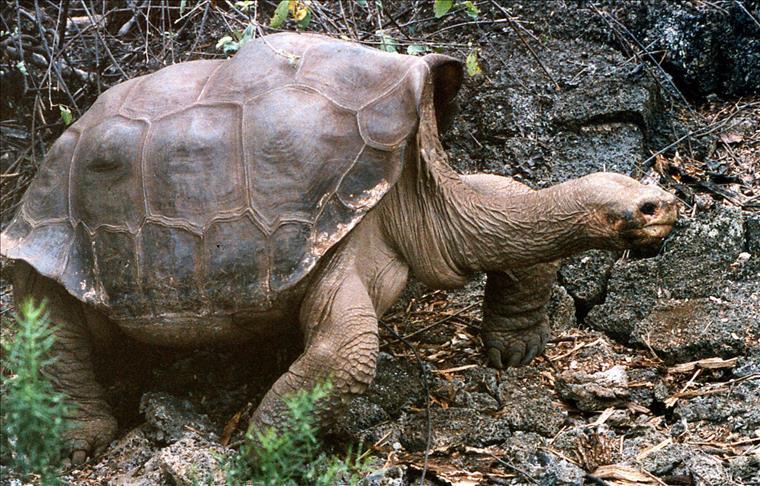
Lonesome George is the last known male individual of the Pinta Island giant tortoise, a subspecies of the giant land tortoises endemic to the Galápagos Islands. Lonesome George represents the abingdoni subspecies native to Pinta Island. Because of this, Lonesome George has become not only a member of the Galápagos fauna but also one of the iconic symbols of conservation biology.【1】 Lonesome George is described as “the world’s most famous conservation icon.”【2】
The last documented tortoises from Pinta were collected by the California Academy of Sciences in 1906, after which no live tortoises were observed on the island for many years.【3】 This giant tortoise, long believed to be extinct, was rediscovered on Pinta Island in 1971 by biologist Jozsef Vagvolgy. In March 1972, he was named “Solitario Jorge” (Lonesome George) and transported to the Charles Darwin Research Station.【4】 The name “Lonesome George” was inspired by the nickname of a popular television personality of the time, George Gobel.【5】
Lonesome George lived under conservation care for approximately forty years, during which numerous efforts were made to find him a suitable mate and ensure the continuation of his lineage, but all attempts proved unsuccessful.【6】
Lonesome George occasionally suffered from health issues such as skin problems, goiter, and weight gain.【7】
Lonesome George died unexpectedly on 24 June 2012 at approximately 100 years of age.【8】 With his death, the last known individual of the Pinta Island tortoise disappeared. A necropsy determined that his death was due to old age and natural causes; although most of his organs appeared healthy, signs of advanced aging were detected in his liver.【9】 Tissues were preserved after his death for potential future scientific studies.【10】
Pinta Island is a relatively arid island located in the northern section of the Galápagos Islands, with much of its surface covered by lava flows. The majority of the island consists of bare lava fields rising slightly above 2,000 feet. Opuntia cacti on the island provided food, water, and shade for the giant tortoises, while a small but significant moist zone with denser vegetation existed near the summit throughout the year.【11】
Galápagos giant tortoises diversified through adaptation to different environmental conditions across the islands, giving rise to as many as 15 subspecies. This differentiation is particularly evident in morphological traits such as shell shape.【12】 Until Lonesome George’s death, 11 of these 15 subspecies had survived into the present day. Six of these lived on separate islands, while the other five inhabited Isabela Island.【13】 With George’s death, five of the original subspecies became extinct.
The Pinta tortoise belongs to the saddle-backed group, which also includes the Santa Fe, Floreana, and Fernandina tortoises; these lineages adapted to the drier island conditions of the Galápagos.【14】
Based on mitochondrial DNA evidence, Lonesome George, the last representative of the abingdoni lineage from Pinta Island, was found to be genetically closer to tortoises from San Cristóbal and Española, geographically distant from Pinta.【15】
Individuals carrying Pinta-origin genes were discovered near the Sierra Negra Volcano on Isabela Island. This finding demonstrates that although Lonesome George was the last known pure representative of the Pinta lineage, the abingdoni genetic legacy has persisted partially through hybrid individuals among Galápagos giant tortoises.【16】
Galápagos tortoises began declining from the 17th century onward due to hunting by pirates and whalers.【17】 It is estimated that up to 200,000 tortoises may have been removed from the Galápagos within a period of less than 50 years.【18】
Anadolu Ajansı. "Soyları tükendi." Accessed June 22, 2026. https://www.aa.com.tr/tr/yasam/soylari-tukendi/359723
Caccone, Adalgisa, James P. Gibbs, Valerio Ketmaier, et al. "Origin and Evolutionary Relationships of Giant Galapagos Tortoises." *PNAS* 96, no. 23 (November 9, 1999): 13223–13228. Accessed June 22, 2026. https://www.pnas.org/doi/epdf/10.1073/pnas.96.23.13223
Cayot, Linda J. *The Lonesome George Story Where Do We Go From Here?* Galapagos Conservancy. 2014. Accessed June 22, 2026. https://www.galapagos.org/wp-content/uploads/2022/10/Cayot-2014_Lonesome-George.pdf
Jones, Jen. "Lonesome George: The Legacy." *Testudo* 7, no. 5 (2013): 69–78. Accessed June 22, 2026. http://www.britishcheloniagroup.org.uk/sites/default/files/u8/v7n5joneswm.pdf
Russello, Michael A., Luciano B. Beheregaray, James P. Gibbs, et al. "Lonesome George is not Alone among Galápagos Tortoises." *Current Biology* 17, no. 9 (May 1, 2007): 317–318. Accessed June 22, 2026. https://www.cell.com/current-biology/pdf/S0960-9822(07)01068-8.pdf
[1]
Jen Jones, "Lonesome George: The Legacy," Testudo 7 (5), (2013): p. 69, Access Date: 22 June 2026, http://www.britishcheloniagroup.org.uk/sites/default/files/u8/v7n5joneswm.pdf
[2]
Jen Jones, "Lonesome George: The Legacy," Testudo 7 (5), (2013): p. 69, Access Date: 22 June 2026, http://www.britishcheloniagroup.org.uk/sites/default/files/u8/v7n5joneswm.pdf
[3]
Jen Jones, "Lonesome George: The Legacy," Testudo 7 (5), (2013): p. 71, Access Date: 22 June 2026, http://www.britishcheloniagroup.org.uk/sites/default/files/u8/v7n5joneswm.pdf
[4]
Jen Jones, "Lonesome George: The Legacy," Testudo 7 (5), (2013): p. 71, Access Date: 22 June 2026, http://www.britishcheloniagroup.org.uk/sites/default/files/u8/v7n5joneswm.pdf
[5]
Linda J. Cayot, The Lonesome George Story Where Do We Go From Here?, Galapagos Conservancy, 2014, p. 6, Access Date: 22 June 2026, https://www.galapagos.org/wp-content/uploads/2022/10/Cayot-2014_Lonesome-George.pdf
[6]
Jen Jones, "Lonesome George: The Legacy," Testudo 7 (5), (2013): p. 71, Access Date: 22 June 2026, http://www.britishcheloniagroup.org.uk/sites/default/files/u8/v7n5joneswm.pdf
[7]
Linda J. Cayot, The Lonesome George Story Where Do We Go From Here?, Galapagos Conservancy, 2014, p. 17, Access Date: 22 June 2026, https://www.galapagos.org/wp-content/uploads/2022/10/Cayot-2014_Lonesome-George.pdf
[8]
Jen Jones, "Lonesome George: The Legacy," Testudo 7 (5), (2013): p. 71, Access Date: 22 June 2026, http://www.britishcheloniagroup.org.uk/sites/default/files/u8/v7n5joneswm.pdf
[9]
Linda J. Cayot, The Lonesome George Story Where Do We Go From Here?, Galapagos Conservancy, 2014, p. 25, Access Date: 22 June 2026, https://www.galapagos.org/wp-content/uploads/2022/10/Cayot-2014_Lonesome-George.pdf
[10]
Jen Jones, "Lonesome George: The Legacy," Testudo 7 (5), (2013): p. 76, Access Date: 22 June 2026, http://www.britishcheloniagroup.org.uk/sites/default/files/u8/v7n5joneswm.pdf
[11]
Linda J. Cayot, The Lonesome George Story Where Do We Go From Here?, Galapagos Conservancy, 2014, p. 7, Access Date: 22 June 2026, https://www.galapagos.org/wp-content/uploads/2022/10/Cayot-2014_Lonesome-George.pdf
[12]
Jen Jones, "Lonesome George: The Legacy," Testudo 7 (5), (2013): p. 70, Access Date: 22 June 2026, http://www.britishcheloniagroup.org.uk/sites/default/files/u8/v7n5joneswm.pdf
[13]
Adalgisa Caccone, James P. Gibbs, Valerio Ketmaier, et al., "Origin and Evolutionary Relationships of Giant Galapagos Tortoises," PNAS, 96 (23), (9 November 1999): p. 13223, Access Date: 22 June 2026, https://www.pnas.org/doi/epdf/10.1073/pnas.96.23.13223
[14]
Linda J. Cayot, The Lonesome George Story Where Do We Go From Here?, Galapagos Conservancy, 2014, p. 8, Access Date: 22 June 2026, https://www.galapagos.org/wp-content/uploads/2022/10/Cayot-2014_Lonesome-George.pdf
[15]
Adalgisa Caccone, James P. Gibbs, Valerio Ketmaier, et al., "Origin and Evolutionary Relationships of Giant Galapagos Tortoises," PNAS, 96 (23), (9 November 1999): p. 13223, Access Date: 22 June 2026, https://www.pnas.org/doi/epdf/10.1073/pnas.96.23.13223
[16]
Michael A. Russello, Luciano B. Beheregaray, James P. Gibbs, et al., "Lonesome George is not Alone among Galápagos Tortoises," Current Biology 17 (9), (1 May 2007): p. 318, Access Date: 22 June 2026, https://www.cell.com/current-biology/pdf/S0960-9822(07)01068-8.pdf
[17]
Adalgisa Caccone, James P. Gibbs, Valerio Ketmaier, et al., "Origin and Evolutionary Relationships of Giant Galapagos Tortoises," PNAS, 96 (23), (9 November 1999): p. 13223, Access Date: 22 June 2026, https://www.pnas.org/doi/epdf/10.1073/pnas.96.23.13223
[18]
Linda J. Cayot, The Lonesome George Story Where Do We Go From Here?, Galapagos Conservancy, 2014, p. 8, Access Date: 22 June 2026, https://www.galapagos.org/wp-content/uploads/2022/10/Cayot-2014_Lonesome-George.pdf


Date of Death | 24 June 2012 | ||||||||
|---|---|---|---|---|---|---|---|---|---|
Place of Death | Charles Darwin Research Station | ||||||||
Discoverer | Jozsef Vagvolgy | ||||||||
Gender | Male | ||||||||
Natural Habitat | Pinta Island, Galapagos | ||||||||
Species | Pinta Island Giant Tortoise | ||||||||
Discovery of Lonesome George
Life in Conservation
Natural Habitat
Place Among the Galápagos Giant Tortoises
Decline of Galápagos Tortoises