


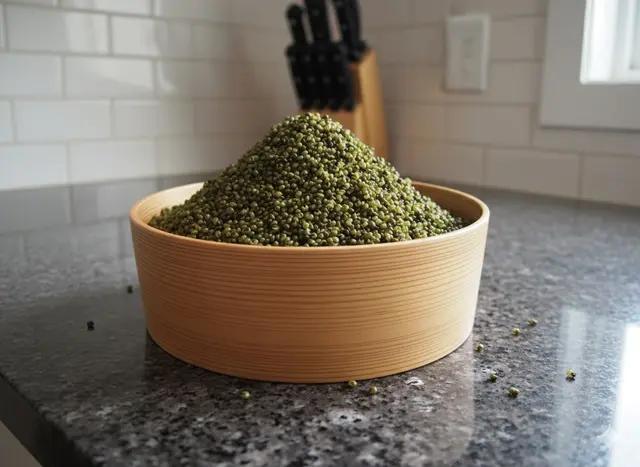
Odate Tonburi (Generated by Artificial Intelligence.)
Geographical Indication Name | Odate Tonburi | ||||||||
|---|---|---|---|---|---|---|---|---|---|
Class | Processed Foods | ||||||||
Production Area | Akita Prefecture Odate City, Japan | ||||||||
Raw Materials | Kochia (annual herb) ripe fruit | ||||||||
Applicant Organization | Akita Kita Agricultural Cooperative (JA Akita Kita) | ||||||||
Odate Tonburi is a processed field-grown food native to Odate, Akita Prefecture, Japan. It is made from the ripe fruit of the annual kochia herb, which is heat-treated. Tonburi is also known as "field caviar" due to its appearance and texture, and its production and consumption in this region has a tradition dating back to the Edo period. It was registered as a Geographical Indication (CI) in 2017.
Tonburi is the fruit of the kochia plant, which was once used to make brooms in various regions of Japan. With the decline in broom production, kochia cultivation also declined. However, in the Odate region, the tradition of eating kochia fruit as a food has persisted since the Edo period, with farmers cultivating it for personal consumption. The nationwide recognition of Odate Tonburi and the increase in its cultivation and processing occurred with the establishment of a factory in Odate City in 1973.
About Odate Tonburi (地理的表示産品情報発信サイト)
Production of Odate Tonburi is limited to Odate City, Akita Prefecture. Due to the difficulties in growing and processing tonburi, it has not spread to other parts of Japan. The Hinai district of Odate City is an area surrounded by mountains and has little wind. Furthermore, the Sumitani River basin in this region provides spring water, which is essential for processing tonburi.
Odate Tonburi has a grainy structure, approximately 1 to 2 mm in diameter. It is used as an odorless and tasteless food ingredient. The processing process begins with harvesting ripe kochia fruit with a combine harvester and drying it in the sun or in a dryer for about a week. The dried fruit is then thoroughly boiled in a pot, followed by soaking in hot water for 24 hours. In the final stage, the fruit is scrubbed, peeled, and dried again, making it ready for consumption.
Japan Geographical Indication Center. ''Registered Geographical Indication''. Accessed October 23, 2025). https://pd.jgic.jp/en/register/entry/32.html.
MAFF (Ministry of Agriculture, Forestry and Fisheries). ''Product Summary (Registration No. 32)''. Accessed October 23, 2025. https://www.maff.go.jp/e/policies/intel/gi_act/register/s32.html.
地理的表示産品情報発信サイト. "32 Odate Tonburi." April 19, 2019. Youtube video. 02:02. https://www.youtube.com/watch?v=1vFIEloGO0o.

Odate Tonburi (Generated by Artificial Intelligence.)
Geographical Indication Name | Odate Tonburi | ||||||||
|---|---|---|---|---|---|---|---|---|---|
Class | Processed Foods | ||||||||
Production Area | Akita Prefecture Odate City, Japan | ||||||||
Raw Materials | Kochia (annual herb) ripe fruit | ||||||||
Applicant Organization | Akita Kita Agricultural Cooperative (JA Akita Kita) | ||||||||
Origin and History
Production Area and Natural Conditions
Properties and Processing
This article was created with the support of artificial intelligence.