


This article was automatically translated from the original Turkish version.
Nuclear batteries are special devices that generate electricity by harnessing the heat released during the natural decay of radioactive materials. They typically use plutonium-238 and other isotopes. Their most significant feature is their ability to operate for very long durations (10–50 years) and to provide power even under harsh environmental conditions.
For this reason, they are preferred in spacecraft medical devices and military equipment. Since they have no moving parts, they are silent and, because they require no maintenance, they are reliable.
In light of increasing energy demands today, the need for long-lasting energy sources that operate independently of environmental conditions is growing. In this context, nuclear batteries offer ideal solutions due to their capacity to provide continuous power under harsh environmental conditions. The performance and durability limitations of traditional lithium-ion batteries have directed researchers toward alternative energy generation technologies.
Nuclear batteries operate on the principle of converting the heat energy generated by the decay of radioactive isotopes into electrical energy. There are two main types:
Recently, researchers in South Korea have successfully improved the efficiency of betavoltaic batteries by using the carbon-14 isotope. Carbon-14 emits only beta radiation, making it a safer option. Additionally, as a byproduct of nuclear power plants, it is low-cost and recyclable.
Traditional RTGs convert the heat emitted by radioactive isotope decay into electricity using thermoelectric modules. In betavoltaic batteries, beta radiation directly strikes a semiconductor structure, generating an electron flow.
Researchers from the Daegu Gyeongbuk Institute of Science and Technology (DGIST) in South Korea have increased energy conversion efficiency to 2.86 percent by using carbon-14 as both anode and cathode. In this design, beta particles interact with a titanium dioxide-based semiconductor and a ruthenium-based dye to create an “electron avalanche,” which generates electricity.
Space Missions: Used in numerous missions by NASA such as Voyager, Cassini and Curiosity.
Medical Devices: Used in limited applications for devices requiring long-term power, such as cardiac pacemakers.
Defense Industry: Used in long-term monitoring and sensor systems.
Polar Regions and Submarines: Provide power in areas where sunlight is insufficient.
Newly developed carbon-14-based nuclear batteries show potential as long-lasting and reliable power sources in fields such as medical implants, remote sensors and data centers.
With further improvements in efficiency and safety, nuclear batteries could enable new applications ranging from IoT devices and microsatellites to micro-robots. Additionally, researchers aim to enhance efficiency in betavoltaic technologies through the use of nanomaterials. Research in South Korea demonstrates that carbon-14 is a promising candidate for this field.
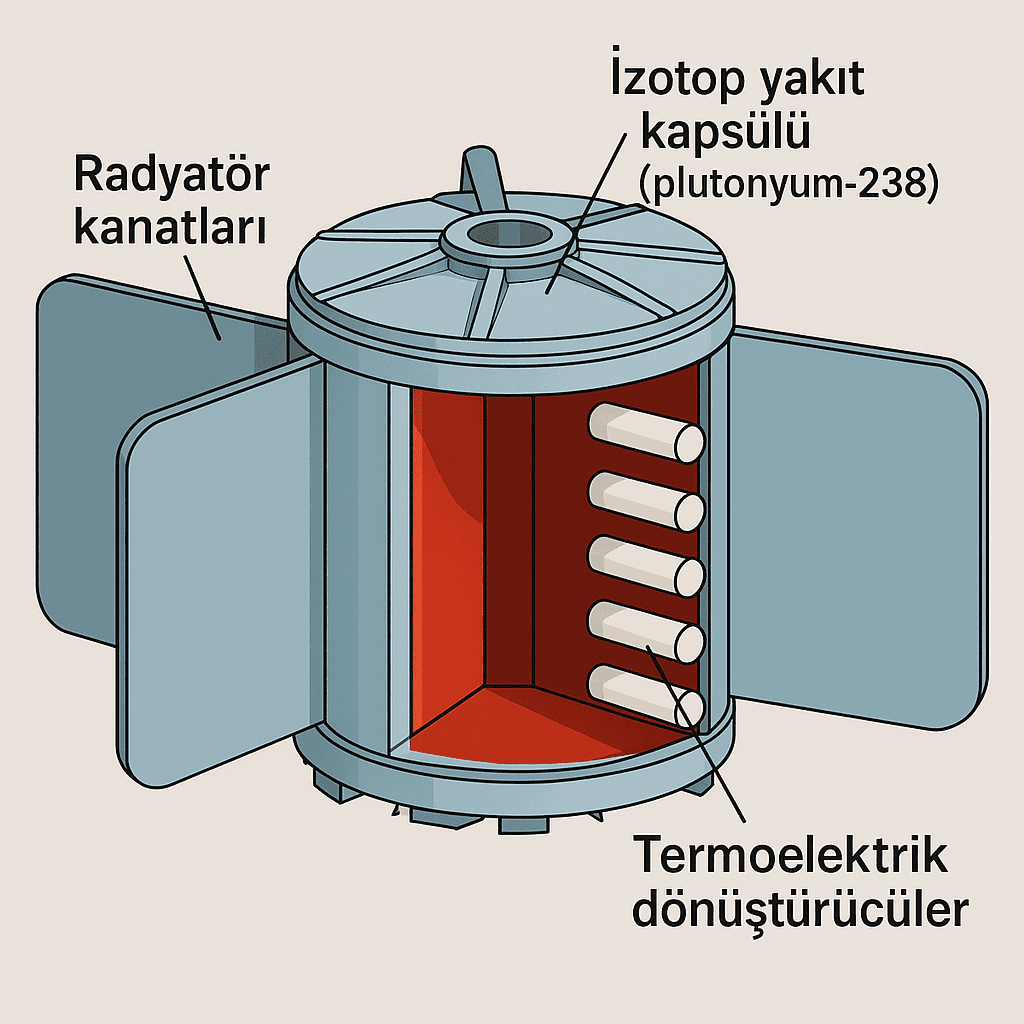
Radyoizotop Termoelektrik Jeneratör (RTG) – Temel Bileşenler (Yapay Zeka Tarafından Oluşturulmuştur)
RTGs are preferred in space missions due to their lack of moving parts and reliable performance under harsh environmental conditions.
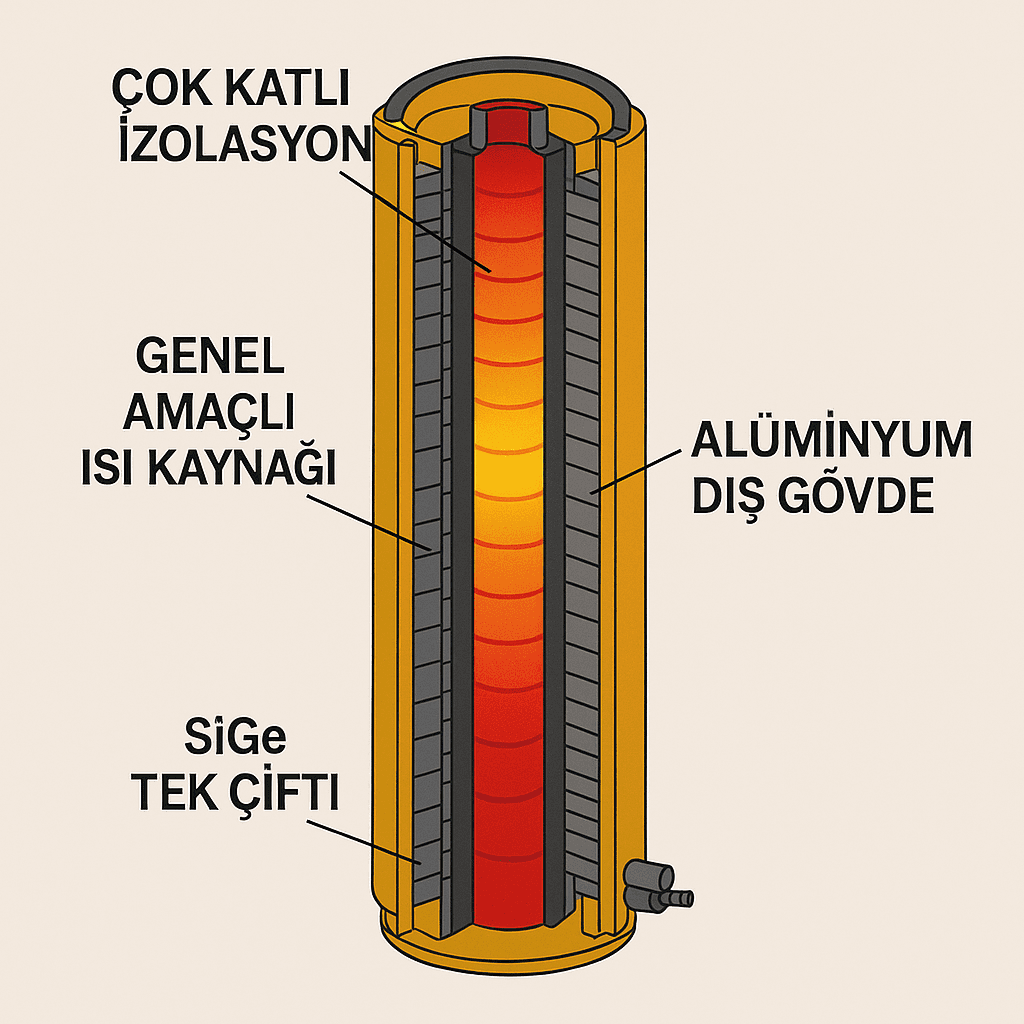
Termoelektrik Dönüşüm Yapısının Detaylı Kesiti (Yapay Zeka Tarafından Oluşturulmuştur)
This structure is ideal for long-term power generation in systems with fixed and low power requirements.
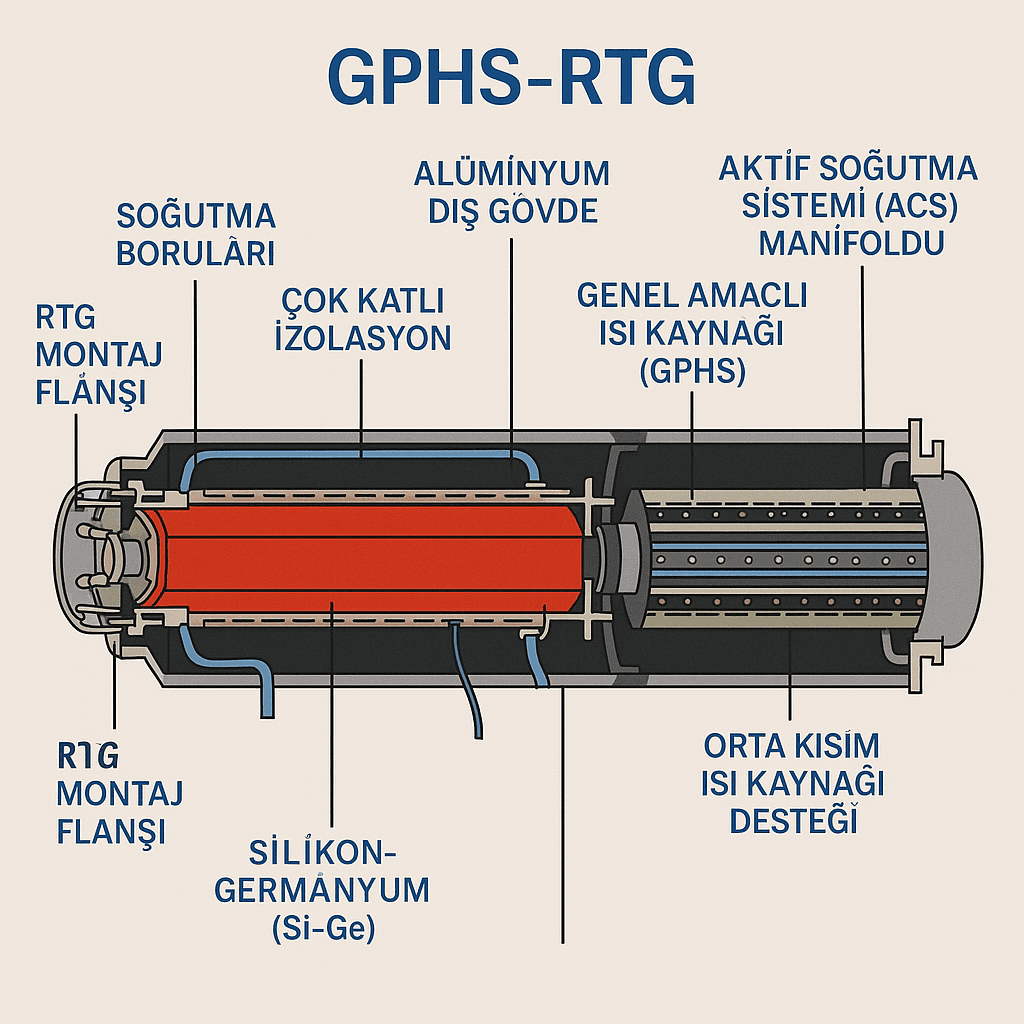
GPHS-RTG – Gelişmiş RTG Tasarımı (Yapay Zeka Tarafından Oluşturulmuştur)
Thanks to this complex structure, GPHS-RTGs can be safely used in long-duration and remote environments such as Mars missions.
American Chemical Society. "A Safe Nuclear Battery That Could Last a Lifetime." Accessed May 6, 2025.https://www.acs.org/pressroom/presspacs/2025/march/a-safe-nuclear-battery-that-could-last-a-lifetime.html.
National Aeronautics and Space Administration. “RTGs for Space Missions.” Accessed May 6, 2025.https://www.nasa.gov.
Poole, Charles P. Encyclopedic Dictionary of Condensed Matter Physics. Amsterdam: Elsevier, 2004.
U.S. Department of Energy. “Radioisotope Power Systems.” Accessed May 6, 2025.https://www.energy.gov.

Types
Working Principle
Applications
Advantages and Disadvantages
Advantages
Disadvantages
Future Potential