This article was automatically translated from the original Turkish version.
+2 More
Catalog Name | NGC 7027 | ||||||||
|---|---|---|---|---|---|---|---|---|---|
Other Name | PN G084.9–03.4 PK 084+12.1 | ||||||||
Constellation | Cygnus | ||||||||
Object Type | Planetary Nebula | ||||||||
Distance | Approximately 3,000 light years (~920 pc) | ||||||||
Angular Dimensions | 0.2 x 0.1 arcminutes | ||||||||
Age | ~600 years (relatively young) | ||||||||
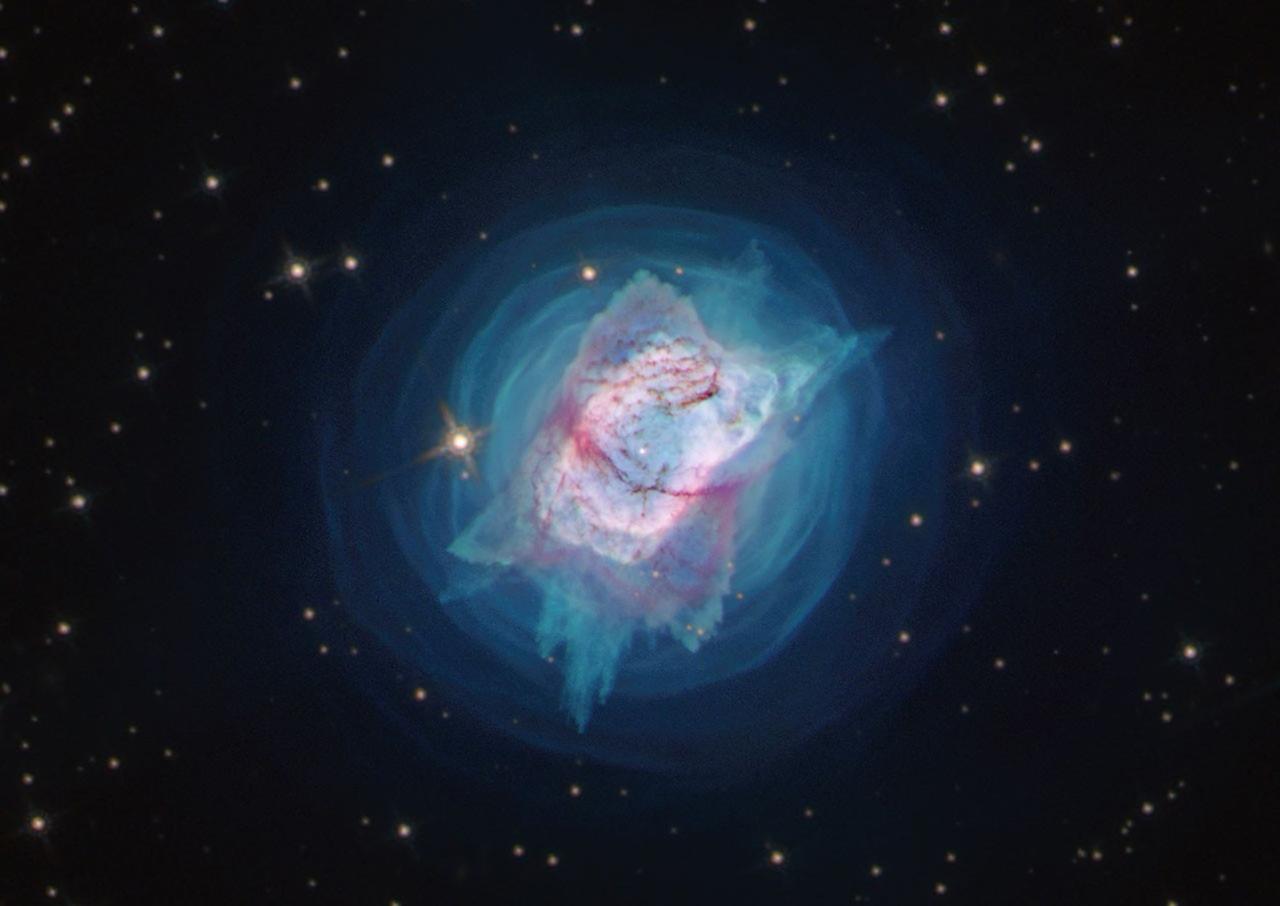
NGC 7027 Nebula, is a young and dense planetary nebula located in the direction of the Cygnus constellation. First discovered in 1878 by Édouard Stephan, this object attracts attention due to its morphological features and intense radiation field. Located approximately 3,000 light years away, NGC 7027 stands out among planetary nebulae for its complex internal structure and high surface brightness. The nickname "Jewel Bug Nebula" was given to it because of its rich color variety and symmetric structure; however, this name is not commonly used in scientific literature.
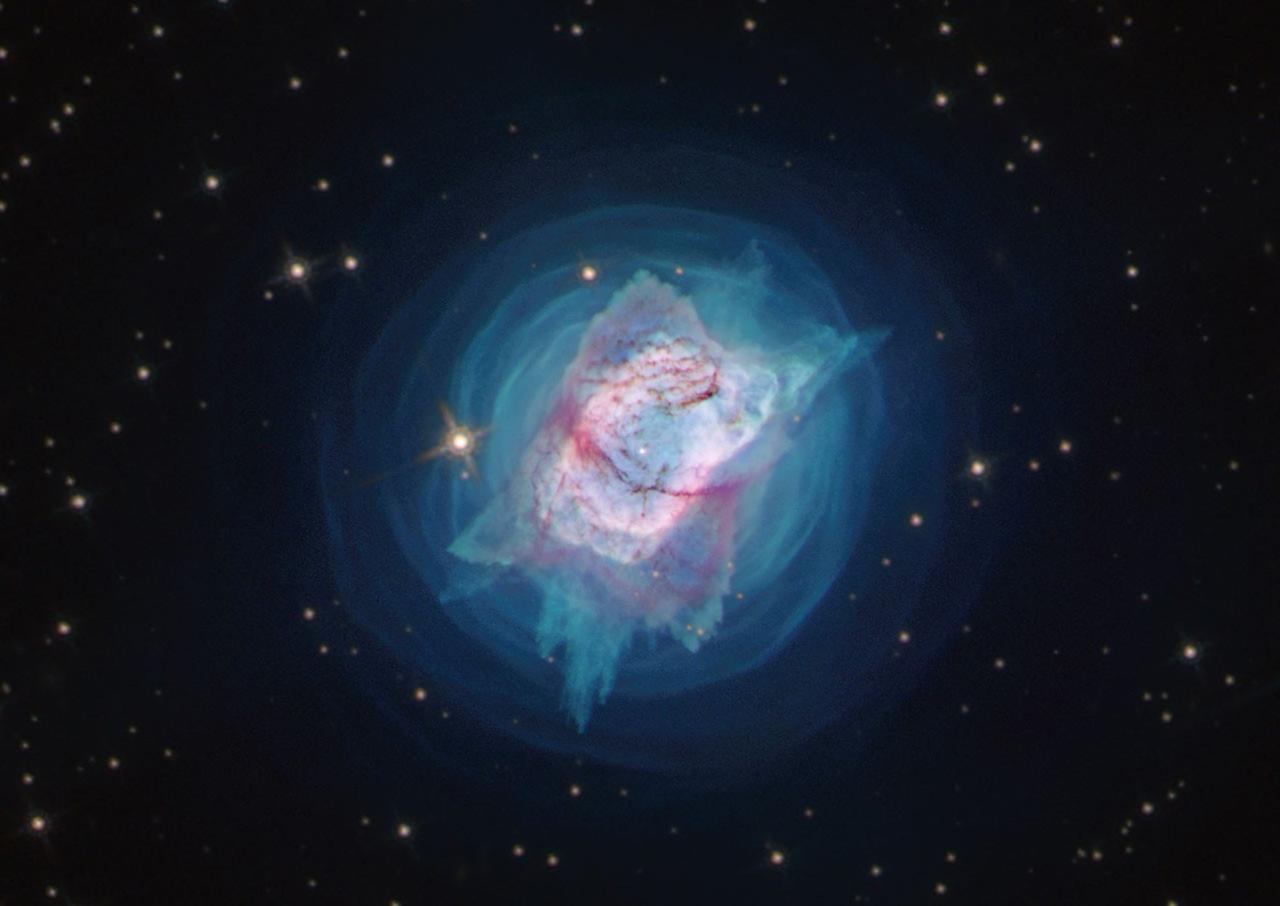
NGC 7027. (NASA)
NGC 7027 has a roughly ellipsoidal geometry with a hot white dwarf precursor at its center. The spectrum of the central star produces ionizing ultraviolet radiation. This energy output causes the surrounding gas to ionize and emit light.
The star at the center of NGC 7027 is extremely hot and dense. Its surface temperature is estimated to exceed 200,000 Kelvin. Due to this high temperature, the star acts as a powerful source of ultraviolet radiation, ionizing the surrounding gas and enhancing the nebula’s brightness.
The nebula contains various elements including ionized hydrogen (H⁺), helium (He⁺ and He²⁺), oxygen (O²⁺), carbon (C²⁺), nitrogen (N⁺), and neon (Ne²⁺). These elements have been detected in both optical and infrared wavelengths. Data from observatories such as the Spitzer Space Telescope and Herschel reveal that the nebula has a complex structure composed of molecular gas, ionized gas, and dust.
Unlike many planetary nebulae, NGC 7027 contains a significant amount of dust and molecular gas. In particular, carbon-rich (C-rich) molecules such as polycyclic aromatic hydrocarbons (PAHs) have been detected in infrared spectra. This provides important insights into the evolutionary history of the central star.
The distribution of molecular hydrogen (H₂) within the nebula has been clearly observed using narrow-band filters. This gas is located around the ionized region and is detected in photodissociation regions (PDRs), known as transition zones.
NGC 7027 has been studied in detail through observations across X-ray, ultraviolet, visible, and infrared wavelengths. Data from the Chandra X-ray Observatory indicate the presence of a high-energy plasma at the nebula’s center. This is likely the result of interactions between the fast stellar wind from the central star and slower winds ejected in earlier stages.
High-resolution images from the Hubble Space Telescope show that NGC 7027 has a compact structure with central symmetry. Although traces of bipolar morphology are present, it is primarily classified as a compact elliptical planetary nebula. The ionized gas shell is surrounded by molecular gas and exhibits an expanding structure.
The expansion velocity of the gas has been measured at 17–25 km/s. This expansion is interpreted as a consequence of mass loss from the central star during its final evolutionary stages.
NGC 7027 belongs to the planetary nebula phase, one of the final stages in a star’s life cycle. During this phase, the star sheds its outer layers after completing the red giant stage, leaving behind a dense, hot core. This core, a proto-white dwarf, ionizes the surrounding gas to form the nebula. The youth of NGC 7027 indicates that this evolutionary transition is still in its early stages.
NGC 7027 has been extensively studied through multi-wavelength observations:
These multi-wavelength studies have provided critical data for understanding the physical structure and evolutionary history of the nebula. NGC 7027 is a valuable example of the short-lived but highly energetic phase of planetary nebulae. Its youth, high density, complex structure of molecular and ionized gas, dust composition, and rich morphological details revealed by multi-wavelength observations make it a significant object for astrophysical modeling. NGC 7027 is regarded as an observable representation of the complex physical processes occurring during the final stages of stellar evolution.
ESA/Hubble. “NGC 7027.” ESA/Hubble. Accessed July 10, 2025.https://esahubble.org/images/heic2011c/.
NASA. “Compass Image for NGC 7027.” NASA Science. Accessed July 10, 2025.https://science.nasa.gov/asset/hubble/compass-image-for-ngc-7027/.
NASA. “NGC 7027.” NASA Science. Accessed July 10, 2025.https://science.nasa.gov/asset/hubble/ngc-7027/.

Catalog Name | NGC 7027 | ||||||||
|---|---|---|---|---|---|---|---|---|---|
Other Name | PN G084.9–03.4 PK 084+12.1 | ||||||||
Constellation | Cygnus | ||||||||
Object Type | Planetary Nebula | ||||||||
Distance | Approximately 3,000 light years (~920 pc) | ||||||||
Angular Dimensions | 0.2 x 0.1 arcminutes | ||||||||
Age | ~600 years (relatively young) | ||||||||
Physical and Morphological Properties
Central Star and Chemical Composition
Dust and Molecular Gas
Radiation and Emission Properties
Morphological Analysis and Kinematic Structure
Evolutionary Process
Observations and Research