


This article was automatically translated from the original Turkish version.
+1 More
Nanobots are nanoscale robots typically operating at a size of 1 to 100 nanometers designed to perform specific tasks and commonly used in medical environmental or technological applications. Their purpose is to intervene with high precision by manipulating matter at the atomic or molecular level. Although nanobots are still in the experimental stage today birlikte they hold significant potential for future development in areas ranging from disease diagnosis and treatment in medicine to material production.
Nanobots are typically constructed from nanomaterials such as carbon nanotubes DNA based nanostructures metal oxide nanoparticles or polymer matrices gibi. These robots are engineered to possess mobility controllability and targeted functions.
Some nanobots are based on biohybrid systems inspired by microorganisms that can move naturally in biological environments such as bacteria. In addition autonomous structures guided by magnetic fields sound waves or chemical reactions also exist.
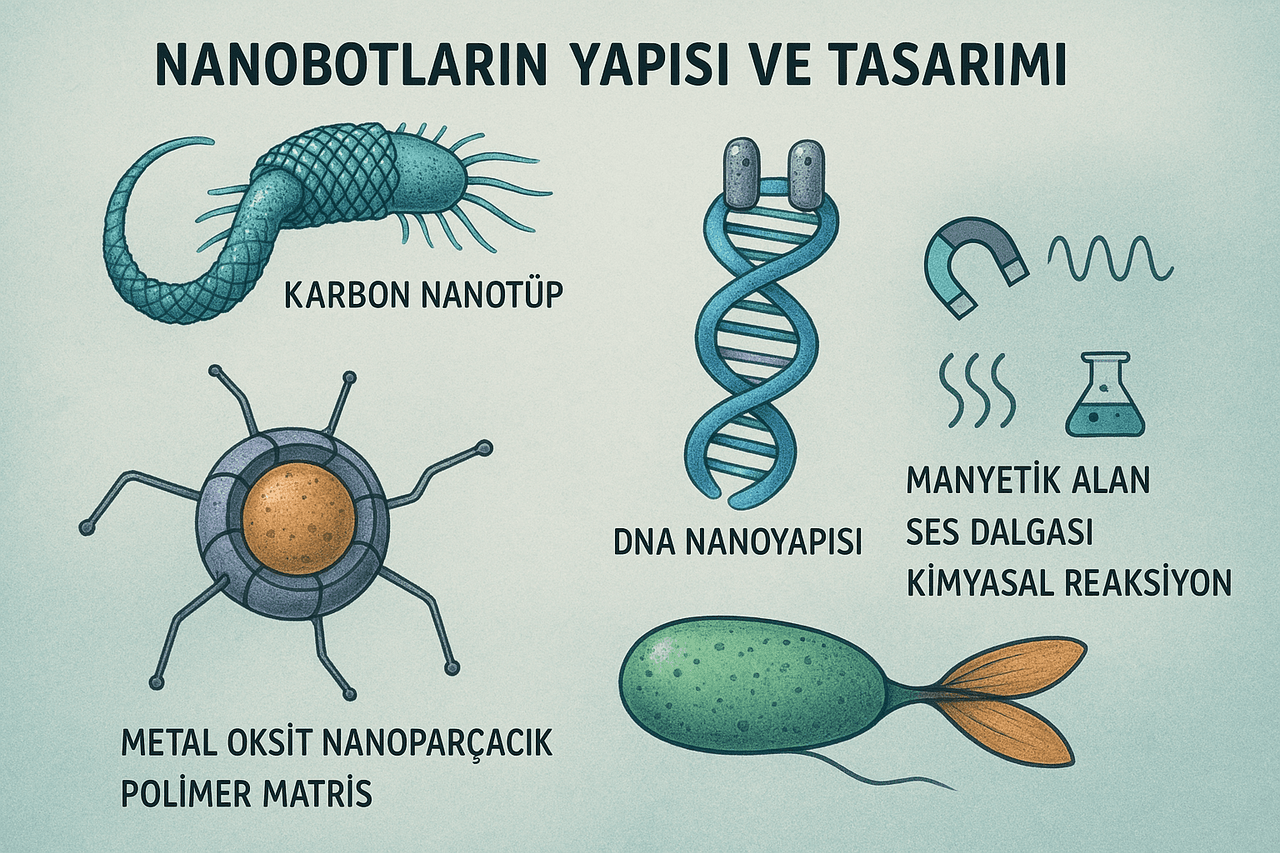
Structure and Design of Nanobots (designed with artificial intelligence).
Various methods are employed to enable nanobots to move controllably in their environment. These include:
These mechanisms can be used to guide nanobots to target tissues or to trigger specific chemical reactions.
One of the most important applications of nanobots is in medicine. In this field nanobots are developed for purposes such as drug delivery systems cancer cell detection and destruction vascular plaque removal and gene therapy delivery.
Nanobots are being evaluated for advanced defense systems such as the detection and neutralization of chemical or biological agents and the delivery of neuroactive compounds. However these applications also raise ethical and legal concerns.
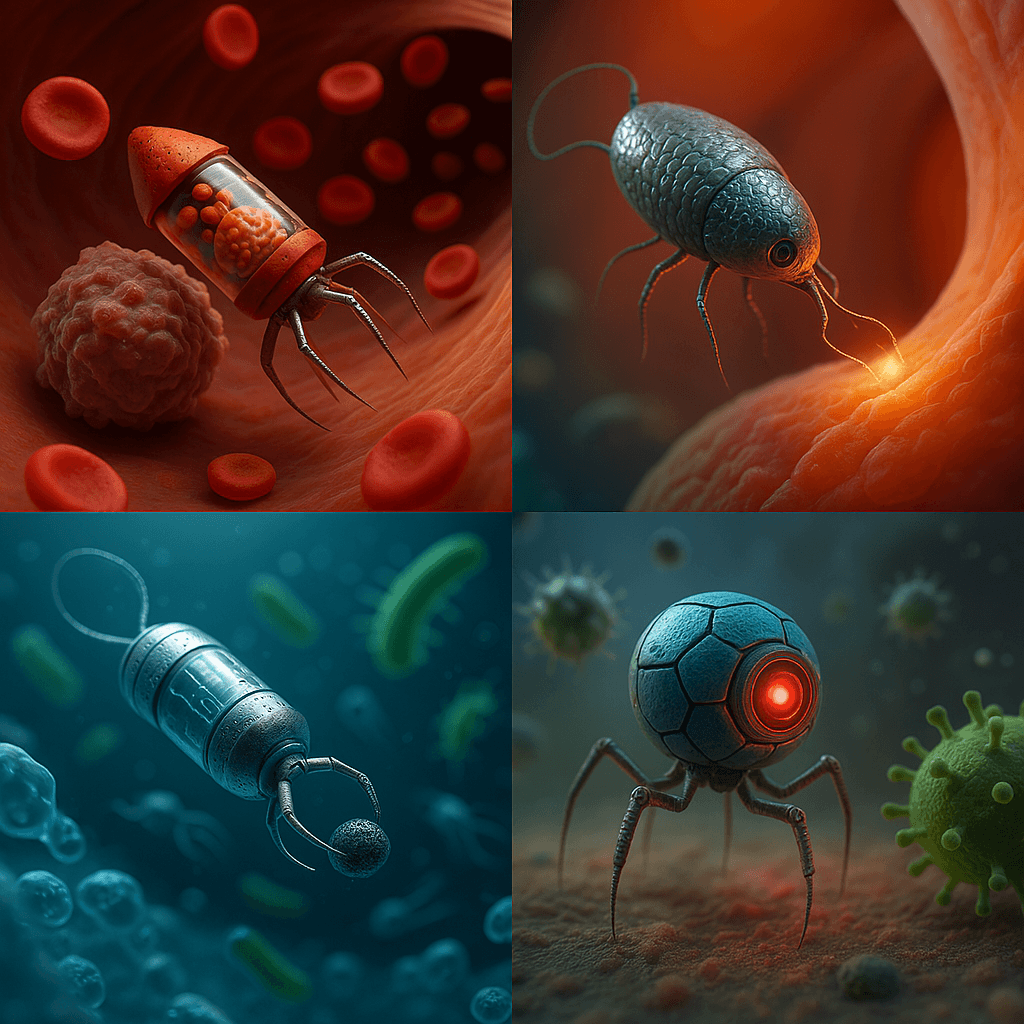
Visual representation of medical environmental industrial and defense applications of nanobots (designed with artificial intelligence).
Several technical and ethical challenges hinder the widespread adoption of nanobot technology:
Cavalcanti, A. et al. "Nanorobot Hardware Architecture for Medical Defense." Sensors, vol. 8, no. 5, 2008, pp. 2932–2958.
Freitas, R. A. Nanomedicine, Volume I: Basic Capabilities. Landes Bioscience, 1999.
Martel, S. "Microrobotics in the vascular network: present status and future challenges." Journal of Micro-Bio Robotics, vol. 6, 2010, pp. 1–18.
Nelson, B. J., Kaliakatsos, I. K., and Abbott, J. J. "Microrobots for Minimally Invasive Medicine." Annual Review of Biomedical Engineering, vol. 12, 2010, pp. 55–85.
Wang, J. "Can Man-Made Nanomachines Compete with Nature Biomotors?" ACS Nano, vol. 3, no. 1, 2009, pp. 4–9.

Structure and Design of Nanobots
Movement Mechanisms
Applications of Nanobots
Medical Applications
Environmental and Industrial Applications
Defense and Security Applications
Challenges and Ethical Debates