This article was automatically translated from the original Turkish version.
When you hear something constantly, after a while you begin to think it has always been there.
As if it had no beginning.
Some poems, some songs, certain music genres are like this. They play at a wedding, appear in a film, linger in your ear on a street corner… They are everywhere. So we accept them as “always present,” and some even call them “universal.” But in truth, of course, everything has a beginning—in someone’s life, in someone’s story…
Today, if you are reading this, it means we are at the same starting point together.
If you didn’t catch the clue from the title...
No matter where in the world you are, you will encounter them—in the cry of a violin, the wildest tone of a guitar, the most lively rhythm of a darbuka, or the swirl of a skirt. They are the representatives of a spirit that lives beyond borders and cannot be contained within passports.
Behind the vast legacy often reduced to the “entertainment” industry lies a centuries-old story of art healing exclusion.
Are we talking about Romanes? Don’t you understand?
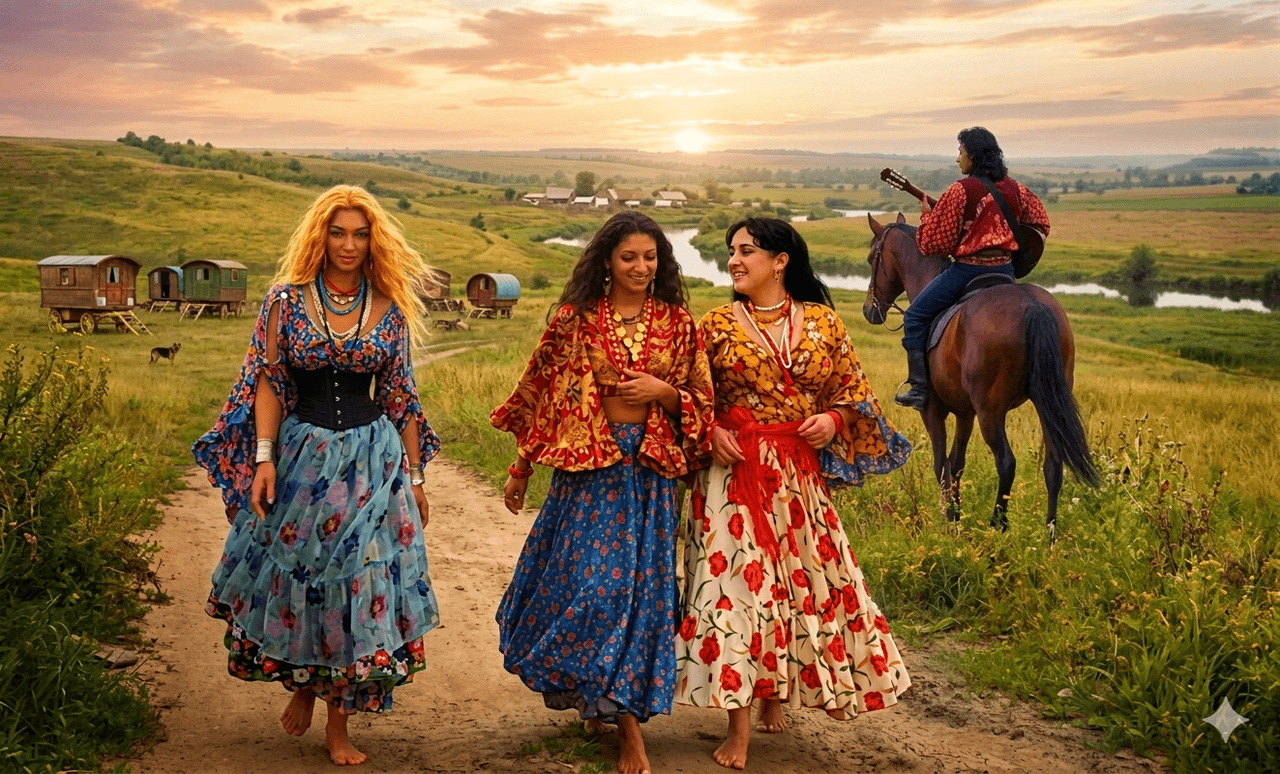
A visual representing Romanes. (Generated by artificial intelligence.)
Before history, let us turn to etymology. When we pause to examine the word “Roman,” the issue immediately finds its most accurate direction. One of the meanings emerging from the etymological layers of the word is “human.”
Yes, Roman means “human.”【1】
Roman, in their own languages, is a word derived from the root “Rom,” meaning “human” or “man.”
This may sound simple, but I find it profoundly striking. Because when we look at the history of the Roma, what we see is not some special or exotic tale; rather, it is a familiar, even all too familiar—unfortunately—human story: being displaced, excluded, forced to start over again and again, and yet somehow surviving.
Every society strives to survive, of course, but not all make the same choices… Here there is a collective will. Roma have chosen to manage this process through music, rhythm, and aesthetics.
Linguistic and genetic research into Roma history shows that their origins extend to the northwestern regions of India, particularly Rajasthan and Punjab. This long migration process, beginning around the 9th and 11th centuries, spread Roma communities first to the Middle East, then through Anatolia to the Balkans, and ultimately across all of Europe.
The strong similarity between the Romani language and Sanskrit is considered one of the most concrete proofs of this origin.
For centuries in Europe, Roma faced a series of oppressions—from slavery and forced settlement to assimilation policies and systematic discrimination—and yet they preserved their identity not primarily through settled institutions, but through the cultural practices they carried—especially music and oral tradition.
In Türkiye, Roma have carried the memory of these lands alongside us for centuries. Since the Ottoman period, Roma communities have been particularly visible in fields such as music-making, blacksmithing, and craftsmanship, creating a broad cultural influence stretching from palaces to streets.
Today, Roma living in regions from Thrace to the Aegean, from Istanbul to Adana, assume a role in transforming and defining the music of their respective geographies.
Thus, this is not merely a story of migration; it is the transcontinental transmission of music, language, and spirit.
We tend to think of music as something light—entertainment, leisure, perhaps a bit of distraction… Yet throughout history, for some communities, music was not a “luxury” or “entertainment,” but nearly a necessity. For Roma, this was precisely the case. After all, many things could be taken from them: land, property, status, security…
But taking away their voices? That was far harder.
It still is.
Thus, music became not merely a form of expression, but a means of clinging on. Where you cannot speak, you hum a song; where you are afraid, you hold onto rhythm—such a state of being. That is why Roma music is often not merely “beautiful,” but also intense, broken, and authentic.
Flamenco is a good example. Today, we admire this art form on stage for its aesthetics, often interpreting it merely as technical mastery. Yet behind this music from Andalusia lies the exclusion and oppression experienced by Roma communities. That searing vocal tone or sharp rhythmic structure is not a stylistic choice; it is the consequence of necessity. You understand: sometimes people simply cannot express themselves plainly.
The issue of rhythm is also intriguing here. The 9/8 rhythm frequently heard in the Balkans and Anatolia may, at first glance, appear as merely a technical detail. But with closer attention, we realize it is not merely mathematical. Because this rhythm is not smooth; it is fragmented.
It contains small breaks. Yet it flows, even compelling the listener to move. This is one of the fundamental characteristics of Roma aesthetics: transforming a fragmented experience into a unified feeling.
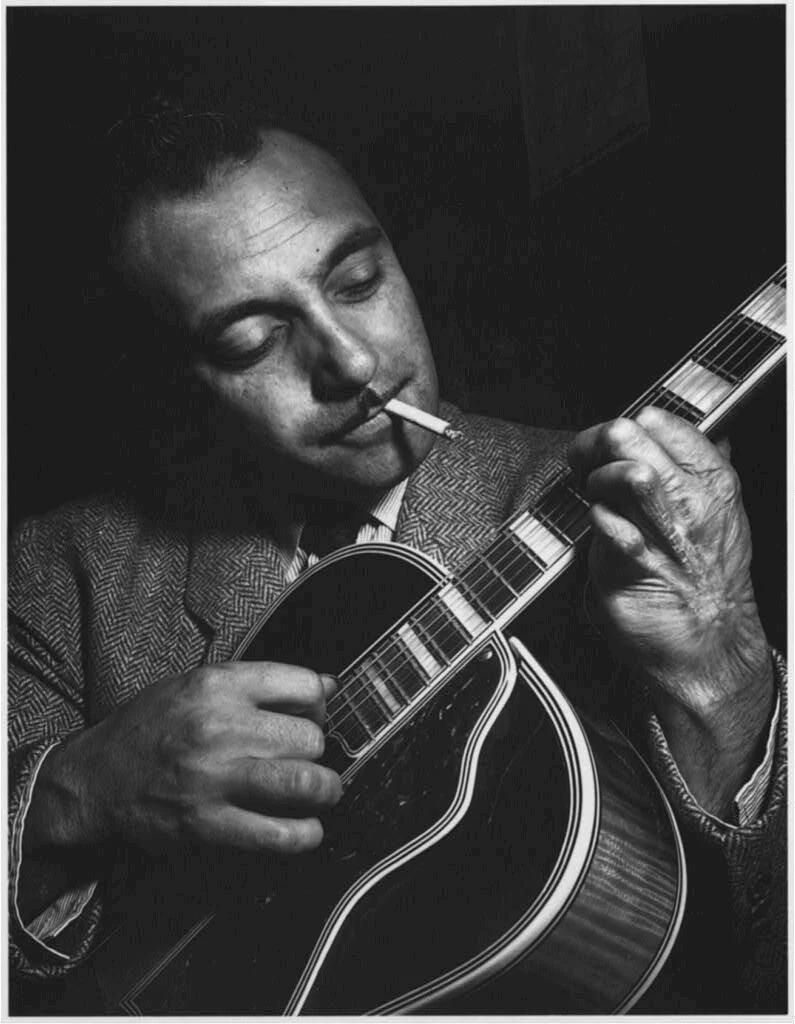
Django Reinhardt (Getarchive)
A similar phenomenon can be observed in jazz music. One of the most striking examples is Django Reinhardt, who played a major role in shaping European jazz. Reinhardt’s story alone is enough to illustrate how this culture functions…
Reinhardt lost two fingers in a fire, which under normal circumstances would have ended a guitarist’s career. But he did not stop. On the contrary, he developed a new playing technique using his remaining fingers and created a style whose influence endures to this day. This story is usually told as one of “determination,” but I believe it speaks to something more fundamental: Roma music often emerges not from possibilities, but from impossibilities.
At the foundation of many art forms now recognized as world heritage lies the rhythm of the Roma. Yet this legacy is often denied the credit it deserves.
Having spoken of music and visibility…
Why so much red? Why so many bright yellows and massive floral patterns?
Numerous ornaments, dense patterns, layered appearances… At first glance, this may seem merely a stylistic preference. It may well be. But again, I believe it can also be understood psychologically as a form of overcompensation: when something is taken from you, you produce it excessively elsewhere. In Roma culture, this production manifests in music and visual aesthetics.
Where security is absent, movement becomes prominent; where acceptance is denied, visibility becomes essential; where silence is imposed, sound rises to the forefront. For Roma, colors and lively rhythms are not aesthetic concerns—they are flags of rebellion woven from these elements.
What about those enormous flowers? Those giant roses?
Flowers—generally—do not wait for what is appropriate; they wait for what is possible. They find a crack and push through toward life. I interpret the large, overflowing floral patterns in Roma culture in exactly this way: no matter the conditions, life finds a way. The insistence on existence, visibility, and blooming even without deep roots is not a privilege here—it is the norm itself.
Throughout history, the world has often been gray, cold, and distant to Roma. In the cold climate created by exclusion, Roma set fire to their own worlds—with their clothing, their homes, their flowers. Vivid colors are a visual declaration: “I am here, I am alive, and I still shine.”
Just as Mexican artist Frida Kahlo transformed her pain into beauty by pouring it onto canvas in the most vivid colors, Roma culture has treated poverty and trauma as a “visual rebellion.”
The Roma have taught us how pain can become a song, exclusion a color, and journeying a identity.
The next time you hear a Roma melody, please do not merely listen or dance quietly; listen a little to the thousand-year story within those tones—the raw essence of being human.
The clearest signature the Roma have left on the world is hidden within their music. Of course, the music itself is “solid,” but… their true legacy is the method they created. Those who were forced to learn how to endure suffering have gifted us, polished like pearls, a way of being.
So when a violin’s sound suddenly seeps into your soul, or a darbuka unexpectedly makes your foot tap, you are not merely hearing music. You are touching a method, a memory you may have never realized you needed to know.
Perhaps now, for the first time, you notice.
That sound does not come from some distant place..
It comes much closer… yes yes…
“It comes from within.”
Kibariye - İllede Roman Olsun (Kibariye - Topic)
Aşkın, Uğur. "Çingene/Roman Toplumunun Sosyo-Ekonomik Durum ve Beklentileri: İzmir İlinde Bir Araştırma." *Kesit Akademi Dergisi* 3, no. 10 (2017): 208–45. Accessed April 5, 2026. https://dergipark.org.tr/en/pub/kesitakademi/article/864588
Bulunmaz, Ali. "Akustik Caz Esintisi: Django Reinhardt’ın ‘Eksik Solo’su." 2yaka.org (blog), 2021. Accessed April 5, 2026. https://2yaka.org/akustik-caz-esintisi-django-reinhardtin-eksik-solosu/
Dişli, Semra Özlem. "‘Çingene’ mi, ‘Roman’ mı? Bir İnşa Süreci." *Antropoloji*, no. 31 (2016): 97–117. Accessed April 5, 2026. https://doi.org/10.1501/antro_0000000329
Fırat, Muhammet. "Geçmişten Günümüze Çingene Göçleri: Sosyo-Tarihsel Bir Bakış." *İçtimaiyat* 6, no. Göç ve Mültecilik Özel Sayısı (2022): 36–52. Accessed April 5, 2026. https://doi.org/10.33709/ictimaiyat.1111454
Gottlieb, William P. "Portrait of Django Reinhardt, Aquarium, New York, N.Y., ca. Nov. 1946." Getarchive. Photograph. Accessed April 5, 2026. https://loc.getarchive.net/media/portrait-of-django-reinhardt-aquarium-new-york-ny-ca-nov-1946-2.
Güler, Zeynep. "‘Burada Her Şey Kendiliğinden’: Mersin'de Yaşayan Romanlar Üzerine Alan Araştırması." *MSGSÜ Sosyal Bilimler Dergisi* 2, no. 18 (2018): 380–92. Accessed April 5, 2026. https://dergipark.org.tr/en/download/article-file/434476
Kibariye. "İllede Roman Olsun." YouTube. Accessed April 5, 2026. https://www.youtube.com/watch?v=WrPaGwf5Up8.
Striegler, Kurt. "Çingene Musikisi." Translated by Sinan Şanlıer. *MSGSÜ Sosyal Bilimler Dergisi* 2, no. 18 (2018): 393–97. Accessed April 5, 2026. https://dergipark.org.tr/en/download/article-file/757941
Yanıkdağ, Tülin. "Türkiye’de Romanlar ve Alt Kimlik Grupları: Etno-Dilsel Farklılıkların Kimliğe Yansımaları." *Roman Dili ve Kültürü Araştırmaları Enstitüsü Dergisi* 2, no. 1 (2021): 57–76. Accessed April 5, 2026. https://dergipark.org.tr/en/pub/raedergisi/article/930044
Yıldız, Serpil and Gökhan Tok. "Geldik Geldik Uzun Uzak Yollardan: Romanlar Üzerine..." *Bilim ve Teknik Dergisi*, September 2004. Accessed April 5, 2026. https://bilimteknik.tubitak.gov.tr/wp-content/uploads/sites/154/2025/09/ee30bfe9-2c69-4011-8980-7173b08a9160-1.pdf.
[1]
Serpil Yıldız and Gökhan Tok. "Geldik Geldik Uzun Uzak Yollardan: Romanlar Üzerine..." Bilim ve Teknik Dergisi, September 2004, p. 1.
“He Is a Servant of God, Whoever He May Be...”
“Roma Are Like This: They Cannot Live Without Instruments, They Will Die!”
"Oh My, Now the Hands..."
“They Love Red, They Praise Each Other”
“I Must Be Roma, Even If I Am Made of Mud…”