



Moka Pot (Generated by Artificial Intelligence.)
History | First introduced in Italy in the 1930s | ||||||||
|---|---|---|---|---|---|---|---|---|---|
Structural Components | Upper chamber (brewed coffee section) Middle filter (coffee section) Lower chamber (water section) | ||||||||
Pressure/Temperature | Approximately 1–2 bars of pressure, Water temperature 90–95 °C | ||||||||
Brewing Time | Approximately 3–5 minutes | ||||||||
Coffee-to-Water Ratio | 10 g coffee : 100 ml water | ||||||||
Moka Pot is a coffee brewing device that operates using steam pressure. It functions on the principle of passing hot water through ground coffee under the influence of steam pressure generated by the boiling water. Considered a precursor to home espresso machines, this method dissolves coffee components through its simple mechanical structure and heat transfer-based extraction system. It is typically made from aluminum or stainless steel. During the brewing process, as the water in the lower chamber boils, steam pressure increases, pushing the water through the coffee grounds in the filter and into the upper chamber. The coffee obtained under approximately 1–2 bars of pressure exhibits intense aromatic characteristics and a full-bodied texture.

Moka Pot (Generated by Artificial Intelligence.)
The Moka Pot was invented in Italy by Alfonso Bialetti in the mid-1930s and has since been used to prepare espresso-style coffee in home settings. Traditionally designed for small, single-serving portions, it relies on the pressurized boiling method in coffee production. Since the mid-20th century, this device has become widely used, particularly in European and Latin American countries. Its design principle is based on producing a concentrated coffee by passing hot water through coffee grounds under high pressure. In this regard, it is considered a forerunner of espresso machines.
The Moka Pot consists of three main components:
The Moka Pot is classified under espresso-style coffee brewing methods and is considered a traditional and classical example among home-use pressurized coffee devices. Its fundamental mechanism is the upward movement of water through steam pressure. When water in the lower chamber is heated, the expanding steam creates pressure inside the chamber. This pressure forces the water upward through a narrow tube and the coffee bed. The hot water passing through the coffee granules carries dissolved aromatic compounds, oils, and organic acids into the upper chamber.
The brewing time typically ranges between 3–5 minutes. The water temperature is approximately 90–95 °C. Under these conditions, the extraction dissolves most of the coffee's aromatic components, while partially extracting acidic components.
The grind size of the coffee used is also an important factor. Overly fine grounds result in over-extraction, while overly coarse grounds lead to insufficient aromatic extraction. Medium grind is the optimal level for achieving a balanced flavor profile in the Moka Pot.
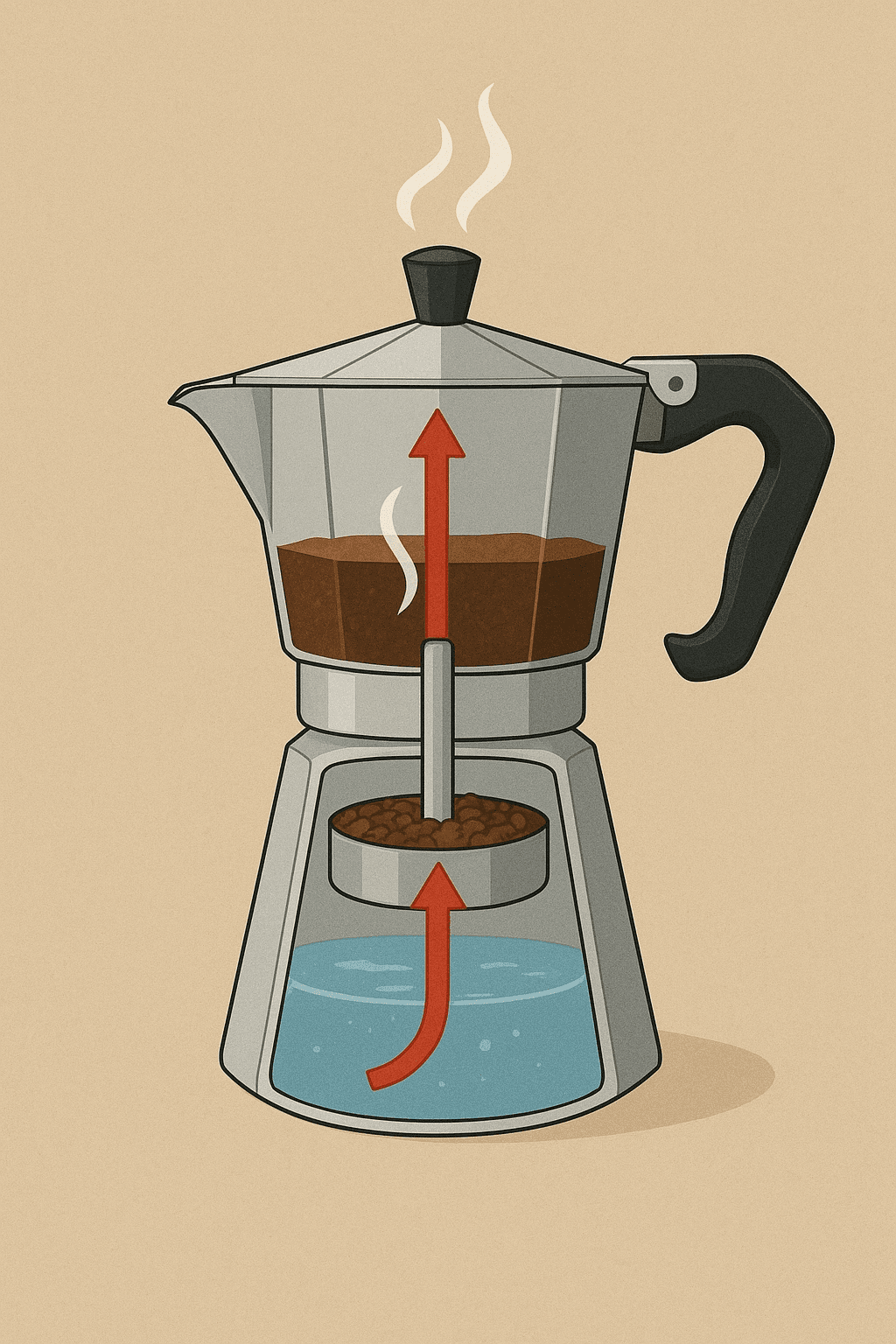
Moka Pot Working Principle (Generated by Artificial Intelligence.)
The use of the Moka Pot has been standardized with specific ratios. For example, a ratio of 10 grams of coffee to 100 milliliters of water is applied. Water is added to the lower chamber, ground coffee is placed in the middle section, and its surface is leveled. The device is then assembled and heated on a hot plate. As the water vaporizes, pressure increases, forcing the water through the coffee grounds into the upper chamber. When the coffee flow is complete, the heat source is turned off, concluding the brewing process. This pressurized extraction is a key factor affecting the body and clarity of the coffee.
Studies have evaluated the sensory qualities of coffee brewed using the Moka Pot through panelist assessments. These evaluations considered aroma, taste, body, acidity, clarity, and aftertaste.
The results indicate that Moka Pot coffee is characterized by high aroma intensity and a pronounced body. Coffee prepared by this method typically exhibits low acidity, medium-to-high bitterness, and long-lasting flavor persistence. The effect of temperature and pressure during extraction increases the dissolved solids, resulting in a darker and more viscous beverage.
The Moka Pot has been compared to manual brewing methods such as Siphon and French Press. The Siphon method also operates using steam pressure but at lower temperatures and in a controlled environment. Coffee brewed with the Siphon is clearer, more acidic, and lighter in aromatic profile. The French Press is an immersion method based on prolonged contact between coffee and water, producing oily, full-bodied beverages with higher particulate content. The Moka Pot falls between these methods; it produces a coffee that is more intense than Siphon but clearer and more balanced than French Press. Evaluations indicate that Moka Pot coffee is darker and more aromatic than Siphon coffee, and cleaner with lower oil content than French Press coffee.
Passing water through coffee under pressure in the Moka Pot increases the dissolved solids content, which determines the coffee’s density and viscosity. Experimental findings indicate that the dissolved solids in Moka Pot coffee are higher than in filter coffee but lower than in espresso.
Caffeine content varies depending on the coffee type, with Robusta coffees exhibiting higher caffeine levels. The short, high-temperature extraction limits the dissolution of acidic components, resulting in Moka Pot coffee having low acidity and pronounced body.
The Moka Pot operates directly on a heat source without the need for mechanical or electric pumps, making it highly energy-efficient. A stove or hot plate can be used as the heat source. The metal construction facilitates heat transfer and supports pressure formation. Proper assembly of the lower and upper chambers is crucial for ensuring a tight seal during brewing. Additionally, turning off the heat source after brewing is necessary to prevent coffee burning and over-extraction.
Anggraini, Anna, and Egi, Gustaman. "Teknik Penyeduhan dengan Metode Syphon, Moka Pot dan French Press." JURAGAN-Jurnal Agroteknologi 2, no. 2. (2024): 65-71. Accessed October 19, 2025. https://www.rumahjurnal.or.id/index.php/juragan/article/view/1221
Gano, Selam. "Comparing the Strength and Extraction of Coffee Brewing Methods." worldpress. Accessed October 19, 2025. https://selamjie.wordpress.com/wp-content/uploads/2020/07/final-paper.pdf
Simbolon, Bincar Parningotan. "Perbedaan Penyeduhan Kopi Dengan Metode Siphon, French Fresh, Dan Moka Pot." JURAGAN-Jurnal Agroteknologi 2, no. 2. (2024): 55-64. Accessed October 19, 2025. https://rumahjurnal.or.id/index.php/juragan/article/view/1203
Situmorang, Riris Kindeng. "The Effect Of Brewing Technique on Sensory Testing of Arabica and Robusta Coffee." JURAGAN-Jurnal Agroteknologi 3, no. 1. (2025): 1-5. Accessed October 19, 2025. https://www.rumahjurnal.or.id/index.php/juragan/article/view/1224
Tamara, Tiur Gressela. "The Effect of Shypon, French Press and Moka Pot Brewing on Robusta and Arabica Coffee." JURAGAN-Jurnal Agroteknologi 3, no. 1. (2025): 13-18. Accessed October 19, 2025. https://www.rumahjurnal.or.id/index.php/juragan/article/view/1217


Moka Pot (Generated by Artificial Intelligence.)
History | First introduced in Italy in the 1930s | ||||||||
|---|---|---|---|---|---|---|---|---|---|
Structural Components | Upper chamber (brewed coffee section) Middle filter (coffee section) Lower chamber (water section) | ||||||||
Pressure/Temperature | Approximately 1–2 bars of pressure, Water temperature 90–95 °C | ||||||||
Brewing Time | Approximately 3–5 minutes | ||||||||
Coffee-to-Water Ratio | 10 g coffee : 100 ml water | ||||||||
History
Working Principle and Technical Structure
Brewing Process
Sensory Characteristics
Comparison with Other Brewing Methods
Physical and Chemical Properties
Energy and Usage Characteristics
This article was created with the support of artificial intelligence.