


This article was automatically translated from the original Turkish version.
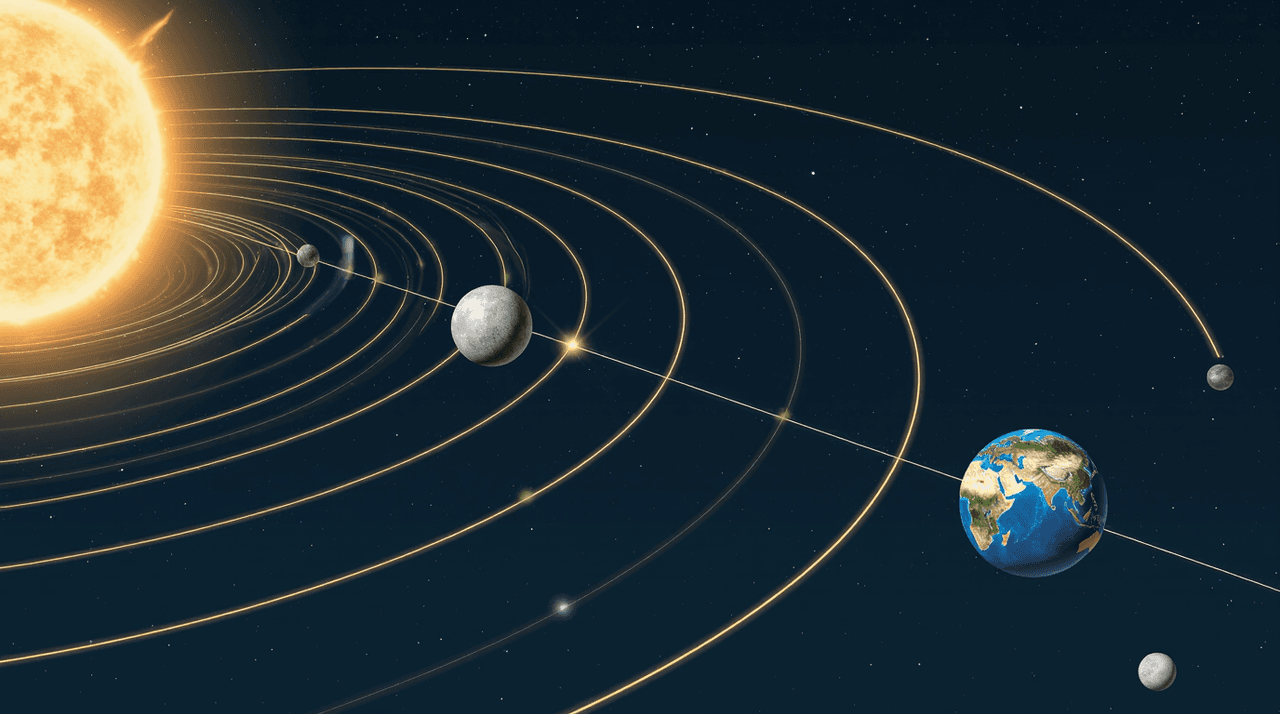
Mercury Retrograde (Generated by Artificial Intelligence)
Actual Situation | The direction does not change; it is entirely a perspective effect | ||||||||
|---|---|---|---|---|---|---|---|---|---|
Why It Occurs | The angular difference caused by Earth's transit across Mercury | ||||||||
Visible Feature | Apparent motion from east to west in reverse | ||||||||
Process Structure | Pause phases of backward and forward motion | ||||||||
Synodic Connection | Duration of repetition is dependent on the synodic period | ||||||||
Merkür retrograde motion is an astronomical phenomenon in which the planet appears to briefly reverse its direction of motion when observed from Earth in a heliocentric sky. This occurrence is not due to an actual reversal of the planet’s orbital direction; rather it is a perspective effect caused by the observer’s position on Earth and the differing orbital speeds of planets. Throughout history this motion has been explained in various astronomy models and held particular significance in the Ptolemaic and Copernican systems. In modern astronomy, Mercury’s retrograde motion is understood as a natural consequence of orbital dynamics.
Mercury Retrograde (Generated by Artificial Intelligence.)
Apparent retrograde motion can manifest differently in inner and outer planets. Inner planets, being located closer to the Sun than Earth, appear near the Sun in the sky and never exceed a certain angular distance from it. Mercury, belonging to this group, completes its orbit more quickly than other planets. As Earth moves along its wider orbit around the Sun, it periodically overtakes Mercury. During this overtaking, Mercury appears to drift east to west against the background stars, creating the illusion of retrograde motion.
Apparent retrograde motion does not involve any reversal of a planet’s actual orbital direction. The phenomenon is explained by the change in viewing angle due to Earth’s motion. This effect is especially pronounced in inner planets with short orbital periods.
Historical models played a crucial role in explaining the origin of retrograde motion. The Ptolemaic system assumed that all planets including Mercury moved in a geocentric arrangement using epicycles and deferents. In this model, retrograde motion arises from the combined effect of a planet’s motion along its small epicycle and its motion along the larger deferent circle, resulting in a perceived change in direction.
The Copernican model describes this phenomenon more simply. According to this model, planets orbit the Sun at different speeds. The angular shift observed when Earth passes Mercury causes the apparent retrograde motion. This explanation naturally accounts for both the timing and duration of retrograde events.
Because Mercury remains close to the Sun in the sky, its retrograde motion is brief and confined to a small angular region. During the phenomenon, the planet appears to move from east to west. Observational data show that this backward drift recurs cyclically and is linked to the planet’s synodic period.
Due to Mercury’s rapid orbital motion, its retrograde phase is shorter than that of outer planets. The process follows a pattern: the planet slows to a standstill, then undergoes a brief retrograde motion before resuming its forward motion. Historical records have associated this motion with changes in the planet’s brightness and identified it as a regular cycle.
Today, retrograde motion is explained through position and velocity relationships in orbital mechanics. The differing speeds at which Earth and Mercury move along their elliptical orbits continuously alter the observation angle, causing the apparent direction of motion in the sky to change.
Research confirms that retrograde motion is purely an apparent effect with no actual change in the planet’s orbital momentum or direction. Modern numerical studies show that retrograde motion is also considered in broader contexts such as high-inclination or counter-orbital resonances with other planets. These studies highlight the distinction between apparent retrograde motion and true retrograde orbits.
Retrograde motion was regarded as one of the most fundamental problems in ancient astronomy and contributed to the designation of planets as “wanderers.” While the Ptolemaic model explained this phenomenon through complex circular paths, the acceptance of the Copernican model made its cause far more comprehensible.
In educational contexts, retrograde motion serves as a key example for understanding theoretical shifts in the history of astronomy. This process is essential for grasping how modern science relates observational data to theoretical models.
Mercury retrograde is an apparent motion phenomenon dependent on the observer’s position and independent of the planet’s true orbital motion. In both historical models and modern astronomy, this phenomenon is explained by celestial bodies orbiting at different speeds. Its regular structure is tied to synodic cycles and exhibits a distinctive character in sky observations. Retrograde motion remains an important example in both astronomical education and the understanding of orbital dynamics.
Caritá, Gabriel Antonio, Alan Cefali Signor, and Maria Helena Moreira Morais. “A Numerical Study of the 1/2, 2/1, and 1/1 Retrograde Mean Motion Resonances in Planetary Systems.” *Monthly Notices of the Royal Astronomical Society* 515, no. 2 (2022): 2280–92. Accessed November 15, 2025.https://doi.org/10.1093/mnras/stac1606
Lee, Kaela J., Paul R. DeStefano, Lori Shaaban, Justin C. Dunlap, and Ralf Widenhorn. “Teaching Planetary Retrograde Motion Using a Local Positioning System.” *Physics Education* 58, no. 1 (January 2023): 015017. Accessed November 15, 2025.https://doi.org/10.1088/1361-6552/ac9ef8.
McLeish, Tom, and Mary Garrison. “Reversals in Wartime: Alcuin and Charlemagne Discuss Retrograde Motion.” Accessed November 15, 2025.https://doi.org/10.54103/interfaces-08-03
Signor, Alan Cefali, Gabriel Antonio Caritá, and Maria Helena Moreira Morais. *A Numerical Study of Fourth and Fifth Order Retrograde Mean Motion Resonances in Planetary Systems.* Preprint, 2023. Accessed November 15, 2025. (MNRAS preprint)https://arxiv.org/abs/2303.06479.
Signor, Alan Cefali, Gabriel Antonio Caritá, and Maria Helena Moreira Morais. “A Numerical Study of Fourth- and Fifth-Order Retrograde Mean Motion Resonances in Planetary Systems.” *Monthly Notices of the Royal Astronomical Society* 520, no. 3 (2023): 4696–4714. Accessed November 15, 2025.https://doi.org/10.1093/mnras/stad336.

Mercury Retrograde (Generated by Artificial Intelligence)
Actual Situation | The direction does not change; it is entirely a perspective effect | ||||||||
|---|---|---|---|---|---|---|---|---|---|
Why It Occurs | The angular difference caused by Earth's transit across Mercury | ||||||||
Visible Feature | Apparent motion from east to west in reverse | ||||||||
Process Structure | Pause phases of backward and forward motion | ||||||||
Synodic Connection | Duration of repetition is dependent on the synodic period | ||||||||
Astronomical Basis of Apparent Retrograde Motion
Explanation of Retrograde Motion in Geocentric and Heliocentric Models
Observational Characteristics of Apparent Motion
Orbital Dynamics and Modern Astronomical Context
Historical Perspective and Conceptual Significance