This article was automatically translated from the original Turkish version.
Angular Size | It spans a relatively large area in the sky, with a diameter of approximately 10 arcminutes (′). | ||||||||
|---|---|---|---|---|---|---|---|---|---|
Expansion Rate | On average 20–30 km/s; this is the speed at which gases are moving away from the center. | ||||||||
Surface Brightness | Very low; therefore, it is visible only through long-exposure imaging and narrowband filters. | ||||||||
Age | Approximately 10,000 years; this indicates that the nebula is an evolved planetary nebula. | ||||||||
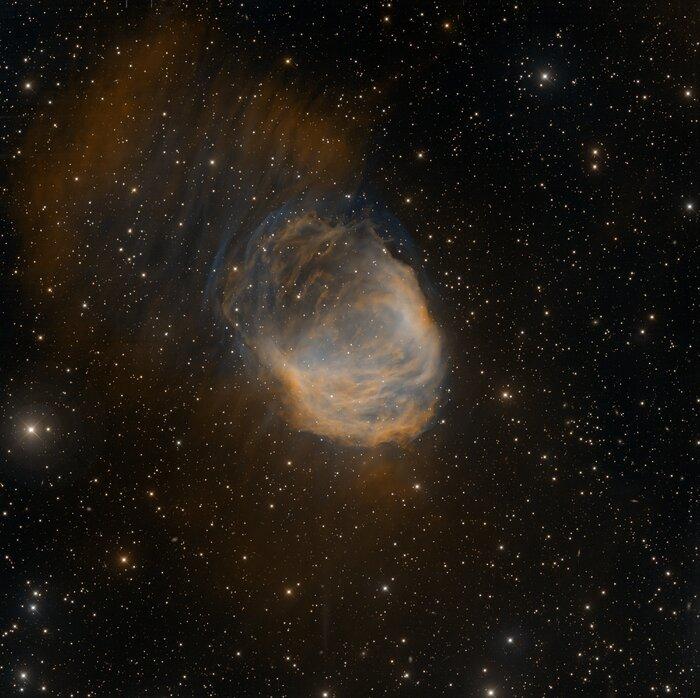
The Medusa Nebula, cataloged as Abell 21, is a planetary nebula located approximately 1,500 light-years from Earth in the direction of the Gemini constellation. It was first identified in 1955 by George O. Abell as part of his catalog of low-surface-brightness nebulae. The name "Medusa Nebula" derives from its visual resemblance to the snake-haired Gorgon Medusa from Greek mythology. However, this designation is symbolic and not used in scientific classification.
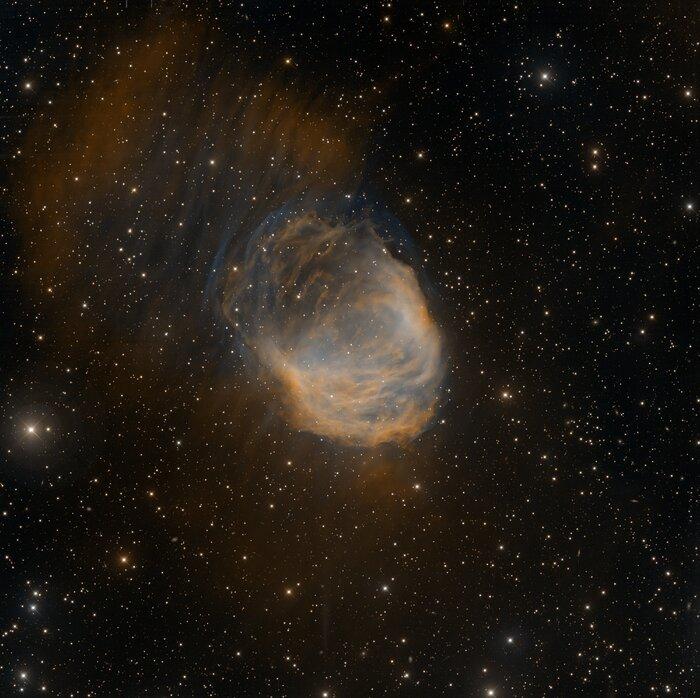
Medusa Nebula. (NOIRLab)
Abell 21 stands out due to its irregular and extended structure. Gas formations arranged roughly in a semicircular pattern indicate that it is an evolutionarily advanced planetary nebula. Such structures consist of ionized gas ejected from the central star into space. The structural features of the Medusa Nebula include:
Common characteristics of planetary nebulae apply to the Medusa Nebula. Such nebulae form during the final evolutionary stages of stars similar to the Sun. Abell 21 conforms to this definition.
The Medusa Nebula has been studied in detail through observations across various wavelengths. Particularly, optical and narrowband filter observations have revealed the distribution of its gas structures.
These features serve as key indicators in spectral analyses of Abell 21.
The Medusa Nebula is considered an elderly planetary nebula. Such nebulae form when the central star’s hot core becomes exposed and its outer layers expand and disperse into space. Due to its low expansion rate, Abell 21 has spread over a larger area, lost density, and become fainter over time.
Due to its low surface brightness, the Medusa Nebula presents challenges for amateur observers. However, its detailed structure can be revealed through astrophotography techniques requiring long exposures. Images captured using narrowband filters such as H-alpha and O III clearly show the nebula’s filamentary and complex structure.
Planetary nebulae like Abell 21 are important for understanding stellar evolution. Their spectra provide insights into the chemical composition of stars and their contribution to the galactic matter cycle. Additionally, the changes these nebulae undergo during their lifetimes are used to model the physical processes experienced by low-mass stars throughout their lives.
NASA Astronomy Picture of the Day. “Abell 21: The Medusa Nebula.” *APOD (Astronomy Picture of the Day)*. June 12, 2015. https://apod.nasa.gov/apod/ap150612.html. Accessed July 16, 2025.
NASA Astronomy Picture of the Day. “Abell 21: The Medusa Nebula.” *APOD (Astronomy Picture of the Day)*. November 22, 2024. https://apod.nasa.gov/apod/ap241122.html. Accessed July 16, 2025.
NOIRLab. “Abell 21, the Medusa Nebula.” *NOIRLab Image Gallery*. 2009. https://noirlab.edu/public/images/noaoann09008a/. Accessed July 16, 2025.
Sky & Telescope. “Abell 21 – The Medusa Nebula.” *Sky & Telescope Online Gallery*. https://skyandtelescope.org/online-gallery/abell-21-the-medusa-nebula/. Accessed July 16, 2025.

Angular Size | It spans a relatively large area in the sky, with a diameter of approximately 10 arcminutes (′). | ||||||||
|---|---|---|---|---|---|---|---|---|---|
Expansion Rate | On average 20–30 km/s; this is the speed at which gases are moving away from the center. | ||||||||
Surface Brightness | Very low; therefore, it is visible only through long-exposure imaging and narrowband filters. | ||||||||
Age | Approximately 10,000 years; this indicates that the nebula is an evolved planetary nebula. | ||||||||
No Discussion Added Yet
Start discussion for "Medusa Nebula (Abell 21)" article
Morphology and Appearance
Physical Properties
Radiation and Observational Data
Evolutionary Status
Observation and Astrophotography