


This article was automatically translated from the original Turkish version.
The phenomenon of management has emerged throughout human history as an inevitable consequence of collective living and the pursuit of shared goals. The need for individuals to act more effectively with limited resources has transformed management into not only a practical activity but also a theoretical discipline. This discipline, which became prominent after the Industrial Revolution, came to be defined by systematic approaches especially during the 20th century. The process of identifying the fundamental functions of management was matured through the contributions of Henri Fayol and Luther Gulick, among the founding figures of the field.
Management has evolved historically from the need for individuals to work together and has gradually become a systematic discipline. The conceptualization of management functions marks key turning points in Henri Fayol’s theoretical framework and Luther Gulick’s systematization. In particular, Gulick’s POSDCORB framework (Planning, Organizing, Staffing, Directing, Coordinating, Reporting, Budgeting) has become a foundational template for analyzing management processes in both public and private sectors.

Yönetimi Planlama (Pexels)
Planning is the first function of the management process and involves the predetermined determination of the paths to be followed in order for an organization to achieve its future goals. According to Fayol, planning is the process of developing forecasts about the future based on data from the past.
Gulick defines planning as the determination of what needs to be done and how it should be done to achieve the organization’s objectives.
Fundamental principles of planning include goal orientation, unity, measurability, flexibility, and reliability.
The planning process encompasses the following stages:
Organizing is the process of dividing tasks according to established objectives, defining authority and responsibility, and creating a structure. Fayol views organizing as the arrangement of resources and structures necessary to achieve objectives. For Gulick, organizing integrates with coordination based on division of labor and specialization.
The organizing process consists of three main stages
Organizing models are implemented in two primary forms: vertical (centralized) and horizontal (decentralized) structures.
Staffing encompasses activities related to acquiring, selecting, training, and developing the necessary human resources within an organization. It was systematically incorporated into POSDCORB by Gulick. This function aims to place the right person in the right job and enhance organizational efficiency.
Main processes of staffing
Directing is the process of guiding, motivating, and supervising personnel to align their efforts with organizational goals. Fayol referred to this as “commanding.” Directing encompasses leadership, motivation, communication, and decision-making processes.
The manager’s communication skills and leadership style directly affect the success of this function.
Coordinating is the process of ensuring that units operating within an organization work in harmony. According to Gulick, coordination is an inevitable outcome of division of labor and can occur in two forms: structural (through organizing) and conceptual (through shared objectives).
Types of coordination
Reporting is the process of collecting, evaluating, and presenting information about management activities to upper management or relevant stakeholders. Gulick regarded this function as an indispensable element for controlling and assessing management performance.
Budgeting is a management function that involves planning, allocating, and monitoring financial resources in public or private organizations. According to Gulick, budgeting is not merely a tool for financial control but also a component of strategic decision-making.
The budgeting process
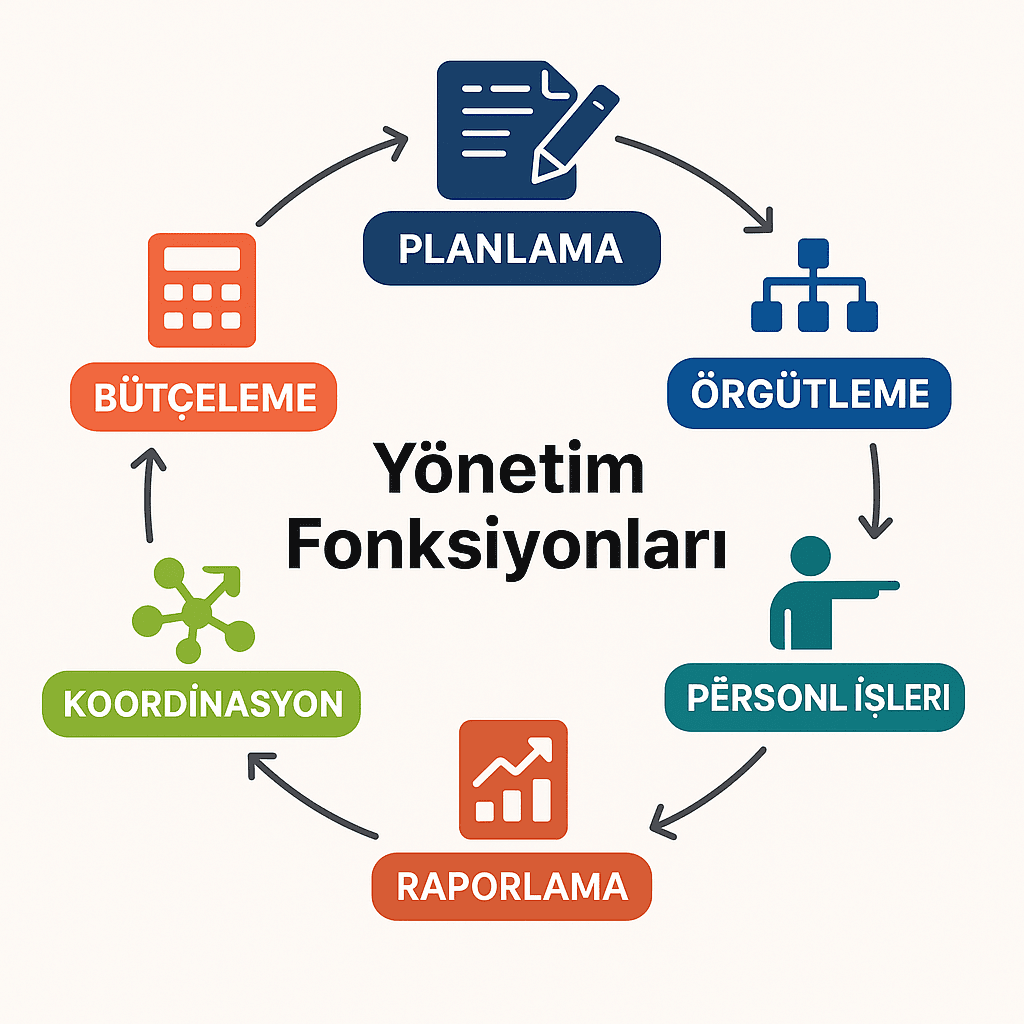
Yönetim Fonksiyonları Aşamaları (Yapay zeka oluşturulmuştur)
Henry Fayol-Management Theory (Youtube)
The management functions outlined in the POSDCORB model constitute the fundamental building blocks of management, both theoretically and practically. However, these functions are not static. Transformations within the public administration paradigm—particularly the shift from the welfare state model to neoliberal policies—have led to significant changes in the content and application of these functions. Organizations are moving away from mechanical structures toward more flexible, participatory, and performance-based models. In this context, the dynamic nature of POSDCORB retains its potential to adapt to contemporary management concepts.
Demirol Duyar, D. (2018). *Fayol ve Gulick’ten günümüze yönetim fonksiyonlarının dönüşümü üzerine bir değerlendirme*. DergiPark. Accessed May 26, 2025.https://dergipark.org.tr/tr/download/article-file/545543
Pexels. (n.d.). *Beyaz defter üzerinde mavi tükenmez kalem tutan kişi* [Photograph]. Accessed May 26, 2025.https://www.pexels.com/tr-tr/fotograf/beyaz-defter-uzerinde-mavi-tukenmez-kalem-tutan-kisi-669610/
YouTube. (n.d.). *Henry Fayol - Yönetim Kuramı* [Video]. YouTube. Accessed May 26, 2025.https://youtu.be/3BEULPp6N2s?feature=shared
Çavuşoğlu, G. (2021). *Yönetim Psikolojisi – 3. Hafta* [Presentation]. Accessed May 26, 2025.https://avys.omu.edu.tr/storage/app/public/gul.cavusoglu/76429/Y%C3%B6neti%CC%87m%20psikolojisi%203.%20hafta.pptx
Şencan, H. (2018). *Yönetim ve organizasyon* [Lecture notes]. Accessed May 26, 2025.https://ders.es/27_51_yonetim_ve_organizasyon.pdf

No Discussion Added Yet
Start discussion for "Management Functions" article
Management Stages
1. Planning
2. Organizing
3. Staffing
4. Directing
5. Coordinating
6. Reporting
7. Budgeting