


This article was automatically translated from the original Turkish version.
+2 More
Machine learning (ML) is a subfield of artificial intelligence (AI) that enables computer systems to acquire the ability to learn from data without being explicitly programmed. This learning process involves statistical and algorithmic approaches that allow systems to improve their performance on specific tasks. Machine learning is classified into three main categories:
These methods enable the learning and application of complex decision-making processes and are widely used in areas such as image processing, natural language processing, and time series analysis.
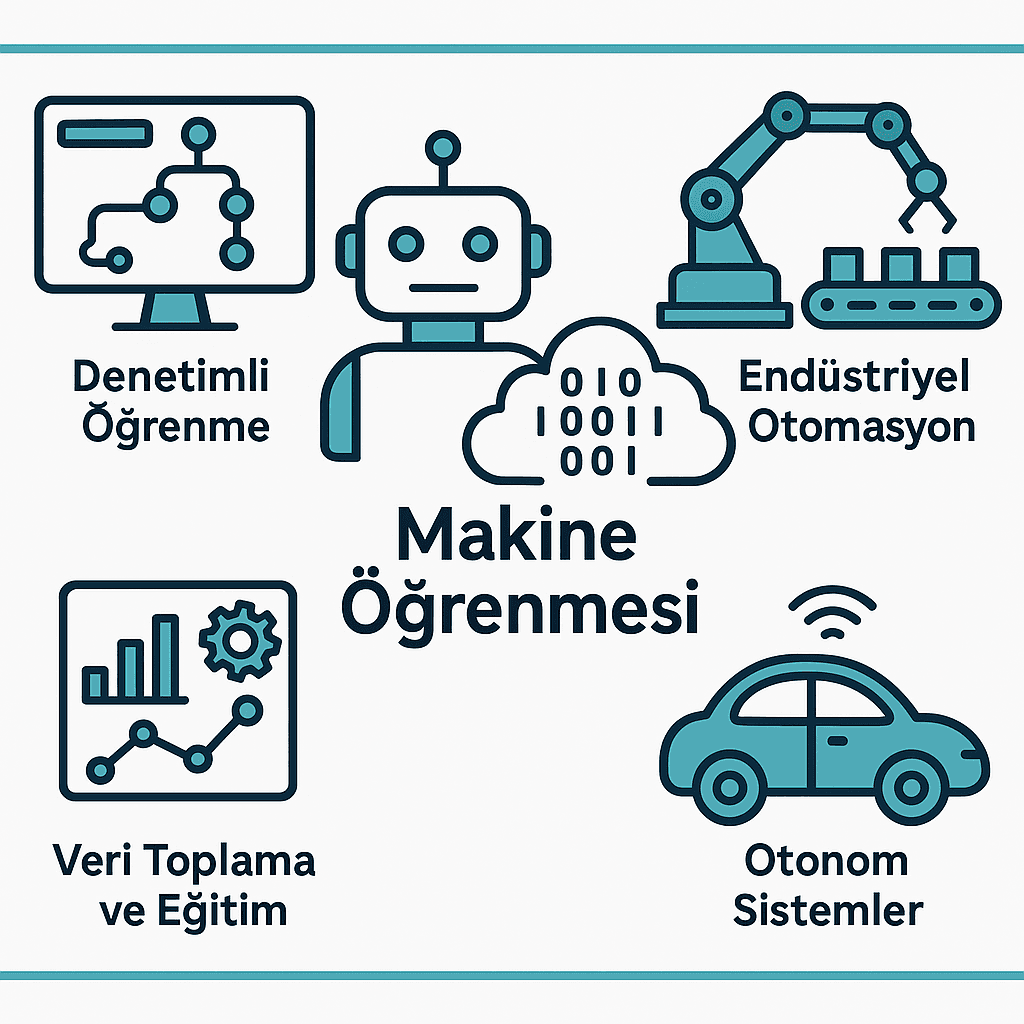
Makine Öğrenmesi Temsili Görseli (Yapay Zeka İle Oluşturulmuştur)
Robotic systems are among the primary domains where machine learning techniques are applied. While industrial industrial robots previously performed only pre-programmed tasks, today they have evolved into flexible systems capable of perceiving and responding to environmental changes. This transformation enables AI-supported robotic systems to make dynamic decisions in production lines.
For instance, a welding robot used in an automotive production line can analyze the position of components using data from cameras and sensors and automatically adjust its position. Image recognition algorithms and deep learning techniques can be employed for this task.
Additionally, research has applied predictive maintenance algorithms to forecast robot maintenance needs. Sensor data such as temperature vibration and current are analyzed to predict when a failure might occur. This approach increases production continuity while reducing maintenance costs.
Industry 4.0 is a concept representing the digital transformation of manufacturing technologies and machine learning is one of its foundational pillars. This architecture which integrates the Internet of Things (IoT) cyber-physical systems (CPS) cloud computing and big data analytics enables robots to develop not only physically but also cognitively.
Autonomous systems are systems capable of perceiving environmental conditions and making their own decisions. In these systems machine learning algorithms are central to the decision-making process. For example:
To enable timely and accurate decision-making in such systems powerful artificial neural networks trained on sensor data are employed. For instance LIDAR data can be used to map the environment and calculate the safest and shortest route in real time.
The success of machine learning models largely depends on the quality and suitability of the data used. In industrial applications this data is collected from IoT sensors camera systems RFID readers and control units of production machinery.
The data collection process proceeds through the following steps:
The model’s success rate is evaluated using error metrics such as accuracy F1 score or RMSE. Based on this evaluation parameter optimization can be performed using techniques such as grid search and cross-validation.
In traditional manufacturing environments PLCs form the core control points of production workflows. However in some cases access to the programs running on these PLCs may be unavailable. In a developed application scenario the behavior of a PLC program has been imitated using machine learning by analyzing only digital input-output (I/O) data.
The algorithms used are as follows:
The widespread use of machine learning in robotic systems is driving not only technical but also social transformations. Some of the most significant impacts include:
Machine learning enhances the cognitive capacity of industrial robotic systems and supports their autonomous decision-making capabilities forming a foundational pillar of the Industry 4.0 vision. Thanks to data-driven learning processes systems can adapt to environmental conditions optimize production workflows and ensure maintenance continuity. However the widespread adoption of these technologies also brings changes to employment structures and new ethical debates. Therefore the use of machine learning in robotic systems is not merely a technological advancement but also a harbinger of socio-economic transformation.
Aylak, B. L., Oral, O., and Yazıcı, K. "Yapay Zeka ve Makine Öğrenmesi Tekniklerinin Lojistik Sektöründe Kullanımı." El-Cezerî Fen ve Mühendislik Dergisi 8, no. 1 (2021): 74–93.
Bulut, Serkan. "Dijital Çağda Medya: Makine Öğrenmesi, Algoritmik Habercilik ve Gazetecilikte İşlevsiz İnsan Sorunsalı." Selçuk İletişim 13, no. 1 (2020): 294–313.
Ulamış, Faruk, Yüce, Yasin, and Cesur, Bülent. “Bilinmeyen PLC Programının Makine Öğrenmesi Yöntemleriyle Taklit Edilmesi.” *Uluslararası Mühendislik Araştırma ve Geliştirme Dergisi* 15, no. 3 (2023): 257–269.https://doi.org/10.29137/umagd.1364512
Yılmaz, Fevzi. “Robotlar Hayatımızda.” FSM İlmî Araştırmalar İnsan ve Toplum Bilimleri Dergisi 12 (2018): 109–120.http://dergi.fsm.edu.tr/index.php/ia/article/view/884

No Discussion Added Yet
Start discussion for "Machine Learning in Industrial Robotic Systems" article
Application in Robotic Systems
Industry 4.0 and Autonomous Systems
Data Collection and Training Process
Example Application: Imitation of PLC Programs
Social and Economic Impacts