


This article was automatically translated from the original Turkish version.
+1 More
Law on Surnames is the law that mandates citizens of Türkiye Cumhuriyeti to adopt a surname in addition to their given names, and regulates the principles concerning the selection, use, and registration of such surnames. It was adopted by the Türkiye Büyük Millet Meclisi on 21 June 1934, published in the Resmî Gazete on 2 July 1934 under number 2741, and came into effect on 2 January 1935.
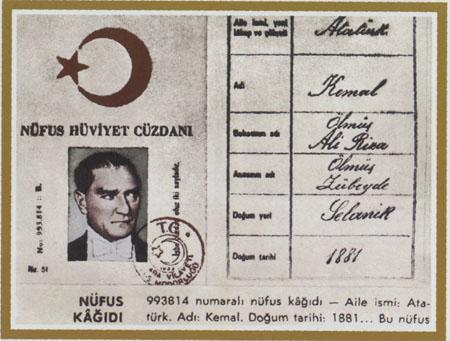
Mustafa Kemal Atatürk's Population Record (Atatürk Ansiklopedisi)
As part of the cultural revolutions of the Republic, the Law on Surnames was not only enacted to ensure social order and facilitate official procedures but also to establish a new societal structure based on modernization and equality. During and after the Millî Mücadele period, it became evident that the large number of individuals sharing the same name caused various confusions within state institutions, military and administrative operations, and hindered the clear identification of individuals.
In the Osmanlı Devleti, individuals were predominantly identified by nicknames, patronymics, occupations, or place names. However, in line with the requirements of the modern state concept, the adoption of a unique and fixed surname system became inevitable. Moreover, ending the use of titles and nicknames that reflected class-based privileges inherited from the past was considered essential for establishing a social structure consistent with the principle of equal citizenship.

Kanunun Yürürlüğe Girdiği Günlerden Gazete Küpürü (TRT Haber)
Article 1 of the law mandated every Türk citizen to adopt a surname in addition to their given name. Article 3 prohibited the selection of surnames based on military ranks, tribal names, foreign ethnic or national designations, or those contrary to morality or absurd in nature. The right to choose a surname was initially granted to the husband within marriage, but this provision was annulled by the Anayasa Mahkemesi in 2011.
The law also empowered local administrative authorities governors and district governors to resolve disputes arising during surname selection and to intervene in cases where individuals failed to choose a surname or selected an inappropriate one. Administrative sanctions were foreseen for those who did not choose a surname or used an unlawful surname within two years.
Shortly after its adoption, the Law on Surnames was widely embraced by the public and implemented throughout the country. The state undertook various initiatives to guide citizens in the surname selection process and ensure orderly administration. The law contributed not only to preventing administrative confusion but also to strengthening the concept of social equality. In this context, the transmission of familial titles such as “Binbaşızade” and “Kaymakamzade” inherited from the past was prohibited, reducing the visibility of social privileges.
On the other hand, the Law on Surnames made a significant contribution to the process of simplifying the Turkish language and aligning names and titles in common usage with the national cultural understanding. The use of native Turkish words in surname selection was encouraged, and restrictions were imposed on the use of Arabic, Persian, and foreign-origin names to support the movement toward linguistic simplification.
Atatürk Ansiklopedisi. "Soyadı Kanunu." Atatürk Ansiklopedisi. Accessed May 6, 2025.https://ataturkansiklopedisi.gov.tr/detay/298/Soyad%C4%B1-Kanunu.
Mevzuat Bilgi Sistemi. *Soyadı Kanunu (Kanun No. 2525)*. Date Enacted: June 21, 1934. Accessed May 6, 2025.https://www.mevzuat.gov.tr/mevzuatmetin/1.3.2525.pdf
TRT Haber. “Cumhuriyetin Kültür Devrimi: Soyadı Kanunu.” Accessed May 6, 2025.https://www.trthaber.com/haber/turkiye/cumhuriyetin-kultur-devrimi-soyadi-kanunu-735175.html.

Historical Background and Rationale
Content of the Law
Implementation and Effects